
AI
Meta’s Cloud Computing Play Challenges AWS, Azure, and Google
Meta is building a cloud business to sell excess AI compute, Bloomberg reports. Shares jumped 9% as Meta Compute targets AWS, Azure, and Google Cloud.

Meta Platforms is building a cloud computing business to sell excess AI compute capacity to outside customers, according to a Bloomberg report on July 1. The news pushed Meta shares up nearly 9% on Wednesday and put the company on a collision course with Amazon Web Services, Microsoft Azure, and Google Cloud. Demand for AI compute has outpaced supply since OpenAI kickstarted the boom with ChatGPT in 2022, and Meta is now joining the race to monetize the underlying infrastructure.
The new unit, internally called Meta Compute, would monetize spare capacity from the social media company’s multi-billion-dollar AI data center buildout. Of the four giant hyperscalers in the U.S., Meta is the only one that does not yet operate a cloud infrastructure and services business. CEO Mark Zuckerberg first signaled the move in a May 27 shareholder meeting, calling the cloud option ‘definitely on the table.’ The cloud push is also Meta’s mechanism for defending its AI spending, which lifted its 2026 capex range to between $125 billion and $145 billion in April.
Bloomberg’s Two-Track Plan for Meta Compute
According to Bloomberg, Meta is debating which cloud model to pursue: raw AI computing power sold as a commodity, or hosted AI models running on its infrastructure. The two tracks mirror what Amazon and Microsoft already sell through AWS and Azure, and would put Meta in direct competition with both.
The new initiative is reportedly dubbed Meta Compute. It is led by Santosh Janardhan, Meta’s head of infrastructure; Daniel Gross from Meta Superintelligence Labs; and president Dina Powell McCormick. A representative for Meta did not immediately respond to CNBC’s request for comment, and the company has not publicly confirmed the unit’s name or its leadership. CNBC’s report adds that Zuckerberg first flagged a cloud move in the company’s Q3 2025 earnings call, and addressed it again at the May shareholder meeting.
Bloomberg also reported Meta is deciding which AI models to host on its rails. One candidate is Muse Spark, the closed-weight model Meta debuted in April under the leadership of Alexandr Wang, hired last year from Scale AI for $14 billion. CNBC positioned the Muse Spark launch as “a powerful foundation, not a state-of-the-art offering,” a signal Meta knows its first homegrown model is not yet strong enough to anchor a hosted-model business on its own.
| Category | Meta Compute (reported) | AWS | Microsoft Azure | Google Cloud |
|---|---|---|---|---|
| Cloud business status | Under development | Established | Established | Established |
| Sell raw GPU compute | Planned (per Bloomberg) | Yes | Yes | Yes |
| Host third-party AI models | Under review (per Bloomberg) | Yes | Yes | Yes |
Zuckerberg Already Teed This Up in May
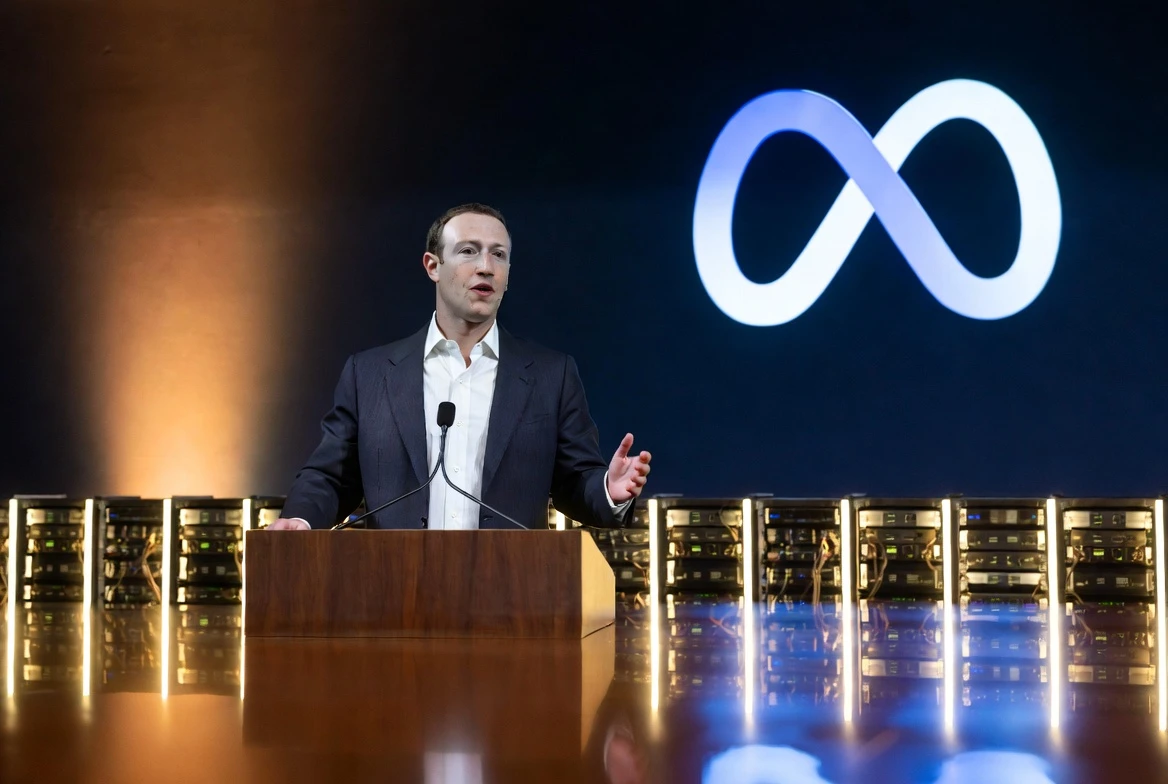
Zuckerberg first tested the cloud idea publicly at Zuckerberg’s May shareholder meeting remarks on cloud computing, where he called entering cloud computing “definitely on the table.” He returned to a theme he raised on the Q3 2025 earnings call, noting that outside companies already approach Meta about buying spare compute. Meta raised its 2026 AI capex guidance to between $125 billion and $145 billion in April, up from a prior range of $115 billion to $135 billion. Investors sent shares down 7% on better-than-expected first-quarter earnings, underscoring concern about the company’s AI spending. The optionality of selling compute later is what gives Meta “confidence in investing in building this out,” Zuckerberg said.
Obviously if we get to a point where we feel that we have overbuilt, then that is an option that we have, and that is partially what gives us confidence in investing in building this out.
Mark Zuckerberg, Meta’s CEO, said this at the company’s annual shareholder meeting on May 27, in response to a question about potentially competing with Amazon and Microsoft in cloud computing. He also disclosed Meta would begin testing monthly subscription services for its Meta AI app and website, the first time the company charges users directly for AI features, with the plans priced at $7.99 or $19.99 a month in Singapore, Guatemala, and Bolivia. The subscription test marks a second front in Meta’s push to monetize AI compute.
The $182.9 Billion Reason This Has to Happen
Meta is not entering cloud on a hunch. As of the end of the first quarter, the company had committed to spending $182.9 billion on AI infrastructure in the coming years, including large-scale projects in Louisiana and Ohio.
The Ohio project, which Zuckerberg said would be the size of Manhattan, is expected to come online in 2026 and will draw power from natural gas. The 2,250-acre Hyperion campus in Louisiana, anchored by a nuclear power arrangement, will deliver about 5 gigawatts of compute capacity at an estimated $10 billion buildout cost. Meta has purchased more than 1.3 million GPUs across Nvidia, AMD, and Google TPU lines to fill those shells. The company also secured a $27 billion funding agreement with Blue Owl Capital to support construction of its largest data center projects.
The strategic logic is simple. Once a multi-gigawatt campus is built, the marginal cost of selling unused cycles to a third party is close to zero, and the alternative is leaving capacity idle. CNBC noted the new business would “throw Meta into a new and fiercely competitive market, which is dominated by companies including Amazon, Microsoft, Google and CoreWeave, among others,” and investors saw the optionality, bidding the stock up.
TechCrunch’s coverage framed the move as a structural shift in who wins AI. Reporting on Meta Compute and the AI infrastructure race called Meta’s pivot a signal that “the winners of the AI race may not be the ones providing the best models and services, but rather the ones who own the data centers.” Meta’s 2025 capex was $71 billion, less than half the lower bound of the 2026 range.
- Meta 2025 capex: $71 billion
- Blue Owl Capital data center funding for Meta: $27 billion
- Hyperscaler combined 2026 data center capex: nearly $700 billion
SpaceX Already Proved the Money Is There
Meta is not the first non-cloud company to discover that AI infrastructure can be rented out. Elon Musk’s SpaceX has signed two compute deals this year that effectively established the pricing for everyone else in the market. SpaceX’s regulatory filings now show the company is structured to monetize AI data centers it built for its own Grok workload.
The CNBC reporting on the SpaceX-Google deal noted the structure was designed to “ensure we have bridge capacity to meet surging customer demand for our agent platform, Gemini Enterprise, which has been even higher than we expected.” SpaceX disclosed the agreement in a regulatory filing tied to its planned IPO, which is expected to value the combined SpaceX-xAI entity above $1.75 trillion. The SpaceX template also explains Meta’s timing. Musk’s company had no cloud business in February and now has anchor tenants underwriting its build, per the $920 million monthly SpaceX-Google compute lease filing.
- Anthropic to SpaceX: $1.25 billion per month for all Colossus 1 capacity
- Google to SpaceX: $920 million per month for about 110,000 Nvidia GPUs through June 2029
- SpaceX 2026 Q1 AI capex: $7.7 billion of $10.1 billion total
- SpaceX AI segment 2026 Q1 operating loss: $2.5 billion on $818 million in revenue
Who Gets Squeezed by a Fourth Hyperscaler
The first market reaction landed on the so-called neoclouds, the GPU-rich upstarts that rent AI compute to enterprises. Shares of CoreWeave and Nebius Group both plunged following the Meta news, sinking about 12% each, per Meta’s stock pop and the SpaceX compute deal details. AWS also raised GPU instance prices 20% effective July 1, per AWS’s recent 20% GPU price hike ahead of Meta’s cloud entry, the second hike in 2026.
The bigger fight is with the incumbents, and each has a different angle. AWS still leads the cloud market by revenue, Azure has the deepest AI model bench through its OpenAI partnership, and Google Cloud is leaning on Gemini Enterprise to pull in agent workloads. Google raised its 2026 capex forecast in April to between $180 billion and $190 billion, up from $175 billion to $185 billion. The combined 2026 hyperscaler data center spend is now nearly $700 billion, a figure Meta’s entry is unlikely to slow.
Meta’s advantages are different. It owns its own chips and servers outright, runs on its own private network, and starts with captive demand from its own AI labs.
Its disadvantages are also clear. CNBC reported Meta “hasn’t seen significant demand for its own AI models and services,” and Meta does not break out Meta AI or Llama revenue in its earnings. Oracle cut 21,000 jobs this year while pushing $70 billion in annual AI data center spend for OpenAI and Meta, per Oracle cutting 21,000 jobs to fund its AI data center buildout.
What Could Still Break
The biggest risk is the one Meta’s own investors keep raising. TechCrunch reports that some skeptics warn the buildout “is creating a bubble that leans heavily on rapidly depreciating chips,” and if demand softens, Meta Compute would be selling into a shrinking market.
The second risk is execution. Meta’s closed-weight Muse Spark model launched in April was positioned by the company as “a powerful foundation, not a state-of-the-art offering,” and Meta’s open-weight Llama family has yet to produce a breakout hit with enterprise developers. AWS Bedrock’s hosted-model roster is what Meta Compute would need to match before challenging AWS at the model layer. Hosting Anthropic and Mistral alongside its own models is what gives AWS Bedrock its pull.
The third risk is thin demand for Meta’s own AI stack. CNBC reports that Meta “hasn’t seen significant demand for its own AI models and services,” and Meta does not break out Meta AI or Llama revenue in its earnings. Zuckerberg’s May framing, that Meta Compute is the optionality if Meta “overbuilt,” also implies the cloud business only scales once Meta’s own compute needs are met.
Frequently Asked Questions
What is Meta Compute?
Meta Compute is the internal name Bloomberg reported for Meta Platforms’ planned cloud computing business. It would sell excess AI computing capacity from Meta’s data centers to outside companies, and may also offer Meta’s AI models, including Muse Spark, as hosted services.
Why is Meta entering cloud computing now?
Meta has committed to spending $182.9 billion on AI infrastructure through the end of the first quarter of 2026, with $125 billion to $145 billion earmarked for 2026 alone. CEO Mark Zuckerberg told shareholders on May 27, 2026 that cloud computing was “definitely on the table” if Meta ended up with excess capacity, and that external companies already ask Meta about buying compute every week.
Who will Meta compete with?
Meta Compute would compete directly with Amazon Web Services, Microsoft Azure, and Google Cloud, the three established hyperscalers that already offer both raw compute and hosted AI models. It would also compete with neoclouds like CoreWeave and Nebius Group, whose shares fell about 12% on the news of Meta’s cloud push.
How much has Meta committed to AI infrastructure?
Meta had committed to $182.9 billion in AI infrastructure spending as of the end of the first quarter of 2026. The 2026 cash capex range sits between $125 billion and $145 billion, up from a prior $115 billion to $135 billion. Major projects include the 2,250-acre Hyperion campus in Louisiana and the Prometheus facility in Ohio, which is expected to come online in 2026.
What are the biggest risks for Meta’s cloud push?
The three named risks are: a possible AI infrastructure bubble built on rapidly depreciating chips, Meta’s limited track record selling AI models to enterprises (Meta AI and Llama revenue is not broken out in earnings), and limited demand for Meta’s own AI services compared with AWS Bedrock’s roster of hosted models.


South Korea Retail Investors Face Reckoning After KOSPI AI Rally Collapses

Surrey AI Maps Three Heart Attack Paths and Their Molecular Roots

Germany Locks Neutral Apple ATT Prompts Across Most of Europe

Apple’s 5% EU Fee Quietly Rewrites Alternative App Store Math

Apple’s EU Fee Truce Cuts Complexity but Leaves Rivals Fuming

Pixel 11 Pro Fold Trades Thinness for Durability and Seven-Year Stay

Mayo AI Flags HCM Obstruction From Everyday Ultrasound Videos

Indian Brands Quietly Scale Landmark Screens and Home Tech

Navin Vatsa Turns Grief Into a Lifetime of Quiet Seeing

Google Bets Pixel 11 Agentic AI Will Redefine Phones

Oracle Cuts 21,000 Jobs in a Year, Cites AI in 10-K Filing

Fable 5 and Mythos 5 Return as US Lifts Anthropic Export Controls

SpaceX’s Google Deal Turns a Rocket Company Into a Cloud Landlord

CD Projekt Red Co-CEO: Redemption Arc Isn’t Done, Witcher 4 in 2027

XPL Rallies 30% Ahead of Plasma One Card Tier Launch

Google Search Profiles Build a Follow Graph Inside Discover

DGO App Brings Rs 549 Mobile Pass for FIFA World Cup 2026 in Nepal

Moonshot AI Targets $30 Billion in China’s Fastest AI Funding Sprint

Oppo’s ColorOS 17 Eligibility List Leaves A-Series Buyers Behind

Microsoft Xbox Layoffs Start in July as Sharma Slams 3% Margin
-
 AI2 months ago
Oracle Cuts 21,000 Jobs in a Year, Cites AI in 10-K Filing
-
 AI2 months ago
Fable 5 and Mythos 5 Return as US Lifts Anthropic Export Controls
-
 AI3 months ago
SpaceX’s Google Deal Turns a Rocket Company Into a Cloud Landlord
-
 GAMING2 months ago
CD Projekt Red Co-CEO: Redemption Arc Isn’t Done, Witcher 4 in 2027
-
 CRYPTO2 months ago
XPL Rallies 30% Ahead of Plasma One Card Tier Launch
-
 NEWS3 months ago
Google Search Profiles Build a Follow Graph Inside Discover
-
 APPS2 months ago
DGO App Brings Rs 549 Mobile Pass for FIFA World Cup 2026 in Nepal
-
 AI3 months ago
Moonshot AI Targets $30 Billion in China’s Fastest AI Funding Sprint