
AI
AWS Hikes GPU Capacity Blocks 20 Percent, Spares Trainium
AWS still posts July 1 Capacity Block GPU rates, Trainium stayed off the hike, and CoreWeave raised SKUs about 25 percent the same month.

Amazon Web Services still posts the July 1 Capacity Block rates, and the next scheduled update is October 2026. The about 20% rise hit reserved Nvidia GPU time used to train and fine-tune models, not on-demand instances, and it left Trainium off the list.
Other clouds did not open a cheap overflow lane. CoreWeave raised SKUs about 25% in the same month and said near-term capacity was sold out.
AWS Raised the Price of a Guaranteed Training Window
Capacity Blocks for ML are a booking product. A team pays up front for a future cluster in an EC2 UltraCluster, for a set number of days, so a training run does not die halfway through for lack of GPUs.
AWS says those reservation prices move with supply and demand. The public card is a published base rate, refreshed on a calendar, and a purchase locks the rate even if the block starts after the next refresh. On-demand list prices and other EC2 options were not part of the July notice, which closed with the line that all other prices remain unchanged.
That split is the whole move. Teams that can gamble on spare capacity keep the old menu. Teams that need a date certain for an H100, H200, or Blackwell cluster pay the new premium for the calendar slot.
Cloud economist Corey Quinn, who runs Last Week in AWS, rejected the supply-and-demand framing after the January rise, saying AWS was updating published base rates on the pricing page and that it was a policy decision, not supply and demand. July repeated the same shape: named families, a single effective date, a flat new per-chip rate across listed regions.
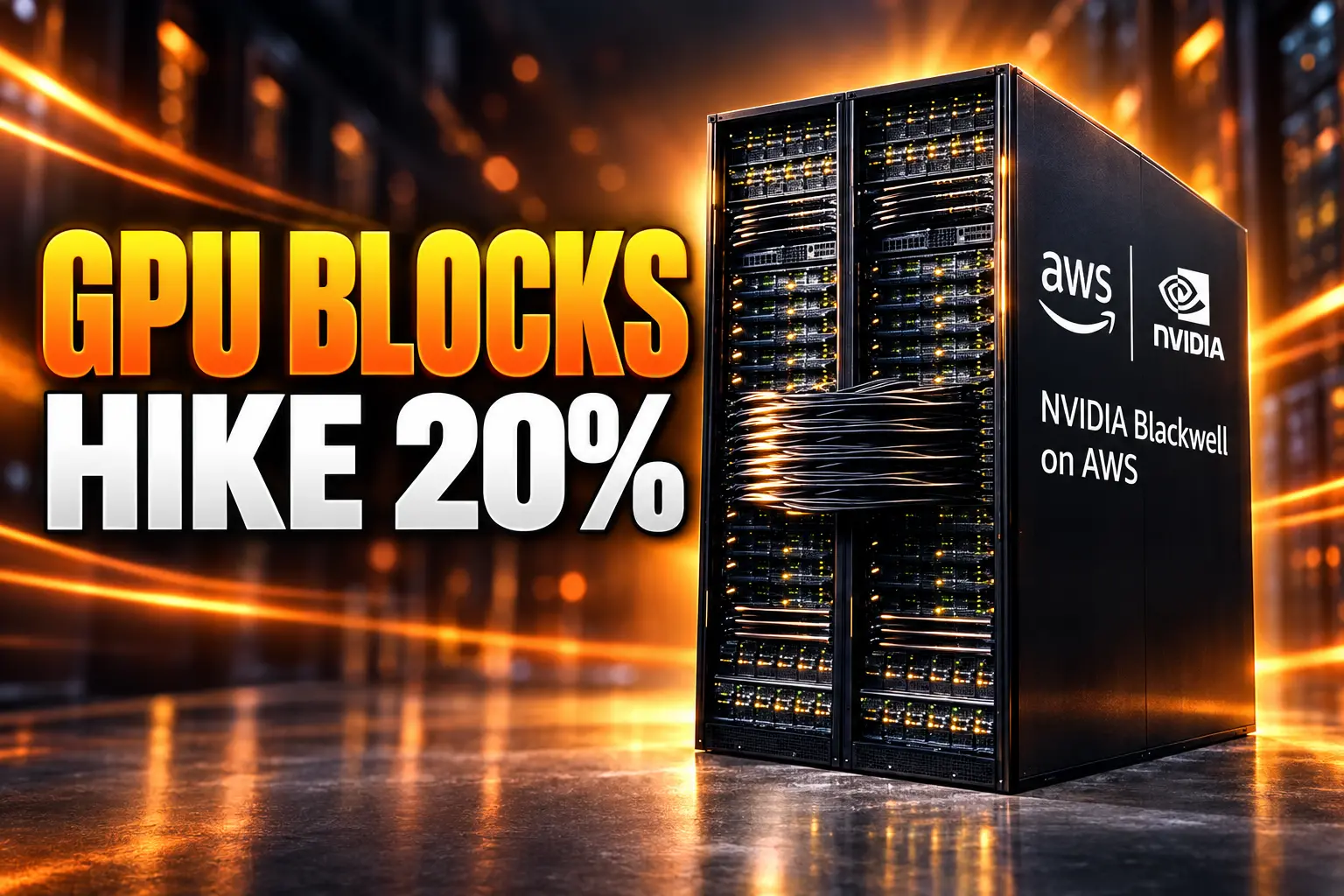
What AWS Capacity Blocks Cost After July 1
The current Capacity Blocks reservation rates match the July 1 notice, and AWS says those prices are scheduled to be updated next in October 2026. A block bought before that refresh keeps the rate paid at purchase.
JULY 1 CAPACITY BLOCK RATES
| Instance | Accelerators | US rate per chip | US rate per instance |
|---|---|---|---|
| p6-b300.48xlarge | 8 x B300 | $14.04 | $112.32 |
| p6-b200.48xlarge | 8 x B200 | $12.355 | $98.84 |
| p5en.48xlarge | 8 x H200 | $6.865 | $54.92 |
| p5e.48xlarge | 8 x H200 | $5.97 | $47.76 |
| p5.48xlarge | 8 x H100 | $5.191 | $41.528 |
P6-B300 in AWS GovCloud (US-East) lists $14.625 per chip and $117.00 per instance. P5 outside the United States lists $4.720 per H100 and $37.76 per p5.48xlarge. P5en outside the United States lists $6.241 per chip and $49.928 per instance. P5e is $5.97 per H200 in every listed region. P4de, the A100 80GB line, is $2.214 per accelerator in available US regions.
P6-B300 instances pack eight Nvidia Blackwell Ultra GPUs with 2.1 TB of high-bandwidth GPU memory. AWS opened them in US East (N. Virginia) on May 6, 2026, after US West (Oregon) and GovCloud (US-East).
15 Percent in January Already Reset the Floor
July was the second Capacity Block rise of 2026. On Saturday, January 4, AWS lifted the same product about 15% without a separate customer email, after a pricing-page note that rates would be updated in January with no direction attached.
THE 2026 CAPACITY BLOCK RATE CARD
- 2024 and 2025: AWS cut Capacity Block pricing three times, once in 2024 and twice in 2025, while a June 2025 promotion cut some On-Demand and Savings Plans GPU prices by up to 45%.
- January 4, 2026: p5e.48xlarge moves from $34.61 to $39.80 per hour in most regions, and p5en.48xlarge moves from $36.18 to $41.61. An AWS spokesperson said the adjustment reflected supply and demand patterns expected that quarter.
- July 1, 2026: New per-accelerator rates take effect for P6-B300, P6-B200, P5, P5e, P5en, and P4de. The H200 p5e.48xlarge instance rate goes from $39.80 to $47.76, a 20% step, and 38% above the $34.61 print from before January.
- October 2026: AWS schedules the next update of the published reservation card. A block bought at the July rates keeps those rates even if it starts after the refresh.
The 38% stack is the p5e.48xlarge path, not a claim about every family. US P5en went from $41.61 after January to $54.92, which is a steeper step than 20%, so the honest read is the published chip rates, not a single percentage on every SKU.
Trainium Stayed off the July Card
The July notice named P6-B300, P6-B200, P5, P5e, P5en, and P4de, then said all other prices remain unchanged. Trn1 and Trn2 Capacity Blocks are still on the same public card as those Nvidia rows, at the prior reservation rates.
A trn1.32xlarge lists $9.532 per hour in US East (N. Virginia), Ohio, and Oregon, which is $0.596 per Trainium chip across 16 chips. A trn2.48xlarge in US East (Ohio) lists $35.7608 per hour, or $2.235 per Trainium2 chip across 16 chips. Those figures sit on the same page as the $14.04 B300 rate and were not in the July list.
Andy Jassy, Amazon’s president and CEO, said in the second-quarter results that AWS’s AI business and its chips business each passed annual run rates of more than $25 billion, both growing at triple-digit rates. The same release said Anthropic and OpenAI have made multi-year, multi-gigawatt Trainium commitments, with more startups and larger firms such as Uber and Pinterest also on the list.
That is the relief valve AWS left on the rate card. A lab that can rewrite a training stack for Trainium keeps the cheaper booking path. A lab that is stuck on CUDA pays the new Nvidia reservation rate, or it leaves the guaranteed window and takes on-demand, spot, or another cloud.
The Same Month, CoreWeave Raised SKUs 25 Percent
The June question was whether Microsoft Azure and Google Cloud would hold price and pull cost-sensitive training off AWS. Through mid-September, no matching Capacity Blocks-style reservation hike from those two showed up in public rate cards, and no broad GPU price cut did either.
The peer move came from CoreWeave. On the company’s second-quarter call on August 11, 2026, CFO Nitin Agrawal said July pricing changes included an about 25% increase across SKUs, a response to demand and to the return customers were seeing as they shifted work toward inference. Management also said near-term capacity remained effectively sold out. CoreWeave reported second-quarter revenue of $2.58 billion, up 112% from a year earlier.
This operating margin improvement came before our July pricing changes, which included an approximately 25% increase across SKUs in response to the current demand environment and the increasing ROI our customers are observing from their investments in the CoreWeave platform as they shift to inference.
Nitin Agrawal, CFO, CoreWeave Q2 2026 earnings call
GPU rental did not enter a discount war after AWS moved. The scarce product, a dated cluster you can actually start, got more expensive in more than one place, including older chips that were supposed to be leftover inventory. AWS’s cheaper path is the one it owns: Trainium blocks that never appeared in the July notice.
No Cancellations, and No Savings Plan Discount
Capacity Blocks are a short-dated lease with hard edges. AWS lets customers reserve GPU capacity up to eight weeks ahead, in cluster sizes from one to 64 instances, which is 512 GPUs or 1,024 Trainium chips, and up to 256 instances across blocks in an organization. The maximum term is six months. Cancellations are not allowed.
CAPACITY BLOCK TERMS THAT DO NOT MOVE
- Up-front bill: The reservation fee is charged when you buy, and the rate does not change after that purchase.
- No extra unused-time fee: You already paid for the window; unused hours inside it do not draw a second compute charge, though a premium operating system still bills while instances run.
- Linux is $0.000: The OS add-on for Linux on these sizes is listed at $0.000 per hour; RHEL, SLES, and Ubuntu Pro are extra.
- Savings Plans do not apply: Reserved Instance discounts do not apply either, so enterprise commit programs do not blunt this particular line item.
- Hard stop: Blocks end at 11:30 a.m. UTC, and instance termination starts at 11:00 a.m. UTC on the final day.
You can inspect a price before you buy, and a search across dates returns the lowest-priced offering in range. Payment posts within 5 minutes to 12 hours. If it cannot be processed, the reservation moves to payment-failed and the block is released. Instances launched into a block must target the reservation ID and do not count against On-Demand instance limits.
Memory Costs Pushed Amazon’s Capex Guide to $220 Billion
Amazon’s second-quarter results, for the period ended June 30, 2026, went out on July 30, four weeks after the new Capacity Block rates took effect. The company reported AWS sales of $42.2 billion, up 37% year over year, the fastest AWS growth in 18 quarters, at a $169 billion annualized run rate. AWS operating income was $16.6 billion, a 39.4% margin, up from $10.2 billion a year earlier.
AWS IN AMAZON’S SECOND QUARTER
- Segment sales: $42.2 billion, up 37%, 21% of company sales.
- Operating income: $16.6 billion, 39.4% of AWS sales, about 60% of Amazon’s $27.5 billion in operating income.
- Company sales: $200.6 billion, up 20%.
- Cash drain: Trailing-twelve-month free cash flow was an outflow of $7.6 billion, after a $66.1 billion year-over-year rise in purchases of property and equipment, net of proceeds, which Amazon tied primarily to AI.
On the earnings call, Jassy raised 2026 cash capital spending to about $220 billion from a prior plan of about $200 billion, and pointed to higher memory costs. The written guidance in the release lists resource and supply volatility, including for memory chips, among the factors that can move results. That spend is going into halls full of AI chips that wear out fast, which is one reason a reservation product can reprice even while Amazon is still adding GPUs.
The same capex year is large enough to show up in credit markets, where the AI boom crowding bond markets is already a live funding story. Amazon is building more capacity and charging more for the slice of that capacity you can date on a calendar. October is when the public card is scheduled to move again, in whichever direction supply and the company’s rate policy point.
Frequently Asked Questions
What Are Amazon EC2 Capacity Blocks for ML?
They are a self-service reservation for selected GPU and Trainium instances in EC2 UltraClusters, sold in durations of 1 to 14 days in one-day steps or 15 to 182 days in seven-day steps, with a start as soon as about 30 minutes out. SageMaker HyperPod flexible training plans can stitch more than one block together so a long job has a dated path without a multi-year capacity commit.
Did AWS Raise On-Demand GPU Instance Prices on July 1, 2026?
No. The July notice applied to Capacity Blocks for the named families and said all other prices remain unchanged, so On-Demand and Savings Plans GPU list prices were not part of that card. In June 2025 AWS had publicized cuts of up to 45% on some On-Demand and Savings Plans GPU instances, a promotion that did not cover Capacity Blocks.
Can You Cancel an EC2 Capacity Block After You Buy It?
No. AWS documentation says Capacity Block cancellations are not allowed, and the reservation fee is billed up front. Payment is supposed to clear within 5 minutes to 12 hours; if it cannot be processed at least 5 minutes before start time or within 12 hours, whichever comes first, the reservation state becomes payment-failed and the block is released.
Were AWS Trainium Capacity Blocks Included in the July 2026 Price Rise?
No. The official notice listed P6-B300, P6-B200, P5, P5e, P5en, and P4de only. P6e-GB200 UltraServers in the US East (Dallas) Local Zone still list $10.582 per accelerator on the same pricing page and were not in that named set, which is how Trainium and that UltraServer line stayed on the prior reservation card.
Why Do Capacity Block Rates Differ by AWS Region?
AWS publishes different per-chip rates for some families by region group. P5 and P5en split US and non-US (P5 at $5.191 versus $4.720, P5en at $6.865 versus $6.241), P5e is $5.97 in every listed region, and GovCloud P6-B300 is $14.625 against $14.04 in commercial regions. The July change updated those published bases; it did not introduce a live per-offer auction in the public table.
The October refresh will tell buyers whether July was a ceiling or another step. Until that card changes, the posted Nvidia reservation rates are the ones that took effect on July 1, Trainium is still the cheaper booking path on the same page, and a Capacity Block bought now keeps the price paid at checkout.
Disclaimer: This article is news reporting on AWS product pricing and on company results. It is for information only and is not investment advice, not a recommendation to buy or sell any security, and not a recommendation of any cloud contract or reservation. Readers should consult a qualified financial adviser and their own cloud-cost or procurement team before making spending or investment decisions. Reservation rates, instance availability, and company figures follow the AWS pricing page and Amazon’s second-quarter 2026 results cited here and can change at the next scheduled review.

Instagram Plus Tests a Read-Only Mode That Cuts Stories

Altman Asks the Public to Accept Some AI Harm

Google Freezes OSS VRP Product Reports After AI Flood

AI Agents Make Payment Rails the Scarce Prize

Turkey’s Crypto Boom Now Runs Through Three Banks

Fable 5 Came Back Under a Commerce On-Off Switch

Google’s SpaceX GPU Lease Has a Sept. 30 Deadline

Plasma One’s XPL Locks Face a 1.81 Billion Cliff

DGO’s Rs 549 World Cup Pass Cost Fans Sleep and Data

Moonshot AI’s $30 Billion Ask Became a $35 Billion Close
-
 AI4 months ago
Fable 5 Came Back Under a Commerce On-Off Switch
-
 AI4 months ago
Google’s SpaceX GPU Lease Has a Sept. 30 Deadline
-
 CRYPTO4 months ago
Plasma One’s XPL Locks Face a 1.81 Billion Cliff
-
 APPS4 months ago
DGO’s Rs 549 World Cup Pass Cost Fans Sleep and Data
-
 AI4 months ago
Moonshot AI’s $30 Billion Ask Became a $35 Billion Close
-

 NEWS4 months ago
ColorOS 17 Device List Spans Oppo, OnePlus and Realme
-

 GAMING4 months ago
Xbox Cuts 3,200 Jobs After Five Years of Thin Returns
-
 GAMING4 months ago
The RTX 4050 Under Rs 70,000 Hides a Wattage Gap