
AI
Zapata Quantum Stakes Its Future on Filling the Quantum Software Gap
Zapata Quantum calls itself the only US public pure-play quantum software company. NVIDIA, KRAS research and a $15M raise now back the claim.

Sumit Kapur pitched Zapata Quantum to investors on July 9, 2026 as the only US-based, publicly traded pure-play quantum software company, one with a $15 million fresh balance sheet and a freshly inked collaboration with NVIDIA. The CEO used his slot at the OTC Markets Global Technology Conference to argue that the trillion-dollar quantum opportunity will land not with hardware vendors but with the software vendors that figure out what to run on them.
Kapur’s pitch leans on two pieces of recent credit and one peer-reviewed result. The $15 million oversubscribed financing, closed in April, was led by Triatomic Capital, and the NVIDIA collaboration announced in June puts agentic AI to work on quantum resource estimation. The third plank is a cancer-mutation study co-authored with Dana-Farber Cancer Institute that Nature Biotechnology named one of its top 10 papers of 2025.
The Hardware Race Left a Hole Behind It
The pitch Kapur laid out is that the quantum sector is shifting from proving quantum advantage to finding quantum utility. In his telling, the hardware half of the industry has matured far enough that attention now belongs on the layer that connects those machines to paying enterprise problems. The framing pulls on a slide deck he showed at the conference, furnished to the SEC after the event as an 8-K filing. That deck refers to a “collective action problem” shaping how software gets built across competing hardware efforts.
The deck names the hardware players in the room as IonQ, Quantinuum, D-Wave, Rigetti, Google, and IBM. It cites a $2 trillion economic value figure for quantum in 2035, attributing the number to McKinsey’s Quantum Monitor. The same slide sets a $100 billion-plus platform TAM, marked as a company estimate rather than a third-party figure. Kapur went further at the podium and called the gap a collective action problem with software progress moving slowly because each vendor focuses on its own hardware rather than shared algorithmic work.
“Pure-Play” and Proud of It
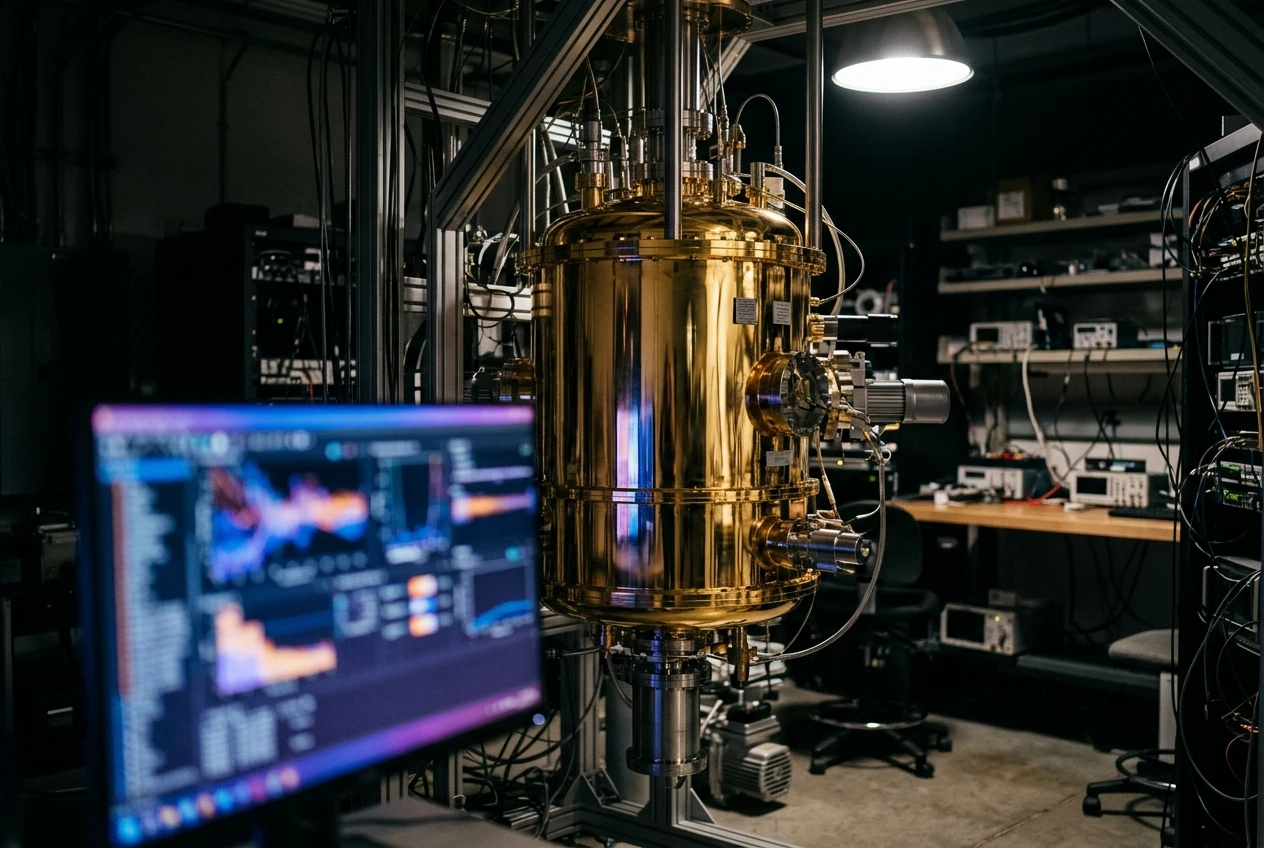
Zapata’s claim to a piece of that gap rests on distinctive positioning. The company describes itself as the only US-based publicly traded pure-play quantum software company. It builds for hardware it does not own. The pitch to enterprise customers is that they can work with Zapata without committing to one vendor’s hardware, the same way a web app runs on any cloud. The product set sits in four named pieces:
| Zapata tool | Role |
|---|---|
| QuantumGraph | Database mapping quantum algorithms to commercial use cases |
| QuantumPilot | AI assistant supporting quantum application development |
| QuantumOps | Operational layer for deploying quantum applications |
| Bench-Q | Specification for benchmarking quantum algorithms |
Kapur broke out the company’s stack into a three-layer framework at the conference: a “why” of use cases such as drug discovery, optimization, and simulation; a “what” of the algorithms that address them; and a “how” of the hardware. Zapata sits across the top two layers and tries to stay portable at the third. Work with BMW, BP, and BASF has gone into that thesis, with past collaborations extending to Mitsubishi Chemical. The same posture let the company tell investors it led all three phases of DARPA’s Quantum Benchmarking program.
The company has built that posture over nearly a decade. Zapata traces back to a 2017 spinout from Harvard’s Quantum Computing Lab and, by the CEO’s count, holds more than 60 foundational patents in quantum software along with more than 40 peer-reviewed scientific papers. The product set is sold under the Orquestra Platform name and runs on an AI-native development model the company says compresses headcount costs without compressing output.
Where NVIDIA Fits, and Why It Matters
In June 2026 Zapata Quantum and NVIDIA announced a collaboration to apply agentic AI to a step inside the quantum software development workflow called quantum resource estimation, or QRE. The pipeline is meant to figure out how many physical qubits, what error-correction budget, and how much wall-clock time a given algorithm will need before it is ever run on a real machine. Zapata and NVIDIA framed QRE as an “underappreciated bottleneck” in quantum application development, with a goal of compressing benchmarking work that historically spans years of expert effort across molecular modeling, algorithm design, and hardware evaluation.
We believe that automation, powered by advances in AI and informed by domain-specific knowledge, is the key to scaling quantum application development for real-world applications such as drug discovery.
That framing came from Yudong Cao, Zapata Quantum’s CTO and a former head of quantum at BCG X, in the joint release. Sam Stanwyck, NVIDIA’s director of quantum product, called the agentic pipeline transformative for shortening the timeline to useful quantum applications in the same announcement.
Kapur framed the bet for investors in concrete terms at the conference: compressing the QRE process from its current one-to-two-year timeline with teams of PhDs into a process that could initially take months and eventually weeks or days with a smaller technical team. The two companies tested the workflow in homogeneous catalysis, a quantum-chemistry problem Zapata had previously benchmarked during its DARPA work. Zapata has filed a provisional patent covering the agentic framework’s application to quantum computing. The joint work also includes Zapata’s separate collaboration with the University of Maryland on formal verification of quantum algorithms. Zapata plans to roll the workflow out across its existing enterprise customers.
Alongside the NVIDIA work, Zapata closed an oversubscribed $15 million financing in April 2026 led by Triatomic Capital and rounded out the funding as the final milestone of a year-long restructuring. The CEO called the capital “jet fuel” in the announcement, with plans to scale the science, engineering, product, and commercial functions in parallel. The deal release frames the capital as the working runway needed to convert interest in regulated and defense sectors into long-duration contracts.
The KRAS Paper Wasn’t Marketing
At the conference Kapur cited one piece of validation he treats as proof of concept for the whole company: a study co-authored with Dana-Farber Cancer Institute, the University of Toronto, and Insilico Medicine targeting the KRAS cancer mutation. The research used a hybrid quantum-classical approach on a 16-qubit IBM quantum computer and combined a Quantum Circuit Born Machine with classical LSTM networks. It produced 15 molecules worth synthesizing, with a couple showing binding activity. The study was named by Nature Biotechnology as one of its top 10 scientific papers of 2025 and graced the journal’s December 2025 cover.
It is a validated application. We actually went end-to-end and produced new scientific knowledge on the basis of a quantum computing software.
That was Sumit Kapur at the investor conference, framing the result as more than a demonstration. Quantum Computing Report’s write-up of the funding press release describes the study as producing the first experimental “hit” for a quantum-generative model in drug discovery, with candidates validated through surface plasmon resonance and cell-based assays.
The molecules went through surface plasmon resonance and cell-based assays before the journal cover recognition arrived, separating the work from most quantum demonstrations that stay on paper. Zapata is pitching the KRAS framework as a template for new pharmaceutical and biotech engagements, with Kapur pointing to it as an answer to investor questions about real-world quantum applications. The team is now pitching the framework as repeatable across other cancer targets and protein classes. The Nature Biotechnology cover slot, the company argues, places the result alongside the year’s most consequential biology research rather than only alongside quantum-internal validation work.
The Comeback Has a Paper Trail Too
Zapata in 2026 is the second iteration of a story that did not survive its first version intact. The predecessor company, Zapata Computing, shut down operations in October 2024 after a SPAC pivot that brought in effectively no equity capital and more than $20 million in liabilities.
Kapur joined the predecessor as chief financial officer in 2024 and later took over as CEO. Zapata Quantum re-emerged in September 2025 after a bankruptcy filing that consolidated more than $18 million of debt and preserved the IP portfolio, including the more-than-60 patents the company still cites. The QIR patent, a foundational piece for bridging quantum software front-ends to hardware back-ends, was granted in Canada, Europe, Israel, and Australia on top of an existing US grant. A March 2026 profile of Zapata’s QIR patent grant and recovery lays out the timeline. Kapur said at the conference the company is at the “very, very tail end” of its restructuring, with the listing now on OTCQB after having moved down from Nasdaq.
The balance sheet came out of restructuring cleaner than it went in. More than $20 million of debt was addressed through the bankruptcy and the subsequent debt work, and Zapata closed an oversubscribed $15 million financing in April led by Triatomic Capital. The CEO framed the financing as “jet fuel” for scaling the science, engineering, product, and commercial functions in parallel. Investor interest is concentrating in regulated and defense-related sectors where contracts can run for long durations. Zapata has applied to the Department of Energy’s Genesis Mission program with Lawrence Berkeley National Lab and MIT Lincoln Lab as subcontractors and a NVIDIA letter of support.
The deck Kapur showed at the conference sets out the recent figures in a tight ledger. The rest of the business case has to be made on top of them, especially if the company wants to convert interest into the kind of long-duration work the defense and regulated sectors are hinting at. The state of the balance sheet today:
- $15 million oversubscribed financing led by Triatomic Capital, closed April 23, 2026
- $20 million+ of debt restructured through the bankruptcy and a subsequent phase
- 60+ foundational patents in quantum software, inherited from the predecessor’s IP estate
- 40+ peer-reviewed scientific papers
- Zero reported revenue since September 2024, per the company’s most recent 10-K filing
What Hasn’t Been Proven Yet
The deck Kapur filed under Item 7.01 of an 8-K with the SEC carries a stand-out line of its own: an admission that the company may be unable to meet the initial listing standards of a national securities exchange within the time required or at all, hindered in part by minimal operations since October 2024. Zapata has not provided specific revenue guidance during the public push. The 10-K covering fiscal year 2025, filed in March 2026, lists no revenue since September 2024 and an estimated $5 million in liabilities, according to a third-party summary of the filing.
The next material catalysts Kapur named are commercial conversions with both private-sector and public-sector customers, applications to government grants and programs, continued product development, additional partnerships similar to the NVIDIA collaboration, and an uplisting. The pitch on AI leverage remains the same one Cao made in June: automation can shrink the cycle time from years to weeks. That 12-to-24-month window, in Kapur’s framing, is when the company has to show the AI-driven pipeline can compress quantum development work at scale.
Frequently Asked Questions
What does Zapata Quantum actually do?
Zapata Quantum is a Boston-based quantum software company that builds applications, algorithms, and tooling designed to run across any quantum hardware platform. The product set, sold under the Orquestra Platform name, includes QuantumGraph for mapping quantum algorithms to commercial use cases, QuantumPilot as an AI-assisted development tool, QuantumOps for deployment, and a Bench-Q specification for benchmarking algorithms.
Who runs Zapata Quantum?
Sumit Kapur is CEO. Kapur joined the predecessor company, Zapata Computing, as chief financial officer in 2024, led it through its October 2024 shutdown, then re-emerged as CEO of Zapata Quantum in September 2025 after a bankruptcy proceeding. Yudong Cao, a former head of quantum at BCG X, holds the CTO seat.
What is Zapata Quantum’s deal with NVIDIA?
In June 2026, the two companies announced an agentic-AI collaboration targeted at quantum resource estimation, the workflow that calculates the hardware specifications and physical execution times required to run a quantum algorithm. The joint pipeline uses NVIDIA’s Agent Toolkit software to orchestrate multi-agent AI benchmarking and has been validated on a homogeneous catalysis test case built on prior Zapata DARPA work. Zapata has filed a provisional patent on the framework.
Is Zapata Quantum profitable?
No. Zapata Quantum’s most recent 10-K filing, submitted in March 2026, lists no reported revenue since September 2024 and an estimated $5 million in liabilities, per a third-party summary. CEO Sumit Kapur pointed to interest from regulated and defense-related sectors as a potential path to longer-duration revenue contracts, but did not provide specific revenue guidance at the July 2026 investor presentation.


YouTube Joins Meta’s Appeal of the Social Media Addiction Verdict

Russian Realtors Could Soon Verify Credentials via Max Messenger

Apple’s Maps Ad Rules Quietly Dodge Google’s Messiest Ad Categories

Globe Telecom Backs Regulating Social Media Access for Under-16s

Argentina Inspects Pickford’s Water Bottle After Beating England Anyway

Eye Doctors Warn Childhood Myopia Is Rising Faster Than Ever

OnePlus to Exit India, US and Europe in OPPO’s Broader Retreat

Xero Shares Rebound to A$69.83 as CEO Pay Fight Overshadows Gains

OnePlus Faces a Deeper Retreat as India Joins Oppo’s 2027 Exit Plan

Bitcoin’s Quantum Threat Needs 500,000 Qubits, Not Today’s 105

Google Search Profiles Build a Follow Graph Inside Discover

Microsoft Xbox Layoffs Start in July as Sharma Slams 3% Margin

Oracle Cuts 21,000 Jobs in a Year, Cites AI in 10-K Filing

Moonshot AI Targets $30 Billion in China’s Fastest AI Funding Sprint

WhatsApp Meta Business Agent Reaches India, With a New Pricing Meter

Oppo’s ColorOS 17 Eligibility List Leaves A-Series Buyers Behind

Google DeepMind and A24 Sign $75 Million AI Partnership Deal

SpaceX’s Google Deal Turns a Rocket Company Into a Cloud Landlord

Meta’s Iris AI Chip Enters Production in September, Tests Clean

OCC Issues AML Consent Order Against Wise and Crypto.com Sponsor Bank
-
 NEWS1 month ago
Google Search Profiles Build a Follow Graph Inside Discover
-
 GAMING1 month ago
Microsoft Xbox Layoffs Start in July as Sharma Slams 3% Margin
-
 AI3 weeks ago
Oracle Cuts 21,000 Jobs in a Year, Cites AI in 10-K Filing
-
 AI1 month ago
Moonshot AI Targets $30 Billion in China’s Fastest AI Funding Sprint
-
 AI6 days ago
WhatsApp Meta Business Agent Reaches India, With a New Pricing Meter
-
 NEWS1 month ago
Oppo’s ColorOS 17 Eligibility List Leaves A-Series Buyers Behind
-
 AI3 weeks ago
Google DeepMind and A24 Sign $75 Million AI Partnership Deal
-
 AI1 month ago
SpaceX’s Google Deal Turns a Rocket Company Into a Cloud Landlord