
AI
The Dutch Navy’s Robot Ships Reopen a 40-Year-Old Question
The Royal Netherlands Navy tested uncrewed ships and AI drones off Den Helder, aiming for autonomous systems to run half its missions within five years.

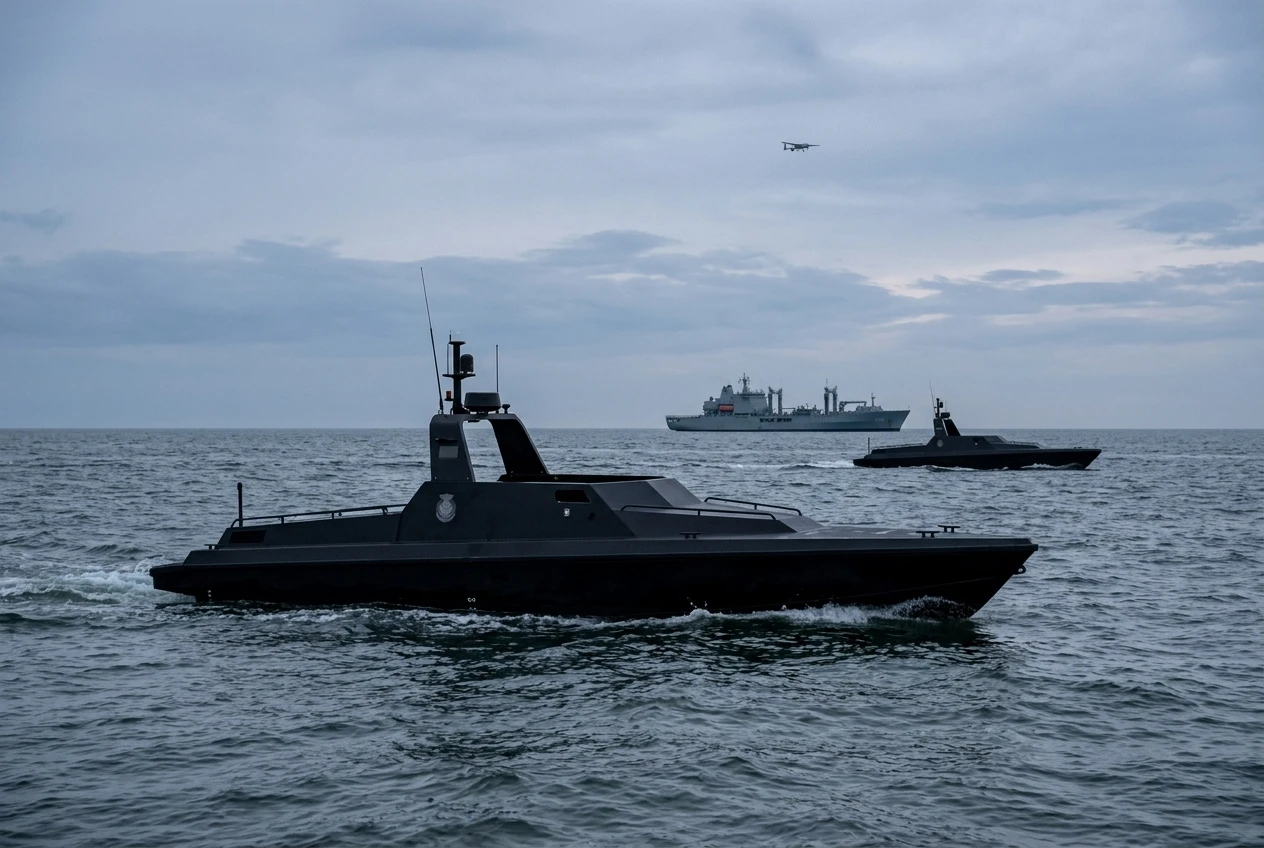
Two unmanned patrol boats shadowed a target ship off the Dutch coast this summer, and nobody touched the wheel. The Royal Netherlands Navy calls them Defender 1 and Defender 2, and for five weeks they have been the test subjects in the country’s biggest bet yet that ships without crews can do a warship’s job.
Capt Sjoerd Feenstra, head of the navy’s expertise centre for unmanned systems, wants a battle group ringed by robots within a decade. The Netherlands has run an autonomous weapon before, just never at this scale, and the question of who answers for a machine’s mistake is exactly as old as that first gun.
Two Black Hulls Shadow a Target Off Den Helder
The trial runs out of Den Helder, the Dutch navy’s home port in the country’s north, using the GeoSea vessel, a ship once used to monitor windfarm seabeds, as the floating base. Around it operate the two Defender boats, a pair of carbon fibre Noa drones that look like giant flies, a bat shaped drone flying high overhead, and an undersea mine mapper built by Lobster Robotics.
On a single command such as monitor that ship, the whole mix launches at once. It is what the navy calls a system of systems, built so any one drone or vessel can be swapped out as newer models arrive.
The exercise has an official name and a start date. Dutch naval sources describe the drills as Maritime Uncrewed Sea Trials, or MUST, running five weeks from June 1, the first edition of what the navy intends to repeat every year. Command runs through IDUS, short for Intelligent Distributed Uncrewed Systems, a control platform the navy built to steer aerial, surface and underwater drones from one screen. During the trial, crews ran a tasking called FIND, in which aerial, surface and undersea drones worked together to locate and track a target, the same job Defender 1 and Defender 2 practiced on the water off Den Helder.
“For the last year and a half we’ve been working to change our organisation,” Feenstra said. “In about 10 years there will be crewed platforms surrounded by a ring of uncrewed systems operating as autonomously as possible.”
The Budget Line Behind the Robot Push
The vision has money behind it. The Netherlands’ defense budget hit €27 billion ($30.8 billion) this year, up €3.4 billion from 2025, according to Bloomberg, and the Defense Ministry wants more than half of the military’s operational effects to come from unmanned systems within five years.
Defense Minister Dilan Yeşilgöz-Zegerius and State Secretary Boswijk put it plainly in a defense plan reported by NL Times. “Defense is investing heavily in unmanned systems and in defenses against them,” the ministers wrote. “Within five years we aim for more than half of our operational effects to be achieved with the help of unmanned systems.” The same plan sets up a joint development lab with Dutch industry focused on counter-drone technology, since fighting a drone often means flying one back at it.
Russia’s 2022 invasion of Ukraine is the plan’s stated reference point, and the Netherlands is not spending alone. The UK intends to put more than £5 billion into comparable uncrewed technology over a similar stretch, and the Dutch government is separately working toward NATO’s target of 3.5% of GDP on defence by 2035.
- €27 billion ($30.8 billion) is the Netherlands’ total defense budget this year, up €3.4 billion from 2025.
- More than half of the military’s operational effects are meant to come from unmanned systems within five years.
- £5 billion-plus is the United Kingdom’s parallel commitment to uncrewed defense technology.
- 12 V-BAT reconnaissance drones now sit aboard eight Royal Netherlands Navy ships, up from an original order of eight.
Those V-BATs point to how fast the buying is moving elsewhere in the fleet, well beyond the Den Helder trial itself.
Meet the Fleet With No One Aboard
Add up what the navy is testing and buying at once, and a pattern shows up: air, surface and underwater domains are all getting an uncrewed option in parallel, rather than one drone type at a time.
| Platform | Domain | Role in the Trial or Fleet | Key Detail |
|---|---|---|---|
| Defender 1 & Defender 2 | Surface | Shadow and monitor a target ship | Steered entirely by computer, no one aboard |
| Noa drones | Air, close range | Reconnaissance around the formation | Carbon fibre airframes, deployed in pairs |
| Bat shaped drone | Air, high altitude | Persistent overhead watch | Flies above the whole exercise area |
| Lobster Robotics mapper | Underwater | Undersea mine mapping | Scans the seabed without a diver or sub crew |
| V-BAT (Shield AI) | Air, fleet-wide ISR | Ship launched reconnaissance | 12 units aboard 8 ships, flies over 12 hours per sortie |
The V-BAT already carries no weapons. It functions purely as a reconnaissance tool, extending a ship’s sightline beyond the horizon while freeing crewed helicopters for other missions, and it can keep flying without a satellite link if one gets jammed or cut.
The Netherlands’ own 2022 modernization white paper laid groundwork for this buildout years before Den Helder, including a plan to double its MQ-9 Reaper unmanned aircraft fleet to eight airframes. The Den Helder trial is the newest layer on an older buildout, not a standalone experiment.
How the Navy Decides Which Jobs Go to Robots
The navy sorts missions into three categories, according to its Future Vision Maritime Uncrewed doctrine, published at the end of April: jobs that are dangerous, jobs that are difficult, and jobs that are decisive. Those categories map onto seven mission areas the doctrine names directly.
- Naval mine warfare
- Anti-submarine warfare
- Integrated air and missile defence
- Amphibious and littoral operations
- Special operations support
- Maritime strike
- North Sea and Caribbean protection
Feenstra frames the shift in blunter terms than a doctrine paper does. “The work has got a lot more difficult, especially with the amount of information, speed and capacity demanded,” he said. “And some jobs are unbelievably boring.”
Boredom is not an abstract complaint. Sidharth Kaushal, senior research fellow for sea power at the Royal United Services Institute (RUSI) thinktank in London, said the appeal runs deeper than cost. “Uncrewed systems don’t completely remove the requirement for manpower, you tend to need more engineers, but they provide a different balance in terms of family life,” Kaushal said. “This is the direction of travel.”
Lee Willett, a naval analyst, ties the urgency to the Netherlands’ size relative to its patch of ocean. “The Dutch punch above their weight,” Willett said. “They are also advancing what they have because they recognise that they are a relatively small navy in an incredibly important part of the world.” The Ministry of Defence, meanwhile, still expects to employ more than 100,000 people by 2030, robots or not, with a larger reservist force built to scale the ranks up fast if a crisis demands it.
The Goalkeeper Precedent
The ethical question is not new for the Dutch. For more than 40 years, the Netherlands has operated the Goalkeeper air defense system, a weapon capable of engaging incoming threats without a human pulling a trigger. The country has lived inside this argument since before most of today’s naval officers were born.
Feenstra insists the newest systems keep a person in the loop regardless. “A person is always part of the decision-making chain,” he said.
But he does not pretend the old questions have been settled just because the technology improved.
What we know from the past is that even when people make the plan or collect the information, something can go wrong. The question is where the culpability will lie if you automate everything.
Feenstra said that, and the debate it points to has spread well past Dutch shipyards. A research institute studying the backlash against military AI has flagged tools like Israel’s Lavender targeting system in Gaza as evidence that delegating lethal choices to machines has global unease building. It is not only navies wrestling with the line between assistance and autonomy either. A Dubai security chief who insists robots won’t replace bodyguards made a nearly identical case this year about frontline physical security work, arguing a human still has to own the final call.
What Happens When the Signal Gets Jammed
Software integration lead Ferdinand Peters is the one inside the Dutch program who worries about the technology itself failing, not just who gets blamed after. Artificial intelligence can hallucinate, he said, meaning it can generate a confidently wrong answer.
“You need to let the system work for you, but not think for you,” Peters said. “We need to think carefully about where we use it and where we do not.”
Real combat has already stress-tested that line elsewhere. In June, US Central Command (CENTCOM) confirmed that three Corsair sea drones struck a submarine and ship maintenance facility at Iran’s Bandar Abbas naval base, the first known combat use of American autonomous surface vessels. Ukraine’s low-cost sea drones have separately pushed Russia’s Black Sea Fleet away from much of the coastline it once patrolled freely.
None of it has come easy. Maritime analysts covering the wider drone buildup note that heavy jamming has forced crews back onto remote-piloted workarounds in both the Black Sea and the Gulf, which is exactly the failure mode the V-BAT’s satellite-free mode and the navy’s IDUS command layer are built to survive. Whether they hold up in an actual fight, rather than a five-week trial off Den Helder, is the test nobody can run until it happens.
Frequently Asked Questions
What Did the Den Helder Trials Reveal About Bad Weather?
Wind, cloud, rain and waves all had a significant, measurable effect on how well the uncrewed systems performed during the North Sea trial. Because the Dutch navy is building these systems for open ocean use in rough conditions, planners have already recommended running follow-up tests in the Arctic and the Caribbean, where the weather and sea states will stress the drones in very different ways.
How Many People Will the Dutch Military Recruit for Drone Duty?
The Dutch army alone plans to recruit between 1,000 and 1,200 personnel for new drone and counter-drone units starting in April, embedding the capability inside every combat formation rather than centralizing it in one specialist unit. That is separate from the navy’s own unmanned systems staffing under Feenstra’s command.
Are the Dutch Navy’s Drones Armed?
No, not yet. The V-BAT and the Noa and bat shaped drones tested at Den Helder are unarmed reconnaissance tools built to extend a ship’s sightline and track targets, not to strike them. Feenstra has said any move toward weapons still keeps a human inside the decision chain.
Is There an International Rulebook for Autonomous Weapons?
Not a binding one yet. The Pentagon updated its own Directive 3000.09 on autonomy in weapons systems in 2023 to require commanders retain what it calls appropriate levels of human judgment, and a coalition of countries including European Union members has separately pushed for international rules or bans on fully autonomous weapons, but no global treaty currently covers the Dutch navy’s new fleet.
What Happens to the Navy’s Human Sailors?
They are not going away. The Ministry of Defence aims to employ more than 100,000 people by 2030, including a significantly expanded reservist force meant to let the armed forces scale up quickly in a crisis and scale back down once it passes, running alongside the robot fleet rather than replaced by it.


South Korea Retail Investors Face Reckoning After KOSPI AI Rally Collapses

Surrey AI Maps Three Heart Attack Paths and Their Molecular Roots

Germany Locks Neutral Apple ATT Prompts Across Most of Europe

Apple’s 5% EU Fee Quietly Rewrites Alternative App Store Math

Apple’s EU Fee Truce Cuts Complexity but Leaves Rivals Fuming

Pixel 11 Pro Fold Trades Thinness for Durability and Seven-Year Stay

Mayo AI Flags HCM Obstruction From Everyday Ultrasound Videos

Indian Brands Quietly Scale Landmark Screens and Home Tech

Navin Vatsa Turns Grief Into a Lifetime of Quiet Seeing

Google Bets Pixel 11 Agentic AI Will Redefine Phones

Oracle Cuts 21,000 Jobs in a Year, Cites AI in 10-K Filing

Fable 5 and Mythos 5 Return as US Lifts Anthropic Export Controls

SpaceX’s Google Deal Turns a Rocket Company Into a Cloud Landlord

CD Projekt Red Co-CEO: Redemption Arc Isn’t Done, Witcher 4 in 2027

XPL Rallies 30% Ahead of Plasma One Card Tier Launch

Google Search Profiles Build a Follow Graph Inside Discover

DGO App Brings Rs 549 Mobile Pass for FIFA World Cup 2026 in Nepal

Moonshot AI Targets $30 Billion in China’s Fastest AI Funding Sprint

Oppo’s ColorOS 17 Eligibility List Leaves A-Series Buyers Behind

Microsoft Xbox Layoffs Start in July as Sharma Slams 3% Margin
-
 AI2 months ago
Oracle Cuts 21,000 Jobs in a Year, Cites AI in 10-K Filing
-
 AI2 months ago
Fable 5 and Mythos 5 Return as US Lifts Anthropic Export Controls
-
 AI3 months ago
SpaceX’s Google Deal Turns a Rocket Company Into a Cloud Landlord
-
 GAMING2 months ago
CD Projekt Red Co-CEO: Redemption Arc Isn’t Done, Witcher 4 in 2027
-
 CRYPTO3 months ago
XPL Rallies 30% Ahead of Plasma One Card Tier Launch
-
 NEWS3 months ago
Google Search Profiles Build a Follow Graph Inside Discover
-
 APPS3 months ago
DGO App Brings Rs 549 Mobile Pass for FIFA World Cup 2026 in Nepal
-
 AI3 months ago
Moonshot AI Targets $30 Billion in China’s Fastest AI Funding Sprint