
APPS
Secret World Packs Jobs and Deals Into Living Storefronts
Secret World rolls out digital storefronts that let local businesses post deals, jobs, memberships and menus so creators discover real value instead of another ad.

Secret World app introduced digital storefronts on August 11, 2026, that let local businesses post deals, hiring openings, memberships and menus inside one living profile on its neighborhood map. The move expands a creator-first platform so users discover practical ways to save, earn or decide before they leave home.
Founder Kaixiong Zhang, also called Kevin or Kai Zhang of Fastbuck LLC, framed the addition as value before attention. Creators already use the app for tasks, pop-ups and profiles. Now businesses get the same map real estate without starting as another ad.
Living Storefronts Answer What a Business Offers Today
Traditional listings mainly answer where a place sits. Secret World’s storefronts add a second layer: what can this business offer me right now. A restaurant can surface a lunch deal and its full menu. A salon can post an open shift. A coffee shop can list a membership tier. Location details stay, yet the profile stays current with what the shop actually needs or wants to give.
The company calls these living digital storefronts because the content can change with the day. That design sits inside the same local discovery system that already shows Creator Cards, tasks and pop-ups. One map holds people looking for work, people hunting savings, and people deciding where to eat.
| Feature | Traditional listing | Secret World storefront |
|---|---|---|
| Core question | Where is it? | What can it offer me today? |
| Jobs | Rare or external | Direct hiring posts |
| Deals | Separate promo channels | Built into profile |
| Memberships | Usually off-platform | Visible ongoing benefits |
| Menus | Link or none | In-storefront preview |
| Update style | Static or slow | Living, day-to-day |
Zhang put the principle plainly: when businesses give creators ways to save, earn or find opportunities, they create real value, and real value gives people a reason to discover them.
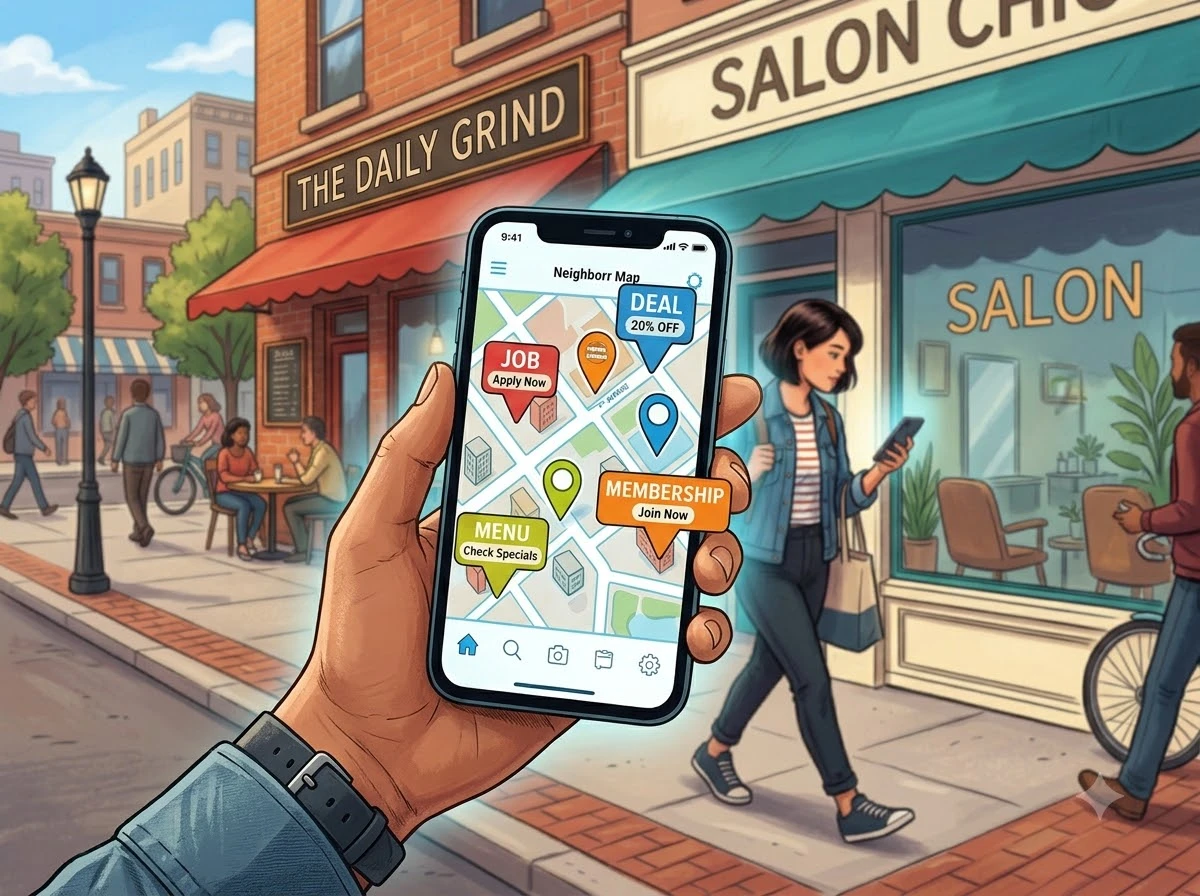
Creators Gain Four Clear Reasons to Open the App
An opportunity on Secret World is not only another creator to follow. Sometimes it is a paid gig. Sometimes it is a discount on something already planned. Sometimes it is a membership that rewards repeat visits. Sometimes it is simply knowing the menu before walking in.
- Jobs and hiring, local businesses post openings so a creator looking for work can find a nearby role without leaving the map.
- Deals, limited offers that help someone save on food, services or goods they already intend to buy.
- Memberships, ongoing benefits that turn a one-time visitor into a returning customer with clearer value.
- Menus and details, practical information that removes friction before a decision is made.
The platform treats these as an opportunity layer that keeps users returning even when they are not hunting for another creator profile. A person can open the app for jobs one day and for a restaurant deal the next. Those needs live in the same community.
Businesses Are Asked to Give Value First
The business pitch rejects pure interruption. Local shops already spend time on social posts, flyers and paid placement that often vanish into noise. Secret World asks them to contribute something useful first: a deal that saves money, a job that lets someone earn, a membership that rewards loyalty, or a menu that helps a decision.
When businesses give creators ways to save, earn or find opportunities, they create real value-and real value gives people a reason to discover them.
Zhang, founder of Secret World, supplied that line with the storefront announcement. A separate value-first release the day before quoted team member Atul Malhotra on the same idea: machines copy data, they cannot copy someone showing up. Post the job. Give the deal. Not tomorrow, today.
The hoped-for loop is simple. Business creates value. Creators and neighbors engage for a concrete reason. The business gains another discovery path. Neither side exists only to serve the other. In markets where how creators outperform ads in tight local markets already shows organic reach beating pure spend, the utility-first approach lands as a practical extension rather than a slogan.
Creator Cards and Storefronts Share One Local Network
The app now runs on two identity types. Creator Cards represent people. They show skills, services, interests, reputation and contact paths so freelancers, side hustlers, photographers, barbers, DJs, trainers and sellers become discoverable before a job is even posted. Digital storefronts represent businesses. They carry the deals, hiring, memberships and menus.
Both live on the same map. A creator can discover a business. A business can discover a creator. Someone looking for work finds a local job. Someone trying to save finds a nearby deal. A customer spots a membership. A diner checks a menu. The July 29 launch of Creator Cards set the people side; the August storefronts complete the business side of that two-sided structure.
Secret World remains creator-first. Businesses join because they make the creator community more useful, not because the goal is to turn creators into an ad audience.
What the App Looks Like on the Ground
The App Store listing and recent reviews describe a free lifestyle app from Fastbuck LLC, sized at roughly 273 MB, requiring iOS 15.6 or later, with in-app purchases that include a Basic Plan at $99.99. It supports English plus French, Hindi, Japanese, Simplified Chinese and Spanish. The developer states it collects no data from the app.
Version history shows steady work. A feeds section for latest offers, vacancies and memberships arrived in mid-January 2026. Earlier updates added map redesigns, pop-up and business store visuals, Instagram story posting for tasks, light and dark mode, and Japanese support. The public rating sits at 4.2 from 15 reviews.
- 4.2 stars from a still-small sample of 15 ratings
- User gigs, one reviewer reported four small gigs and roughly $300 in two days
- Another made $30 plus a meal for a restaurant video
- Earlier friction, a November 2025 review noted missing jobs; developer replied that jobs were being filled
Public conversation on X remains thin. That low volume matches an early community still densifying. Users who land paid tasks treat the map as a side-hustle tool. Density will decide whether storefronts feel rich or sparse in any given neighborhood.
Where This Sits Among Local Discovery Tools
The Secret World neighborhood map platform positions itself against both pure social scrolling and high-take gig marketplaces. Site language emphasizes that most apps skim 10 to 50 percent off every job while Secret World aims to make money on ads rather than taxing the hustle. Tasks, pop-ups, Creator Cards and now storefronts all push toward real-world action instead of endless feed time.
Similar live-map efforts exist, including other gig and employment map products. Secret World’s distinction is the explicit pairing of creator identity with business utility inside one local system, plus the repeated insistence that businesses earn attention by being useful first. That stance collides with ad fatigue and with creator platforms that keep cutting staff while talking about human connection, a tension visible in Patreon’s renewed bet on human creators after its own layoffs.
- Late 2025, self-review trust system and business store visuals on the map
- January 2026, feeds for offers, vacancies and memberships
- July 29, 2026, Creator Cards launch for public profiles and discovery
- Early August 2026, businesses gain expanded roles for deals, jobs, memberships and events
- August 11, 2026, digital storefronts framed as living profiles answering “what today”
The sequence shows a deliberate build from people discovery to business utility rather than a sudden pivot.
The Two-Sided Loop and Its Real Test
Secret World describes a simple loop. Creators discover opportunities. Businesses create opportunities. The community becomes more useful for both. Local discovery, in this view, should do more than show what exists nearby. It should show what someone can do, earn, save, join or try today.
Whether the loop tightens depends on local density and consistent posting. Thin markets will feel empty. Dense ones can turn a map open into a practical errand. For small shops the cost of participation is the effort of keeping a storefront current. For creators the upside is fewer tabs and a clearer path from phone to sidewalk.
The storefronts do not guarantee foot traffic or filled shifts. They do give both sides a shared place where usefulness is the entry ticket instead of another bid for attention. That is the bet Fastbuck LLC is placing with every new pin on the map.


iOS 27 Beta 5 Locks Six iPhones and a Split Launch

Edge AI Forces Hybrid Data Centers Into a Split Reality

Qi2 25W Magnets Quietly Rewrite Desk and Car Charging

Spotify AI Persona Badges Wall Off Synthetic Discovery

GCCs Build AI Bullet Trains on Incomplete Data Tracks

Coreum Bridge Multisig Signed Off on Its Own 200k XRP Drain

AI Shrinks Solar Inspection Crews While Paying Hybrid Skills Far More

Intel Graphics Driver Fixes Still Fight Windows and OEMs

Codex Now Runs Your Mac Apps and Remembers Across Days

Mercado Takes DOH as Dual Leadership Faces Health Funding Test

Fable 5 and Mythos 5 Return as US Lifts Anthropic Export Controls

Oracle Cuts 21,000 Jobs in a Year, Cites AI in 10-K Filing

SpaceX’s Google Deal Turns a Rocket Company Into a Cloud Landlord

CD Projekt Red Co-CEO: Redemption Arc Isn’t Done, Witcher 4 in 2027

XPL Rallies 30% Ahead of Plasma One Card Tier Launch

Google Search Profiles Build a Follow Graph Inside Discover

DGO App Brings Rs 549 Mobile Pass for FIFA World Cup 2026 in Nepal

Moonshot AI Targets $30 Billion in China’s Fastest AI Funding Sprint

Microsoft Xbox Layoffs Start in July as Sharma Slams 3% Margin

Oppo’s ColorOS 17 Eligibility List Leaves A-Series Buyers Behind
-
 AI1 month ago
Fable 5 and Mythos 5 Return as US Lifts Anthropic Export Controls
-
 AI2 months ago
Oracle Cuts 21,000 Jobs in a Year, Cites AI in 10-K Filing
-
 AI2 months ago
SpaceX’s Google Deal Turns a Rocket Company Into a Cloud Landlord
-
 GAMING2 months ago
CD Projekt Red Co-CEO: Redemption Arc Isn’t Done, Witcher 4 in 2027
-
 CRYPTO2 months ago
XPL Rallies 30% Ahead of Plasma One Card Tier Launch
-
 NEWS2 months ago
Google Search Profiles Build a Follow Graph Inside Discover
-
 APPS2 months ago
DGO App Brings Rs 549 Mobile Pass for FIFA World Cup 2026 in Nepal
-
 AI2 months ago
Moonshot AI Targets $30 Billion in China’s Fastest AI Funding Sprint