
AI
Spotify AI Persona Badges Wall Off Synthetic Discovery
Spotify will badge AI-generated artist identities mid-September and keep them out of recommendations by default, reshaping who can grow on the platform.

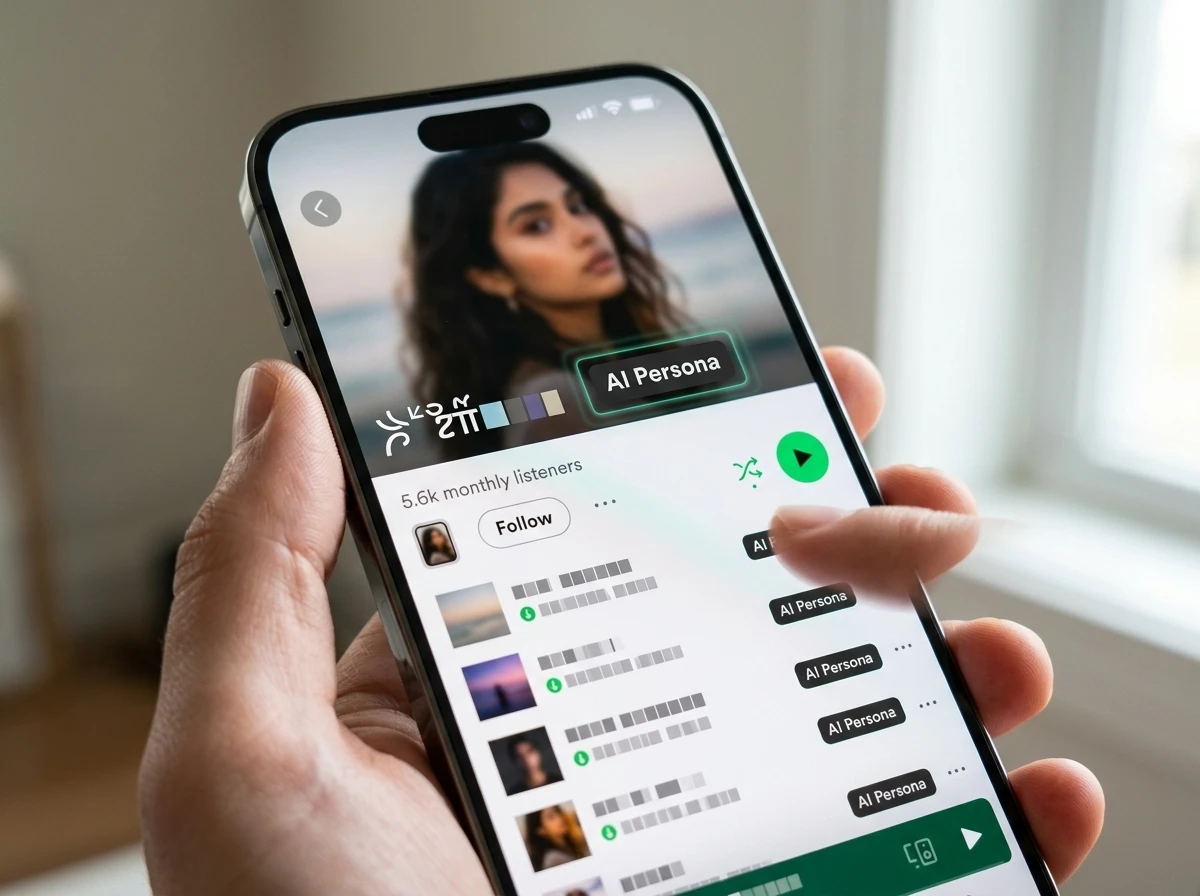
Spotify will begin displaying AI Persona badges on artist profiles whose public identity is AI-generated starting in mid-September, and will keep those acts out of editorial and algorithmic recommendations by default. Artists can already self-disclose through Spotify for Artists, while the company reviews high-audience profiles for photorealistic AI names and imagery.
The move answers listener complaints about profiles that look human until the listener digs deeper. It also draws a sharper line than earlier AI rules: the badge judges the presented identity, not the tools used to make the tracks.
How the Two Badges Will Appear
Spotify defined an AI Persona as an artist whose public identity represents an AI-generated photorealistic human. That covers profile photos, headers, names and other visuals that present a non-existent person. Music production method sits outside the badge.
Two badge versions will show once the feature rolls out this fall. Self-disclosed profiles get a clean “AI persona” mark. Profiles Spotify flags after review get “Likely AI Persona.” Tapping either reveals which path applied. Flagged artists receive a notification inside Spotify for Artists and can confirm by self-disclosing or file an appeal. Spotify makes the final call on appeals. Listeners will later gain a report tool for unlabeled suspects.
| Badge type | How it is applied | Where it shows | Recommendation rule |
|---|---|---|---|
| AI persona | Artist turns on the setting in Profile & Identity | Profile banner and About, Search (mobile), playlist track rows | Excluded from editorial and algorithmic picks unless user follows |
| Likely AI Persona | Spotify review of name and imagery, starting with audience-threshold acts | Same locations | Same exclusion by default |
Self-disclosure cannot be undone inside the artist portal; support must handle removals. Changing name, photo or bio can trigger a fresh review. The company starts with profiles that already clear defined audience thresholds so the bulk of listener visits get covered first.
Why the Identity Line Arrived Now
Generative tools made mass production of both tracks and fake faces cheap. Spotify spent the prior year fighting the resulting spam. In its September 2025 update the company said it had removed over 75 million spammy tracks in twelve months. It tightened voice-clone rules, built a spam filter, and backed the DDEX standard for AI disclosures in credits.
By April 2026 AI credits for individual roles (vocals, lyrics, production) were live in beta and drawing tens of thousands of daily submissions. Verified by Spotify launched the same spring as a human-authenticity signal; hundreds of thousands of profiles, mostly independents, already carry it and account for more than 99 percent of artists listeners actively search. SongDNA and Artist Profile Protection added further layers around contributors and release approval.
- September 2025, Spam purge numbers published, impersonation rules tightened, DDEX AI-credit work announced.
- March-April 2026, SongDNA beta and AI credits rollout begin; Verified by Spotify launches.
- August 11, 2026, Self-disclosure for AI Personas opens; mid-September badge display and rec exclusion set.
Industry pressure kept rising. Deezer reported AI tracks crossing 50 percent of its daily uploads by mid-2026 after earlier figures of 44 percent. Spotify’s own earlier data showed AI-related uploads far outpacing their share of actual streams. Listener feedback, quoted in the official AI Persona badge announcement, was blunt: people dislike discovering that a profile that looked human was synthetic.
Listeners have been clear in telling us that they don’t like seeing an artist profile that seems human, only to find out that the persona is AI-generated.
Spotify’s statement continued that its programming focuses on elevating music from authentic artists building careers.
The Discovery Wall Matters More Than the Icon
The badge itself is visible transparency. The stronger lever is the recommendation rule. Music from AI Personas will not enter editorial playlists or algorithmic personalized recommendations unless the listener already follows the act or shows other intentional engagement. Following is an explicit choice only the user can make.
That changes the growth math. Spam-style synthetic projects previously rode passive discovery, playlist placement and autoplay into millions of streams. With the default path closed, those projects must earn every new ear through search, external links, social shares or existing fans. Human artists (and real people who use AI tools) keep the full algorithmic oxygen.
- 75 million+ spammy tracks removed in the twelve months before the 2025 policy update
- Tens of thousands of AI credits submitted daily once the feature went live
- 50%+ of Deezer’s daily uploads flagged as AI-generated by mid-2026
- 99% of searched artists already covered by Verified profiles
On X, reactions split along predictable lines. Some AI-music creators called the policy self-sabotage and invited talent to other platforms. Anti-slop listeners welcomed the label and asked for a full block toggle. Clarifying posts correctly noted that mastering or stem generation by a real person does not trigger the badge. The policy targets fake faces and names, not every use of generative software.
Who Keeps the Royalty and Attention Pool
Human artists and rights holders are the clearest winners on discovery share. Spotify already tunes algorithms away from spam, slop and low-effort content. The new exclusion formalizes that preference for a whole class of profiles. Independent acts that secured Verified status gain an extra contrast signal against any remaining unlabeled synthetics.
The company bundles the badge with its other 2026 trust tools:
- Verified by Spotify for confirmed human authenticity
- SongDNA for contributor and creative-process context
- Artist Details for career milestones drawn from platform data
- Artist Profile Protection so artists approve what lands on their page
- AI credits for specific track roles when artists choose to disclose tool use
Synthetic-identity operators lose the free ride. They can still upload, collect streams from followers and appear in search. They simply cannot count on the recommendation engine to expand their audience. Appeals exist, but Spotify retains final judgment after review.
Listeners sit in the middle. Those who want only human acts get cleaner personalized feeds. Those curious about AI projects can still follow and listen. The transparency layer also reduces the kind of identity deception seen in other domains, from AI-generated death hoaxes on athletes to viral fake trailers.
AI Tools Stay Welcome on the Platform
Spotify continues to ship its own AI features: AI DJ, Prompted Playlists, chat-style music assistants and forthcoming licensed remix and cover tools after deals with Universal Music Group and Merlin. Those products sit on the listener and creation side. The Persona badge sits on the identity side. The company repeatedly stresses the distinction: a real artist who uses generative tools for lyrics or production is not an AI Persona.
That separation keeps the door open for hybrid workflows while closing it for fully fabricated front people. It also prepares the catalog for fan-made AI remixes that will still pay the original rights holders. The badge helps users tell those licensed experiments apart from persona farms.
Security and account work continues in parallel. The recent Spotify passkey login rollout is one example of platform hardening that sits alongside the content-trust agenda.
What Changes for Listeners and Creators This Fall
From mid-September the badges surface on mobile profiles first, then more broadly. Search results and playlist rows will carry the mark next to artist names. Users who tap learn the disclosure path. Artists who have not yet decided can still self-identify before the visual launch; the badge will appear once the feature is live.
Creators who run pure AI projects face a strategic choice: disclose early and own the transparency narrative, or wait for review and risk the “Likely” version. Either way the recommendation exclusion applies. Real-person acts that already disclose AI contributions via credits keep full discovery access. False positives can be appealed with supporting evidence of a living human behind the profile.
Spotify says it will keep adapting as the tools and the spam tactics evolve. For now the second-order effect is already clear. Synthetic identities lose the passive growth channel that made spam profitable. Human artists keep the algorithmic default. Listeners get an unambiguous signal about who is on the other side of the speaker.
The music stays available. The free ride does not.


Spotify AI Persona Badges Wall Off Synthetic Discovery

GCCs Build AI Bullet Trains on Incomplete Data Tracks

Coreum Bridge Multisig Signed Off on Its Own 200k XRP Drain

AI Shrinks Solar Inspection Crews While Paying Hybrid Skills Far More

Intel Graphics Driver Fixes Still Fight Windows and OEMs

Codex Now Runs Your Mac Apps and Remembers Across Days

Mercado Takes DOH as Dual Leadership Faces Health Funding Test

Gmail Keeps Breaking in iPhone Mail for a Deeper Reason

Golaman Ties Tourist Tee Times to Filipino Junior Golf Funding

Gemini App Hits 1 Billion Users on Google’s Distribution Edge

Fable 5 and Mythos 5 Return as US Lifts Anthropic Export Controls

Oracle Cuts 21,000 Jobs in a Year, Cites AI in 10-K Filing

SpaceX’s Google Deal Turns a Rocket Company Into a Cloud Landlord

CD Projekt Red Co-CEO: Redemption Arc Isn’t Done, Witcher 4 in 2027

XPL Rallies 30% Ahead of Plasma One Card Tier Launch

Google Search Profiles Build a Follow Graph Inside Discover

DGO App Brings Rs 549 Mobile Pass for FIFA World Cup 2026 in Nepal

Moonshot AI Targets $30 Billion in China’s Fastest AI Funding Sprint

Microsoft Xbox Layoffs Start in July as Sharma Slams 3% Margin

Oppo’s ColorOS 17 Eligibility List Leaves A-Series Buyers Behind
-
 AI1 month ago
Fable 5 and Mythos 5 Return as US Lifts Anthropic Export Controls
-
 AI2 months ago
Oracle Cuts 21,000 Jobs in a Year, Cites AI in 10-K Filing
-
 AI2 months ago
SpaceX’s Google Deal Turns a Rocket Company Into a Cloud Landlord
-
 GAMING2 months ago
CD Projekt Red Co-CEO: Redemption Arc Isn’t Done, Witcher 4 in 2027
-
 CRYPTO2 months ago
XPL Rallies 30% Ahead of Plasma One Card Tier Launch
-
 NEWS2 months ago
Google Search Profiles Build a Follow Graph Inside Discover
-
 APPS2 months ago
DGO App Brings Rs 549 Mobile Pass for FIFA World Cup 2026 in Nepal
-
 AI2 months ago
Moonshot AI Targets $30 Billion in China’s Fastest AI Funding Sprint