
NEWS
HyperOS 4 Opens Global Beta as Glass Stays Chip-Locked
Xiaomi HyperOS 4 global beta covers seven Global and EEA phones, while Soft Light Glass stays limited to current flagship chips.

Xiaomi opened HyperOS 4 global beta on September 10, 2026, for seven phones on Global and EEA firmware. China already has 29 models in a three-wave test that started August 14. The glass look in the promo shots is a separate gate, tied to current flagship chips rather than to the HyperOS 4 version number.
That split is the update. HyperOS 4 is a skin and an AI layer on Android 17, which Xiaomi already shipped in July under HyperOS 3, and a lot of phones that reach the new version will not render Soft Light Glass at all.
Soft Light Glass Stops at the Chipset
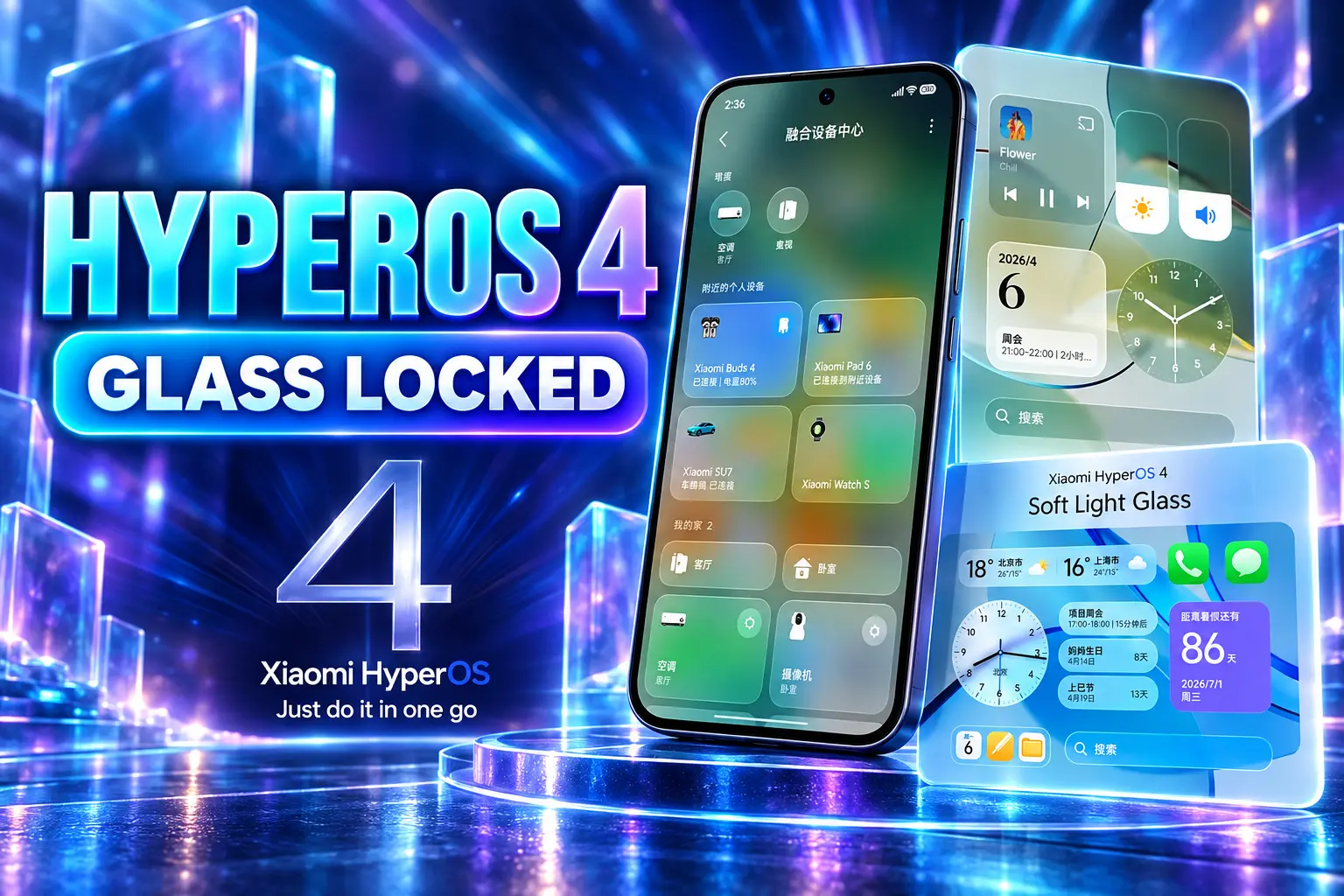
Xiaomi calls the new material Soft Light Glass. Control tiles, cards, and the shade pick up colour from the wallpaper, then add refraction so the panels read as stacked glass instead of flat sheets. Lock screen clocks and notifications can be moved. Folders can be resized. Widgets can sit in groups. Floating windows rotate with the app, and portrait apps can swing into landscape without the old jump-cut.
The look is the screenshot. It is also the rationed part. Xiaomi says the effect still needs work, so the beta keeps it on phones and tablets with Snapdragon 8 Elite or newer chips, Dimensity 9500 or newer, or Xiaomi’s Xring O1 or newer. Qualcomm rates the Elite’s Adreno GPU at 40% more performance than the prior 8-series generation, which is the kind of headroom a live refraction layer actually burns.
A longer planned list, published after the first China wave, stretches Soft Light Glass past that first-week club. It names the Xiaomi 13 series, MIX Fold and MIX Flip models, the Redmi K70 series except the K70E, Redmi Turbo 4 Pro and Turbo 5, plus several pads. POCO does not appear on that list. Redmi Note phones do not appear on the beta waves either. Owners who bought a Xiaomi 17 Ultra for the cameras are already bracing for another glass skin that tracks the iPhone. The sharper cut is simpler: two phones can both say HyperOS 4 and only one will show the material in the ads.
China Lists 29 Devices, Global Opens With Seven
Xiaomi unveiled HyperOS 4 in China on Thursday, August 13, 2026, and started the first beta the next afternoon. International recruitment did not open until September 10, when the Xiaomi HyperOS account posted that the global test was live. The China program is a 29-device ladder. The first global wave is seven phones, and none of them are tablets.
HYPEROS 4 BETA WAVES
| Wave | Start date | Devices | Regions |
|---|---|---|---|
| China batch 1 | August 14, 2026 | 10 phones and tablets | China |
| China batch 2 | August 27, 2026 | 11 phones and tablets | China |
| China batch 3 | September 17, 2026 | 8 phones and tablets | China |
| Global round 1 | September 10, 2026 | 3 phones | Global and EEA |
| Global round 2 | September 17, 2026 | 4 phones | Global and EEA |
China’s first afternoon covered the Xiaomi 17 Ultra (including the Leica Edition), 17 Pro Max, 17 Pro, 17, Redmi K90 Pro Max (including the Champion Edition), Redmi K90, Xiaomi Pad 8 Pro, and Xiaomi Pad 8. August 27 added the 17 Max, 17T Pro, 17T, Xiaomi 15 Ultra (including the Satellite Edition), 15S Pro, 15 Pro, 15, Redmi K90 Max, Redmi K90 Ultra, and Redmi K Pad 2.
The Global List Is Flagships Only
Global round 1 is already recruiting for the Xiaomi 17 Ultra, Xiaomi 17, and Leica Leitzphone powered by Xiaomi. Round 2, on September 17, adds the Xiaomi 17T Pro, 17T, 15 Ultra, and 15. Xiaomi says seats can run out. The path is Xiaomi Community, then Me, then Beta testing, then Recruiting test. Builds are limited to Global and EEA models, with other regions described only as later additions.
Xiaomi HyperOS 4 Global Beta Test is OPEN! 🎉
Ready to be one of the first to experience what's next?
Check your eligibility and join now! Learn more: https://t.co/YOKVM8PeJO#XiaomiHyperOS4Beta #Xiaomi pic.twitter.com/5UiDjDcyhV— Xiaomi HyperOS (@XiaomiHyperOS_) September 10, 2026
Replies under that post were eligibility questions, not feature notes. People asked when a Redmi Note 14 would move, and when the file would actually land. The 17T series got a cheer because it is on the September 17 global list. Everyone else is still reading a roster that does not include them.
Android 17 Already Arrived Without the Look
HyperOS version numbers are not Android version numbers. Xiaomi spent July moving the Xiaomi 17 line onto Android 17 while still calling the software HyperOS 3. The download was a platform bump: new base, same skin, no Soft Light Glass, no Super AI Assistant 2.0. HyperOS 4 sits on that same Android 17 core and spends its headline on the interface and the assistant.
That staging is why a Xiaomi 17 owner can already be on Android 17 and still be waiting for the update the ads show. It is also why the glass cannot be read as “the Android 17 look.” Google is still packing Android 17 features Google is still staging onto Pixel hardware on its own calendar. Xiaomi used the HyperOS 3 label for both an Android 16 skin and an Android 17 dump, then reserved the visual rewrite for HyperOS 4. The number on the About screen stopped being a reliable map of what the phone can do.
Super AI Assistant 2.0 Runs on Xiaomi’s Model
The assistant is the other half of the pitch. Super AI Assistant 2.0, XiaoAi in China, runs on Xiaomi’s in-house MiMo large language model. Xiaomi’s model site now leads with the MiMo-V2.5 and MiMo-V2.5-Pro models, billed for agency, multimodality, and long-horizon work. On the phone, long jobs are supposed to leave the screen and sit on Xiaomi Super Island, the pill around the punch-hole camera, then expand when the answer is ready. A hold on the bottom bar is meant to let someone talk without dumping the current app.
WHAT THE ASSISTANT IS SOLD AS DOING
- Voice notes: Transcription and note sorting, including turning speech into tasks.
- Gallery search: Find photos with a sentence instead of a folder crawl.
- Travel plans: Build itineraries from a prompt.
- Home and car: Control matching Xiaomi home gear and cars.
- Inspiration Ball: Drag a pointer onto an address, a product, a poster, or a photo, then speak a command such as “navigate here.”
- Expert Mode: Chain tools across contacts, messages, calendar, files, and the browser.
Inspiration Ball is the on-screen pointer. Xiaomi’s own examples include starting maps from an address, hunting a product link, dropping a poster’s time into Calendar, and editing a photo by pointing at it. The gesture overlaps Google Circle to Search, which is a live reason a global build might ship thinner than the China page. Xiaomi’s HyperConnect pages already treat phone-to-PC AI handoff on HyperOS 4 as the floor for moving notifications and photos into an AI chat on a Xiaomi PC or a Mac.
Expert Mode is the deep end of that stack, and it is not a lightweight toggle. Xiaomi’s XiaoAi privacy notice says the mode can pull contacts, messages, and location data, plus calendar events, photos, notifications, and files, after a Xiaomi account login. That is the cost of an assistant that can actually send a text or file something. It is also the part of the agentic assistant Xiaomi is building that will not show up in a control-centre screenshot.
The 18% Faster Load After a 9-Hour Day
Xiaomi’s speed pitch is not a cold-boot demo. Internal testing says that after 9 hours of use, HyperOS 4 loads apps about 18% faster than HyperOS 3. The company says AI predicts the next resource draw and preloads it into RAM before the tap. That is an admission as much as a boast: the phone still slows down across a workday, and HyperOS 4 is supposed to hide it.
XIAOMI’S OWN TIMING CUTS
- App loads: About 18% faster after 9 hours of use versus HyperOS 3, in Xiaomi’s lab tests.
- HDR stills: Processing drops from 310ms to 240ms.
- Camera cold start: 200ms cut from opening the camera app from scratch.
- Video: Xiaomi says dropped frames in playback should no longer be a problem.
Those figures are Xiaomi’s, not a third-party bench, and they were measured on hardware that can also draw Soft Light Glass. Refraction on every tile is extra GPU work. That is why the material is locked to current flagship silicon, and why battery life is the first worry once the screenshots fade. The preload trick also spends RAM to buy snappiness, which older devices with less memory will feel as pressure, not polish.
What Changes on September 17?
September 17, 2026, is a double date. In China it is batch 3: Redmi K100 Pro Max, K100 Pro, K80 Pro, K80 Pro Extreme Edition, K80, Xiaomi Mix Flip 2, Xiaomi Pad 7 Ultra, and Xiaomi Pad 7S Pro 12.5. On global and EEA firmware it is round 2 for the 17T Pro, 17T, 15 Ultra, and 15. Same calendar day, different rosters, and still no stable build.
WHAT WE KNOW
- China test: 29 devices across three dated waves, flagships and a short pad list.
- Global test: Seven phones, Global and EEA only, with a Community application and limited seats.
- Glass rule: Soft Light Glass in beta needs Snapdragon 8 Elite or newer, Dimensity 9500 or newer, or Xring O1 or newer.
WHAT IS UNCONFIRMED
- Stable date: Xiaomi has not published a public global stable schedule.
- Other ROMs: India, Indonesia, and further regions are described only as later additions.
- POCO and Note: Neither line is on the published beta waves or the glass expansion list Xiaomi has shown.
- Inspiration Ball abroad: Xiaomi has not said the pointer tool will ship in the global beta at full China strength.
The people left reading those open items are the volume of Xiaomi’s business: Redmi Note, POCO, last year’s T-series, and anyone on an India or Indonesia package. They can watch the 17 Ultra glass demos. They cannot join the test from the Community screen yet.
Rolling Back Means a Full Flash
Xiaomi’s own global-beta notes warn that test builds break things, and that going back to HyperOS 3 is not a simple uninstall. Testers who want out have to flash the older software. Backup first is the practical rule, because the Community signup is not a day pass.
Until a stable package exists, HyperOS 4 stays a split product: 29 China devices versus seven global phones, a glass skin reserved for current flagship chips, and an assistant that wants account login and a deep look at messages if Expert Mode is on. September 17 adds more names to both tests. It does not close the gap between the screenshot and the phone in someone’s hand.

Instagram Plus Tests a Read-Only Mode That Cuts Stories

Altman Asks the Public to Accept Some AI Harm

Google Freezes OSS VRP Product Reports After AI Flood

AI Agents Make Payment Rails the Scarce Prize

Turkey’s Crypto Boom Now Runs Through Three Banks

Fable 5 Came Back Under a Commerce On-Off Switch

Google’s SpaceX GPU Lease Has a Sept. 30 Deadline

Plasma One’s XPL Locks Face a 1.81 Billion Cliff

DGO’s Rs 549 World Cup Pass Cost Fans Sleep and Data

Moonshot AI’s $30 Billion Ask Became a $35 Billion Close
-
 AI4 months ago
Fable 5 Came Back Under a Commerce On-Off Switch
-
 AI4 months ago
Google’s SpaceX GPU Lease Has a Sept. 30 Deadline
-
 CRYPTO4 months ago
Plasma One’s XPL Locks Face a 1.81 Billion Cliff
-
 APPS4 months ago
DGO’s Rs 549 World Cup Pass Cost Fans Sleep and Data
-
 AI4 months ago
Moonshot AI’s $30 Billion Ask Became a $35 Billion Close
-
 NEWS4 months ago
ColorOS 17 Device List Spans Oppo, OnePlus and Realme
-

 GAMING4 months ago
Xbox Cuts 3,200 Jobs After Five Years of Thin Returns
-

 GAMING4 months ago
The RTX 4050 Under Rs 70,000 Hides a Wattage Gap