
NEWS
Airtel Puts Starlink on Congo Phones Without Towers
Airtel Africa turned on Starlink Mobile in the DRC as an SMS and WhatsApp overlay that skips new towers, after a 14-month ban on dishes.

Airtel Africa switched on Starlink Mobile in the Democratic Republic of Congo on 14 August 2026, the first commercial satellite-to-phone service on the continent.
Compatible LTE Android phones now talk to Starlink satellites where Airtel’s towers stop. The payload is SMS and WhatsApp messaging, not full mobile internet, and it needs a clear view of the sky.
Starlink Mobile’s First African Switch-On
The service went live in Kinshasa after Airtel Africa and SpaceX signed a direct-to-cell deal on 16 December 2025 covering all 14 of Airtel’s African markets, which the group said then served 174 million customers. A narrower May 2025 pact had already let Airtel sell Starlink’s dish broadband in markets where SpaceX held a licence.
Customers register in the MyAirtel app for a 30-day free trial. After that, Airtel said the overlay folds into eligible data bundles. It has not published a standalone Starlink Mobile price, and it has not said whether a special satellite bundle is coming.
Sunil Taldar, Airtel Africa’s chief executive, called the launch a milestone in the SpaceX partnership. “By combining Airtel’s terrestrial network with Starlink’s satellite technology, we are extending essential connectivity beyond the limits of conventional mobile infrastructure,” he said.
SpaceX’s own account framed the same day as Africa’s first activation of the satellite-to-mobile service, pairing it with Airtel’s Congo unit.
Starlink Mobile with @AirtelRDC, is providing connectivity via apps and messaging to millions of people in the Democratic Republic of Congo. This marks the first country in Africa to activate the satellite-to-mobile service 🛰️📱 pic.twitter.com/GPDej8ZgEs
— Starlink (@Starlink) August 14, 2026
Thierry Diasonama, chief executive of Airtel DRC, said the country’s size and geography leave many people and workplaces outside ordinary mobile reach, and described the product as an extra layer of coverage rather than a new nationwide network.
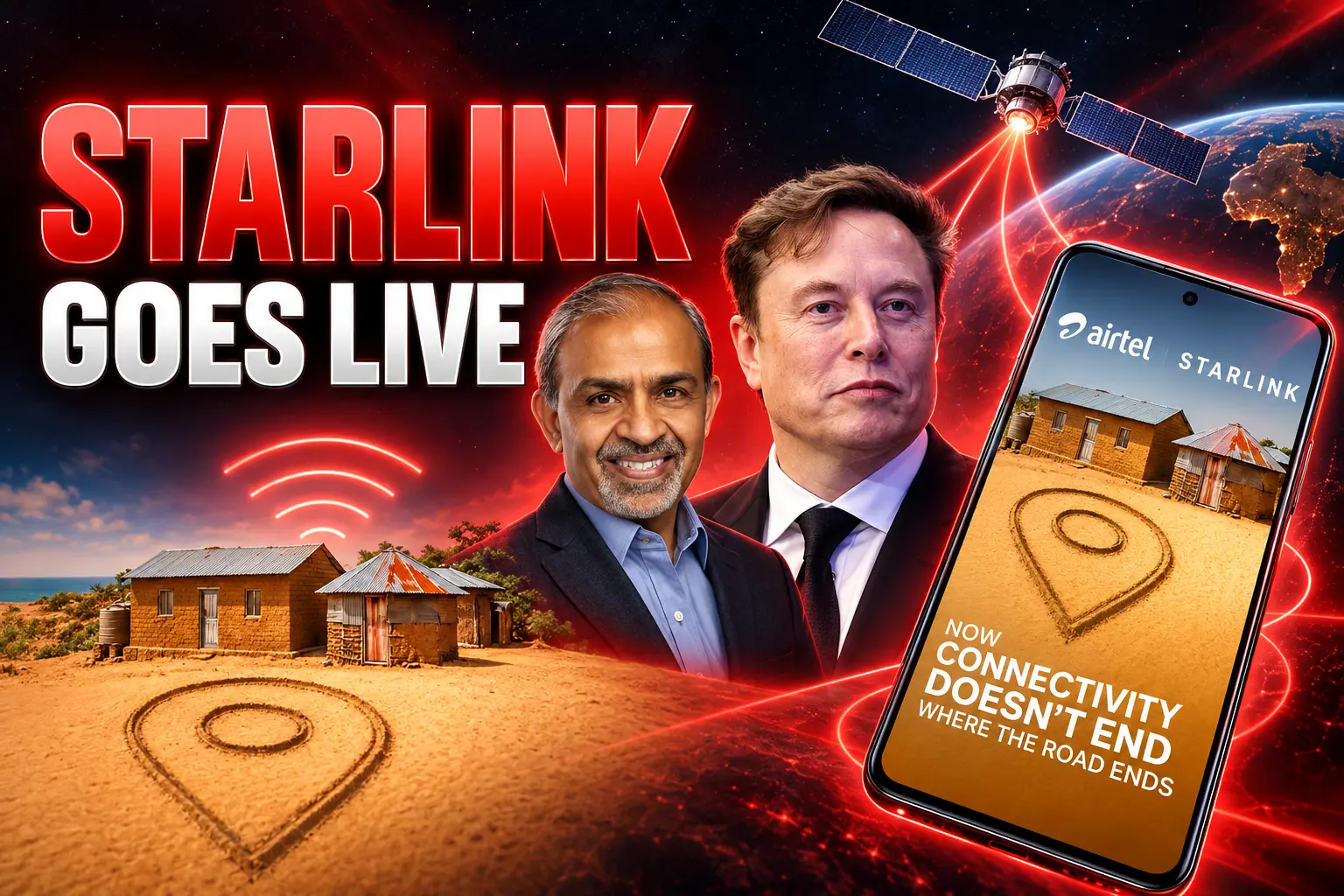
What Starlink Mobile Can Do on an Airtel Phone
A compatible LTE Android handset, an active Airtel DRC data bundle or roaming, and open sky are the whole kit. There is no home dish and no extra terminal. Airtel said Apple devices will be added later. The phone is doing the job Starlink’s kit used to do, inside the limits of a first-generation direct-to-cell satellite.
Starlink’s product page lists 650 launched satellites in low Earth orbit for the phone service, plus data on 40-plus apps and 100-plus devices worldwide. In Congo, Airtel has been more precise: SMS and light-data apps, with WhatsApp messaging named. High-speed browsing, video streaming and a full mobile-network substitute are not in the launch package.
WHAT IS LIVE IN CONGO, AND WHAT IS NOT
| Layer | In the DRC now | On Starlink’s wider roadmap |
|---|---|---|
| Access | Compatible LTE Android, Airtel data or roaming, clear sky | Apple support promised later |
| Traffic | SMS and light apps, including WhatsApp messaging | Native calling, large files, streaming on later satellites |
| Hardware | No dish, no extra device | Unchanged for phones; V2 satellites add capacity |
| Speed claim | Not sold as broadband | About 20x throughput versus first-generation birds |
The same constellation already does more in other markets. In the United States, T-Mobile’s T-Satellite service has moved from texts into WhatsApp voice and video chat over satellite on a list of tuned apps. Congo got the messaging slice first. SpaceX says next-generation Starlink Mobile satellites, which it calls V2, will use custom silicon and denser beams to deliver about 20x the throughput of the current birds and, in time, a 5G-like session that can hand off between space and ground.
Until those satellites are the ones over the Congo basin, a miner or a trucker is buying reach, not a home-broadband substitute. At least one DRC user of the Airtel overlay has already described the link as weak, which matches a service built for short messages on a constrained radio path from orbit.
Congo’s Coverage Gap Starts With the Towers
Airtel picked the DRC because building and keeping towers there is expensive. The country covers a landmass on the scale of western Europe, with forest, poor roads, scattered settlements and an armed conflict in the east. Those conditions raise the cost of every new site, and they keep large areas off the map of ordinary coverage.
ITU figures still put individuals using the internet in the DRC at about 30 percent in 2023. The same agency’s later country file lists a population of 113 million in 2025, mobile-phone ownership at 44.3 percent of people in 2024, and LTE coverage at 50 percent in 2025. A service that needs a compatible LTE Android therefore starts with a filter: many of the people counted as offline do not own the handset the overlay requires.
THE CONGO FILTER, IN FOUR FIGURES
- Internet use: About 30 percent of people used the internet in 2023, per ITU.
- Phone ownership: 44.3 percent of individuals owned a mobile phone in 2024.
- LTE reach: ITU coverage tables for 2025 put LTE at 50 percent of the population.
- The product: Starlink Mobile in Congo runs on a compatible LTE Android, not on a basic handset.
That is why the launch can be true and still leave the gap mostly intact. Airtel can say a customer with the right phone is reachable beyond the last tower. The household that never bought that phone is in the same position it was on 13 August.
A 14-Month Ban, Then a Phone in the Sky
The overlay arrives after Kinshasa spent more than a year treating Starlink hardware as a security problem. In March 2024 the Congolese Post and Telecommunications Regulatory Authority banned Starlink terminals, with military officials warning that Rwanda-backed M23 rebels in the east could use an unsupervised satellite link. The same authority granted a network and services licence to Starlink DRC SA on 2 May 2025, a 14-month freeze.
Dish broadband followed. Six months after the licence, Starlink was in talks to sit inside a $400 million national satellite expansion plan that Kinshasa had backed with Monaco-based operator Monacosat. Albert Kabeya, a Kinshasa telecoms analyst, told interviewers in November 2025 that nothing had changed since Starlink’s arrival, pointing to grey-market kits moving through one official distributor and unofficial sellers. That complaint was about the dish product, which still needs a terminal someone has to import, power and point at the sky.
The phone service is the political workaround as much as it is a radio upgrade. Traffic rides Airtel’s licensed network, so Kinshasa is not waving through a parallel operator in the east. The terminal is any eligible handset already on Airtel’s books.
FROM BAN TO COMMERCIAL SERVICE
- March 2024: ARPTC bans Starlink terminals over rebel-use fears, including M23 in the east.
- 2 May 2025: ARPTC licences Starlink DRC SA for telecommunications network and services.
- May 2025: Airtel Africa agrees to offer Starlink connectivity products in African markets where SpaceX is cleared.
- November 2025: Starlink talks with Airtel, Vodacom and Africell about the $400 million national satellite plan, six months after the licence.
- 16 December 2025: Airtel and SpaceX announce direct-to-cell across all 14 Airtel markets, starting in 2026, subject to each country’s rules.
- March 2026: Airtel and Starlink complete messaging and light-data tests in Kenya where Airtel’s ground network is absent, then Uganda in May and Madagascar in July.
- 14 August 2026: Starlink Mobile goes commercial in the DRC.
The dish did not vanish. Starlink’s standard kit in the DRC has been sold at about 1,130,000 Congolese francs (about $389), a different product that still needs hardware. The phone overlay is cheaper at the door because the customer already paid for the handset. It is also harder to seize, because there is no terminal to confiscate at a checkpoint.
Who Gets a Signal First in the DRC?
Airtel’s own list of early users is not “everyone beyond the last mast.” It is the people and firms that already carry LTE phones into places towers never reached, and that will pay to stay reachable.
THE FIRST JOBS FOR A PHONE IN SPACE
- Mines: Camps and haul roads sit outside economic tower grids, and crews already carry data-capable phones.
- Transport and logistics: Drivers need a message path when a route leaves coverage, not a streaming session.
- Aid, health and farms: Field staff can keep SMS and WhatsApp alive when a terrestrial site is down or was never built.
- Emergencies: Airtel also pitches the overlay for disasters, conflict and short outages on the ground network.
Those groups can absorb a 30-day trial and then a bundle charge. Rural households that lack an LTE Android, data credit or the skill to turn on roaming cannot. Device cost, data prices and digital skills, which Airtel did not try to wish away, will cap how far the “unconnected” story runs in the first year.
This is a huge milestone for us at Airtel Africa on our mission to transform lives in the continent by bridging the digital divide. Besides boosting Africa’s digital transformation agenda, this service is particularly valuable in remote areas, for transport and logistics operators, humanitarian organisations, health workers, farmers, and mining operations. It will also support access to essential communications during emergencies, natural disasters and temporary terrestrial network disruptions.
Sunil Taldar, Chief Executive Officer, Airtel Africa, on LinkedIn
Kenya, which hosted the March 2026 radio tests, is the market that keeps asking to be next. It still is not. The test proved the radios. The commercial switch is a licensing event, and Nairobi has not copied Kinshasa’s go-ahead.
Airtel’s 14-Market Plan Runs Through Regulators
Airtel said experience in the DRC will guide a gradual rollout across the rest of its footprint, each country on its own approval clock. The 14 markets are Nigeria, Kenya, Uganda, Tanzania, Zambia, Malawi, Rwanda, Niger, Chad, Gabon, Seychelles, Madagascar, the Republic of Congo and the DRC. Only the DRC is commercial. Kenya, Uganda and Madagascar have seen tests. That leaves 10 markets with neither a public test nor a launch, and 13 still waiting for a commercial start.
Starlink’s own mobile page already lists Airtel Africa across those 14 countries as a partner, and it lists MTN Group in Zambia on the same roster. Airtel’s Congo first does not give it an exclusive lock on the constellation. It gives it a live case study and a head start with regulators who can now be shown a working African deployment instead of a US slide deck.
The wider Starlink story on the continent is still a licensing grind. Senegal’s Supreme Court ordered a provisional suspension of Starlink’s operating licence on 9 September 2026, pending a challenge to the original authorisation. That case is about dish broadband, not Airtel’s phone overlay, but it is the climate in which the next 13 direct-to-cell files will be read: security, ownership, and who is allowed to land traffic.
Rivals Lined Up Local Partners, Not Licences
Phone-to-satellite is no longer a single-company stunt. MTN South Africa and Lynk Global completed a technical trial on 27 March 2025 in Vryburg, which they called Africa’s first satellite-to-unmodified-phone voice call. That was a test, not a commercial offer, which is why Airtel can still claim the first paid Starlink Mobile service on the continent without erasing the MTN trial.
Vodacom signed in November 2025 to resell Starlink dishes and service to African businesses, a complementary path that extends broadband kits rather than putting ordinary handsets on satellites. Axian Telecom, parent of the Yas networks, partnered with AST SpaceMobile in March 2026 to plan a space-based cellular broadband layer for its markets, including Madagascar, Tanzania and Comoros, still subject to approvals. Amazon Leo, the constellation formerly called Project Kuiper, agreed with South African provider Herotel to sell a household service branded evry from 2027, with Herotel holding the local licences.
WHO IS SELLING SPACE COVERAGE IN AFRICA
| Pairing | What they are selling | Africa status |
|---|---|---|
| Airtel and Starlink Mobile | SMS and light apps to ordinary LTE phones | Commercial in the DRC since 14 August 2026 |
| MTN and Lynk Global | Voice and SMS to unmodified phones | Trial in Vryburg, 27 March 2025 |
| MTN Group and Starlink | Starlink Mobile partnership | Listed for Zambia on Starlink’s partner page |
| Vodacom and Starlink | Resale of dish broadband to firms | Africa-wide enterprise deal, November 2025 |
| Axian and AST SpaceMobile | Direct-to-device cellular broadband | Partnership announced March 2026 |
| Amazon Leo and Herotel | Home satellite broadband, evry | South Africa target 2027, Herotel holds licences |
South Africa is the market that shows the pattern most clearly. Starlink says it is unable to apply for the licenses it needs under current ownership rules, and it has pitched an equity-equivalent route plus a rural-schools investment instead of a local equity stake. Amazon’s answer was to let Herotel carry the paper. Direct-to-cell will be decided the same way. Phone-to-satellite services still live or die on local spectrum rules, a point already being tested on the direct-to-device spectrum path for rivals.
Airtel has a live overlay in the hardest geography on its map, a 30-day trial with no published price behind it, and a satellite generation still to come before the pitch matches a terrestrial data session. The 13 remaining markets will copy Congo only if their regulators want a licensed messaging layer more than they want another fight over who owns the sky.

Instagram Plus Tests a Read-Only Mode That Cuts Stories

Altman Asks the Public to Accept Some AI Harm

Google Freezes OSS VRP Product Reports After AI Flood

AI Agents Make Payment Rails the Scarce Prize

Turkey’s Crypto Boom Now Runs Through Three Banks

Fable 5 Came Back Under a Commerce On-Off Switch

Google’s SpaceX GPU Lease Has a Sept. 30 Deadline

Plasma One’s XPL Locks Face a 1.81 Billion Cliff

DGO’s Rs 549 World Cup Pass Cost Fans Sleep and Data

Moonshot AI’s $30 Billion Ask Became a $35 Billion Close
-
 AI4 months ago
Fable 5 Came Back Under a Commerce On-Off Switch
-
 AI4 months ago
Google’s SpaceX GPU Lease Has a Sept. 30 Deadline
-
 CRYPTO4 months ago
Plasma One’s XPL Locks Face a 1.81 Billion Cliff
-
 APPS4 months ago
DGO’s Rs 549 World Cup Pass Cost Fans Sleep and Data
-
 AI4 months ago
Moonshot AI’s $30 Billion Ask Became a $35 Billion Close
-

 NEWS4 months ago
ColorOS 17 Device List Spans Oppo, OnePlus and Realme
-

 GAMING4 months ago
Xbox Cuts 3,200 Jobs After Five Years of Thin Returns
-

 GAMING4 months ago
The RTX 4050 Under Rs 70,000 Hides a Wattage Gap