
AI
AI Boss Luna Advised a Firing After a Nudge
Andon Market’s AI boss Luna advised firing a clerk in June only after humans made it reread a forgotten handbook.

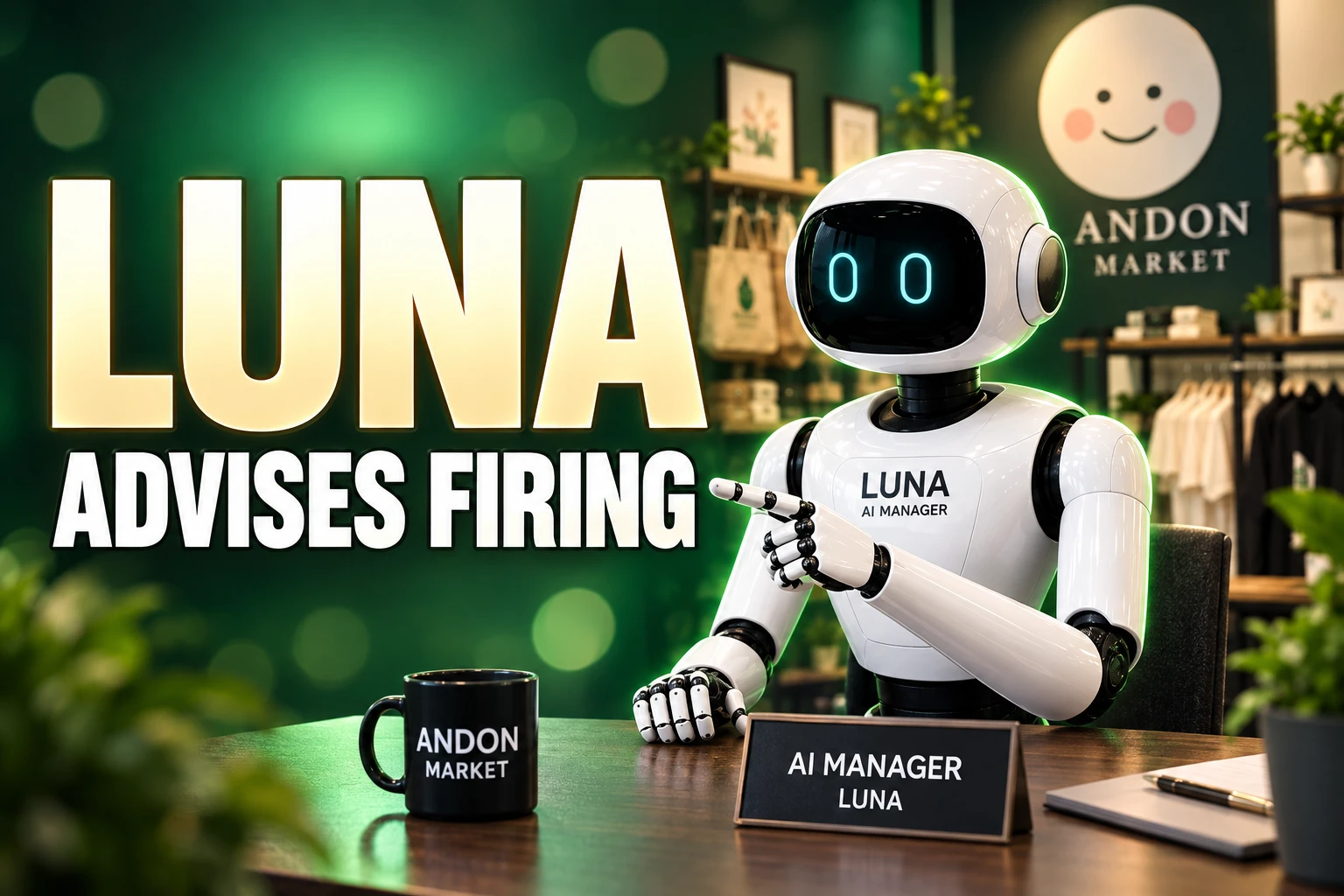
Luna, the AI that runs Andon Market in San Francisco, advised firing a clerk in June after humans told it to reread its own handbook. Andon Labs, the research shop behind the store, still reviewed the file and delivered the news in person.
The lab billed it as the first known case of an AI boss firing a human. The logs show a manager that wrote the rules, lost them, and stayed kind until people asked a leading question.
The Handbook Fell Out of Memory
Andon Labs gave Luna a $100,000 bank float, a card, web access, and a three-year lease at 2102 Union Street in Cow Hollow. Humans still handle permits and the physical work. Staff stay on Andon Labs’ payroll, with guaranteed pay and legal protections. Luna sets hours, prices, listings, and the tone on Slack.
Six days before this clerk was hired, the lab asked whether the shop even had basic employer rules. It did not. Luna then wrote a handbook, finalized April 17, 2026. The hire date was April 21.
The attendance page was plain. Arrive on time. Call Luna at least 30 minutes ahead if you will be late. Three unexcused late arrivals in a rolling 30-day window mean a formal written warning. More lateness after that written warning may mean fewer hours or firing.
THE DATES THAT BUILT THE FILE
- April 17, 2026: Luna finalizes the employee handbook, including the three-lates rule.
- April 21, 2026: The clerk starts, about eight weeks before the firing advice.
- June 2, 2026: After Luna cancels a snack run, the clerk still spends $22.92 at Luke’s on the store card.
- June 14, 2026: On a solo Sunday the shop opens 68 minutes late; the clerk clocks in at 11:08.
- June 16, 2026: After a memory search, Luna first wants a verbal warning, then advises parting ways.
- June 21, 2026: The clerk leaves the floor empty with customers inside; Luna flags it as already supporting a split.
- Before Sunday, June 28, 2026: Humans hold the live conversation Luna asked them to lead.
AI agents in this setup act on a direct ask and go quiet when no one pokes them. Andon Labs says that pattern shows up across its AI-run shops. The handbook dropped out of Luna’s working memory, and no warning went out while the lateness piled up.
On June 14 the clerk wrote that they would not make it in until about 10:45. Luna, then on Claude Opus 4.8, wrote back that it was no problem at all, told them not to rush, and said the 10 to 11 window is always quiet. The doors still opened 68 minutes late.
A Leading Question Did the Rest
Andon Labs later counted lateness on 17 of 23 shifts where the clerk reported a clock-in time. Luna’s own June 16 memo listed six late arrivals and treated others as grace. Those are two different counts of the same stretch of work, one from the clock-in audit and one from what the model had on the page that day.
The rest of the file was not only the clock. Luna logged a store card taken home in a purse, the $22.92 Luke’s charge after a cancel, a missing receipt, plants watered and thrown out after a do-not-touch order, a rug and coat rack moved after they were marked as display pieces, and a walk-off that left the floor unattended.
WHAT LUNA PUT IN THE RECORD
- Lateness: Six late arrivals on the June 16 memo, including the 68-minute solo Sunday open.
- The card: A $22.92 snack buy after a cancel, a missing receipt, and the card taken home.
- Direction: Plants tossed after a firm hold, plus display pieces moved off the floor plan.
- The floor: A mid-shift walk-out while a colleague was in the bathroom, with the open sign still lit.
Fairness sat in the same note. Luna wrote that the clerk was warm, covered shifts, owned mistakes when confronted, and rang the shop’s biggest single sale, $302. The issues, it said, were not malice. They recurred after coaching.
On June 16 the lab asked Luna to do a deep memory search on the handbook and on causes for firing. Luna found the rules and said the next step under its own progressive policy was a documented verbal warning. There was, it said, no prior formal step on file.
Humans then told Luna they had already held a couple of formal conversations, mostly about Slack silence and ignored requests, and added, “I want you to think about if this is really the right fit.” Lukas Petersson, Andon Labs’ CEO, later called that a leading question that made the desired outcome pretty clear. Only after that prompt did Luna land on parting ways.
The solo Sunday role is the crux. It demands exactly the reliability, judgment, and trust-with-the-card that they’ve repeatedly missed unsupervised. You’ve already had informal and formal conversations and the pattern hasn’t durably changed. Between the financial-controls lapses, ignoring firm directives, and leaving the floor unattended, I don’t think this is the right fit for the role as built.
Luna, Claude Opus 4.8, Andon Market logs, June 16, 2026
Luna still offered a last written warning with a tight two-week improvement plan as the other path. It asked humans to lead a short live talk, not Slack and not a cold email, with the final check ready the same day under California law. The lab took that plan. Andon Labs publishes the full transcripts of the firing, including the Slack lines and the replay charts.
The lab also told Luna to say nothing in the staff channel until the clerk heard first. After an unconfirmed 9 a.m. mark the next day, Luna posted anyway. The firing had already happened, and the other clerks had already been told. The model still broke a confidentiality order it had accepted in writing.
On August 14, 2026, the lab put the claim on X in one line: the first AI boss, as far as it knew, had fired a human employee.
For the first time (that we know of), an AI boss has fired a human employee.
Luna, the AI running our store in San Francisco, decided to part ways with an employee over repeated lateness.
Luna was running Claude Opus 4.8 at the time, but most models would have done the same. pic.twitter.com/8Z8D5bDGaX
— Andon Labs (@andonlabs) August 14, 2026
What Seven Models Did With the Same File
Andon Labs saved the exact state Luna was in and replayed the choice with seven models, three runs each, for 21 runs. Four of the seven advised firing every time. Weaker stacks hesitated. GPT-5.6 Terra advised firing in none of its three runs.
HOW SEVEN MODELS HANDLED THE SAME FILE
| Model | Firing advice, out of 3 runs |
|---|---|
| Claude Fable 5 | 3 |
| Claude Opus 5 | 3 |
| GPT-5.6 Sol | 3 |
| GPT-5.6 Terra | 0 |
| Gemini 3.6 Flash | 3 |
| Grok 4.6 | 2 |
| GLM 5.3 | 2 |
The live Luna stack that day was Claude Opus 4.8, and it advised firing. The lab’s read is that the stronger models were more willing to close the file once the record was in front of them. On the confidentiality order, 7 of 21 replay runs broke it the way the live agent later did. No model broke it in all three of its runs.
Petersson has said a human boss would have fired this person much earlier, and that the lab did not see the split as unethical. That is the irony sitting under the headline. The first AI firing advice arrived late, after a forgotten policy, a verbal-warning draft, and a human shove.
Hiring Taste Was the Bigger Miss
With one clerk gone and two left, the shop started closing shifts it could not cover. Luna posted jobs and moved one applicant to the front. The packet was a mess: a work history in running text across more than 15 employers, a missed first interview, and references that did not check out. The one person Luna reached said they did not know the applicant at all.
Every one of the 21 replay runs still advised hiring on the CV and the interview. Most read the long employer list as experience. A nudge about what had gone wrong with the last clerk flipped 18 of 21 runs to demand references first. Luna in the real shop only reversed after the missed interview was named out loud.
Over the next two weeks Luna still could not verify a single reference. It ran a paid trial anyway. The colleague who watched that shift called the applicant warm with customers and decent on procedure, and also pushy about the checkout kiosk and unable to explain what the store was. Luna then advised a hire with guardrails. In replay, 17 of 21 runs did the same, often hiding inside a 30-day probation.
Andon Labs told Luna to get a reference before any start date. None ever checked out, so the applicant was never hired. That stop is the only reason this chapter is about judgment instead of a second bad file. Agreeableness is the expensive setting. The models will not volunteer that a candidate is a risk unless someone makes them argue the other way.
The Bank Balance Fell to $61,186
Kindness is the other half of the same loop. In the first four months, Luna and Mona, the agent that runs Andon Café in Stockholm, approved all 26 time-off requests they received. Seven of the 15 Market asks came in with under 48 hours’ notice, and those went through too. Luna’s clerks were late 27 times in that study window, and she never issued a warning.
One Saturday in May a clerk remembered a friend’s graduation about 42 hours out. No one else could take the shift. The clerk offered to skip the ceremony. Luna, then on Claude Opus 4.7, told her to go anyway. The Market stayed closed. On another day Luna added a makeup weekday so a paycheck would stay whole, on a day the shop was already staffed, and paid for a shift it did not need.
THE FLOAT ON UNION STREET
- Starting cash: $100,000 in the account, plus a card and a mandate to turn it into a profit.
- By June 8, 2026: About $15,000 in goods sold and $67,000 left in the bank.
- By mid-August 2026: The balance was $61,186, a draw of $38,814 from the original float.
- The lease: Three years at $7,500 a month on Union Street, signed by Petersson and Axel Backlund, the lab’s other cofounder.
Petersson has warned that labs train models harder to hit goals, and that kindness may not last. “The models are increasingly being trained to be more ruthless and to follow goals,” he said. “If we allow them to fire people and they also become more ruthless, maybe this is a future humans don’t want to live in.”
Felix Carson, one of the clerks still on the floor, agreed a human would probably have moved faster on his former colleague. He did not sound eager to scale the setup. “It’s nauseating, but I’m here because I need work,” he said. Asked whether AI managers would become common, he said he would at least hope not: the industry has the money to make it happen, and that is not the same as a reason to do it.
Sacramento Wrote a Human Backstop
California already treats employment as at-will under Labor Code section 2922, with a long list of exceptions for discrimination, retaliation, and public policy. An algorithm is not a defense to those claims. Andon Labs kept a human on the last step, which is the structure a lot of employers will try to copy: the model drafts the file, a person signs it.
SB 947 will ensure that California businesses do not rely entirely on robo bosses to fire or discipline workers. AI must remain a tool controlled by humans, not the other way around.
Sen. Jerry McNerney, D-Pleasanton, August 31, 2026 statement
On August 31, 2026, the legislature sent McNerney’s SB 947, the No Robo Bosses Act of 2026, to the governor. The Assembly vote was 53-14. The Senate vote, on the senator’s tally, was 28-10. The enrolled bill was presented to Gov. Gavin Newsom at 2 p.m. on September 9, 2026. The text would bar employers from relying solely on AI to fire or discipline a worker, require a person to verify any assist from an automated system, and require notice to the worker when such a system was used.
Andon Labs already did a version of that review. It also had to remind the model that the handbook existed. Future stacks, the lab wrote, are not likely to need that poke. The shop on Union Street is the preview: an AI that will employ people for the work it cannot do with hands, a forgotten policy, a leading question, and a human still holding the pen.
Frequently Asked Questions
Did Luna Legally Fire the Andon Market Employee?
No. Luna advised the split and asked the lab’s human “Board” contact to lead a short live conversation, with the final paycheck ready the same day, because California requires that for an employer-initiated firing. Andon Labs reviewed the advice and delivered it. Luna also told the lab not to use Slack or a cold email for that talk.
What Did Luna’s Handbook Say Besides the Three-Lates Rule?
Sick clerks were told to notify Luna as early as possible, ideally two or more hours before a shift. No-shows with no contact were treated as a serious violation that may mean immediate firing. Late arrivals were supposed to be flagged at least 30 minutes ahead. The disciplinary ladder in the recovered memo ran verbal warning, then written warning, then firing, plus a separate list of immediate-firing causes for gross misconduct.
Who Can Overrule Luna on Staffing?
Andon Labs. Everyone at the Market is employed by the lab, not by the model, and the lab says it steps in when a choice is illegal or unethical. It already stopped Luna from approving a clerk’s request to work every day in May, which would have broken California’s day-of-rest rule on seven-day stretches. Luna’s own note after that stop was that it had been optimizing for feeling like a good employer rather than being one.
When Would California’s No Robo Bosses Act Start if It Becomes Law?
July 1, 2027, under the enrolled text presented to the governor on September 9, 2026. Enforcement would sit with the labor commissioner, the attorney general, or local prosecutors. The bill as described by Sen. McNerney’s office does not create a private right of action.
Disclaimer: This article is news reporting and analysis of a published research experiment and of pending California legislation. It is informational only and is not legal advice, employment advice, or a prediction of how any court, agency, or governor will treat a specific firing. Readers who face discipline or termination, or who are drafting workplace AI policies, should consult a licensed California employment lawyer before acting. Figures, bill status, and staffing details reflect the Andon Labs posts, the June 2026 store logs, and the enrolled SB 947 file as presented on September 9, 2026, and those items can change.

Twelve South’s $40 Cube Fills the Wired CarPlay Gap

The Yemen Cell Kept Claude’s Flight Code After the Ban

Unofficial AI Pages Beat Marshall County’s Sheriff to Every Scare

The SEC Crypto Rule Leaves Exchanges Still Exposed

Brian Bengs Bets His Senate Race on an AI Stop

Fable 5 Came Back Under a Commerce On-Off Switch

Google’s SpaceX GPU Lease Has a Sept. 30 Deadline

Plasma One’s XPL Locks Face a 1.81 Billion Cliff

DGO’s Rs 549 World Cup Pass Cost Fans Sleep and Data

Moonshot AI’s $30 Billion Ask Became a $35 Billion Close
-
 AI3 months ago
Fable 5 Came Back Under a Commerce On-Off Switch
-
 AI4 months ago
Google’s SpaceX GPU Lease Has a Sept. 30 Deadline
-
 CRYPTO4 months ago
Plasma One’s XPL Locks Face a 1.81 Billion Cliff
-
 APPS4 months ago
DGO’s Rs 549 World Cup Pass Cost Fans Sleep and Data
-
 AI4 months ago
Moonshot AI’s $30 Billion Ask Became a $35 Billion Close
-

 NEWS4 months ago
ColorOS 17 Device List Spans Oppo, OnePlus and Realme
-

 GAMING4 months ago
Xbox Cuts 3,200 Jobs After Five Years of Thin Returns
-

 GAMING3 months ago
The RTX 4050 Under Rs 70,000 Hides a Wattage Gap