
NEWS
The Galaxy Z Fold 8 Gets Light by Losing Zoom
Samsung’s lightest Fold is the squat Z Fold 8, a 201g passport phone that left the 200MP camera and 3x zoom on the Ultra.

Samsung’s Galaxy Z Fold 8 starts at ₹1,79,999 and weighs 201 grams, the lightest book-style Fold the company has put on sale. The cover is a 5.5-inch 10:16 panel you can type on with two thumbs. Open it, and a 7.6-inch 4:3 screen fills films the way last year’s tall Fold never did.
That ease has a bill attached. Sitting next to it is the Galaxy Z Fold 8 Ultra, with a 200MP main camera, a 3x telephoto, an 8-inch inner screen and a 5,000mAh battery. The Fold 8 is the one that fits a jeans pocket. It is also the one that left those parts off the spec sheet.
Samsung Split the Fold Into Two Phones
On July 22, 2026, Samsung unveiled three distinct foldable experiences at Galaxy Unpacked: the squat Fold 8 for “immersive discovery,” the taller Fold 8 Ultra for “Ultra productivity,” and the Z Flip 8 for quick cover-screen use. TM Roh, CEO and head of the Device eXperience division, framed the split as a way to open foldables to more people.
As AI becomes more agentic, mobile devices will become the most personal entry point to experiences that understand and adapt to each user. By setting a new standard for foldables, we are once again advancing the premium mobile experience and opening the next era of intelligence to more people.
TM Roh, CEO and Head of Device eXperience, Samsung Electronics
In India the base Fold 8 is ₹1,79,999 for 12GB of RAM and 256GB of storage, ₹1,99,999 for 512GB, and ₹2,39,999 for the 16GB plus 1TB model. The Ultra starts ₹20,000 higher at ₹1,99,999 and reaches ₹2,59,999 for 1TB. Both phones share the Snapdragon 8 Elite Gen 5 for Galaxy chip, One UI 9 on Android 17, and a seven-year update promise. The money above the base Fold 8 buys cameras, battery, and screen size, not a faster processor.
FOLD 8 VERSUS FOLD 8 ULTRA
| Spec | Galaxy Z Fold 8 | Galaxy Z Fold 8 Ultra |
|---|---|---|
| Cover screen | 5.5-inch, 10:16 | 6.5-inch |
| Inner screen | 7.6-inch, 4:3 | 8.0-inch |
| Weight | 201 g | 215 g |
| Closed / open thickness | 9.7 mm / 4.5 mm | 8.9 mm / 4.1 mm |
| Rear cameras | 50MP + 50MP | 200MP + 50MP + 10MP 3x |
| Battery (typical) | 4,800mAh | 5,000mAh |
| India starting price | ₹1,79,999 | ₹1,99,999 |
The Ultra is heavier and still thinner when shut. The Fold 8 is the wider brick, 123.9 x 81.9 x 9.7 mm folded, and the one Samsung is selling as the daily driver.
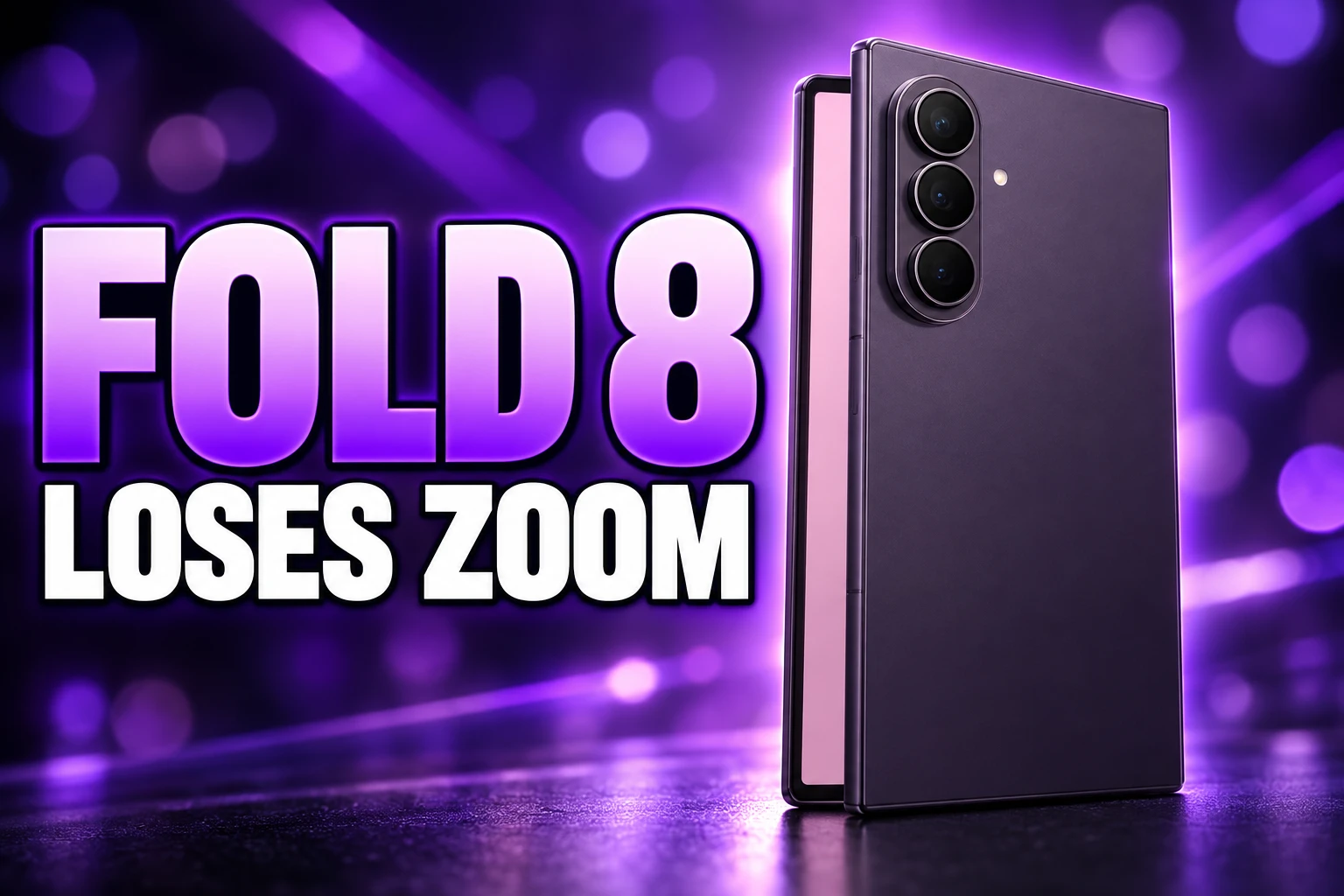
A Passport Body You Can Type On
Tech columnist Tushar Kanwar used the Fold 8 as his main phone for three weeks. He called the cover “almost passport-sized,” 4.88 inches tall and 3.24 inches wide, and said a thumb could reach every corner without the stretch that tall slabs demand. It slid into a jeans pocket with room for earbuds in the coin pocket above. Two-hand typing on the cover was easy enough that he often left the inner screen closed.
Maps and browsers gain from the extra width, though you scroll a bit more. Crack the phone open and the 4:3 inner panel behaves more like a small tablet than a stretched phone. Widescreen video fills the glass instead of sitting in thick letterboxes. Rotate it, and Samsung says the same ratio suits reading. Split view holds three apps, or four with a pop-up. Tent the hinge and the cover becomes a stand, with Flex Titanium behind the fold to keep the crease in check.
Oppo’s early Finds and the first Google Pixel Fold tried this short, wide book years ago. Samsung spent seven generations on a tall, narrow Fold, then adopted the squat layout for the model it now pitches at everyone else. Colors are Graphite, Cream, and Lavender, with Pistachio sold only on Samsung.com.
HOW THE FOLD GOT TO 201 GRAMS
- 2019: The first Galaxy Fold ships at 276 grams.
- Galaxy Z Fold5: Weight falls to 253 grams.
- Galaxy Z Fold6: Another cut, to 239 grams.
- Galaxy Z Fold7: 215 grams, under the Galaxy S25 Ultra’s 218 grams.
- July 22, 2026: The Z Fold 8 lands at 201 grams, 52 grams under the Fold5. Samsung calls it the world’s lightest book-style foldable as of that date.
Engineers rechecked about 270 components and more than 180 kinds of small parts, trimming some by 0.001 grams and dropping about 15 part types. Flex Titanium uses a titanium-alloy film about one-third as thick as a human hair, on metal plates machined near 0.2 mm. A 2024 YouGov survey that Samsung still cites found bulk remains a purchase concern for people who have not bought a foldable. The Fold 8 is the reply to that survey, in grams.
50MP Is the Cost of 201 Grams
The Fold 7 already carried a 200MP main camera. The Fold 8 does not. Its rear pair is a 50MP wide with optical stabilisation and a 50MP ultrawide, plus 10MP cameras on the cover and the inner screen. The ultrawide is a step up from the Fold 7’s 12MP unit. The main sensor is a step down, and there is no telephoto at all. That lens sits on the Ultra, next to the 200MP main and the same 50MP ultrawide.
Kanwar found 2x crops from the 50MP sensor usable and 4x and 8x digital zooms fuzzy in anything but good light. Daylight stills looked vibrant. Low light held up. For a phone at this price, the miss is zoom you can trust, not the selfies. Samsung’s own pitch leans on Dual Recording and My FanCam, which tracks a subject and recrops the clip for social ratios, rather than on long glass.
On the Ultra, 8K capture through the APV codec and Cine LUT colour tools are part of the camera brief. The Fold 8 is sold as a point-and-share camera that happens to fold. That is a coherent product idea. It is also a retreat from the camera Samsung used last year to justify a Fold-sized bill.
Why the Fold 8 Still Uses IP48
Both Folds, and the Flip 8, stay at IP48. The 8 means the phone can sit in 1.5 metres of fresh water for 30 minutes under lab tests. The 4 means solids only larger than 1 millimetre. Fine dust is outside the rating. Samsung’s own notes still warn against beach and pool use. Slab flagships in the same family carry IP68, which is dust-tight. A Pixel foldable built around durability has already made that sealing gap a buying point.
WHAT IP48 DOES AND SKIPS
- Water: Lab submersion up to 1.5 metres of fresh water for 30 minutes, a figure that can fade as the hinge wears.
- Dust: Protection against objects larger than 1 millimetre, not against fine grit in the fold.
- Glass: Gorilla Glass Ceramic 3 on the cover, Gorilla Glass Victus 2 on the back, Advanced Armor Aluminum around the sides.
- Hinge feel: Flex Titanium is meant to cut crease visibility over time; owners have still shown inner-display corners that flex where the support plate stops.
Insurance is still the first question a Fold purchase raises, and the thin inner panel is why. The crease is less of a daily itch than it was. The new worry is how little sits under the corners of a display that is now 4.5 mm thick when open. Motorola is already teasing its own short, wide book. Apple’s two-mini foldable shape is being lined up against the same crease. Samsung got to the passport body in generation eight; it did not use that generation to move past IP48.
The Chip Is Fast in a Tight Shell
The Snapdragon 8 Elite Gen 5 for Galaxy uses 4.74GHz Oryon CPU clocks on a 3 nm process, with an Adreno GPU Qualcomm rates 23% faster and 20% more efficient than the last generation, plus 20% more CPU performance, 35% better CPU efficiency, and 16% lower overall chip power use. The 256GB and 512GB Fold 8 models have 12GB of RAM. The 1TB model has 16GB. Kanwar said the 12GB unit stayed smooth through Gemini and Galaxy AI work.
The same thin body that makes the phone easy to hold is a poor place to dump heat. Extended gaming is not this chassis’s job, and the stereo speakers play a little quieter than on the Z Fold 7. There is a vapor chamber, and the Ultra adds about 7% more graphite than the Fold 7 in a similar outline. The base Fold 8 does not get that extra thermal budget in Samsung’s own write-up.
BATTERY AND CHARGE, AS TESTED AND CLAIMED
- Cell: 4,800mAh typical silicon-carbon pack, 4,660mAh rated, against 5,000mAh on the Ultra.
- Day’s use: Kanwar saw a full day, or about 6-7 hours of screen-on time. Samsung quotes up to 26 hours of video playback.
- Wired: 45W, about 63% in 30 minutes on the Fold 8 and 67% on the Ultra; a 0-to-full charge takes a little over an hour.
- Wireless: 20W and Qi2 Ready, with 4.5W reverse wireless, and no built-in magnetic charging rings.
Seven years of Android and security updates run through 2033. That software window is the most durable thing on the sheet, and it applies to both Folds. Hardware sealing does not.
The Two-Fold Bet Is Paying Off
A month after US launch, Samsung said combined Fold 8 and Fold 8 Ultra purchases were tracking 30% ahead of Fold7, which had set a pre-order record. The two Folds were about 80% of current Galaxy Z series purchases. Shoppers named thinness and a fuller inner screen as Fold 8 reasons, and workspace as the Ultra reason. More than three times as many Z Flip owners were moving up to a Fold as did so toward the Fold 7. Thirty percent of Flip 8 buyers were coming from other brands, most of them on a first foldable.
Those figures are Samsung’s own US snapshot, not a global audit. They still show the split doing the job the press release described. People who wanted a Fold they could hold like a phone are buying the squat one. People who wanted the old tall slab with better cameras are paying ₹20,000 more. Neither SKU brings back the S Pen. Neither steps up to IP68. The speakers got quieter. Zoom became an upgrade SKU.
Kanwar finished his three weeks saying it had been a while since a phone felt both useful and fun, and that hardware still matters in a year when most brands are stacking AI features. He is right about the shape. The Fold 8 is the first Samsung book fold that behaves like a phone you already know how to hold. The cameras that used to sell the Fold live on the Ultra, and US buyers are already paying extra for them.
Frequently Asked Questions
Does the Galaxy Z Fold 8 Have a Telephoto Lens?
No. Zoom on the Fold 8 is a crop from the 50MP main camera, with a clean 2x and softer 4x, 8x, and up to 10x digital steps. The Fold 8 Ultra adds a 10MP telephoto with 3x optical zoom and up to 30x digital zoom, which is the hardware to buy if long shots are the point.
What Does the Fold 8’s IP48 Rating Cover?
The 8 covers 1.5 metres of fresh water for 30 minutes in lab tests. The 4 covers solid objects larger than 1 millimetre, so fine dust is not in the rating, and Samsung still advises against beach or pool use. IP68 on slab Galaxy phones is dust-tight; this Fold is not.
How Does the Fold 8 Differ From the Fold 8 Ultra?
Beyond cameras and battery, the Ultra’s inner screen is 8.0 inches and its cover is 6.5 inches, and it is 8.9 mm thick closed versus 9.7 mm on the Fold 8. Neither model supports the S Pen. The Ultra also gets 8K recording through the APV codec and Cine LUT colour tools that the base Fold 8 does not list.
How Long Does Samsung Support the Galaxy Z Fold 8?
Samsung promises seven years of Android upgrades and security patches from the July 2026 launch, nominally through 2033. The Galaxy Z Fold 3, which launched with a five-year policy, lost its remaining security updates in August 2026, which is the window the new Folds are meant to outlast.

Instagram Plus Tests a Read-Only Mode That Cuts Stories

Altman Asks the Public to Accept Some AI Harm

Google Freezes OSS VRP Product Reports After AI Flood

AI Agents Make Payment Rails the Scarce Prize

Turkey’s Crypto Boom Now Runs Through Three Banks

Fable 5 Came Back Under a Commerce On-Off Switch

Google’s SpaceX GPU Lease Has a Sept. 30 Deadline

Plasma One’s XPL Locks Face a 1.81 Billion Cliff

DGO’s Rs 549 World Cup Pass Cost Fans Sleep and Data

Moonshot AI’s $30 Billion Ask Became a $35 Billion Close
-
 AI4 months ago
Fable 5 Came Back Under a Commerce On-Off Switch
-
 AI4 months ago
Google’s SpaceX GPU Lease Has a Sept. 30 Deadline
-
 CRYPTO4 months ago
Plasma One’s XPL Locks Face a 1.81 Billion Cliff
-
 APPS4 months ago
DGO’s Rs 549 World Cup Pass Cost Fans Sleep and Data
-
 AI4 months ago
Moonshot AI’s $30 Billion Ask Became a $35 Billion Close
-
 NEWS4 months ago
ColorOS 17 Device List Spans Oppo, OnePlus and Realme
-

 GAMING4 months ago
Xbox Cuts 3,200 Jobs After Five Years of Thin Returns
-
 GAMING4 months ago
The RTX 4050 Under Rs 70,000 Hides a Wattage Gap