
NEWS
Pixel 11 Trails Galaxy Phones That Last as Long
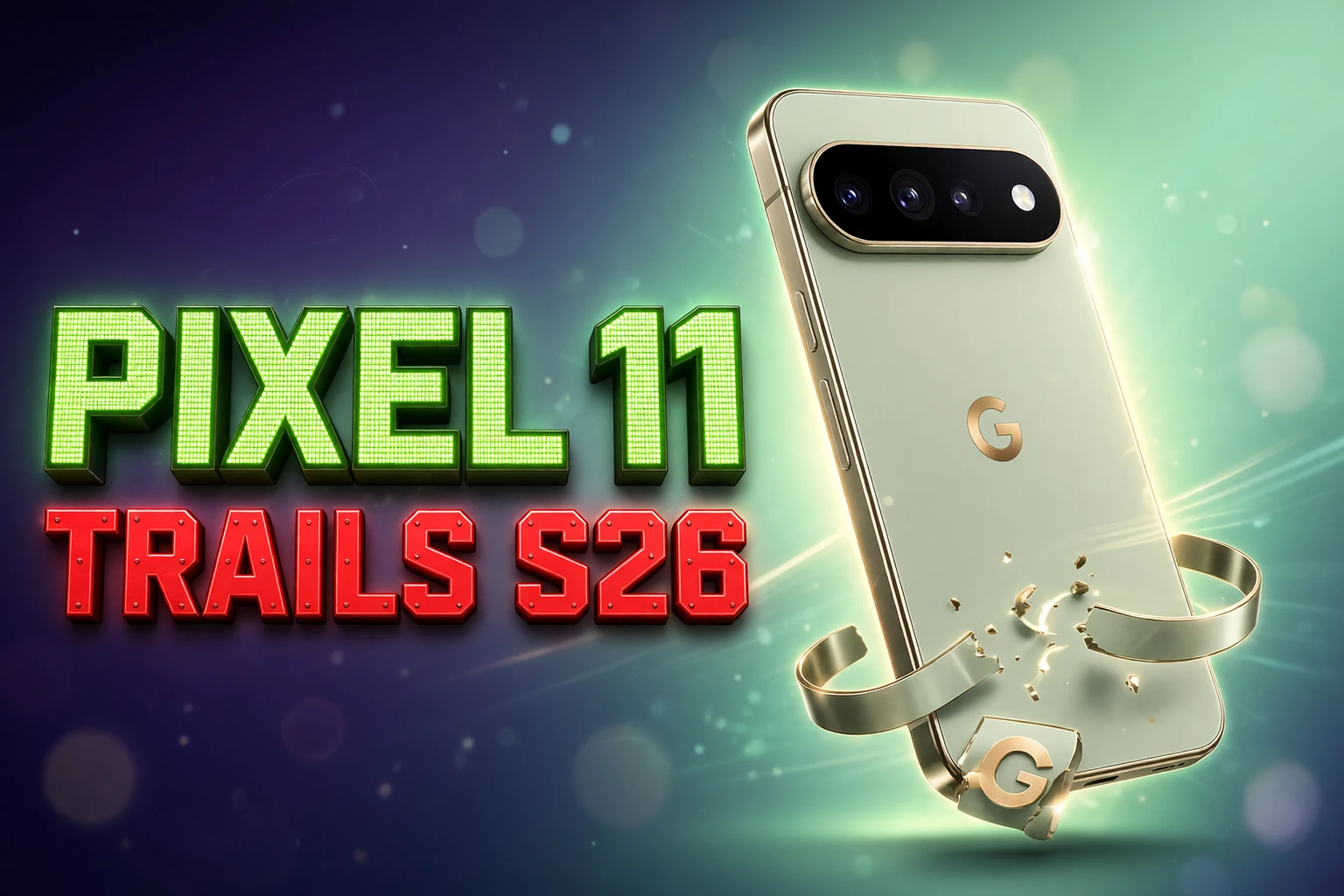
Pixel 11 promises seven years of Android, but Tensor G6 already trails Snapdragon 8 Elite, so Galaxy S25 and S26 own the long hold.

The Google Pixel 11 starts at $899 with seven years of Android 17 updates, and its Tensor G6 already trails last year’s Snapdragon 8 Elite. Google announced the phone on August 12, 2026, put it on sale on August 20, and called Tensor G6 its fastest, most powerful chip yet.
Five current Androids beat that chip on Geekbench 6 and 3DMark Wild Life Extreme. Only two of them, Galaxy S25 and Galaxy S26, also match Pixel’s software clock, which is the part of the pitch that is supposed to matter in 2032.
Pixel 11’s Seven-Year Clock Starts Behind
Google ships Pixel 11 with Android 17 and a written promise of seven years of OS and security updates, running through August 2033. The Tensor G6 3 nm spec sheet lists a 7-core Arm C1 layout, 12 GB of RAM, 256 GB as the storage floor, a 6.3-inch OLED panel at 60-120 Hz and 3,000 nits peak, and a 4,985 mAh battery at 30 W wired.
On Geekbench 6 the standard Pixel 11 lands at 2,575 single-core and 6,027 multi-core. In 3DMark Wild Life Extreme it averages 3,353. Even the much costlier Pixel 11 Pro XL only reaches 3,462 in that GPU test.
Those numbers are fine for mail, maps, and Gemini. They are not the scores of a 2026 flagship that has to carry new Android builds, desktop-style windows, and heavier games into the early 2030s. Google’s own rate of AI feature drops has already left older Pixels without tools the new ones advertise on day one.
Galaxy S25 and S26 Match the Window
Samsung has matched Pixel’s seven-year pledge on every Galaxy S flagship since S24. Galaxy S26 is due updates until at least 2033, with seven major Android upgrades, not a security-only tail. Galaxy S25, launched in January 2025, sits on the same policy.
S26 starts at $799, $100 under Pixel 11, and uses Qualcomm’s Snapdragon 8 Elite Gen 5 for Galaxy. S25 uses last year’s Snapdragon 8 Elite and still clears Pixel 11 on CPU and GPU. Both phones keep 12 GB of RAM; S25 is selling near $700, which is the price that makes the older chip the sharper hold.
PIXEL 11 VS FIVE FASTER ANDROIDS
| Phone | Chip | Geekbench 6 multi | 3DMark WLE | OS years | Street price |
|---|---|---|---|---|---|
| Pixel 11 | Tensor G6 | 6,027 | 3,353 | 7 | $899 |
| Galaxy S25 | Snapdragon 8 Elite | 9,669 | 5,959 | 7 | about $700 |
| Galaxy S26 | 8 Elite Gen 5 for Galaxy | 10,545 | 6,607 | 7 | $799 |
| Nubia Z80 Ultra | 8 Elite Gen 5 | 10,550 | 6,324 | 3 | $649-$799 |
| OnePlus 15 | 8 Elite Gen 5 | 10,415 | 5,328 | 4 | $899.99 |
| Razr Ultra (2025) | Snapdragon 8 Elite | 8,823 | 5,910 | 3 | about $700 |
S26’s 6,607 Wild Life Extreme score is 97% above Pixel 11’s 3,353. Its Geekbench 6 single-core result of 3,586 is 39% above 2,575, and its 10,545 multi-core run is 75% above 6,027. Last year’s S25 still leads Pixel 11 by 78% in that GPU test at 5,959.
How Far Tensor G6 Trails Snapdragon 8 Elite
Tensor G6 is a TSMC 3 nm part with one Arm C1-Ultra core at 4.1 GHz, four C1-Pro cores at 3.4 GHz, and two C1-Pro cores at 2.65 GHz. Google dropped a CPU core versus Tensor G5, moved the GPU to an Imagination PowerVR CXTP-48-1536 at 1.29 GHz, and still ships no ray tracing. Robert Triggs, who ran the usual bench suite on the Pixel 11 series, found single-core Geekbench 6 up about 18% and multi-core up about 21% versus G5, with Wild Life GPU gains of only 7% to 10%.
TENSOR G6, IN THE LAB
- Yearly CPU bump: About 18% single-core and 21% multi-core over Tensor G5 on Geekbench 6.
- Yearly GPU bump: About 7% to 10% in 3DMark Wild Life and Wild Life Extreme.
- Stress hold: About 79% of peak left after a 20-run 3DMark stress test, better share than several faster rivals that start much higher.
- Missing feature: No hardware ray tracing, after Qualcomm and others have shipped several generations of it.
Snapdragon phones in the same tests keep a large lead, and Triggs put that gap at 37% single-core and 52% multi-core against current Snapdragon rivals. The Adreno 840 in Snapdragon 8 Elite Gen 5 more than doubles Tensor’s Wild Life Extreme score. Dimensity 9500’s Arm G1-Ultra is about 135% ahead. After a few minutes of the stress test, G6’s extra GPU clocks fall back toward last year’s level.
Google markets its handsets with seven-year lifespans yet ships phones with performance that’s easily a year, if not two, behind what rivals offer.
Robert Triggs, chip tests on the Pixel 11 series
Qualcomm’s own 8 Elite Gen 5 brief is the other side of that gap. The company says the 3rd gen Oryon CPU clocks up to 4.6 GHz, with 20% more CPU speed and 35% better CPU efficiency, while Adreno gains 23% graphics speed, 20% GPU efficiency, and 25% better ray tracing. Spec sheets put the Adreno 840 graphics on 3 nm at 1.2 GHz. Samsung’s Galaxy bin raises the prime cores as high as 4.74 GHz.
Three Faster Phones That Age Out Sooner
The other three names on the usual faster-than-Pixel list win the lab and lose the calendar. They are the wrong answer to a seven-year question, and they are a fair answer if you swap phones in 2028.
THE SHORT-FUSE SPEED TRIO
- Nubia Z80 Ultra: Snapdragon 8 Elite Gen 5, 3,487/10,550 on Geekbench 6 and 6,324 in Wild Life Extreme, from $649 for 12 GB/256 GB or $799 for 16 GB/512 GB, with a 7,200 mAh cell and 80 W wired and wireless charging, and about three years of support after an Android 16 launch in October 2025.
- OnePlus 15: The same 8 Elite Gen 5 chip, 3,551/10,415 and 5,328 in that GPU test, $899.99 for 12 GB/256 GB, a 6.78-inch 165 Hz panel, a 7,300 mAh silicon-carbon pack, four years of major Android and six years of security patches, and no clean U.S. or European storefront after OnePlus left those markets.
- Motorola Razr Ultra (2025): Last year’s Snapdragon 8 Elite in a clamshell, 2,796/8,823 and 5,910 in Wild Life Extreme, 16 GB/512 GB, a 7-inch inner screen and 4-inch cover at 165 Hz, 68 W charging, a $1,299 launch price now near $700, and three years of software after an Android 15 start in April 2025.
Nubia’s 6,324 GPU score is the closest of this trio to S26. OnePlus 15, on the same chip generation, posts a lower 5,328, which is still 59% above Pixel 11 and well short of Samsung’s Galaxy-tuned part. Razr Ultra is the foldable that already beats Pixel 11 on silicon and RAM while promising less than half the OS life.
If you like a flip phone and change devices often, that trade is honest. If you bought Pixel 11 so the software would still be current in 2032, a three-year Motorola or Nubia clock is not the same product.
Google’s TPU Bet Leaves No Ray Tracing
Google is not confused about the gap. Tensor G6 puts a claimed 50% TPU bump on the table for on-device Gemini, Instant Night Sight, and 120x Pro Zoom on the Pro models, plus a 20% efficiency claim, 25% faster browsing, and 15% faster app loads versus G5. That is the same agentic AI bet on Pixel 11 the company is using to sell the whole lineup.
The silicon budget shows up in the GPU history. Imagination’s PowerVR block is the same family as last year, on a higher clock, while Qualcomm, MediaTek, and Samsung spent the generation on Adreno, G1-Ultra, and Xclipse parts that already run ray tracing. Games that lean on that path, and emulators that want shader throughput, do not pick Pixel first.
TENSOR GPU PATH, FOUR CHIPS
- 2023, Tensor G3: Arm Mali-G715 MC7 around 890 MHz, still the older graphics stack.
- 2024, Tensor G4: Mali-G715 again, a small clock bump, same architecture.
- 2025, Tensor G5: Switch to PowerVR DXT-48-1536 at 1.1 GHz on TSMC 3 nm.
- 2026, Tensor G6: PowerVR CXTP-48-1536 at 1.29 GHz, still no ray tracing, still a 7-10% Wild Life bump.
A 7-core CPU and a mid-range GPU leave main cores to backfill AI work that never hits the TPU. As other chips add their own matrix gear, that backup lane is also slower. The phone still feels fluid in chrome and chat. The headroom argument is about year five, when Android’s heavier shells and the games you keep installed have had four more cycles of assets.
The Battery Test Pixel 11 Still Wins
The case for Tensor is not zero. Pixel 11 swapped the old Samsung modem for MediaTek’s M90, and early cellular drain tests have the Pixel 11 Pro XL using less radio power than Galaxy S26 Ultra and iPhone 17 Pro Max. Reviewers who live with the phone keep saying standby drain, the old Pixel complaint, is finally gone, and that the 48 MP main camera is more consistent than the over-processed look of the last few years.
Daily UI smoothness is also not the fight. People who never open Genshin or a PC emulator will not feel 6,027 versus 10,545 on Geekbench 6. They will feel Gemini landing first on Pixel, then the slow drip of features that Google later gates to newer TPU revisions. That is the other half of the seven-year promise: the updates arrive, and some of them want a chip the 2026 Pixel does not have.
Buyers who want Google’s camera stack, clean Android, and seven years of OS and security updates still have a coherent phone at $899. Buyers who want that same calendar with a GPU that is already 97% ahead should be looking at Galaxy S26 at $799, or at last year’s S25 near $700, not at a Nubia or Razr that wins a bench and ends support in 2028.
Frequently Asked Questions
What Chip Does the Google Pixel 11 Use?
Pixel 11 uses Google’s Tensor G6, a TSMC 3 nm 7-core chip with one C1-Ultra core at 4.1 GHz, four C1-Pro cores at 3.4 GHz, and two C1-Pro cores at 2.65 GHz, plus an IMG CXTP-48-1536 GPU, a Titan M3 security coprocessor, and a MediaTek M90 5G modem, the first Pixel generation to drop Samsung’s Exynos modem.
When Did Google Release the Pixel 11?
Google announced Pixel 11 on August 12, 2026, and released it on August 20, 2026, with pre-orders opening on the announcement day; the U.S. base model is 12 GB of RAM and 256 GB of storage, because the 128 GB tier is gone across the lineup.
How Fast Does the Pixel 11 Charge?
The 4,985 mAh battery is rated for 30 W wired charging with USB Power Delivery, reaching 55% in 30 minutes, plus 25 W magnetic wireless charging on Qi2.2, reverse wired charging, and bypass charging.
Does Galaxy S26 Get the Same Seven Years of Updates?
Yes. Samsung’s seven-year OS and security policy started with Galaxy S24 in 2024 and covers later S, Z, and Tab S flagships, so S26 is due seven major Android upgrades and can eventually run Android 23, with support listed through at least 2033.
How Long Does OnePlus Support the OnePlus 15?
OnePlus 15 is covered for four years of major Android upgrades and six years of security patches, a window that runs through 2031, which is longer than Motorola’s three-year Razr Ultra clock and shorter than Pixel and Galaxy’s seven-year flagship pledge.
S26 at $799 is the phone that copies Pixel’s calendar and refuses Tensor’s GPU ceiling. Pixel 11 remains the one that gets Gemini first. Those are different products, and the bench list that lumps them with a three-year Nubia is doing buyers a disservice.


Pixel 11 Trails Galaxy Phones That Last as Long

OpenAI’s Research Intern Arrives With a Warning Attached

Robinhood Prices XRP Into a Two-Cent 9 a.m. Bet

Sony’s 10 Percent Disc Drop Leaves the 2028 Cutoff Intact

Chip Allocation Sidelines the Base iPhone 18 This Fall

Miami-Dade Fights the Vice City Brand It Already Wears

IFA 2026 Awards Put Tecno Ahead of Flagship Phones

USB-C Gadgets Made the Junk Drawer Rechargeable

Pixel 11 Pro Asks $1,099 for a Light Google Locked

The iPhone Ultra Sells Two Retired Minis as One Foldable

Oracle Cuts 21,000 Jobs in a Year, Cites AI in 10-K Filing

Fable 5 and Mythos 5 Return as US Lifts Anthropic Export Controls

SpaceX’s Google Deal Turns a Rocket Company Into a Cloud Landlord

CD Projekt Red Co-CEO: Redemption Arc Isn’t Done, Witcher 4 in 2027

XPL Rallies 30% Ahead of Plasma One Card Tier Launch

Google Search Profiles Build a Follow Graph Inside Discover

DGO App Brings Rs 549 Mobile Pass for FIFA World Cup 2026 in Nepal

Moonshot AI Targets $30 Billion in China’s Fastest AI Funding Sprint

Oppo’s ColorOS 17 Eligibility List Leaves A-Series Buyers Behind

Microsoft Xbox Layoffs Start in July as Sharma Slams 3% Margin
-
 AI3 months ago
Oracle Cuts 21,000 Jobs in a Year, Cites AI in 10-K Filing
-
 AI2 months ago
Fable 5 and Mythos 5 Return as US Lifts Anthropic Export Controls
-
 AI3 months ago
SpaceX’s Google Deal Turns a Rocket Company Into a Cloud Landlord
-
 GAMING3 months ago
CD Projekt Red Co-CEO: Redemption Arc Isn’t Done, Witcher 4 in 2027
-
 CRYPTO3 months ago
XPL Rallies 30% Ahead of Plasma One Card Tier Launch
-
 NEWS3 months ago
Google Search Profiles Build a Follow Graph Inside Discover
-
 APPS3 months ago
DGO App Brings Rs 549 Mobile Pass for FIFA World Cup 2026 in Nepal
-
 AI3 months ago
Moonshot AI Targets $30 Billion in China’s Fastest AI Funding Sprint