
GADGETS
Homey Portal Puts LG’s Energy Control on the Wall
Homey Portal preorders open at $249, but the round wall dial is the consumer face of LG’s energy platform, and it still needs a separate Homey brain.

Homey opened preorders today for the Homey Portal, a $249 round wall controller that still needs a separate Homey brain. Units are due before the end of 2026. After the first batch, the same dial is $299.
LG bought the Dutch company behind Homey in 2024. At IFA in Berlin this week, that parent is showing Homey as the layer that runs meters, solar, batteries and EV chargers next to LG appliances. The Portal is the small screen that makes that stack visible in a kitchen.
A Dial That Still Needs a Brain
The Homey Portal is a 2.8-inch round touchscreen with a stainless steel ring, a proximity sensor, a speaker and USB-C power. Homey put a quad-core Cortex-A55 chip and a magnetic rotation sensor behind the glass. You tap icons for lights, speakers, climate and shades, then twist the ring for brightness, volume or temperature.
Stefan Witkamp, CEO at Athom, Homey’s parent, has been chasing a physical control he can compare to a wall switch.
We’ve always wanted a smart home to feel as simple as flipping a light switch
Stefan Witkamp, CEO at Athom, Homey Portal launch
The Portal is not that switch on its own. It has no microphone, so there is no voice on the device. Voice still goes through Amazon Alexa, Google Home or Siri Shortcuts. Homey’s own product page is blunt about the other gap: the Portal talks to Homey Cloud, Homey Pro, Homey Pro mini or Homey Self-Hosted Server, and it does not replace a hub.
@Athom, Homey’s official account, posted the launch this afternoon and framed the point of the hardware as shared use in a room, not another phone app.
Meet Homey Portal, a sleek smart home controller for the desk or the wall.
Assign it to a zone and control everything you’ve connected there, with a tap or a twist. Anyone in the room can use it.
Pre-orders open today. Take a look: https://t.co/OnMor8Z1i2 pic.twitter.com/xoX8ouByld
— Homey (@Athom) September 1, 2026
“Anyone in the room can use it,” the company wrote, and that is the pitch that survives contact with a guest who will not open your lighting app. Setup still starts in the Homey iOS or Android app, which is also where you change shortcuts. Guests can tap the glass. They cannot reprogram it.
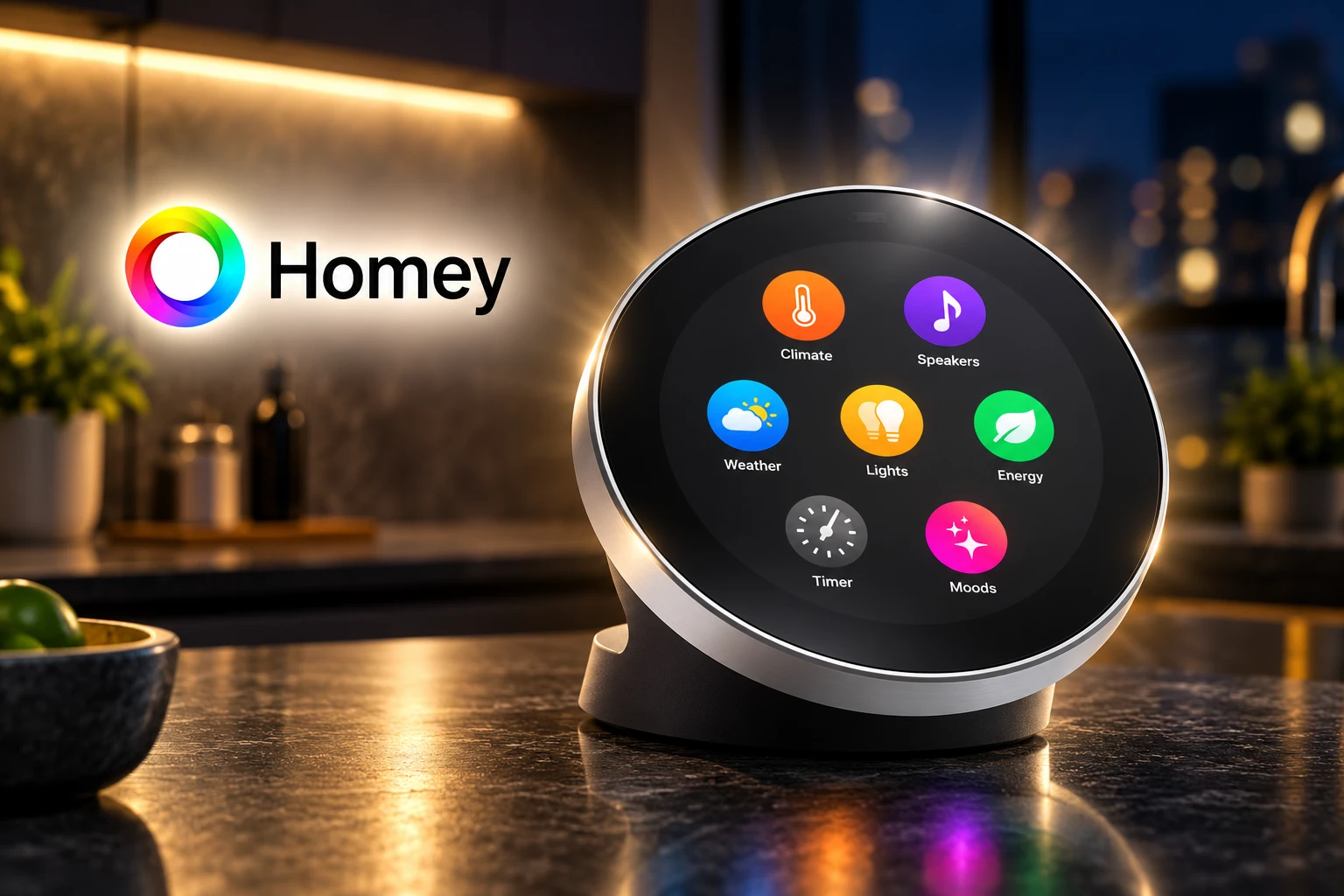
What Homey Portal Can Control
Homey assigns each Portal to one zone, such as a kitchen or bedroom, and the screen follows that room. You can pin extra shortcuts for a device in another zone, or add a second Portal if you want a dedicated panel there. One Portal talks to one Homey at a time; HomeyLink is the workaround if you run more than one system.
WHAT THE 2.8-INCH SCREEN DOES
- Lights: Tap to switch a room or a single lamp, twist brightness, drag color and warmth, then pick a Mood such as Reading.
- Speakers: Album art and track names sit on the glass, the ring sets volume, and a swipe skips the track.
- Climate: Current temperature, target and humidity share one view, orange for heat and blue for cool, with Auto, Heat, Cool or Off.
- Energy: Live wattage, import and export, solar yield and the day’s prices, if a meter feed is present.
- Timer: Presets or a twist-to-set countdown; the screen glows and the speaker beeps, and the end can start a Flow.
- Weather: A short forecast, the week’s highs and lows, and a background that follows clear, cloud or dark sky.
Homey showed a doorbell Flow that throws a live camera on the Portal and asks whether to open a smart lock. A double tap can toggle lights, start a Flow, set a Mood, or play or pause speakers. You can add pages of shortcuts and drag the icons. Homey also says you can strip the default icons for a rental and leave guests only the devices you want them to touch.
It cannot replace a thermostat. Homey’s FAQ says the Portal does not talk to a boiler, though it can drive thermostats, air conditioners and other heating gear already on Homey. If a device type is missing, Homey says support may arrive in a later update.
The Extra Hardware the Dial Depends On
Homey’s US store lists a first-batch price of $249, then $299. The box includes a desk stand that hides the cable and a wall mount with plugs and screws. People who want a custom bracket can download Homey’s free 3D reference schematic. None of that hardware radios Zigbee, Z-Wave, Thread or Matter on its own.
A five-device Homey Cloud home can add a Portal without buying a hub. Cross that cap and Homey Premium is $2.99 a month for unlimited devices, Advanced Flow, Insights, and Logic and Variables. Cloud still has no Matter, Thread or LAN support, which is why Homey keeps selling boxes.
WHAT A WORKING PORTAL ACTUALLY COSTS
| Piece | US price | What it adds |
|---|---|---|
| Homey Cloud | Free for 5 devices, then $2.99/month | App and Portal with no extra box; no Matter, Thread or LAN |
| Homey Pro mini | $249 | Local Matter, Thread and Zigbee, 1 GB RAM, Ethernet required |
| Homey Pro | $449 | Local radios including Z-Wave, infrared and 433 MHz, 4 GB RAM |
| Self-Hosted Server | $4.99/month or $149 lifetime | Homey OS on your hardware; radios need a Bridge |
| Homey Portal | $249 first batch, then $299 | The screen and ring; needs one of the rows above |
| Energy Dongle | €39 | P1 smart-meter feed for the energy view, sold in Europe |
Those hub prices already moved once this year. On June 1, Homey raised Homey Pro from $399 to $449 and Homey Pro mini from $199 to $249, and blamed RAM and eMMC costs that Raspberry Pi, which supplies a core part of Homey Pro, had passed through. Homey Pro (2026) doubled RAM to 4 GB and is sold as able to run well over 100 Homey Apps; the mini is comfortable at about 20 to 25. Homey says both 2023 and 2026 Pro units are supported until at least June 2031. An Ethernet adapter is $29. Homey Bridge, which adds Z-Wave and other radios to a mini, is $69.
Hardwired display switches from Aqara, Shelly and Brilliant try the same job in a gang box. Homey’s edge is USB-C and a claimed catalog of over 70,000 devices from more than 2,000 brands, plus Matter, Zigbee, Z-Wave and Thread on the hubs. The cost of that breadth is a second box, and sometimes a third.
LG Paid for a Seat in Every Room
Athom launched Homey in 2014 and kept the brand after the sale. LG Electronics announced in July 2024 that it had taken an 80 percent stake in Athom, with a plan to buy the remaining 20 percent within three years. Financial terms were not disclosed. Founders Emile Nijssen and Stefan Witkamp stayed as executives. Jung Ki-hyun, then executive vice president and head of LG’s Platform Business Center, put the deal in writing as a home-platform buy, not a gadget add-on.
The acquisition of Athom is a cornerstone for our AI home business
Jung Ki-hyun, executive vice president, LG Electronics press release
Homey still ships under its own name, and an official LG ThinQ app sits in the Homey App Store. The IFA floor this week is where the two brands stop pretending they are distant. LG’s August 30 release says the AI Home Zone is “powered by Homey,” and that Homey orchestrates energy generation, storage and consumption in real time by tying smart meters, solar panels, home batteries and EV chargers to LG appliances. LG says that mix can cut bills where dynamic pricing exists. Results, the footnote adds, vary with use, tariffs and local conditions.
HOW HOMEY BECAME LG’S HOME SOFTWARE
- 2014: Athom is founded in Enschede, the Netherlands, and begins shipping Homey hubs.
- July 2024: LG takes 80 percent of Athom and says it will buy the rest within three years.
- June 1, 2026: Homey raises US prices on Homey Pro and Homey Pro mini after memory and storage costs jump.
- June 29, 2026: The Connectivity Standards Alliance certifies Homey’s Matter 1.5 software on firmware 13.3.0.
- August 27, 2026: Homey ships Device Updates so Matter, Zigbee and Z-Wave gear can be patched inside Homey.
- August 30, 2026: LG opens IFA with an AI Home Zone that names Homey as the energy orchestrator.
- September 1, 2026: Homey opens Portal preorders and posts the desk-and-wall controller to its own account.
Closed-source Homey is the plug-and-play foil to Home Assistant, which remains open source under the Open Home Foundation. That contrast still holds. The new fact is that the “independent” Dutch hub is also the software LG put in front of solar, storage and car charging in Berlin.
How the Energy Screen Gets Its Numbers
Homey’s Portal page treats energy as a first-class view, not a buried settings page. You can watch wattage move as devices switch, see today’s import and export, check solar yield, and read the current rate plus cheaper hours. That pane is the consumer version of the IFA demo, shrunk to a disc you can hang beside a kettle.
WHAT THE ENERGY VIEW NEEDS
- A meter feed: Homey says the view requires a Homey Energy Dongle or a third-party smart meter.
- Cloud catch: On Homey Cloud, Premium is required unless you use a Homey Energy Dongle.
- Dongle price: Homey sells the Energy Dongle for €39 and plugs it into a European P1 port, with a built-in splitter for a second reader such as an EV charger.
- US gap: The English-US storefront says the dongle is not available in that country; Homey lists the Netherlands, Belgium, Luxembourg, Denmark, Hungary, Sweden, Finland, Austria, Switzerland, Lithuania, Germany and Slovenia.
Matter 1.5 is the other energy door. Homey’s software component was certified on June 29, 2026, for Homey Pro (2023 to 2026), Homey Pro mini and Homey Self-Hosted Server. Homey’s own Matter list now includes EV chargers, solar panels, heat pumps, water heaters and major kitchen and laundry appliances, on top of lights, locks and sensors. Homey Pro and the mini include Thread Border Routers. Self-hosted setups need a Thread Border Router already on the LAN.
A US buyer can still hang the Portal and twist lights. The wattage tile LG is demonstrating in Berlin wants a European meter dongle Homey will not ship to that US address, or some other meter Homey already talks to. Device-level power from smart plugs can fill part of the gap. Whole-home import, export and solar yield cannot, unless the meter path exists.
Firmware Leaves the Maker’s App Behind
Four days before the Portal went up for preorder, Homey told customers they could update Matter, Z-Wave and Zigbee devices from Homey, without opening the manufacturer’s app or rejoining its hub. Matter firmware comes from the Connectivity Standards Alliance’s Distributed Compliance Ledger, independent of any Homey app. Z-Wave and Zigbee updates ride inside each brand’s Homey app, so a silent manufacturer still means a silent device.
Updates are manual. Homey patches one device at a time to keep meshes stable, and you can queue several, except sleepy battery gadgets. There is no downgrade path. Devices added on the basic Z-Wave or Zigbee driver get no files. Homey Pro and Self-Hosted Server need version 13.2.0 or later, and the mobile app needs 9.10.0 or later.
BRANDS ALREADY SENDING UPDATES THROUGH HOMEY
- Lighting and dimmers: IKEA, INNR, EcoDim, Namron and Nous.
- Sensors and Z-Wave specialists: Aeotec, Zooz, frient, ThirdReality and HeatIt.
- European electrical brands: Niko, Inovelli, amina and CTM Lyng.
Homey says more brands are coming. Until they do, Device Updates is a catalog feature, not a universal one. The direction is still the same as the Portal: keep maintenance, energy and daily control inside Homey so the manufacturer hub becomes optional. A wall dial that can dim a Hue lamp and, later, push a lock patch is how that argument leaves the phone.
Three Rooms Add Up Fast
Homey wants a Portal per zone. At the post-intro $299, three rooms are $897 in screens, before a $449 Homey Pro or a $249 mini. First-batch math is kinder at $747 for three dials, then the hub on top. Cloud at $2.99 a month is the cheap way in, until you want Matter, Thread or a house that still answers when the WAN drops. Local control is the reason Homey still sells Pro hardware, and the Portal inherits that rule: compatible local devices keep running, and the dial can still command them, if the brain is a hub on the LAN.
A $249 disc that is not a hub will feel dear next to a $20 smart switch, and that complaint showed up in replies to Homey’s own launch post within the hour, next to people ready to pay on sight. The screen is closer in spirit to a Nest Hub than to a $30 in-wall keypad, yet it refuses the speaker-and-mic extra that turns those displays into assistant speakers. Homey is selling focus. The price assumes you already value the Homey software enough to put another paid object on the plaster.
Orders ship first come, first served, and Homey says they are expected to go out before the end of 2026. You can cancel a preorder any time before it ships for a full refund. Homey is on the IFA floor in Berlin this week with the dial, while LG’s hall next door is running the energy house that Homey software is meant to drive. The Portal is the piece you can hang at eye level. The company that paid for Athom is the one that needs that eye-level wattage to look as obvious as a light switch.

Instagram Plus Tests a Read-Only Mode That Cuts Stories

Altman Asks the Public to Accept Some AI Harm

Google Freezes OSS VRP Product Reports After AI Flood

AI Agents Make Payment Rails the Scarce Prize

Turkey’s Crypto Boom Now Runs Through Three Banks

Fable 5 Came Back Under a Commerce On-Off Switch

Google’s SpaceX GPU Lease Has a Sept. 30 Deadline

Plasma One’s XPL Locks Face a 1.81 Billion Cliff

DGO’s Rs 549 World Cup Pass Cost Fans Sleep and Data

Moonshot AI’s $30 Billion Ask Became a $35 Billion Close
-
 AI4 months ago
Fable 5 Came Back Under a Commerce On-Off Switch
-
 AI5 months ago
Google’s SpaceX GPU Lease Has a Sept. 30 Deadline
-
 CRYPTO4 months ago
Plasma One’s XPL Locks Face a 1.81 Billion Cliff
-
 APPS5 months ago
DGO’s Rs 549 World Cup Pass Cost Fans Sleep and Data
-
 AI5 months ago
Moonshot AI’s $30 Billion Ask Became a $35 Billion Close
-
 NEWS5 months ago
ColorOS 17 Device List Spans Oppo, OnePlus and Realme
-
 GAMING4 months ago
The RTX 4050 Under Rs 70,000 Hides a Wattage Gap
-

 AI4 months ago
Boris Cherny’s Loops Still Demand a Higher Production Bar