
NEWS
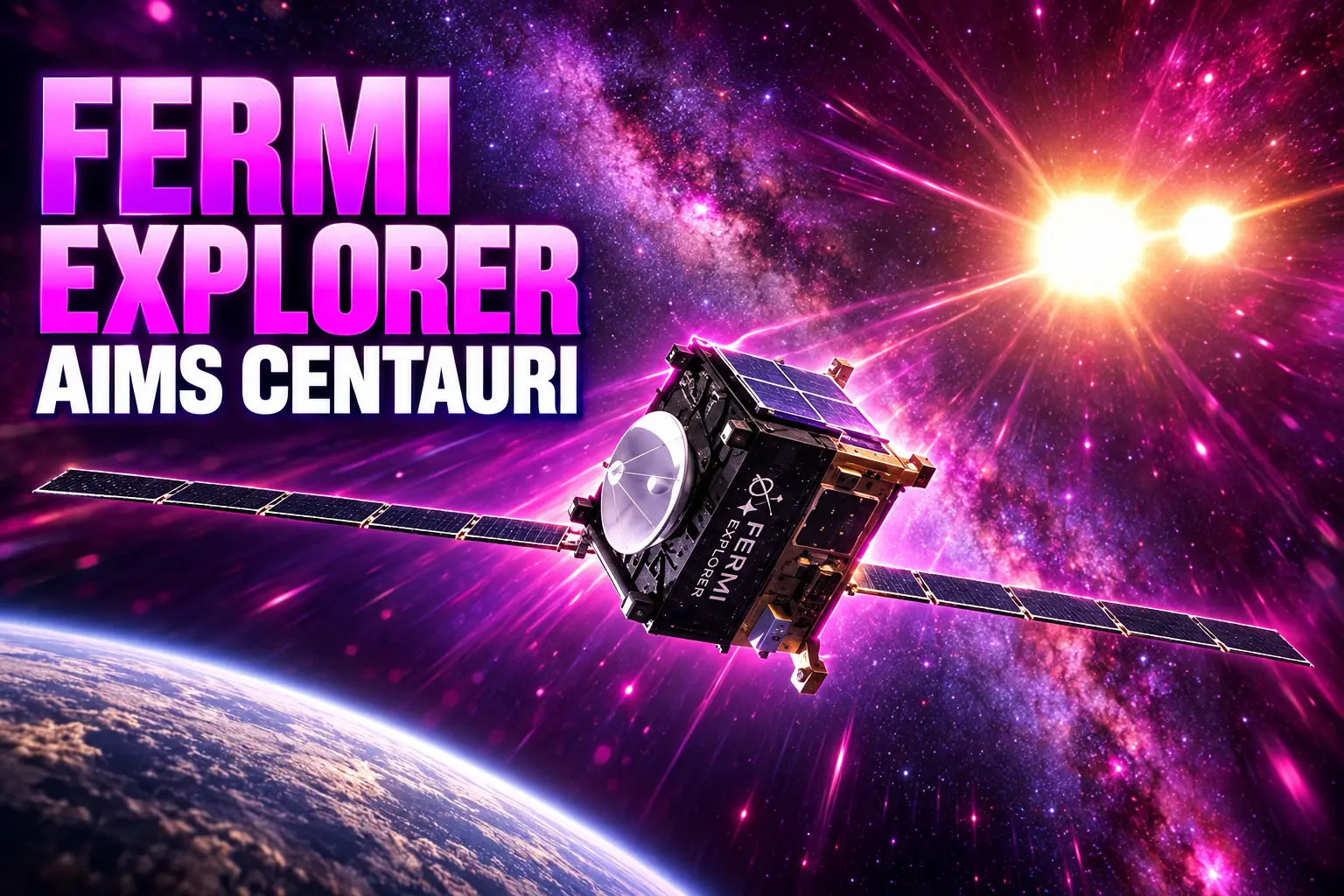
Fermi Explorer Aims a Silent Probe at Alpha Centauri
The Fermi Explorer mission would launch a $15 million probe at Alpha Centauri in 2029 and go silent for 80,000 years.

The Fermi Explorer Mission wants to launch a 1-kilogram probe at Alpha Centauri in 2029, on an 80,000-year coast, for less than $15 million.
If the Redmond, Wash., nonprofit hits that date, the craft would be the first human-built object aimed at another star, and the sixth to leave the solar system. Radio contact is planned for about 18 months. After that the box goes dark on purpose.
Four Objectives, Then the Radio Goes Quiet
Philip Johnston, Adi Oltean, and Ezra Feilden, the three Starcloud cofounders, formed the Fermi Explorer Mission as a 501(c)(3) with program manager Garrett Jameson, a former U.S. Air Force officer. Starcloud builds orbital data centers. In August it closed a $250 million round at a $2.3 billion valuation, with Nvidia among the backers. The nonprofit says the two outfits will stay separate.
Johnston posted the unveil on Tuesday with a concept film and a request for partners, cash, and payloads.
Did you know that humanity has never launched a spacecraft to another star? That is about to change! I'm super excited to share that my cofounders, @AdiOltean, @EzraFeilden, and I, have created a non-profit to attempt to send humanity’s 𝗳𝗶𝗿𝘀𝘁 𝘀𝗽𝗮𝗰𝗲𝗰𝗿𝗮𝗳𝘁 𝘁𝗼… pic.twitter.com/OYcM1MtUiu
— Philip Johnston (@PhilipJohnston) September 1, 2026
The public bar is four lines, and the group calls them the four primary objectives for the flight. Everything else, including gravity assists and the radio, is negotiable.
THE MINIMUM VIABLE STAR MISSION
| Rule | Bar |
|---|---|
| Aim | Reach at least 99% of the way to Alpha Centauri within 80,000 years |
| Payload | At least 1 kg in a 10 x 10 x 10 cm volume |
| Schedule | Launch before the end of 2029 |
| Cost | Under $15 million to design, build, launch, and operate |
Alpha Centauri’s barycenter sits 4.4 light-years away. Closest pass is meant to fall within 0.044 light-years of that point, inside the system’s Oort cloud, around the time the stars cross the ecliptic in about 79,500 years. By then the craft would sit just over 6 light-years from the Sun, because the target is moving away. The team’s preferred intercept is about 77,500 years, which it says uses the least fuel.
Johnston has told interviewers the probe is, in essence, a xenon tank, solar panels, and a few small payloads. He put radio contact at about 18 months. Ground telescopes, using retroreflectors on the bus, might follow it as far as Jupiter. The FAQ is blunter: the satellite will be too small to track and will lose power once it leaves the solar system.
That mute interval is the design. Other interstellar concepts try to finish inside a human life, which forces giant propulsion programs. “We have very deliberately picked 80,000 years as the minimum viable mission,” Johnston said.
Starshot’s $100 Million Plan Never Left Earth
Five probes are already on solar-system escape paths: Pioneer 10 and 11, Voyager 1 and 2, and New Horizons. None was aimed at a chosen star. Pioneer 10 is heading toward Aldebaran. Voyager 1 is bound for a distant pass of Gliese 445 in about 40,000 years. Jameson noted that Voyager 2’s closest stellar approach is about 4.3 light-years, roughly how far Alpha Centauri is from us now.
Voyager 1 entered interstellar space on August 25, 2012, at about 122 astronomical units, or 18 billion kilometers from the Sun. Voyager 2 followed on November 5, 2018. They are still the only craft known to operate outside the heliosphere. Fermi Explorer would be a sixth escapee, and the first sent on purpose toward another sun.
The last well-funded try at that first was Breakthrough Starshot, announced in 2016 by Yuri Milner with Stephen Hawking and Mark Zuckerberg on the board. The idea was a ground laser array pushing gram-scale sails to 15 to 20 percent of light speed, reaching Alpha Centauri in 20 to 30 years. Milner pledged $100 million for research and put a full mission at $5 billion to $10 billion.
Physicist Philip Lubin, whose roadmap fed the concept, later estimated the program had spent about $4.5 million. In 2025, executive director Pete Worden wrote that the effort was “on hold” and that portions were being moved to others. Johnston has said he got excited, then disappointed, and that this is why Fermi Explorer exists. “We are hell-bent on actually launching something in three years,” he said.
TWO BETS ON THE SAME STAR
| Item | Breakthrough Starshot | Fermi Explorer |
|---|---|---|
| Announced | 2016 | September 1, 2026 |
| Money | $100 million pledged, about $4.5 million spent | Cap of $15 million, now fundraising |
| Method | Phased lasers on gram-scale sails | Solar-electric xenon and perihelion burns |
| Travel time | 20 to 30 years at 15-20% of light speed | About 77,500 to 80,000 years at ~24-25 km/s |
| Status | On hold as of 2025 | Vendor search for a 2029 rideshare |
The cheap path is slower than every working probe we already flew. Voyager 1 still recedes at about 16.9 km/s. Fermi Explorer’s planned heliocentric cruise, about 24 to 25 km/s after the burns, is faster than that, and still a crawl next to a light-sail. Relative to Alpha Centauri at arrival, Johnston has put the fly-through at 17.9 km/s, about 25% quicker than New Horizons at Pluto.
A Perihelion Pump From a Cambridge AI Lab
The favored bus is a small solar-powered satellite of about 100 to 200 kilograms. A U.S. manufacturer that has flown more than 50 missions has already bid under $15 million. The board will pick a builder on track record, price, and schedule. Oltean and Feilden did the early planning with teams at Astro Digital and AstroForge.
The trajectory that makes the budget close came from Physical Superintelligence, a Cambridge, Mass., lab run by Alex Wissner-Gross and Matthew Pines. The nonprofit says this may be the first time generative AI has independently devised a novel path that will actually be flown. The lab’s July technical feasibility assessment carries a plain warning: it did not go through comprehensive human peer review.
The trick is a perihelion pump. After a rideshare, the craft would drop its closest solar approach from 1 astronomical unit toward about 0.42 AU, then fire its ion thrusters at each close pass, where sunlight is strong and the Oberth effect adds the most speed. A geostationary transfer orbit start needs about 4.24 km/s to escape Earth. A low Earth orbit start needs about 7.6 km/s over roughly 1.5 years. After about 12 years of pumping, the vehicle would leave on a ballistic coast.
PSI’s own test case was harsher than the public slogan: a 1 kg payload to within 2,600 AU of Alpha Centauri in 500,000 years, from LEO, with no gravity assists, for under $10 million. Trajectory class holds on solar power. The 100 kg concept does not close from LEO in the runs they published. It closes from GTO at 100 kg, or at about 150 kg from LEO with thin margins. Aiming can stay open-loop. Tolerance is about 0.41 degrees, or 168 m/s of velocity error, with no last correction at the star.
THE FLIGHT AS PLANNED
- July 2026: PSI files the feasibility report that sets the perihelion-pump profile.
- September 1, 2026: The nonprofit opens the door to donors, vendors, and payloads.
- Coming months: A U.S. bus maker is chosen; three-month calls go out for science and art.
- By the end of 2029: Rideshare to GTO (preferred) or LEO.
- About 12 years after launch: Repeated sun-skimming burns, then solar-system escape at roughly 24-25 km/s.
- About 77,500 years: Closest planned pass, within a few thousand AU of the Alpha Centauri barycenter.
The cost page is less tidy than the slogan. PSI’s median program cost sits at $15.7 million to $16.6 million, with essentially no chance of $10 million under ordinary aerospace practice. Launch ($1.0-1.3 million) and propulsion ($0.6-1.2 million) come in under the $3 million slots. The overrun sits in the bus, operations, and margin, about $12 million against $3 million set aside. The $15 million public cap is already the tight number, not a fat one.
WHERE THE MONEY PINCHES
- Median bill: PSI puts a conventional build at $15.7 million to $16.6 million.
- The $10 million case: Near-zero odds if the program is run like a normal smallsat.
- Launch and thrusters: Both land well under their $3 million lines in the model.
- The gap: Bus, operations, and program margin, about $12 million against $3 million allocated.
Advisers include Rob Meyerson, former president of Blue Origin and now chief executive of Interlune, and Jeff Thornburg, a former SpaceX propulsion lead who runs Portal Space Systems. “I believe in Philip as a leader, and big ideas like this need to be tried,” Meyerson said. Wissner-Gross, AstroForge chief executive Matthew Gialich, and Astro Digital chief executive Chris Biddy are on the list as well.
What Fits in the 10-Centimeter Cube
The 1 kg, 10-centimeter box is the only payload the four rules require. Some of that volume is reserved for donors, instruments, and art. Scientists are told, in so many words, that most sensors will not deliver results for around 80,000 years. Artists are told the work will not be seen again for the same span. A panel of academics and space people will pick the science. An art panel is still to be named.
WHAT THE CUBE IS MEANT TO HOLD
- A Golden Record copy: Digitized and micro-etched, after the Voyager discs that carry 115 images and greetings in 55 languages.
- Corner-cube retroreflectors: A few grams of fused silica for laser ranging from a few AU to tens of AU, with a possible spin-rate glint if the cubes sit off-center.
- Children’s lines: 300 characters, in each country’s own language, gathered through education ministries and national space agencies, using Olympic-style country lists.
- Open calls: Three months each for science and art that do not break the four rules, plus whatever a $1 million donor can fit in a 3 cm cube.
Johnston has described other candidate sensors, including a cosmic-ray detector and an interstellar dust catcher. He does not plan to wake the craft at the far end. “If a dinosaur bone can last 200 million years, then a metal box can easily survive the radiation environment we expect for 50,000 years,” he said. “We don’t plan on powering spacecraft up at the end of the 80,000 years. We hope that a future human civilization will intercept it.”
It’s basically 12 years of autonomy, and then after it’s left the solar system, then it’s just going. Everything powers down, and it just goes.
Philip Johnston, co-founder and president, Fermi Explorer Mission
That is how the data comes home, in his telling: someone later catches the box. New spacecraft, he notes, have historically had about a 50% chance of full success. The team thinks flight-proven parts raise the odds, and still tells donors to assume 50%.
Names, Gems, and a Copy of the Golden Record
Because 80,000 years is a long wait for a fund, the mission is built on gifts, not a round. A $1 donation puts a name on a supporter list. From there the prices climb onto the metal.
HOW A NAME GETS ON THE BOX
- $10, Asteroidal: Name on the official site as a mission supporter.
- $100, Lunar: Two sets of initials in a small engraving on the satellite.
- $1,000, Planetary: Two full names in a small engraving.
- $1,000,000, Universal: A 3 x 3 x 3 cm object, 3,375 times the $10 class, such as a family gem, plus a 2 x 2 cm image and two names.
Johnston and Jameson will take calls from the press, scientists, and anyone considering more than $100,000. The Golden Record homage is the one payload they have already promised to fly if the rest of the stack closes. Voyager’s discs were never meant to phone home either. Carl Sagan’s line still sits on NASA’s page: the record is played only if some other spacefaring culture finds the hardware.
The tracking hole is the same one a careful reader hits on day one. Once the solar panels quit and the bus is a few tens of AU out, Earth has a dead mass on a computed heading. Laser returns from a few grams of glass do not follow it to another star. The nonprofit has already written that down. Anyone treating “aimed at Alpha Centauri” as a claim that will be checked in our lifetime is reading a different mission than the one on the site.
Two Great Filters, Ticked Without a Reply
The name is Enrico Fermi’s. The FAQ walks through the usual split: maybe minds like ours are rare, maybe they do not last, maybe they stay quiet. A “great filter” would sit at some hard step, behind us or ahead. Two candidates ahead are that a species cannot leave for nearby stars, or that every species chooses not to.
Launch, in this telling, ticks both. After Fermi Explorer, the group says, we can be more sure that leaving is not resource-prohibitive, and that at least one species has tried. The paradox then sharpens toward rarity or a short life for intelligent worlds, which, they argue, should change how we act now. The logic does not need a photo from Alpha Centauri. It needs a stack that leaves.
They picked Alpha Centauri over Proxima because the pair of sun-like stars puts out about 2,000 times Proxima’s energy, a better camp for whoever comes later. They will not aim at where the star sits in tonight’s sky. Over tens of thousands of years it drifts northwest; the aim point in 80,000 years is the patch where Cancer is now. Johnston stood in Chile’s Atacama Desert on July 14, 2026, for a 20-second exposure by Alexis Trigo, pointing at the star inside a circle that marks that 0.044-light-year miss.
Later Ships Will Find a Cold Box
Johnston has said he expects Fermi Explorer to be first out and last in. Faster ships will pass it. That is not a bug in the plan. A magnetic sail riding the solar wind, as some already sketch, could overtake a 25 km/s coast long before the 77,500-year mark. The team even argues that mass-first cargo, including some von Neumann-style ideas, might still arrive after this one, because this path spends fuel on payload, not haste.
So the object they want to hang in the sky is a marker, a first heading, and a metal page for names and children’s sentences. It is also a bet that a $15 million rideshare and an ion pump can do what a $100 million laser program did not: leave. The 80,000-year mute is what makes the bet small enough to try. It is also what makes the arrival unverifiable for everyone who writes the check.
The board still has to pick a manufacturer, raise the money, and book a ride before the end of 2029. Donations start at $1. The star in that Atacama frame will have slid into another constellation long before anyone now alive can know whether the box stayed on course.

Instagram Plus Tests a Read-Only Mode That Cuts Stories

Altman Asks the Public to Accept Some AI Harm

Google Freezes OSS VRP Product Reports After AI Flood

AI Agents Make Payment Rails the Scarce Prize

Turkey’s Crypto Boom Now Runs Through Three Banks

Fable 5 Came Back Under a Commerce On-Off Switch

Google’s SpaceX GPU Lease Has a Sept. 30 Deadline

Plasma One’s XPL Locks Face a 1.81 Billion Cliff

DGO’s Rs 549 World Cup Pass Cost Fans Sleep and Data

Moonshot AI’s $30 Billion Ask Became a $35 Billion Close
-
 AI4 months ago
Fable 5 Came Back Under a Commerce On-Off Switch
-
 AI4 months ago
Google’s SpaceX GPU Lease Has a Sept. 30 Deadline
-
 CRYPTO4 months ago
Plasma One’s XPL Locks Face a 1.81 Billion Cliff
-
 APPS4 months ago
DGO’s Rs 549 World Cup Pass Cost Fans Sleep and Data
-
 AI4 months ago
Moonshot AI’s $30 Billion Ask Became a $35 Billion Close
-

 NEWS4 months ago
ColorOS 17 Device List Spans Oppo, OnePlus and Realme
-

 GAMING4 months ago
Xbox Cuts 3,200 Jobs After Five Years of Thin Returns
-

 GAMING4 months ago
The RTX 4050 Under Rs 70,000 Hides a Wattage Gap