
NEWS
Xiaomi’s Own Chip Lands While Apple Argues Over Color
Xiaomi’s 18 Fold puts a 3nm Xring O3 in a wide foldable on September 7, while Apple still cannot lock iPhone 18 Pro colors and Poco now asks flagship money.

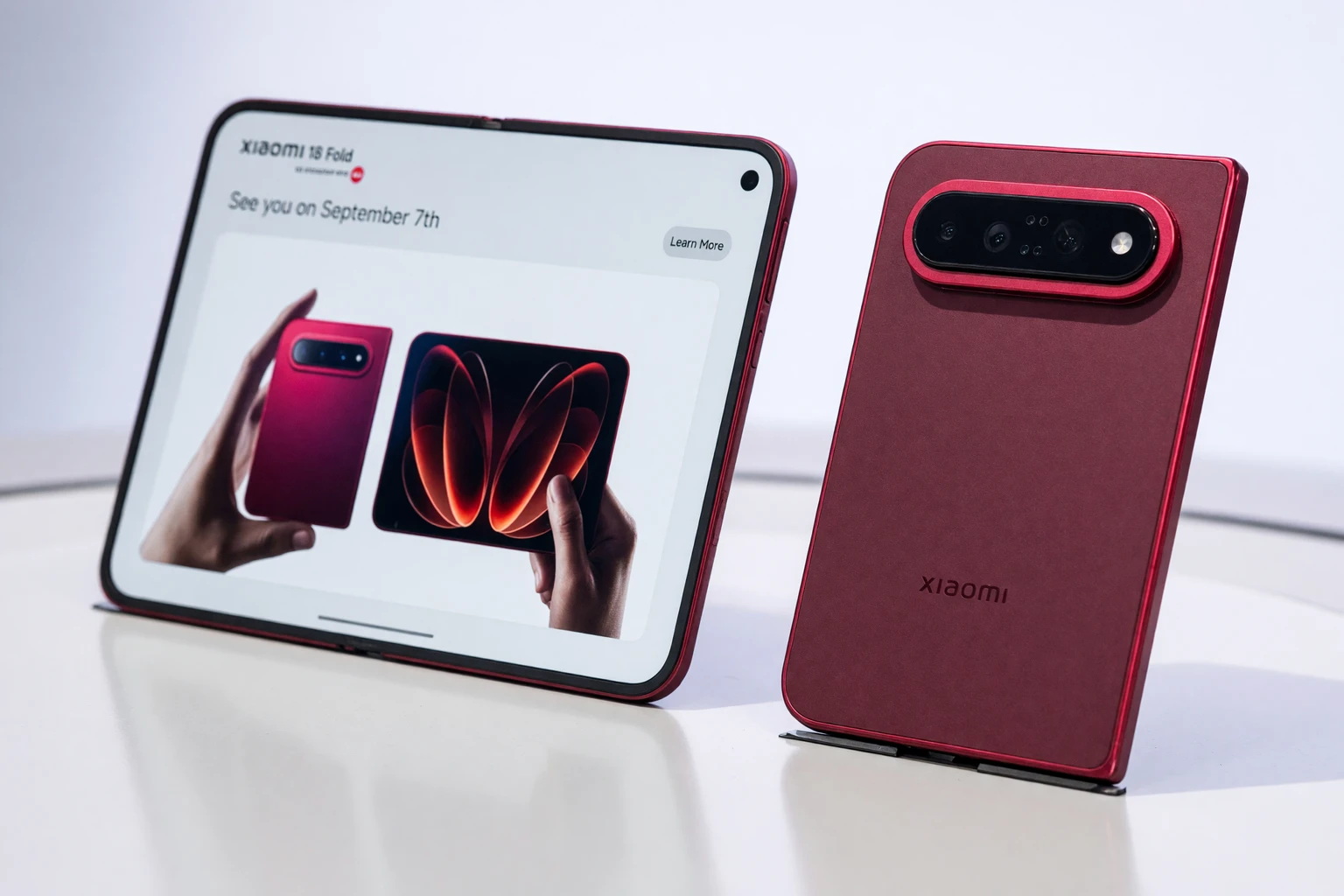
Xiaomi set September 7 to launch the 18 Fold in China with its own 3nm Xring O3 chip. The foldable is the first phone to ship with ChangXin Memory Technologies LPDDR6, and it showed up at IFA in Berlin days earlier in a cherry red finish.
Apple still has not locked iPhone 18 Pro colors ahead of its special Apple Event on September 9. Poco, for its part, already sells a Dark Cherry Ultra from £709.
The week split along that line. Apple held the rumor cycle with three finish names. Xiaomi, Poco, Oppo and vivo put silicon, sensors and batteries on the table, and the cheap-flagship pitch took the hit.
Xiaomi Puts a Homegrown Chip in a Wide Foldable
The 18 Fold is Xiaomi’s first inward-folding phone with a short, wide body, a 5.38-inch cover and a 7.58-inch inner panel. Hardware on the IFA floor pointed to a Leica triple camera with a 17mm to 80mm run on the bar, a redesigned hinge, a 6,000mAh battery and 67W wired charging. Global availability is still unknown. China is the market that gets it first, alongside the Pad 9 Pro Max, which uses the same chip.
The interesting part is not the hinge. Xring O3 is built on TSMC N3P, skips an O2 generation, and is the first mobile SoC designed to talk to LPDDR6. Xiaomi had the chip on the floor in Berlin. The China event is set for 7 p.m. local time on September 7.
Xring O3 Pairs With Chinese LPDDR6
Under the hood the O3 uses Arm C1 cores, the same CPU IP already in MediaTek’s Dimensity 9500, in a ten-core layout with no small efficiency cores. Graphics come from a 16-core Arm G2-Ultra NX. Xiaomi quotes an AnTuTu score of 5.22 million, which would be the first phone chip past five million, and it rates the GPU 85% ahead of the Xring O1 while drawing 64% less power.
THE XRING O3 ON PAPER
- The die: 24 billion transistors on a 133 mm² N3P part, with two C1-Ultra cores at 4.35 GHz, four C1-Premium at 3.68 GHz and four C1-Pro at 3.15 GHz.
- The memory: a 96-bit controller running LPDDR6-10667, about 113.8 GB/s, which is 48% more bandwidth than the Xring O1.
- The AI block: 200 INT8 TOPS and a claimed 45% lift in on-device work, with eight NX neural accelerators on the GPU.
- The caveat: every GPU figure is measured against Xiaomi’s own previous chip, and no one outside the company has run a retail unit yet.
Geekerwan’s analysis puts the O3 at Snapdragon 8 Elite Gen 5 performance at roughly half the power, past the Dimensity 9500 on both speed and draw, and close to Apple’s A19 on the CPU side. Treat the AnTuTu total as a launch number. The efficiency work is the harder claim to wave away.
CXMT said on Weibo that it had started mass production of LPDDR6 and that Xiaomi’s 18 Fold would be first in line. Xiaomi confirmed the plan on its own account. The memory arrived less than a year after CXMT mass-produced LPDDR5. In its first half as a listed company, CXMT posted revenue of 150.3 billion yuan ($22.36 billion), up 874% from a year earlier.
SK Hynix had said it would begin LPDDR6 mass production in the second half of 2026, with Xiaomi named as a first customer. Samsung has an LPDDR6 part of its own. CXMT still beat both to a named shipping phone, even if its parts run at 10,667 MT/s, under the 14,400 MT/s spec ceiling, with Xiaomi quoting speeds up to 12,800Mbps at IFA.
The Foldable Is Short, Wide and China-First
The shape sits in a pack that already includes the wider Galaxy Z Fold 8 and, if leaks hold, Apple’s first foldable. After the IFA photos landed, the argument that followed was not about memory bandwidth. It was whether a wide Android foldable on a Berlin show floor had copied a phone Apple has not put on a stage. The Z Fold 8 already ships, and it does not share that silhouette.
THE DATES THAT SPLIT THE WEEK
- August 24, 2026: Xiaomi unveils Xring O3 and says development took 459 days.
- August 29, 2026: CXMT and Xiaomi confirm LPDDR6 for the 18 Fold.
- September 1, 2026: Poco launches the F9 Pro and F9 Ultra for global markets.
- September 3, 2026: the 18 Fold appears in the flesh at IFA, inside Xiaomi’s 3,300 square meter booth among more than 380 products.
- September 7, 2026: Xiaomi holds the China launch for the 18 Fold and Pad 9 Pro Max.
- September 9, 2026: Apple streams its Surprise and shine event at 10 a.m. PT.
- September 10, 2026: the vivo T5 5G goes on sale in China at CNY 1,999 ($280).
Sustained speed inside a foldable’s thermal budget is still an open question. Peak charts do not answer it. For a company that sells tens of millions of phones a quarter, a first-wave in-house 3nm part in a China-only foldable is still a statement about who gets to ship new memory first.
The Price of a Poco Flagship
Poco unveiled the F9 Pro and F9 Ultra on September 1, and the spec sheet is unapologetic. Both phones use 185Hz AMOLED panels, 200MP main cameras, 100W wired and 50W wireless charging, IP68, ultrasonic in-display fingerprints and Bose-tuned speakers. The Ultra is the louder one. It adds a dedicated rear subwoofer for a 2.1-channel setup, a notification light around that speaker, an 8,050mAh battery and a 6.9-inch panel.
UK list prices start at £799 for the Pro and £899 for the Ultra, about $1,217 at Poco’s own conversion on the top phone. Early-bird cuts those to £639 and £709. That is not the Poco of a few generations ago. The phones are the global versions of the Redmi K100 Pro and K100 Pro Max, and they are not coming to the United States.
POCO F9 UK PRICING AND HARDWARE
| Model | Display | Battery | Chip | UK list | Early bird |
|---|---|---|---|---|---|
| F9 Pro | 6.59-inch 185Hz | 6,330mAh | Snapdragon 8 Elite Gen 5 V | £799 | £639 |
| F9 Ultra | 6.9-inch 185Hz | 8,050mAh | Snapdragon 8 Elite Gen 5 | £899 | £709 |
The Ultra’s UK spec sheet lists a 185Hz ultra-bright AMOLED display, a 200MP f/1.68 main camera with OIS, a 50MP 5x periscope at 120mm, a 50MP ultrawide, LPDDR5X at 9,600Mbps and UFS 4.1. Poco quotes peak brightness at 10,000 nits and high-brightness mode at 2,200 nits. About 20 games can hit 185fps, helped by a 12nm VisionBoost D8 chip that handles super resolution, frame insertion and game HDR. The company’s own labs posted an AnTuTu score of 4,165,108 on the Ultra, well short of Xiaomi’s 5.22 million claim for Xring O3.
The Pro uses a binned Snapdragon 8 Elite Gen 5 V with a weaker GPU, swaps the 5x periscope for a 50MP 2.5x telephoto that can focus from 10cm, and drops the ultrawide to 8MP. It keeps Bose tuning but loses the subwoofer and the rear light. Aurora Green on the Pro can glow in the dark after it sits in sun or indoor light. The Ultra comes in Black and Dark Cherry, the same wine-red name Apple’s leakers have been attaching to iPhone 18 Pro for months.
Poco kept last year’s Snapdragon 8 Elite Gen 5 family instead of jumping to a newer part, a choice that tracks with the memory squeeze already pushing the base iPhone 18 skipping September. The hardware still reads as a full flagship. The brand name on the box is what no longer does.
iPhone 18 Pro Colors Are Still Unsettled
Two days before Apple’s event, the Pro palette is still a fight between leakers. Fixed Focus Digital said the iPhone 18 Pro had entered full mass production in Dark Cherry, Sky Blue and Black, and that Silver would most likely not be offered. Sonny Dickson then posted SIM trays that look like Silver, Dark Cherry and Sky Blue, with no black in the shot. Dummy units earlier in the year had shown four finishes at once: Dark Cherry, Light Blue, Black and Silver.
iPhone 17 Pro shipped in Silver, Deep Blue and Cosmic Orange, with black missing from that lineup. Dark Cherry is the one name that has survived every leak, a wine-like red-purple meant to replace Cosmic Orange as the hero finish. Sky Blue is the quiet one, almost silvery. Black versus Silver is the leftover argument, and it will not be settled in a Weibo comment.
WHAT WE KNOW
- The event: Apple’s invite is titled Surprise and shine, streamed on September 9 at 10 a.m. PT from Apple Park.
- The hero color: Dark Cherry appears in dummy units, SIM trays and supply-chain notes, and Poco is already selling a phone under that name.
- The Pro window: the 18 Pro and Pro Max are the iPhones due this September, with the regular model widely expected to wait.
WHAT IS UNCONFIRMED
- The third finish: Black and Silver are both still in play, and the leakers who usually agree do not agree here.
- The count: three colors or four, depending on which dummy set and which tray photo you trust.
- The foldable: a foldable iPhone Ultra design is expected on the same stage, which is why every wide Android foldable is being read as a preview or a copy.
Color is the thing Apple can still move in public without showing a board or a sensor. That is why Dark Cherry is outrunning Xring O3 in the posts people actually share. It is also why Poco putting that name on a £899 Ultra lands as a poke. The finish is already in shops. The iPhone that is supposed to own it is still a tray photo.
Why Samsung May Drop a Telephoto
Samsung’s next Ultra is months away, and the camera rumor from this week is a subtraction. The tipster phonefuturist said Samsung is testing a 4x “super telephoto” with a 1/1.9-inch sensor for Galaxy S27 Ultra, a single zoom that would replace the 3x plus 5x pair. CAD layouts for the new plateau appear to leave room for only one telephoto in the pill next to the main sensors.
On Galaxy S26 Ultra, the 5x camera uses a 1/2.52-inch sensor and the 3x uses a 1/3.94-inch unit. A 1/1.9-inch 4x would be larger than both, and larger than the 1/2.55-inch-class 4x on iPhone 17 Pro. One leak puts the new module at 50MP. Another older dump of import records still showed two telephotos on S27 Ultra prototypes, so the cut is not locked.
The same tipster said Samsung is weighing the bigger sensor against its bill of materials. If the quality jump is thin, the 5x periscope can stay. A 4x with more glass to gather light is the bet that portraits and night zoom care about more than a printed 5x badge. The phone is still about six months out. Prototype tests are not a camera app.
Camera Islands That Swallow the Back
While Samsung talks about removing a lens, Oppo and vivo are making the camera block the entire rear story. Leaked renders of the Oppo Find X10 Pro Max, shared by Fixed Focus Digital, show a wide plateau stretching across the back with a raised square module inside it. Blue and white Hasselblad-branded finishes are in the set, the white one with a two-tone, textured rear and LUMO lettering on the island.
Digital Chat Station has described a triple 200MP array as a world first: a 200MP main around 1/1.3-inch, a 200MP ultrawide, and a 200MP periscope around 1/1.28-inch, plus a 3MP multispectral sensor for color. Oppo has also tested a cheaper 50MP ultrawide, so the full 600MP back is not a signed spec sheet. Rumors put a 2nm Dimensity 9600 Pro, an 8,000mAh-class battery, ColorOS 17 on Android 17 and a China debut later in September.
The vivo X500 Pro Max showed up in an alleged photo and hands-on video with a circular island even larger than the X300 Ultra’s, and a rotating outer ring with ISO-style markings that may be physical camera controls. The expected stack is a 50MP 1/1.28-inch main, a 200MP 1/1.4-inch telephoto and a 50MP ultrawide. Vivo has already confirmed 4K at 240fps for the Pro series.
FOUR CAMERA BETS ON THE TABLE
- Poco F9 Ultra: 200MP main, 50MP 5x periscope, 50MP ultrawide, shipping now with 8K30 video.
- Galaxy S27 Ultra: a tested 4x unit on a 1/1.9-inch sensor that would retire the 3x and 5x pair.
- Oppo Find X10 Pro Max: three 200MP cameras behind a plateau, Hasselblad badged, still a leak.
- vivo X500 Pro Max: a huge round island with a rotating ring, and a 200MP telephoto next to a 1/1.28-inch main.
Apple’s week, by contrast, was a dispute about whether the third iPhone 18 Pro finish is black or silver. The backs of the Android phones are turning into the product. The glass, the ring, the plateau and the subwoofer light are doing the work a new color used to do.
Samsung’s Next Ultra Tablet Keeps MediaTek
A Geekbench 7 listing for a Wi-Fi Galaxy Tab S12 Ultra, model SM-X940, showed MediaTek’s Dimensity 9500 rather than a Snapdragon. The unit had 12GB of RAM and Android 17, and it scored 2,760 single-core and 9,291 multi-core. Clocks match the standard 9500, not a Plus: one core at 4.21 GHz, three at 3.50 GHz and four at 2.70 GHz.
A comparable Tab S11 Ultra result with the Dimensity 9400 Plus and the same 12GB of RAM scored 2,281 and 8,005. That is about 21% higher in single-core and 16% in multi-core, with the caveat that the new listing is on Android 17 and the old one is on Android 16. Samsung is expected to unveil the Tab S12 Ultra with the Tab S12+ later this month. Carryover rumors still point to a 14.6-inch panel, an 11,600mAh battery and 45W charging.
MediaTek holding Samsung’s biggest tablet is a quiet win in a week of louder camera islands. Snapdragon still owns Poco’s new pair. Xiaomi is trying to leave both of them in a foldable. The tablet listing just confirms Samsung is not using this refresh to switch camps.
At the other end of the same week, vivo’s T5 5G went official with a 6.67-inch 120Hz AMOLED, a Snapdragon 6 Gen 4, a 7,000mAh battery, 90W charging, a 50MP main camera, IP65 and OriginOS 6 on Android 16. It starts at CNY 1,999 ($280) for 8GB/256GB and goes on sale in China on September 10. That phone and the £899 Poco Ultra are both “Android flagships” only if the word has no meaning left.
On September 9 Apple will put the Pro colors on a stage. The 18 Fold will already have been a launch product in China for two days, and Poco’s Dark Cherry Ultra will already have been on sale for eight.


Companies Froze Job Design and Called AI a People Problem

Xiaomi’s Own Chip Lands While Apple Argues Over Color

Pixel 11 Trails Galaxy Phones That Last as Long

Tecno Camon Slim 5G Repeats Artist Colors on New 5G Hardware

Bushel Finds Farm AI Living in the Office

AI Made Feature Moats Cheap and Left Trust Standing

OpenAI’s Research Intern Arrives With a Warning Attached

Robinhood Prices XRP Into a Two-Cent 9 a.m. Bet

Japan’s First Atom Quantum Computer Runs on Infleqtion’s QPU

Pride and Soul Follows Konami’s Locked 2026 Core Formula

Oracle Cuts 21,000 Jobs in a Year, Cites AI in 10-K Filing

Fable 5 and Mythos 5 Return as US Lifts Anthropic Export Controls

SpaceX’s Google Deal Turns a Rocket Company Into a Cloud Landlord

CD Projekt Red Co-CEO: Redemption Arc Isn’t Done, Witcher 4 in 2027

XPL Rallies 30% Ahead of Plasma One Card Tier Launch

Google Search Profiles Build a Follow Graph Inside Discover

DGO App Brings Rs 549 Mobile Pass for FIFA World Cup 2026 in Nepal

Moonshot AI Targets $30 Billion in China’s Fastest AI Funding Sprint

Oppo’s ColorOS 17 Eligibility List Leaves A-Series Buyers Behind

Microsoft Xbox Layoffs Start in July as Sharma Slams 3% Margin
-
 AI3 months ago
Oracle Cuts 21,000 Jobs in a Year, Cites AI in 10-K Filing
-
 AI2 months ago
Fable 5 and Mythos 5 Return as US Lifts Anthropic Export Controls
-
 AI3 months ago
SpaceX’s Google Deal Turns a Rocket Company Into a Cloud Landlord
-
 GAMING3 months ago
CD Projekt Red Co-CEO: Redemption Arc Isn’t Done, Witcher 4 in 2027
-
 CRYPTO3 months ago
XPL Rallies 30% Ahead of Plasma One Card Tier Launch
-
 NEWS3 months ago
Google Search Profiles Build a Follow Graph Inside Discover
-
 APPS3 months ago
DGO App Brings Rs 549 Mobile Pass for FIFA World Cup 2026 in Nepal
-
 AI3 months ago
Moonshot AI Targets $30 Billion in China’s Fastest AI Funding Sprint