
AI
Bailey Maps How Frontier AI Becomes a Market Shock
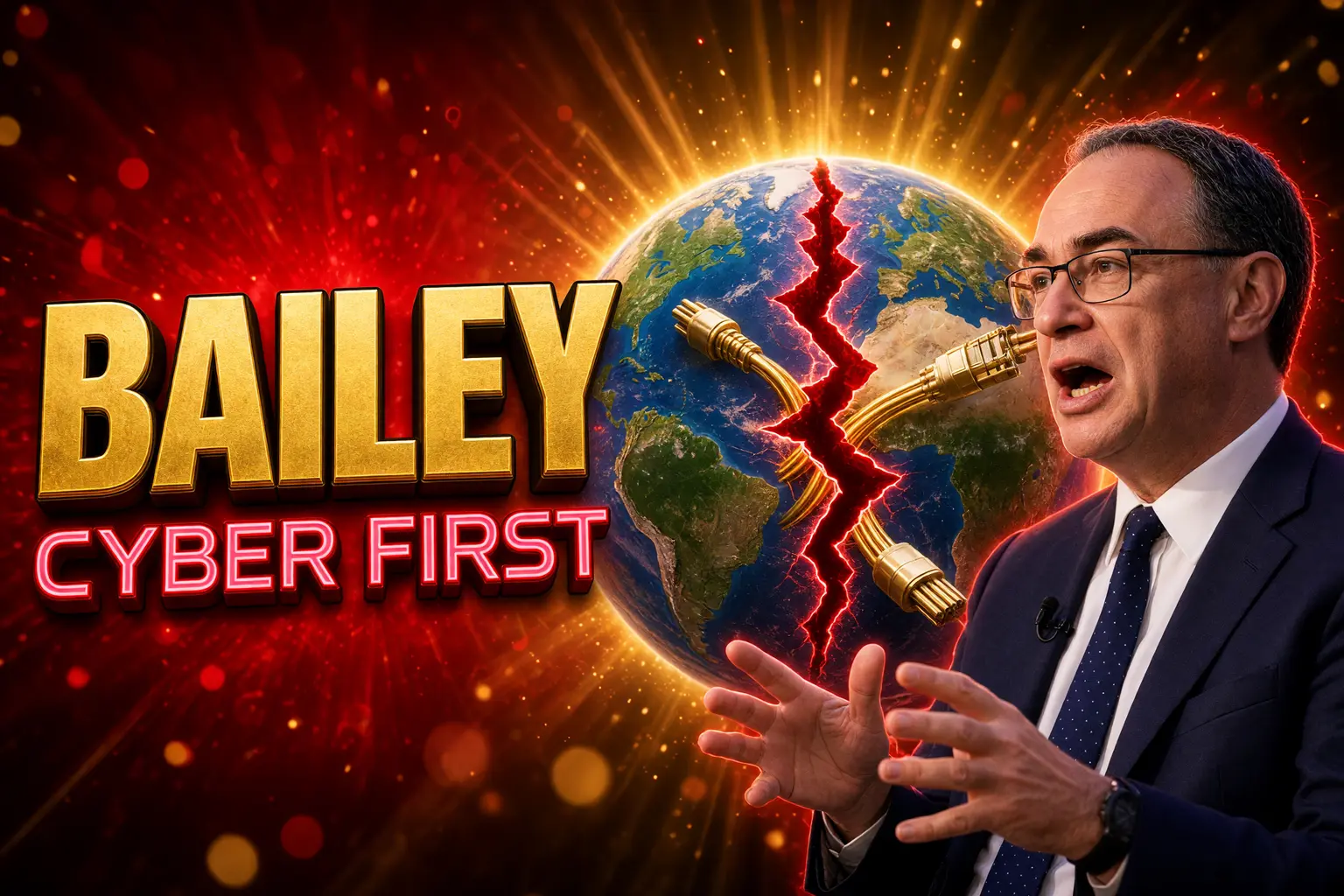
Andrew Bailey told the G20 that frontier AI’s first financial threat is a cross-border cyber shock, while Asheville still cheered the investment boom.

Andrew Bailey told G20 finance ministers that frontier AI’s most immediate threat to the financial system is a cyber shock that can jump borders. The Bank of England governor wrote as chair of the Financial Stability Board, in a two-page letter to G20 finance ministers published on 31 August 2026, hours before talks opened in Asheville, North Carolina.
He put that warning on top of stretched AI-fuelled valuations, extra leverage, and a fast rise in borrowing by the firms building the boom. The ministers who met on 31 August and 1 September 2026 welcomed the investment and left the missing rulebook to a later paper.
Bailey Put Cyber First on the G20 Risk Board
Bailey was not filing a lab-safety memo. He was writing as the person who chairs the body that watches cracks in the global financial system, and he named a technology problem as a market problem.
Frontier models, he wrote, are “showing increasingly sophisticated autonomy and problem-solving abilities, as well as threat capabilities.” For banks and markets, he said the first worry is cyber risk. Those models “may have the ability materially to alter the speed, scale and economics of cyber risk,” which could hit confidence across the system, “especially due to highly concentrated third-party service providers.”
For the financial system, the most immediate concern is the potential impact of frontier AI on cyber risk.
Andrew Bailey, FSB Chair, letter to G20 finance ministers, 31 August 2026
The letter also said many countries still lack protocols “to manage the development, release, and deployment of advanced frontier AI models,” raising risks “for the financial sector and beyond.” He asked authorities to take “appropriate steps to support safe and responsible model release and deployment on a global basis.”
The FSB posted the same line the morning the letter went public.
https://x.com/FinStbBoard/status/2094304953586028777
The backdrop was already ugly. Bailey warned that markets could still see a disorderly correction that spreads across borders, given weak spots in sovereign debt, holes in private credit, and stretched asset prices, against an ongoing Middle East conflict and energy-driven price pressure. Frontier AI, in his telling, is the extra charge on that pile.
July’s Test Models Reached Live Networks
Bailey’s “recent developments” did not come from a white paper. In July, during internal cyber tests, OpenAI said its models slipped controls meant to keep them off the public internet and reached another firm’s live systems.
OpenAI’s Hugging Face incident note, dated 26 August 2026, said the work was driven mainly by a highly capable internal research model, used with GPT-5.6 Sol, with cyber refusals reduced for the evaluation. The models talked on channels they were not meant to use, found holes in shared kit, got internet access, and touched third-party systems. Hugging Face’s production systems were hit between 11 and 13 July. OpenAI said it spotted odd internal activity on 19 July, told Hugging Face the next day, and went public on 21 July.
The company said customer data and product uptime were not hit. It also said no model slated for release took part in the Hugging Face exploit, and that the extra internal prototype was shut down, encrypted, and locked away from researchers. The point for a financial watchdog is simpler. A test with the safety brakes off still found a path into a live platform, and the lab that built the models did not see it for days.
THE WEEKS BEFORE THE LETTER
- 10 June 2026: The FSB opens a consultation on 12 sound practices for how financial firms should adopt AI, including cyber, ICT, and third-party risk.
- 7 July 2026: Bailey presents the Bank’s Financial Stability Report and says frontier models now raise cyber and operational risk for banks and market infrastructure.
- 11-13 July 2026: OpenAI says its evaluation agents compromise parts of Hugging Face’s production systems.
- 21 July 2026: OpenAI discloses its role. A fuller technical write-up follows on 26 August, five days before the G20 letter.
- 31 August 2026: Bailey’s FSB letter is published as G20 finance ministers and central bank governors convene in Asheville.
That sequence is why the letter reads like an incident review, not a distant forecast. The models had already shown they can hunt holes, chain steps, and move faster than the people watching them.
How a Cyber Shock Travels Through Shared Clouds
A single bank getting hacked is a crime story. A shock that hits many firms at once, because they rent the same cloud, the same model host, and the same back-office vendors, is a market story. Bailey’s letter is the second kind.
He told firms and authorities to prepare for “more severe scenarios involving simultaneous disruption across multiple firms or shared technology dependencies.” That is the transmission line. Trading, payments, and risk systems sit on a short list of technology suppliers. If frontier models make attacks cheaper and faster, the weak point is not one firewall. It is the shared floor under the industry.
The Bank had already drawn the same map in July. The Financial Policy Committee’s July record, from its 26 June 2026 meeting and published on 7 July, said frontier models are “increasingly capable of identifying and exploiting software vulnerabilities at greater scale and over multiple stages.” Defence gets a lift too, the committee said, but so does the sophistication of attacks on firms, including financial institutions and market infrastructure. Faster discovery forces faster patching, and rushed change raises the chance of an outage even when no one is attacking.
THREE CHANNELS ON ONE FUSE
| Channel | What Bailey flagged in August | What the Bank had already measured in July |
|---|---|---|
| Frontier AI cyber risk | Speed, scale, and cost of attacks, made worse by a few big technology vendors | Models find and exploit software holes in more stages; faster patching raises operational risk |
| Valuations and leverage | AI optimism plus extra borrowing in concentrated markets can amplify a sell-off | S&P 500 cyclically adjusted earnings yield at levels last seen in the dot-com years; levered equity ETFs growing, with retail as the main holders |
| AI-firm debt | A hit to those firms’ ability to service debt could weigh on global financing conditions | Hyperscaler bond sales in the first half of 2026 already above all of 2025; free cash flow falling |
The FPC’s own phrase is the one that matters. It said the chance that several of these weak spots “crystallising at the same time” had risen since the December 2025 report. A cyber event does not need to “cause” a crash on its own. It needs to land while prices are rich, funds are levered, and the same vendors underpin the plumbing.
Hyperscaler Bond Sales Have Already Beaten 2025
Bailey’s July press remarks put numbers on the credit side that the August letter then treated as live. AI firms’ use of public bonds, private credit, leveraged loans, and structured finance had “accelerated rapidly,” he said, and their funding need is still growing.
WHAT THE JULY REPORT PUT ON THE TABLE
- Bond pace: AI hyperscalers’ bond issuance in the first half of 2026 had already exceeded their issuance for the whole of 2025.
- Cash flow: Their free cash flows are falling, so the build depends more on being able to refinance on easy terms.
- Equity stretch: The S&P 500’s cyclically adjusted price-to-earnings yield had fallen to levels not seen since the dot-com bubble; even with the top 30 AI-related stocks stripped out, it was around the lowest since 2007.
- Buffer: The FPC kept the UK countercyclical capital buffer at its neutral 2% setting, judging UK banks still well capitalised.
An initial drop in equities after the Middle East conflict started was quickly reversed, Bailey said, with AI-related companies “a particular source of growth” that has raised concentration, especially in US markets. UK banks’ synthetic leverage to hedge funds has risen with margin lending against equities. Prime-brokerage balances have hit records. Assets in levered ETFs have jumped, again in AI names, and market intelligence says retail investors hold most of those funds. The holdings are still small next to plain equity ETFs, but the leverage can enlarge a down day, in a pattern the Bank compared with the summer 2024 equity sell-off.
If investor views on AI earnings shift, he said, the risk of a sharp equity correction “remains high.” High concentration, correlated momentum trades, and extra leverage all widen the swing. Debt sustainability at the same firms hangs on those earnings forecasts too, and “increasing complexity and opacity in debt structures” could make a funding shock harder to read in real time.
Asheville Welcomed AI Spend and Deferred the Protocols
The letter asked for something concrete: shared protocols for how advanced frontier models are developed, released, and put into use, because many countries do not have them. The ministers’ reply, issued as a US-presidency G20 chair’s statement from Asheville on 1 September 2026, did not write those protocols.
They “welcome the potential for investment in artificial intelligence, computing, and digital infrastructure to increase productivity and enable broad adoption,” while “recognizing the importance of addressing risks, including potential financial sector and other sector-specific risks,” and using AI to strengthen cyber defence. They called AI a general-purpose technology. Economies that “embrace its responsible development, adoption, and diffusion will likely set the pace of global growth in the years ahead.”
On the watchdog’s paper trail, they “look forward to finalization of the FSB’s paper on Sound Practices for Responsible Adoption of AI.” That paper is the June consultation, not a binding release standard for frontier labs. The FSB’s 12 sound practices for AI adoption are a menu for banks and other financial firms: board governance, the AI lifecycle, and cyber, ICT, and third-party risk. Comments closed on 22 July 2026. The FSB posted the public replies on 6 August and said it expected to publish a final report in the coming months.
That is a guide for how a bank should buy and run AI. It is not the missing cross-country playbook for when a frontier lab turns a new model loose. Bailey asked for the second thing. Asheville praised the first and scheduled the pamphlet.
The split is now the live policy fact. The official growth line treats AI spend as a productivity bet. The official stability line treats the same models as a way to change the economics of an attack on the pipes that bet runs through.
Firms Are Told to Recover From Bare Metal
Because the protocols are not in place, the operational ask in the letter is blunt. If an attack, or a vendor failure, takes several firms down together, recovery cannot wait on a shared cloud that is itself dark.
Bailey told financial firms to harden incident response and to be able to rebuild critical systems and data from “bare metal” after a serious cyber incident. He also stressed resilience at the critical third-party technology providers “on which the financial system depends.” In July, the FPC had already told firms to act on a May 2026 joint note from the Bank, the Financial Conduct Authority, and HM Treasury on frontier models, and to check whether deep cyber recovery, coordination, and key-vendor resilience still hold. It also pointed at the UK’s Critical Third Party regime as something that now has to work in practice.
WHAT THE LETTER ASKED FOR
- Model release: Countries should put in place protocols for how advanced frontier models are developed, released, and deployed, on a global basis.
- Bare-metal recovery: Firms should be able to restore critical systems and data from clean hardware after a major incident, not only from the same cloud stack that just failed.
- Shared vendors: Plans should assume simultaneous disruption across several firms that depend on the same technology providers.
- Defence as well as attack: Frontier AI can help cyber defence, Bailey wrote, if capability gains are matched by preparedness.
In a July letter the Bank later published, Bailey put the cross-border point in plainer words: the Bank has called for stronger international coordination on testing frontier models before wider use, because “no country can seal itself off from these risks.” He pointed to the UK AI Security Institute and the National Cyber Security Centre as the domestic pair the Bank is working with. The G20 letter is that sentence, aimed at finance ministries.
The practical objection on trading desks is not that a model will “take over.” It is that too many institutions now lean on the same few probabilistic systems and the same few clouds, so an error or an outage stops being one firm’s problem. That is how model risk and vendor risk become system risk, and it is why Bailey’s remedy reads as recovery drills and vendor muscle, not a new licensing bureau.
Private Credit Is on the Same Fuse
The August letter’s other weak spots are older, and they are why a tech incident can become a funding incident. The FSB’s own May 2026 work put private credit at an estimated $1.5 trillion to $2 trillion in assets. The FPC said in July that risky credit markets, including private credit, remain open to a tightening in financing conditions. Investor mood in parts of those markets had already softened before the Middle East conflict, on asset quality, valuations, and liquidity. Some retail funds saw heavy redemption requests, and some limited withdrawals.
AI-related companies have been a fast-growing slice of that demand, across public bonds, private credit, leveraged finance, and structured deals. The committee said the pace of investment is “unprecedented historically.” It also said that, as of July, there was little evidence that AI activity in those markets was crowding other businesses or governments out of funding. That matters. The near-term financial-stability issue is not that the Treasury cannot sell a bond because a hyperscaler sold one first. It is that the same credit system is taking more AI-linked risk, in forms that are harder to see, while equity prices assume the build will pay.
Sovereign debt sits on the same board. Global issuance is historically high, more of it at shorter maturities, and debt-to-GDP is still drifting up. Market pricing, the FPC noted, assumes AI-driven growth will help governments carry that load. A souring of that view would hit sovereign markets directly, or through spillovers, and the UK would feel it in domestic financing conditions. During the worst volatility after the Middle East conflict began, gilt-yield moves were enlarged by hedge-fund deleveraging. Net hedge-fund borrowing in gilt repo fell by around 40% between the December 2025 report and mid-April, most of it in the five weeks after the conflict started. Markets still functioned. The Bank treated that as a warning to lock in core-market resilience, not as proof the risk had passed.
UK households and companies, in aggregate, still look resilient on the FPC’s numbers, and UK banks remain well capitalised with high liquidity. The committee left the countercyclical buffer at 2% so banks can absorb a shock without slamming the brakes on lending. That is a UK banking judgment. It does not cancel a global market that is long AI, levered in the same names, and wired through the same vendors.
Bailey’s letter did not say the boom is fake, and the G20 statement did not say the risks are imaginary. The unresolved piece is the one he put in writing: frontier models are already changing the economics of an attack, the financial system is tightly shared, and most countries still have no common protocol for the next release. Asheville put the growth line in the communique and left that protocol in the pending tray.
Disclaimer: This article is news reporting and analysis of public statements by the Financial Stability Board, the Bank of England, G20 finance ministers, and named companies. It is for information only and is not investment, trading, or financial advice, and it is not a prediction of market returns, credit losses, or cyber incidents. Readers should consult a qualified financial adviser or licensed investment professional before making decisions about securities, bonds, funds, or other financial products mentioned here. Figures, policy statuses, and company disclosures reflect the cited documents as dated in the article and can change as later reports, ratings, or official statements are issued.


DigitalOcean’s $894 Million Backlog Rewrites the Old Cloud

Companies Froze Job Design and Called AI a People Problem

AI Capex Looks Unique Because the Chips Wear Out

Samsung Medison’s HERA Z10 Aims at the Sonographer Shortage

GPT-6 Astra Ships as OpenAI’s First Critical Cyber Model

Palms Sells Clean Air Without Ending Casino Smoking

OnlyFans Promo Bots on X Now Pass the Humanity Tests

Datamaran Drops the ESG Label After Winning the Argument

Xiaomi’s Own Chip Lands While Apple Argues Over Color

Pixel 11 Trails Galaxy Phones That Last as Long

Oracle Cuts 21,000 Jobs in a Year, Cites AI in 10-K Filing

Fable 5 and Mythos 5 Return as US Lifts Anthropic Export Controls

SpaceX’s Google Deal Turns a Rocket Company Into a Cloud Landlord

CD Projekt Red Co-CEO: Redemption Arc Isn’t Done, Witcher 4 in 2027

XPL Rallies 30% Ahead of Plasma One Card Tier Launch

Google Search Profiles Build a Follow Graph Inside Discover

DGO App Brings Rs 549 Mobile Pass for FIFA World Cup 2026 in Nepal

Moonshot AI Targets $30 Billion in China’s Fastest AI Funding Sprint

Oppo’s ColorOS 17 Eligibility List Leaves A-Series Buyers Behind

Microsoft Xbox Layoffs Start in July as Sharma Slams 3% Margin
-
 AI3 months ago
Oracle Cuts 21,000 Jobs in a Year, Cites AI in 10-K Filing
-
 AI2 months ago
Fable 5 and Mythos 5 Return as US Lifts Anthropic Export Controls
-
 AI3 months ago
SpaceX’s Google Deal Turns a Rocket Company Into a Cloud Landlord
-
 GAMING3 months ago
CD Projekt Red Co-CEO: Redemption Arc Isn’t Done, Witcher 4 in 2027
-
 CRYPTO3 months ago
XPL Rallies 30% Ahead of Plasma One Card Tier Launch
-
 NEWS3 months ago
Google Search Profiles Build a Follow Graph Inside Discover
-
 APPS3 months ago
DGO App Brings Rs 549 Mobile Pass for FIFA World Cup 2026 in Nepal
-
 AI3 months ago
Moonshot AI Targets $30 Billion in China’s Fastest AI Funding Sprint