
AI
Tesla Is Building Factories to Justify an AI Multiple
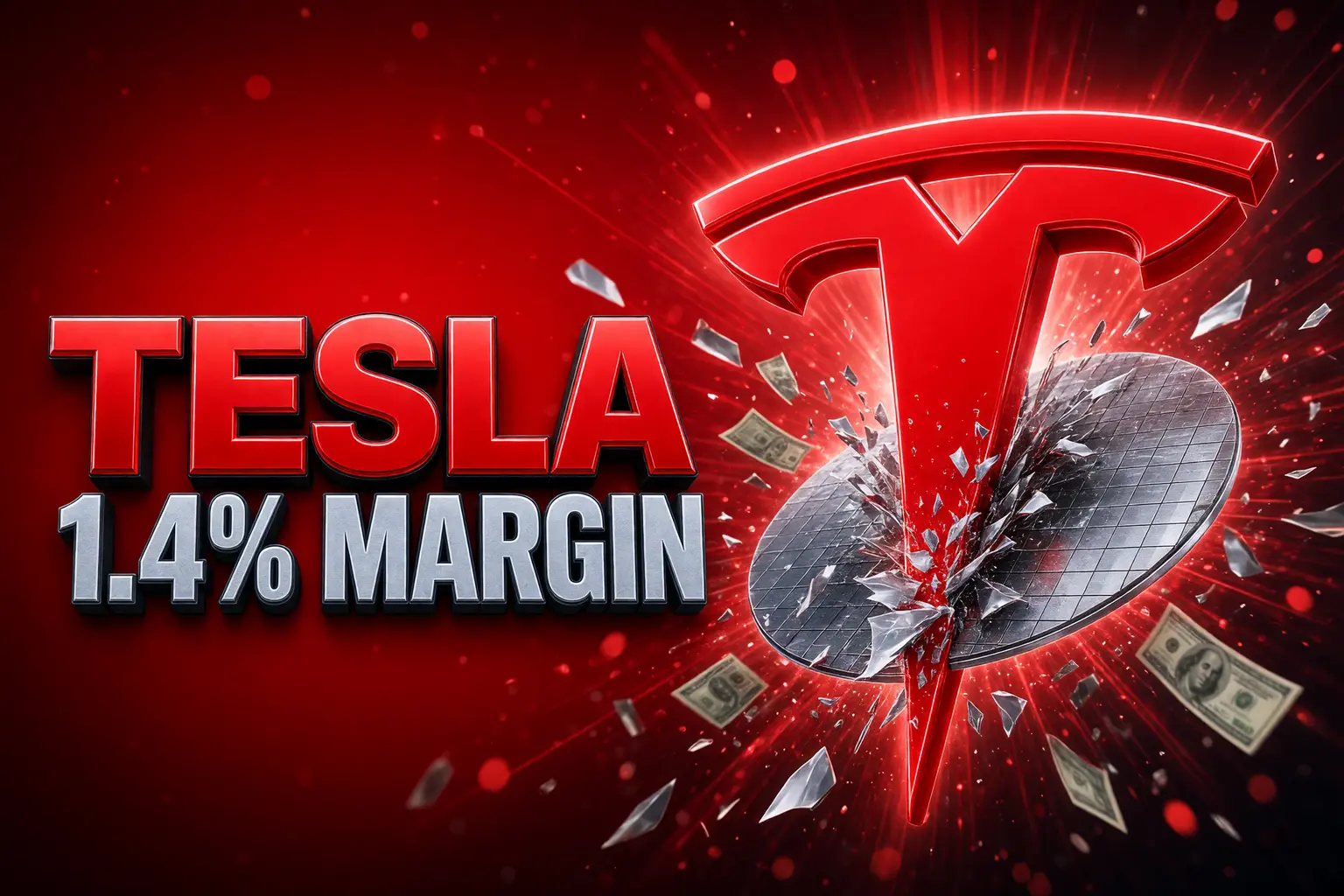
Tesla wants an AI-company multiple while Q2 margins hit 1.4% and capex heads above $25 billion, with Robotaxi miles still rolling on Model Ys.

Tesla is asking investors to pay a software price for a company that now spends like a chip plant. At $354.08, the stock trades at about 369 times trailing earnings, while the car-and-battery business just posted a 1.4% operating margin and burned $1.09 billion of free cash.
Elon Musk is selling Robotaxi, the Optimus robot, in-house AI chips, and a Texas fab as the next Tesla. The bills for that pitch already show up as factories, foundry contracts, and a credit line the size of a small auto group.
Q2 Sold More Cars and Made Far Less
The second quarter was a volume win and a profit loss at the same time. Tesla delivered a record 480,126 vehicles, up 25% from 384,122 a year earlier, and booked $28.24 billion in revenue, up 26% from $22.50 billion. Income from operations still fell 57% to $398 million, and the operating margin of 1.4 percent compared with 4.1% in the year-ago quarter.
TESLA Q2 2025 VS Q2 2026
| Metric | Q2 2025 | Q2 2026 | Change |
|---|---|---|---|
| Total revenue | $22.50 billion | $28.24 billion | +26% |
| Operating income | $923 million | $398 million | -57% |
| Operating margin | 4.1% | 1.4% | -269 bp |
| Capital spending | $2.39 billion | $5.79 billion | +142% |
| Free cash flow | $146 million | -$1.09 billion | n/a |
| Active FSD subscriptions | 0.95 million | 1.48 million | +56% |
GAAP earnings were $0.32 a share on $1.11 billion of net income. Non-GAAP earnings were $0.33. Operating cash flow of $4.70 billion could not cover $5.79 billion of capital spending, so free cash flow flipped from a $146 million inflow to a $1.09 billion outflow. Cash, cash equivalents, and short-term investments ended the quarter at $43.52 billion, down $1.22 billion from the first quarter.
The one line that already looks like software is Services and Other. That book rose 50% to $4.58 billion and posted record gross profit of $648 million at a 14% margin, helped by 1.48 million active Full Self-Driving subscriptions, up 56% from 0.95 million. Energy storage deployments rose 41% to 13.5 GWh. Those are real attach rates on a real fleet. They are also a rounding error next to a year of spending guided above $25 billion.
1 Million Unsupervised Miles, Almost All on Model Ys
On September 3 in Austin, Ashok Elluswamy, Tesla’s vice president of AI, told a Cybercab launch crowd the fleet had reached 1 million miles of unsupervised Robotaxi operation. On the July 22 earnings call he had given 380,000 miles and “zero notable incidents.” The new total adds 620,000 miles in 43 days, after Tesla pulled in-car monitors from most markets outside the San Francisco Bay Area.
The car on the poster did little of that driving. Registration records after the launch listed 45 Cybercabs and 375 Model Y robotaxis in Texas, and the two-seat cab only entered paying service that week. Unsupervised miles are rolling in Austin, Dallas, Houston, Miami, Orlando, and Tampa. The Bay Area service still runs with a safety driver under a California charter permit. Phoenix and Las Vegas sit in “preparations.”
ROBOTAXI CITIES TESLA LISTS NOW
- Texas: Austin, Dallas, and Houston are ramping unsupervised rides on the existing Model Y fleet.
- Florida: Miami, Orlando, and Tampa joined in July and are also ramping without a driver in the seat.
- California: The San Francisco Bay Area remains a supervised FSD service under permit TCP0046782-A.
- Next up: Phoenix and Las Vegas are listed as preparations, not live service.
Tesla’s own deck already listed Cybercab at Giga Texas with installed annual capacity above 125,000 and a status of Production, with the usual warning that installed capacity is not the current build rate. Public Cybercab rides in Austin then produced hour-plus waits and fares that ran above an unsupervised Model Y taxi, which is what a two-seat novelty does in its first weekend, not what a network does when it has to fund a chip plant. The company still put the AI-safety claim at the center of the launch.
https://x.com/Tesla/status/2095647989637263684
Musk spent the following days on the hardware. He wrote that the Cybercab motor uses no rare earth metals while holding range, and that the factory system that makes the cab is unlike any other automotive line. Those are manufacturing boasts. They are also the point: the robotaxi Tesla wants priced as software is being born as a new kind of plant.
What Tesla’s $25 Billion Capex Year Buys
CFO Vaibhav Taneja told analysts Tesla expects capital spending above $25 billion in 2026, with the outlay rising further in the second half and growing for two or three more years. The June 10-Q repeats the same floor and ties it to AI compute, data centers, manufacturing lines, and a larger fleet of company-operated AI-enabled assets. First-half capex was already $8.28 billion, against $3.89 billion a year earlier. Property, plant, and equipment jumped to $47.26 billion on June 30 from $40.64 billion at year-end 2025.
Near-term silicon does not even come from Tesla’s own fab. In July 2025 Musk confirmed a $16.5 billion Samsung deal running through 2033 so the Taylor, Texas, foundry can make Tesla’s AI6 chip, and he wrote that $16.5 billion was “just the bare minimum.” AI5, taped out in April 2026, is slated for volume in 2027 across Samsung and TSMC. Tesla’s Q2 update said construction and equipment buying for an Austin development fab were under way so the company can iterate chip designs on site.
The larger bet is Terafab, the Tesla and SpaceX plant headed to Grimes County, Texas, with an initial phase the companies put at about $16.8 billion. School-district papers tied to the site list a construction start around December 1 and completion by the end of 2028. Until that building makes wafers, Tesla remains a huge foundry customer that is also pouring concrete for a foundry of its own. Cortex 2, the Texas training cluster, is already listed above 115 MW and in production, after Tesla said it more than doubled on-site compute in Texas in the first half.
That is vertical integration as a cash cycle, not as a margin story. Each chip generation has to be designed, taped out, yielded, qualified for cars and robots, and then paid for again at the next node, while the stock is priced as if the software layer were already the business.
Fremont’s Old Luxury Line Is an Optimus Shop
The humanoid program is the same pattern in a different hall. Tesla decommissioned the Model S and Model X lines at Fremont and, in the Q2 update, said it was installing first-generation Optimus lines with production “soon” and “anticipated later this year.” First units go to Optimus Academy for training data, not to outside customers. Both the California and Texas Optimus rows still showed status Construction, with no capacity number attached.
Musk has described the Fremont hall as sized toward 1 million robots a year and a later Texas line toward much higher output, and he has also said the ramp will be slow because the machine has on the order of 10,000 unique parts. Prediction-market contracts on an Optimus release by December 31 have been trading in the low single digits, which matches a factory that is still being tooled rather than a product that is shipping.
FROM EARNINGS TO THE AUSTIN LAUNCH
- July 22, 2026: Tesla reports 380,000 unsupervised Robotaxi miles, $5.79 billion of quarterly capex, and full-year spending above $25 billion.
- August 6, 2026: Tesla and SpaceX name Grimes County for Terafab and put the first phase at about $16.8 billion.
- September 3, 2026: Elluswamy announces 1 million unsupervised miles as Cybercab enters limited public service in Austin.
Three dates, one direction. The AI products move from slide to shop floor, and each step is a construction schedule.
Who Pays If Robotaxi and Optimus Stay Slow?
Shareholders are paying the multiple. The cash on the balance sheet is paying the invoices, for now. Tesla still held $15.22 billion of cash and $28.31 billion of short-term investments on June 30, against $9.08 billion of principal debt and $5.00 billion of unused committed credit. That is a fortress only if spending stays inside operating cash. Taneja already said it will not.
Capex will grow for the next two or three years as we expand our Robotaxi fleet, expand our production capacity for Optimus, make investments for semiconductor fab, install solar manufacturing capacity, and AI compute infrastructure, in addition to all the other expansions we’ll do for other manufacturing for automotive.
Vaibhav Taneja, Chief Financial Officer, Q2 2026 earnings call
He added that Tesla is “being opportunistic” in securing debt facilities with capacity to borrow up to $30 billion to accelerate those investments. A company with $43.52 billion of cash arranging a $30 billion borrow is saying the plan is larger than the cash engine. Trailing twelve-month operating cash flow is about $18.7 billion. A year above $25 billion of capex, with two or three more years of growth after that, is a structural cash drain unless Robotaxi fares, FSD attach, energy, or robot sales step up in a way the P&L has not shown.
FSD subscribers are the quiet third party. The 1.48 million paid accounts, split in the call commentary between upfront purchases and monthly plans, are funding supervised software on cars that still need a driver in California and still need a new chip for the unsupervised leap. They are also the group that has heard unsupervised timelines slip before. Hardware 3 owners were already told their computers cannot reach that bar. The people writing monthly FSD checks are underwriting a fleet that Tesla has not finished qualifying as a robotaxi everywhere it sells the option.
A 22% Bet on California Robotaxi
Equity markets still treat the AI stack as largely inevitable. Contracts that have to pick a date do not. On September 6, Polymarket’s own account posted a 22% chance of a California robotaxi launch by year-end. A separate June 30 California launch market had already resolved to No. Musk’s own reliability bar sits far above a launch-weekend demo.
It’s really just about going through what we call the march of nines of reliability, where you need, how many nines of reliability do you need to scale? Ideally, you want 99.999999% reliable.
Elon Musk, Chief Executive Officer, Q2 2026 earnings call
That standard is why the miles can triple in six weeks and still not re-rate the stock. One serious injury, Musk said on the same call, would be worldwide headline news and would bring regulators down on the program. The Cybercab has no wheel and no pedals, so there is no in-car fallback when the software is wrong. California still requires a person in the seat. The 22% contract is pricing that gap, not the launch video.
WHAT THE MARKET IS WILLING TO UNDERWRITE
- The equity tape: About 369 times trailing earnings at $354.08, after a 21.27% year-to-date decline.
- The California date: A 22% implied chance of an unsupervised Tesla robotaxi launch in the state by December 31.
- Optimus this year: Low-single-digit odds on a 2026 release, against a Fremont line still listed as Construction.
- The cash plan: More than $25 billion of 2026 capex, rising for two or three years, backstopped by up to $30 billion of new borrow capacity.
Average published analyst targets around $390.09 still imply modest upside from $354.08, with the rating split clustered in Hold and Buy. Targets are a lagging vote. The live vote is the multiple against 1.4% margins and a capex year that management has already said will get heavier.
Management Already Told Investors Cash Flow Stays Negative
Tesla’s own outlook language is not subtle. The shareholder update calls this “its largest and most exciting period of investment” and says scaling will be non-linear. Taneja said free cash flow went negative because capex more than doubled sequentially and would rise again in the second half. Operating expenses, $4.35 billion in the quarter and up 47% year over year, are guided to keep growing with AI, Cybercab, Semi, Optimus, and compute depreciation. There is no printed date on which FCF turns positive again.
A clean quarter with rising deliveries and positive free cash flow would take the pressure off the multiple. So would unsupervised Robotaxi in California, or FSD clearance that turns the 1.48 million paid accounts into a true autonomy product in Europe or China. None of those items is on the near-term calendar Tesla just published. What is on that calendar is more plant, more silicon, more robots that are not for sale yet, and a Cybercab fleet that is still counted in dozens while Model Ys do the unsupervised miles.
The AI company pitch is no longer a slide. It is a construction schedule that runs through 2028, priced as if the software were already the business.
Disclaimer: This article is news reporting and analysis of Tesla’s public filings, shareholder update, earnings-call remarks, and related product announcements. It is for information only and is not investment advice, a recommendation to buy or sell TSLA or any other security, or a prediction of future returns. Readers should consult a licensed financial adviser or other qualified professional who can review their own objectives, risk tolerance, and tax situation before making any investment decision. Share prices, earnings multiples, capex plans, Robotaxi operations, and prediction-market odds change, and the figures here reflect the cited Tesla documents and market sources as of the dates in the story.


DigitalOcean’s $894 Million Backlog Rewrites the Old Cloud

Companies Froze Job Design and Called AI a People Problem

AI Capex Looks Unique Because the Chips Wear Out

Samsung Medison’s HERA Z10 Aims at the Sonographer Shortage

GPT-6 Astra Ships as OpenAI’s First Critical Cyber Model

Palms Sells Clean Air Without Ending Casino Smoking

OnlyFans Promo Bots on X Now Pass the Humanity Tests

Datamaran Drops the ESG Label After Winning the Argument

Xiaomi’s Own Chip Lands While Apple Argues Over Color

Pixel 11 Trails Galaxy Phones That Last as Long

Oracle Cuts 21,000 Jobs in a Year, Cites AI in 10-K Filing

Fable 5 and Mythos 5 Return as US Lifts Anthropic Export Controls

SpaceX’s Google Deal Turns a Rocket Company Into a Cloud Landlord

CD Projekt Red Co-CEO: Redemption Arc Isn’t Done, Witcher 4 in 2027

XPL Rallies 30% Ahead of Plasma One Card Tier Launch

Google Search Profiles Build a Follow Graph Inside Discover

DGO App Brings Rs 549 Mobile Pass for FIFA World Cup 2026 in Nepal

Moonshot AI Targets $30 Billion in China’s Fastest AI Funding Sprint

Oppo’s ColorOS 17 Eligibility List Leaves A-Series Buyers Behind

Microsoft Xbox Layoffs Start in July as Sharma Slams 3% Margin
-
 AI3 months ago
Oracle Cuts 21,000 Jobs in a Year, Cites AI in 10-K Filing
-
 AI2 months ago
Fable 5 and Mythos 5 Return as US Lifts Anthropic Export Controls
-
 AI3 months ago
SpaceX’s Google Deal Turns a Rocket Company Into a Cloud Landlord
-
 GAMING3 months ago
CD Projekt Red Co-CEO: Redemption Arc Isn’t Done, Witcher 4 in 2027
-
 CRYPTO3 months ago
XPL Rallies 30% Ahead of Plasma One Card Tier Launch
-
 NEWS3 months ago
Google Search Profiles Build a Follow Graph Inside Discover
-
 APPS3 months ago
DGO App Brings Rs 549 Mobile Pass for FIFA World Cup 2026 in Nepal
-
 AI3 months ago
Moonshot AI Targets $30 Billion in China’s Fastest AI Funding Sprint