
AI
Chewy Bets First-Party Agents Against a $50 Million Save
Chewy named $50 million in annualized AI savings for fiscal 2027, while Kai still reaches a sliver of app traffic and off-the-shelf agents launch in two days.

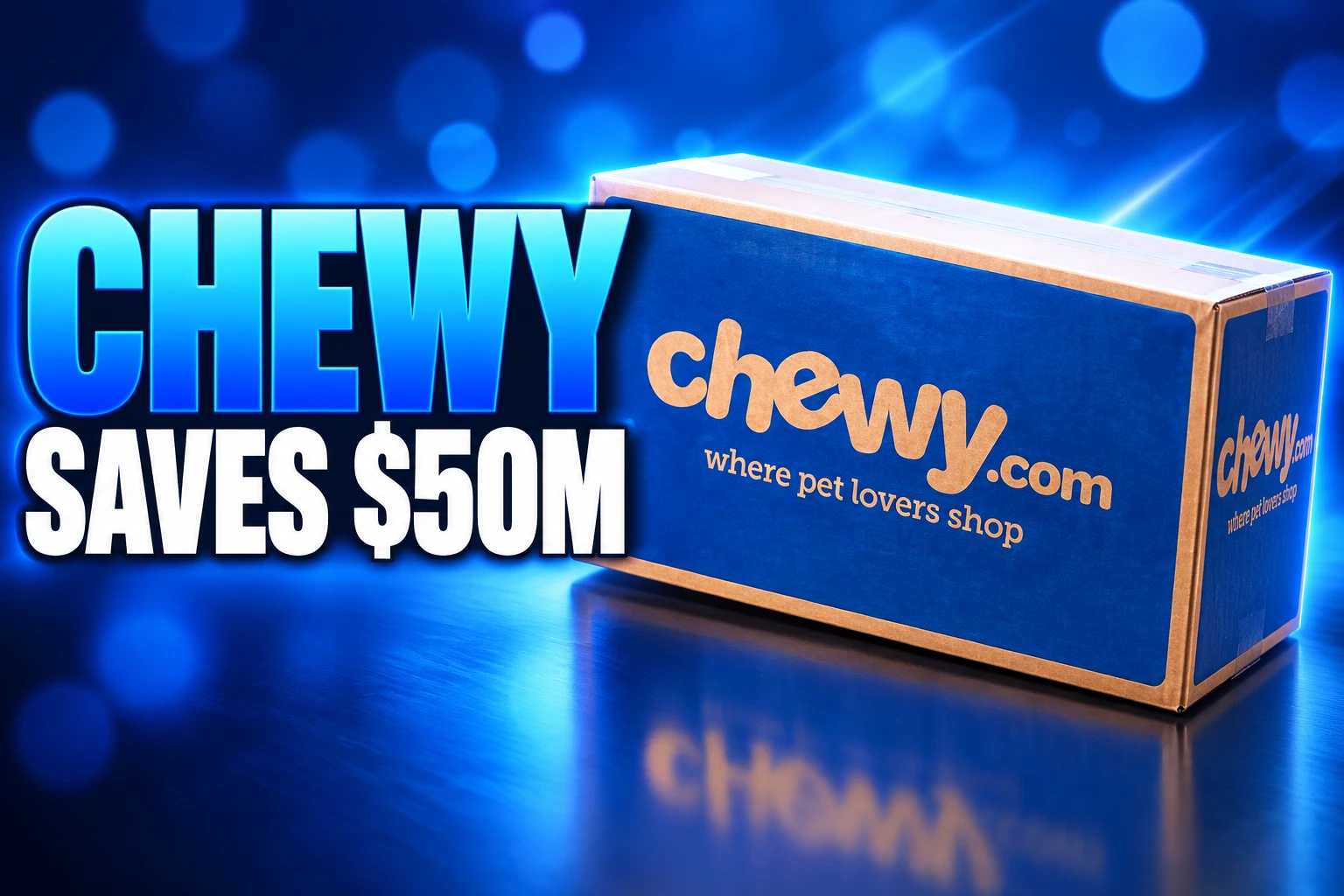
Chewy told investors on September 9, 2026, that AI tools should cut about $50 million a year in costs once fiscal 2027 is underway. The pet retailer’s new in-app assistant, Kai, has been live less than a month and still reaches less than 10% or 15% of traffic.
CEO Sumit Singh is not selling that figure as a one-off cost takeout. He is selling a first-party agent stack that rivals would need years to copy, or else buy from someone else.
$50 Million Is a Small Line on Chewy’s P&L
The quarter that carried the AI number ended August 2, 2026. Chewy posted net sales of $3.33 billion, up 7.3% from a year earlier and 5.7% excluding SmartPak and Modern Animal. Adjusted EBITDA margin hit 6.8%.
Full-year sales guidance is $13.46 billion to $13.57 billion. The midpoint of that range is $13.515 billion. Fifty million dollars is 0.37% of that midpoint.
HOW $50 MILLION COMPARES
| Yardstick | Figure | $50 million as a share |
|---|---|---|
| FY2026 sales guide midpoint | $13.515 billion | 0.37% |
| Implied FY adj. EBITDA at 6.75% margin | $912 million | 5.5% |
| Four times Q2 non-GAAP SG&A | $2.448 billion | 2.0% |
The same 8-K lists adjusted EBITDA of $226.7 million for the quarter, up $43.4 million from $183.3 million a year earlier. That is a 23.7% rise, and almost all of the beat versus Chewy’s own 6.3% to 6.4% margin guide came from about $10 million in early tariff refunds and more than $5 million of other one-off items, CFO Chris Deppe said.
Singh already expects AI-related work to save “low tens of millions of dollars” in fiscal 2026 before the step-up. He also told analysts not to drop the fiscal 2027 figure on top of this year’s margin path and call it extra profit.
Kai Is Still a Beta on a Sliver of Traffic
Kai, which Singh spelled out as K-A-I on the call, went to a select group of mobile-app customers in the second quarter. Chewy pulled that launch forward from the third quarter after it cut sales guidance, he said, because it needed projects it trusted to protect profit in the back half.
Early results: about 30% of chats in that group close in self-service. The topics are the boring, high-volume ones. Customers who want a person still get a care-team member “within seconds,” Singh said.
WHAT KAI HANDLES IN THE BETA
- Order status: Where a shipment is, and when it should land.
- Returns and refunds: Automated returns sit behind the chat, using Chewy’s older machine-learning work on refunds.
- Autoship edits: Changes to the recurring-order program that already supplies most of Chewy’s sales.
- Account tasks: Basic account management for customers who would rather not call.
Singh described several agents sitting under one controller that routes the request. Coverage is the next job. “Still less than 10% or 15% of our traffic is exposed to that, and it’s been in the market less than a month,” he said. He wants the radius opened to more customers and more use cases, and he said the take rate in the beta is already high.
The design rule is brand tone. Kai has to sound like Chewy’s human agents, he said, because it is standing next to a service bench the company has spent years selling as a reason to stay. Younger buyers who will not pick up the phone are the audience he named out loud.
Years of Clean Data Versus Two-Day Agents
The $50 million is the scoreboard. The wager is the stack underneath it.
Singh said Chewy spent several quarters getting data and internal systems in shape before it started layering agents. Pharmacy extraction, care-team tools, chat, and a vet-clinic voice agent now feed the same first-party setup, in his telling. That is the part he thinks a competitor cannot copy on a software order form.
We believe we have a durable competitive advantage here because companies will take years to get to this point. Or they’ll essentially have to go out and integrate through third-party providers where all of our solution is first-party built.
Sumit Singh, CEO, Chewy Q2 fiscal 2026 earnings call
The rest of the market is not waiting years. Salesforce’s Agentic Enterprise Index, published August 7, 2026, tracked Agentforce customers from February 2025 to April 2026 and found organizations nearly tripled the agents they had turned on. Once the tools were provisioned, businesses had agents created in an average of two days, and that creation time was down 53% over the span. Retail produced 22% of the measured agent work and grew that output 18 times.
Those retail agents, in Salesforce’s own cut, still skew narrow: one or two actions for most of the year, the routine ticket work Kai is doing in beta. Chewy’s claim is that Autoship records, pharmacy files, and clinic notes already live in one place, so the next agent can see the dog’s food, the refill, and the appointment without a vendor mash-up.
Gartner’s May 19, 2026 forecast puts worldwide AI spending of $2.59 trillion in 2026, up 47% from $1.76 trillion. That is an $831 billion rise. John-David Lovelock, a distinguished vice president analyst at Gartner, said most companies still want small efficiency wins rather than a rewrite of the business, and that CIOs struggle to prove the money came back. Chewy putting a dollar figure on the call is the proof exercise Lovelock is talking about. Whether first-party data is actually a years-long wall is the untested half of Singh’s pitch.
The Warehouses Already Move Half the Volume
AI is a new lever on a cost base Chewy has been bending with buildings and software for years. Deppe said more than half of shipping volume now runs through automated fulfillment sites, and that share should keep rising. Non-GAAP SG&A was $612 million, or 18.4% of sales, against 19.1% a year earlier, a 70 basis-point gap he tied to those sites, lower variable cost to serve, tight headcount, and AI-enabled tools.
THE COST BASE KAI IS JOINING
- Autoship mix: Recurring orders hit $2.8 billion, up 9.3%, and made up 84.6% of net sales.
- Automated volume: More than 50% of shipments already flow through automated facilities, Deppe said.
- SG&A rate: 18.4% of sales, down 70 basis points from 19.1%.
- Customers: 21.7 million active, up 3.8%, with 208,000 added in the quarter, including 43,000 from SmartPak.
Net sales per active customer reached $602, up 1.9% as reported and 3.8% after adjusting for an extra week in the year-ago period. Treats and other discretionary add-ons softened more than core food, Deppe said. Hard goods still grew in the mid-teens, faster than the wider market Chewy cited.
That mix is why a chatbot on a sliver of app traffic can still matter later. Autoship is habitual replenishment, not a hunt for a new brand each month. If Kai can change a ship date or a flavor without a 12-minute call, the save shows up in cost to serve, not in a splashy new revenue line. The warehouse robots already did the larger share of that job.
Callie Takes the Clinic Follow-Up Calls
The other named product is Callie, a voice agent at some Chewy Vet Care sites. It confirms appointments, books follow-ups, and is supposed to speak in the same register as the clinics. Singh said Chewy now has both modes in production: Kai in chat, Callie on the phone.
Those clinics already give pet parents online scheduling at Chewy Vet Care, records, and a path into the pharmacy. Callie sits on top of that calendar work. On the June 10, 2026 call, Singh said clinic agents were scheduling and printing triage notes on arrival, scribing visits into practice software, and writing follow-up notes, freeing as much as two hours a day per veterinarian. Callie is the outward-facing cousin of that shift.
Pharmacy is quieter and probably closer to cash. AI now pulls and checks data from documents so humans spend less time on intake, Singh said, and the reviews come out more consistent. He called that a durable cut in the cost to pick, pack, and ship a prescription, not a pilot.
Inside customer care, a separate set of tools sits on the agent’s screen. New hires jump across several systems to find an answer, which slows them down. The new software, Singh said, pulls those signals together so a new agent performs closer to a veteran and the training dip shrinks. Live agents stay in the loop. The bet is that they handle fewer “where’s my kibble” chats and more of the cases that still need a person.
The Street Traded Organic Growth, Not Kai
The AI section of the call did not become the argument around the print. Organic growth at 5.7%, a still-soft pet parent, and free cash flow of $90 million against $106 million a year earlier did.
Doug Anmuth of JPMorgan asked the AI question anyway. He wanted Singh’s confidence in the low-tens-of-millions figure for fiscal 2026 and the $50 million for fiscal 2027, and how much room was left to cut cost to serve. Two days later, on September 11, 2026, Anmuth cut Chewy to Neutral from Overweight and set a December 2027 target of $24, about seven times his 2028 adjusted EBITDA estimate of $1.2 billion. The note turned on organic growth and a pressured category, not on Kai.
That split is the tell. Chewy can name a savings number that is large enough to put in a slide and still too small to re-rate a $13.5 billion sales plan. Traders stayed on Autoship stickiness versus Amazon and Walmart, and on whether pet households will form again. Kai never left the transcript.
Singh Says Not to Stack the Savings on Margins
Singh’s own warning is the cleanest read on what $50 million is not. He said the tools are past experiment mode and should compound as coverage grows. He also said wage inflation and other ordinary cost pressure will eat some of the gain, and that Chewy may spend some of it on growth.
Net-net, we view AI as a powerful enabler of continued margin progression, not as a standalone pool of savings that will flow directly into the bottom line.
Sumit Singh, CEO, Chewy Q2 fiscal 2026 earnings call
Deppe pointed at the same multi-year path: more volume through automated sites, more AI on variable cost, more SG&A leverage. Singh wrapped the exchange by saying confidence in a long-term adjusted EBITDA margin of 10% plus is higher now than it was. The 6.8% quarter is still a long walk from that line, and this year’s full-year guide is only 6.7% to 6.8%.
One constraint he did not dress up: model inference still costs enough that he wants the price to fall. “I believe we can scale faster, than right now how some of the cost is actually scaling,” he said. The first-party stack is built. The meter on every extra Kai session is still running.
Fiscal 2027 will show whether $50 million shows up as lower cost to serve, as fuel for ads and clinics, or as a number that looked tidy on a September call. Until Kai is on more than a sliver of traffic, it remains a high take-rate beta sitting on top of a warehouse network that already moves more than half the boxes without a chatbot in sight.
Disclaimer: This article is news reporting and analysis of Chewy’s public filings and its September 9, 2026 earnings call. It is for information only and is not investment advice, a recommendation to buy or sell CHWY or any other security, or a forecast of fiscal 2027 results. Readers who may act on company guidance, margin targets, or analyst ratings should consult a licensed financial advisor who can weigh their own holdings, time horizon, and risk. The sales, margin, savings, and traffic figures here reflect the cited filings, the call, and the research notes named in the piece, and those figures can change with later reports.

The Yemen Cell Kept Claude’s Flight Code After the Ban

Unofficial AI Pages Beat Marshall County’s Sheriff to Every Scare

The SEC Crypto Rule Leaves Exchanges Still Exposed

Brian Bengs Bets His Senate Race on an AI Stop

Agentic Workflows Turn Cheap Tokens Into Larger AI Bills

Fable 5 Came Back Under a Commerce On-Off Switch

Google’s SpaceX GPU Lease Has a Sept. 30 Deadline

Plasma One’s XPL Locks Face a 1.81 Billion Cliff

DGO’s Rs 549 World Cup Pass Cost Fans Sleep and Data

Moonshot AI’s $30 Billion Ask Became a $35 Billion Close
-
 AI3 months ago
Fable 5 Came Back Under a Commerce On-Off Switch
-
 AI4 months ago
Google’s SpaceX GPU Lease Has a Sept. 30 Deadline
-
 CRYPTO4 months ago
Plasma One’s XPL Locks Face a 1.81 Billion Cliff
-
 APPS4 months ago
DGO’s Rs 549 World Cup Pass Cost Fans Sleep and Data
-
 AI4 months ago
Moonshot AI’s $30 Billion Ask Became a $35 Billion Close
-

 NEWS4 months ago
ColorOS 17 Device List Spans Oppo, OnePlus and Realme
-

 GAMING4 months ago
Xbox Cuts 3,200 Jobs After Five Years of Thin Returns
-

 GAMING3 months ago
The RTX 4050 Under Rs 70,000 Hides a Wattage Gap