
COMPUTERS
Asia’s Tech Growth Screen Pairs Samsung’s $73B With a Loss Maker

Samsung Electronics, the Suwon-based memory and consumer electronics giant, will spend roughly USD 73 billion on chip facilities and research this year, the largest annual semiconductor outlay any company has publicly announced. Cetc Potevio Science&Technology Co., Ltd., a Shenzhen-listed network-equipment maker, sits on the same Simply Wall St “high-growth Asian tech” list as Samsung and posted a CN¥16.57 million net loss in its most recent quarter.
The screener this month placed both names, along with smart-utility specialist Willfar Information Technology, in a 127-stock Asian high-growth tech and AI selection. The three sit side by side on a five-star rating scale, even though one is making the largest semiconductor capital outlay in history while the other two are reporting either flat revenue or outright quarterly losses against forward forecasts they have not yet earned.
Three Picks, Three Stories on the Same Star Scale
The full Simply Wall St list runs to 127 stocks. The three names highlighted in the screener’s latest update sit at very different scales of business. Samsung Electronics, headquartered in Suwon, carries a market capitalization of about KRW 1.90 quadrillion (around USD 1.4 trillion). Willfar Information Technology, a Changsha-based maker of smart meters and IoT (internet-of-things) modules trading in Shanghai, is worth about CN¥18.74 billion. Cetc Potevio, the Shenzhen-listed network-communications group, weighs in at CN¥15.61 billion.
| Company | Listing | Market Cap | Forecast Earnings Growth | Latest Quarter Signal |
|---|---|---|---|---|
| Samsung Electronics | KOSE:A005930 | KRW 1.90 quadrillion | 35.1% per year | Q1 2026 operating profit of KRW 57.2 trillion, up over 750% YoY |
| Willfar Information Technology | SHSE:688100 | CN¥18.74 billion | 20.52% per year | Net income CN¥148.28M vs CN¥139.37M YoY, revenue slightly down |
| Cetc Potevio | SZSE:002544 | CN¥15.61 billion | 82.25% per year | Q1 2026 net loss of CN¥16.57M on CN¥844.32M revenue |
Methodology runs as follows. Stars are assigned on the basis of forward revenue and earnings growth projections, rated against home-market averages. A six-star ranking signals that both projected revenue and projected earnings exceed local benchmarks. Five stars signals one of the two. All three companies above carry top or near-top ratings on that basis.
Each row reflects an analyst forecast rolled forward from the latest research sheets. The trailing quarterly print for each company is a separate question, and that quarter is where the divergence between the three starts to show.
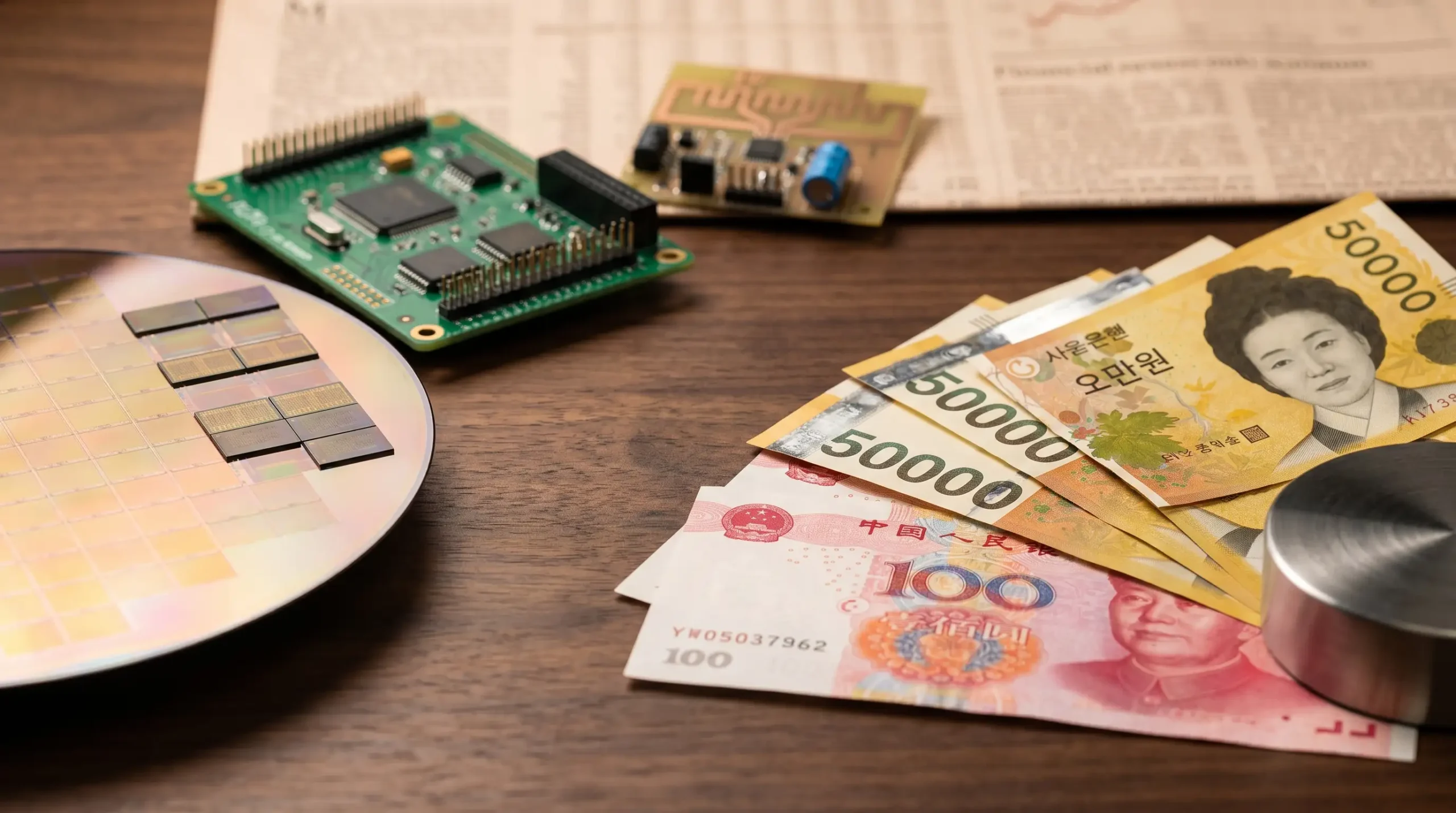
Samsung’s $73 Billion Bet Sits Underneath the Forecast
The Suwon-headquartered group announced on March 19 that it would commit more than KRW 110 trillion to capital expenditure and research this year, the largest single-year semiconductor outlay in corporate history at roughly USD 73 billion. The number is close to double the company’s 2025 chip capex of KRW 47.5 trillion, and it surpasses the projected 2026 capital outlay of about USD 45 billion at Taiwan Semiconductor Manufacturing Company, the foundry market leader.
Where the Money Is Going
Three areas absorb most of the spend, according to the published outline:
- AI accelerator memory, including next-generation HBM4E (high-bandwidth memory, fifth-generation refresh) samples scheduled for delivery to lead customers in the second quarter
- Advanced foundry process nodes, where the chaebol’s share has slipped to about 7.2% against TSMC’s 69.9% according to first-half industry trackers
- Next-generation chip packaging, the connective tissue that lets memory and logic dies stack together as a single product
The new Texas fab build-out absorbs a meaningful share of the foundry line within that bucket.
What the Bet Is Already Buying
HBM3E pricing across 2026 contracts went up about 20% after demand for Nvidia’s H200 AI accelerator pulled the supply line tighter, according to a December research note from TrendForce. The screener’s 35.1% earnings forecast for the Korean group was published before the company’s first-quarter 2026 earnings release reported operating profit of KRW 57.2 trillion, an 8x year-over-year jump that already exceeded the group’s full-year 2025 profit. The chip division alone contributed KRW 53.7 trillion of that, or 94% of the company total.
A May 27 collaboration with Broadcom, the US chip designer, pairs the BCM6776 Wi-Fi 8 system-on-chip with the Korean group’s B1320 5G modem for fixed-wireless-access broadband boxes. The joint Broadcom announcement framed the product as the first integrated 5G plus Wi-Fi 8 reference platform shipped to OEM sampling.
Willfar’s Trailing Print Lags the Forecast Tag
Changsha-based Willfar designs smart meters, EV charging hardware, and IoT modules for utilities. The company most recently reported net income of CN¥148.28 million versus CN¥139.37 million in the comparable period a year earlier, a 6.4% improvement. Revenue slipped slightly over the same span.
The Simply Wall St screener tags Willfar with a forward earnings growth forecast of 20.52% per year. The trailing pace sits at less than a third of that rate. The forecast assumes the company can lift its growth rate, not extend the current pace.
Two factors sit behind the projection. First, China’s smart-meter rollout has entered a late-cycle replacement phase, with national grid operators upgrading earlier-generation hardware on a multi-year schedule. Second, the Changsha-based group’s IoT module exports into South and Southeast Asia have been growing faster than its domestic utility business, opening a second margin lane.
Investor outreach this year included a presentation at the Macquarie Asia Conference, routine but a useful signal that the company is actively courting offshore institutional money. R&D continues to consume a meaningful portion of operating cash flow, which holds margins flat in the near term and pushes the payoff into the forecast window.
A note on the tape: the stock has traded near multi-quarter highs as the broader A-share tech complex recovered through April. That price action is what the star rating reflects more than what the income statement currently shows.
Cetc Potevio’s Forecast Rests on a Loss-Making Quarter
Shenzhen-listed Cetc Potevio’s most recent print broke harder. Revenue fell to CN¥844.32 million from CN¥871.04 million a year earlier, and the company posted a net loss of CN¥16.57 million versus a CN¥7.56 million profit in the prior quarter. Trailing twelve-month earnings stand at CN¥24.94 million, with a net profit margin of 0.51%.
Against that backdrop, the screener attaches a forward earnings growth forecast of 82.25% per year. The math works only because the base is close to zero, where small absolute improvements register as enormous percentages. The company specializes in network communications equipment for Chinese carriers and government clients, with a software and IT services segment that generates about CN¥4.86 billion in annual revenue, and one-off gains of CN¥21.4 million in the quarter softened the operating loss but also revealed how thin the recurring base is once special items strip out.
A line from the same data set is worth flagging: over the last three years, the network-equipment maker’s share price growth has exceeded its earnings growth by about 110 percentage points per year on average, according to the company analysis page on Simply Wall St. That mismatch is the screener’s own blind spot, and star ratings reward forecast trajectories without adjusting for the gap between trailing price action and underlying profit.
The Kospi Rally Has a Concentration Problem
The screener’s headline assumes a healthy, broad-based Asian tech rally, while the trading tape this quarter shows something narrower. South Korea’s Kospi index has surged more than 80% year to date, and Samsung Electronics together with SK Hynix, the Icheon-based memory rival, now make up over 42% of the benchmark, a record share. Taiwan’s Taiex has hit fresh highs with TSMC weighting at over 40% of the index.
Nomura, the Japanese investment bank, raised its Kospi target this month from the previous 7,500-to-8,000 range to a 10,000-to-11,000 range. Samsung Securities, the brokerage arm of the same chaebol, followed with an 11,000 target, up from 8,400.
The index targets share a single dependency. Memory contract pricing held by the duopoly of the two Korean chipmakers sets the earnings glide path more than any other variable, and the screener’s mid-cap names ride that wake whether their own income statements warrant the lift or not.
- 80% Kospi year-to-date gain through May
- 42% combined Samsung plus SK Hynix weight in the Kospi
- 40% TSMC weight in the Taiex
- 20% HBM3E price hike the two Korean memory makers put through for this year’s contracts
Conventional DRAM (dynamic random-access memory) is currently delivering higher margins than HBM, an unusual inversion driven by quarterly DRAM pricing against annual HBM contracts. If conventional DRAM normalizes downward before the HBM4 contract renegotiation window opens, the index leadership cracks, and small-cap names that ride sentiment more than fundamentals get repriced first.
Reading the Star Map Without Conflating Forecast and Fact
The star ratings work as the screener describes them, but the user behavior around the stars is where the methodology gets mishandled. Two reading habits collapse the screen, both stemming from conflating forward forecasts with realized growth.
Forecast Quality vs Forecast Magnitude
An 82.25% earnings growth projection for the Shenzhen network-equipment maker carries far more uncertainty than the 35.1% projection for the Korean megacap. The Korean number is being validated quarter by quarter in print, while the Chinese small-cap number rests on a base that just turned negative. A star scale treats both as comparable inputs, although statistically they are inputs of very different quality, and a reader who reads the star alone collapses that distinction.
Trailing vs Forward Context
A reader looking at just the star rating sees a five-out-of-five for several names on the list. The trailing twelve-month earnings of CN¥24.94 million at the network-equipment maker against KRW 53.7 trillion at the Korean group’s chip division for a single quarter is the order-of-magnitude gap the stars do not surface. Both companies make the list, but only one is currently buying down execution risk on its own forecast by posting quarterly results that match the projection.
What a Useful Filter Adds
A practical filter on top of the stars is a trailing-print check that requires the most recent quarter to be either profitable or showing year-over-year revenue growth. The Changsha-based smart-meter maker passes the profit test but fails the revenue test. The Shenzhen group fails both. The Korean megacap passes both at a scale that overshadows most of the screener’s other 124 names. Applied across the full 127-stock universe, the same filter would knock perhaps 30 to 40 names out of the high-growth bucket, while the remaining list would carry a higher base-rate of follow-through into the next reporting season.
Whether the gap between the Korean group’s KRW 110 trillion outlay and the two small-cap forecasts narrows depends on the next print cycle. If HBM3E pricing holds through the third quarter and HBM4 sampling wins fall the Korean megacap’s way, the screener’s star for that line lands inside the actual income statement. If the memory cycle peaks early and the smaller forecasts have to be revised down, the same five-star tag will refer to three very different probabilities of paying out by year-end.
Disclaimer: This article is for informational purposes only and does not constitute investment advice. Equity investments carry market risk, and forecasts cited from third-party research are estimates that may revise materially. Consult a qualified financial professional before acting on any view discussed here. Figures are accurate as of publication on May 29, 2026.


OpenAI Ultrafast Puts GPT-5.6 Sol on Live Workloads

Apple’s 15% External Fee Bid Admits Its Own Zero Floor

JBL Beats Bose and Sony on Value for 2026 Soundbars

iPhone Users Pull 40 Percent More From Microdrama Apps

Nebius Q2 Turns AI Cloud Demand Into Prepaid Growth Machine

One UI 9.5 App Lock Ends Years of Samsung Delays

Shiprocket IPO Premium Hides ESOP Costs and Flat Merchant Base

Google Halves Gemini 3.7 Flash Price to Fuel Agent Swarms

Dawnwalker Time Clock Cracks Open-World RPG Habits

Gemini 3.7 Flash Cuts Agent Costs While Pro Stays Delayed

Fable 5 and Mythos 5 Return as US Lifts Anthropic Export Controls

Oracle Cuts 21,000 Jobs in a Year, Cites AI in 10-K Filing

SpaceX’s Google Deal Turns a Rocket Company Into a Cloud Landlord

CD Projekt Red Co-CEO: Redemption Arc Isn’t Done, Witcher 4 in 2027

XPL Rallies 30% Ahead of Plasma One Card Tier Launch

Google Search Profiles Build a Follow Graph Inside Discover

DGO App Brings Rs 549 Mobile Pass for FIFA World Cup 2026 in Nepal

Moonshot AI Targets $30 Billion in China’s Fastest AI Funding Sprint

Microsoft Xbox Layoffs Start in July as Sharma Slams 3% Margin

Oppo’s ColorOS 17 Eligibility List Leaves A-Series Buyers Behind
-
 AI1 month ago
Fable 5 and Mythos 5 Return as US Lifts Anthropic Export Controls
-
 AI2 months ago
Oracle Cuts 21,000 Jobs in a Year, Cites AI in 10-K Filing
-
 AI2 months ago
SpaceX’s Google Deal Turns a Rocket Company Into a Cloud Landlord
-
 GAMING2 months ago
CD Projekt Red Co-CEO: Redemption Arc Isn’t Done, Witcher 4 in 2027
-
 CRYPTO2 months ago
XPL Rallies 30% Ahead of Plasma One Card Tier Launch
-
 NEWS2 months ago
Google Search Profiles Build a Follow Graph Inside Discover
-
 APPS2 months ago
DGO App Brings Rs 549 Mobile Pass for FIFA World Cup 2026 in Nepal
-
 AI2 months ago
Moonshot AI Targets $30 Billion in China’s Fastest AI Funding Sprint