
NEWS
Five-Hour MyIMMs Outage Strands Thousands at Malaysia Borders

Malaysia’s Immigration Department lost control of every computerised checkpoint in the country for close to five hours on Thursday morning, with the MyIMMs central system going dark from about 5am to 8:45am and stranding thousands of travellers across all 114 entry points nationwide.
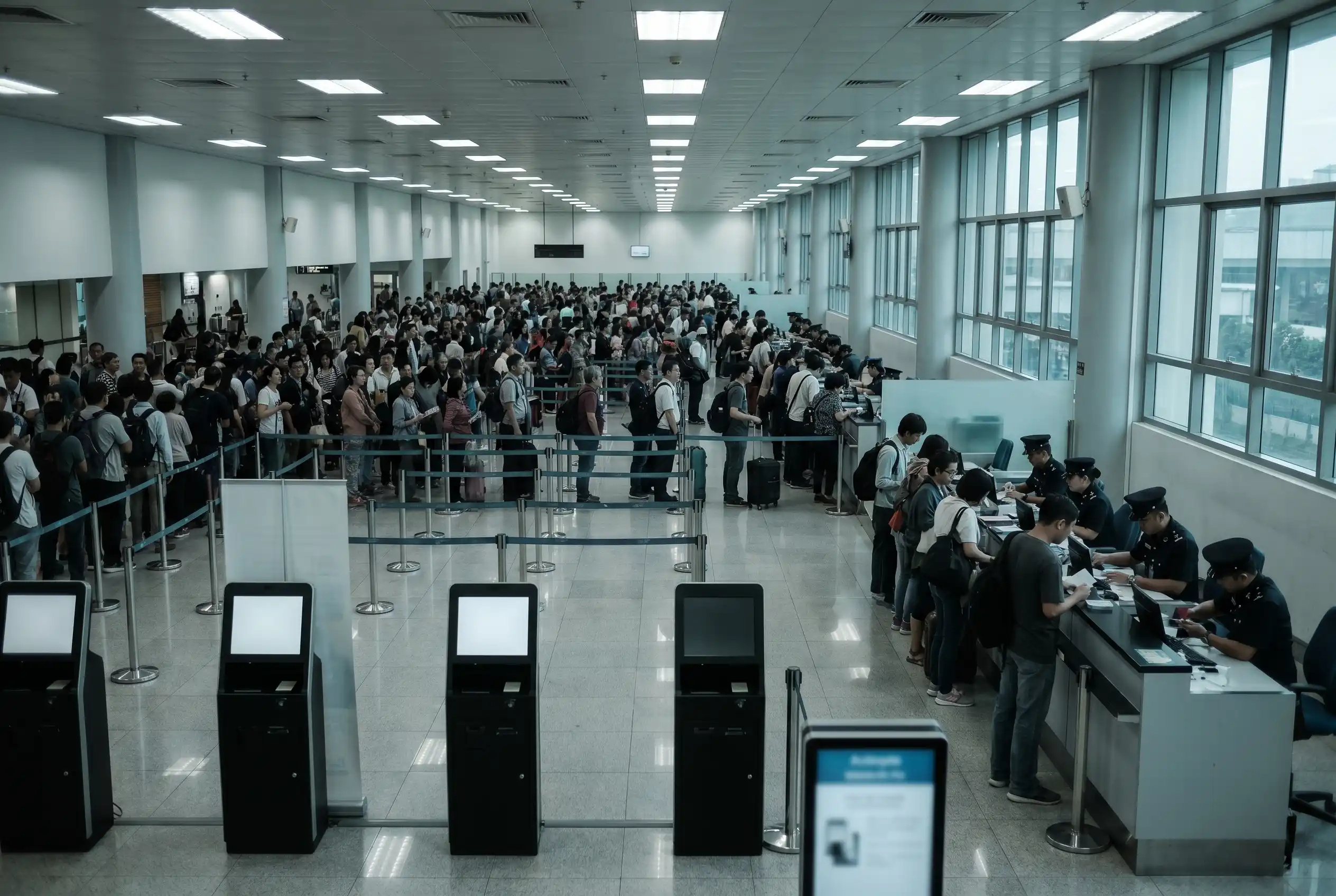
Officers fell back to manual stamping at airport halls, motorcycle lanes, and bus terminals while autogates and facial recognition kiosks sat black. It was the second countrywide blackout in barely five weeks, and the Immigration director general has now publicly conceded the box keeping the borders running is on its last legs.
The Five-Hour Window That Broke 114 Checkpoints
The Malaysian Immigration Management System (MyIMMs, the central database that authenticates every passport read at the border) stopped responding at the data centre in the small hours of May 28. Immigration officers told The Star the screens went blank closer to 4:30am and stayed down until 9:30am. The official account from director general Datuk Zakaria Shaaban put the window slightly tighter, at 5am to 8:45am.
Either timeline lands inside the worst possible part of the day. Peak commuter traffic between Johor and Singapore runs from 5am to 10am, when tens of thousands of Malaysians cross to reach jobs on the island. The collapse took out the autogates, facial recognition kiosks, e-passport readers, and the manual counter terminals at the same time, leaving uniformed staff to handprint forms.
The MyIMMs system is old and I cannot ensure that such a problem will not recur. Problems are bound to happen.
That admission came from Zakaria, who also confirmed the outage was not the result of a system breach. The April 23 crash, which his department had described as a one-time technical fault, lasted roughly two hours. Thursday’s incident ran more than twice as long and broke more services along the way.
Why a Decades-Old System Is Still the Front Door
Zakaria put the blame squarely on the age of the platform behind every gate. He told The Star the MyIMMs core is around 30 years old, predating modern biometric processing and the volumes the network now handles. Auditors flagged the same problem nearly a decade ago, and successive ministers have promised replacements that did not arrive.
Built for a Different Volume of Travel
The system was specified when Malaysia cleared a fraction of today’s traffic. The country received more than 30 million foreign visitors by October 2024 and was tracking toward 33 million for the full year, according to figures the Immigration Department published with its official NIISe transition note. About 90% of the agency’s services already run digitally, but they all sit on the same ageing spine.
Patches Holding the Spine Together
The Immigration Department has spent the last decade bolting newer modules onto MyIMMs: ePLKS for temporary work passes, MyTRIP QR codes in proof-of-concept, autogate access for citizens of 63 countries. None of those changed the central architecture. When the data centre stops answering queries, every layered service stops with it, which is what travellers saw on Thursday and again last month.
Johor Commuters Took the Hardest Hit
The Bangunan Sultan Iskandar (BSI) complex at the Causeway and the Sultan Abu Bakar (KSAB) complex at the Second Link carry the bulk of the Singapore-Malaysia daily crossing, and Thursday morning is the busiest shift in the schedule. A senior Home Affairs official told The Star personnel were redeployed to manual counters across the bus halls, motorcycle bays, and vehicle lanes.
Volumes through Woodlands and Tuas, the Singapore-side mirrors of BSI and KSAB, illustrate what the Malaysian gates were trying to absorb. The Immigration and Checkpoints Authority (ICA, Singapore’s border agency) recorded almost 565,000 travellers crossing the two checkpoints on February 13 during Lunar New Year, and more than 5 million across the March holiday and Hari Raya Puasa weekend. Even an average weekday clears several hundred thousand.
Commuters who reached BSI before 5am stamped through. Those who arrived during the blackout sat in stationary vehicle queues that stretched back along the approach roads. Videos uploaded to the柔新关卡Both Checkpoint分享站 Facebook group showed motorcycle lanes wrapped around the building. By 11am, an AsiaOne reader at Woodlands reported no queue at all, the system back up and the morning’s missed commuters either at work late or turned around.
The Audit That Counted 4,489 Outages
The pattern of MyIMMs falling over is not new. An Auditor-General’s report covering 2016 to 2018 found the system went down 4,489 times across the three-year window, an average of roughly four incidents a day. Most were brief; some were not. That document framed MyIMMs as a structural risk to entry-exit record integrity years before NIISe entered planning.
The recent outages stack into a worsening trend rather than an isolated rough patch.
| Incident | Date | Duration | Scope |
|---|---|---|---|
| National autogate failure | July 19, 2025 | Several hours | 200+ autogates, foreign passport holders |
| Nationwide MyIMMs outage | April 23, 2026 | About 2 hours | Most of 114 checkpoints |
| Nationwide MyIMMs outage | May 28, 2026 | Around 5 hours | All 114 checkpoints, autogates, facial recognition |
The shared cause across the recent incidents is a data integration failure inside the MyIMMs cross-verification process. Foreign passport holders, who depend on the automated biometric path, are typically hit first. Thursday’s failure cascaded further because the manual counter terminals also depend on the same backend handshake.
NIISe, AKPS, and the Long Road to 2028
The replacement plan exists, and it has been announced more than once. The challenge is that it does not arrive in time to absorb this year’s traffic.
What NIISe Actually Replaces
The National Integrated Immigration System (NIISe, an artificial intelligence enabled platform consolidating every Immigration Department service) is scheduled for full completion in 2028. Zakaria first publicly committed to that timeline in a November 2024 Bernama announcement, with Phase 1 set for 2026. The Home Ministry launched a marketing rollout earlier this year, and the platform is now being introduced in stages from Q2.
NIISe promises tighter integration with the National Registration Department and the Royal Malaysian Police, a single sign-on for departmental services, and biometric processing built for current passenger volumes. The Immigration Department has stressed the migration will not move user records in a way that compromises data integrity, addressing a recurring concern flagged by privacy advocates during procurement.
AKPS Takes the Reins
Sitting behind NIISe is a new border control agency, Agensi Kawalan Sempadan dan Perlindungan Malaysia (AKPS, the federal border protection authority that began operations in January 2025). AKPS is on a path to assume full operational control of all 125 international entry points into Malaysia during the course of this year. Officers at the gates this week were Immigration Department personnel; their reporting lines and tooling are due to shift before NIISe is fully live.
That dual transition, agency restructuring on one track and core system replacement on the other, is what Zakaria implicitly referenced when he said disruptions should be expected until NIISe is up. The government’s working assumption is that the cost of running MyIMMs another two years is lower than the cost of a botched accelerated cutover. Thursday’s outage is the line item on the other side of that ledger.
The Hari Raya Haji and June Holiday Squeeze
The next month is the worst possible stretch for a fragile system. The ICA issued a traveller advisory on May 22 warning of heavy traffic at Woodlands and Tuas from May 26 through June 28, covering Hari Raya Haji on May 27, the Vesak Day long weekend on June 1, and the June school holidays. ICA also noted that security checks at the land checkpoints have been stepped up since February 28 in response to the global threat environment.
Travellers planning to cross during the window have a small set of practical defaults.
- Move the trip to non-peak hours, ideally before 5am or after 8pm
- Carry a physical passport even if registered on autogate, in case biometric kiosks go offline mid-shift
- Monitor ICA’s social channels and the Land Transport Authority’s One Motoring site for real-time queue status
- Allow at least an extra hour of clearance time on any morning crossing between now and the Vesak weekend
If MyIMMs holds steady through Hari Raya Haji and the Vesak weekend, the Home Ministry buys itself credibility for the staged NIISe rollout. If a third nationwide outage lands in the same six-week window, the political pressure to compress the 2028 timeline becomes harder to deflect, and the cost-of-waiting calculation that has held this transition together starts to flip.


Lunit Turns Routine H&E Slides Into a Lung Pre-Screen

Meta’s Muse Agent Wants Your Inbox and Your Card

Police Chase Mules as AI Chatbots Run Romance Scams

Ticketmaster’s Personalized App Is Built to Move Empty Seats

Software Deals Now Hinge on Filing Accuracy, Not Beats

Iowa Counties Warn Workers That ChatGPT Keeps Their Files

Shaalan Beg’s Oncology AI Hits an Enrollment Wall

Exowatt Warns Gas-Fired AI Campuses May Not Last a Decade

Philips Splits Innovation and Hands AI to Partovi

Chrome 153 Puts the Whole Web on a Two-Week Clock

Oracle Cuts 21,000 Jobs in a Year, Cites AI in 10-K Filing

Fable 5 and Mythos 5 Return as US Lifts Anthropic Export Controls

SpaceX’s Google Deal Turns a Rocket Company Into a Cloud Landlord

CD Projekt Red Co-CEO: Redemption Arc Isn’t Done, Witcher 4 in 2027

XPL Rallies 30% Ahead of Plasma One Card Tier Launch

Google Search Profiles Build a Follow Graph Inside Discover

DGO App Brings Rs 549 Mobile Pass for FIFA World Cup 2026 in Nepal

Moonshot AI Targets $30 Billion in China’s Fastest AI Funding Sprint

Oppo’s ColorOS 17 Eligibility List Leaves A-Series Buyers Behind

Microsoft Xbox Layoffs Start in July as Sharma Slams 3% Margin
-
 AI3 months ago
Oracle Cuts 21,000 Jobs in a Year, Cites AI in 10-K Filing
-
 AI2 months ago
Fable 5 and Mythos 5 Return as US Lifts Anthropic Export Controls
-
 AI3 months ago
SpaceX’s Google Deal Turns a Rocket Company Into a Cloud Landlord
-
 GAMING3 months ago
CD Projekt Red Co-CEO: Redemption Arc Isn’t Done, Witcher 4 in 2027
-
 CRYPTO3 months ago
XPL Rallies 30% Ahead of Plasma One Card Tier Launch
-
 NEWS3 months ago
Google Search Profiles Build a Follow Graph Inside Discover
-
 APPS3 months ago
DGO App Brings Rs 549 Mobile Pass for FIFA World Cup 2026 in Nepal
-
 AI3 months ago
Moonshot AI Targets $30 Billion in China’s Fastest AI Funding Sprint