
GAMING
Alibaba Sells Lingxi Games as Trustar Buys the Cash Flow
Alibaba is selling Lingxi Games to Trustar for more than $1.5 billion, handing a still-profitable studio to private equity to pay for AI.

Alibaba agreed on August 17, 2026 to sell Lingxi Games to Trustar Capital for more than $1.5 billion (more than 10.1 billion yuan). The Hangzhou group is handing a Guangzhou studio that still prints cash to a CITIC Capital buyout firm so it can keep spending on models and cloud.
Lingxi chief executive Zhou Bingshu told staff in an internal memo that Alibaba would transfer its entire stake, and that he and the management team would stay. The memo named no price, no closing date, and no list of regulatory conditions.
Trustar Pays Cash for a Studio Alibaba Called Non-Core
Trustar, the private equity arm of CITIC Capital Holdings, said it had reached a transaction agreement to take Alibaba’s whole Lingxi holding. Zhou wrote that Alibaba was handing the studio over because it wanted a sharper focus, and he described the talks as friendly, stable, and mutually beneficial. People close to the bidding said Trustar had already looked like the likeliest buyer by August 14, 2026, after it outbid other suitors, including game makers.
The package is the full Lingxi business, not a single title. That means the in-house studios, the 9game and Jiaoyimao distribution platforms, and a staff of about 1,000 people. Lingxi had reported to group chief financial officer Toby Xu Hong since August 2025, a shift the trade read as a prelude to a sale. Alibaba had already sold hypermarket operator Sun Art Retail and department store chain Intime Retail, raising nearly RMB 20 billion, before it put the games unit on the block.
WHAT WE KNOW
- The agreement: Alibaba transfers its entire Lingxi stake and Trustar becomes the new controlling shareholder, per Zhou’s August 17 memo.
- The team: Zhou Bingshu and the current managers stay in their jobs after the ownership change.
- The flagship: Three Kingdoms: Strategy Edition, built with Japan’s Koei Tecmo Holdings, keeps running under Lingxi.
WHAT IS UNCONFIRMED
- Exact price: The memo is silent; the working figure is a valuation of more than $1.5 billion.
- Close and approvals: No completion date or regulator list was attached to the letter or to Trustar’s statement.
- Leftover ties: It is unclear whether Alibaba keeps cloud hosting, publishing, or other commercial hooks, or how the Koei Tecmo contract is treated.
That silence is the live part of the story. A September 9 description of a new Lingxi project still called the studio an Alibaba subsidiary, which is what you would expect if the shares have not yet changed hands.
One Seven-Year-Old Game Still Prints Most of the Money
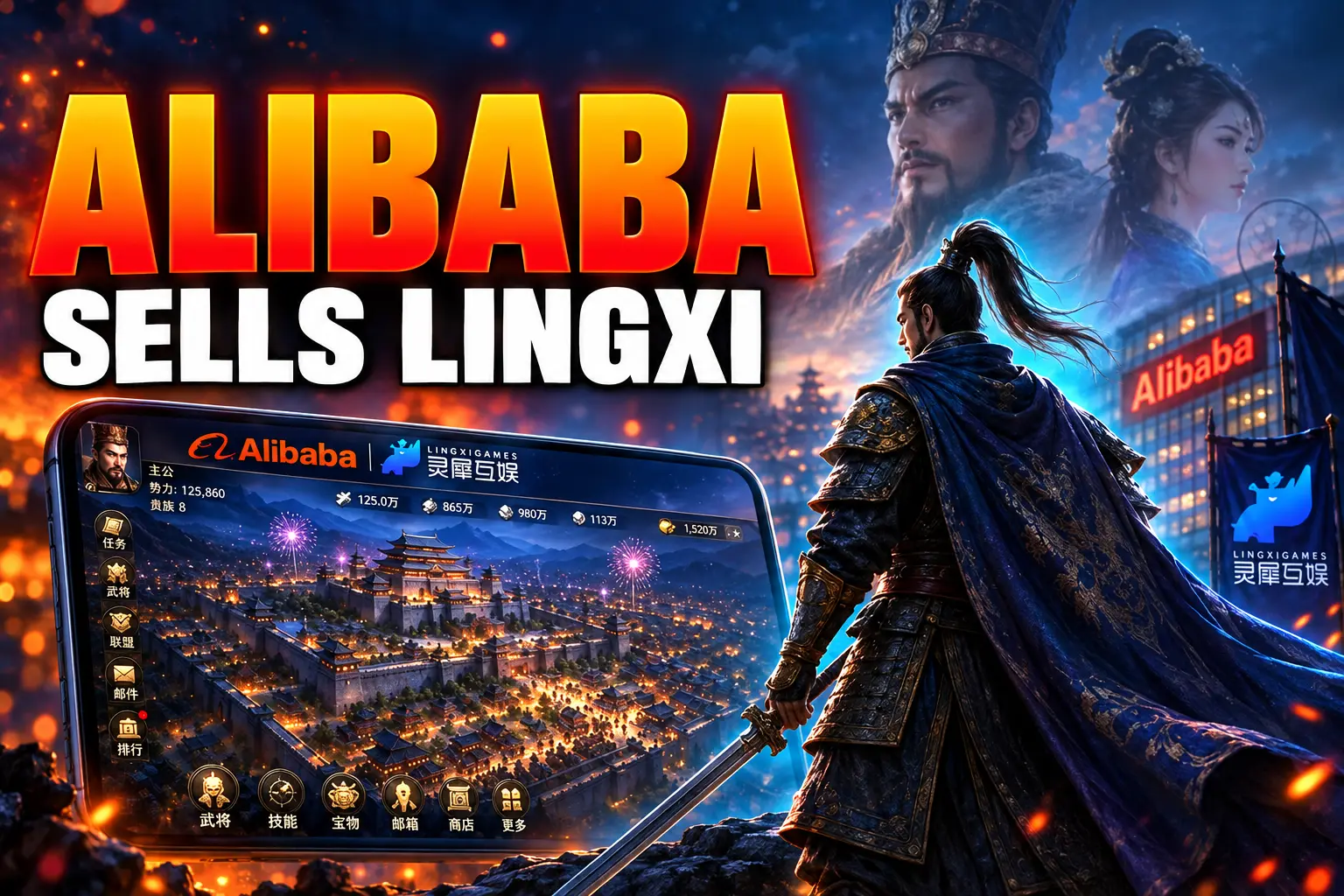
Lingxi is not a distressed leftover. Three Kingdoms: Strategy Edition launched in September 2019 and has more than 100 million registered users. Sensor Tower estimated that by April 2021 the title had already taken in more than $1 billion on the App Store and Google Play. In 2025, seven years on, domestic gross was still 2.1 billion to 2.2 billion yuan, with monthly gross roughly 180 million to 250 million yuan.
That one SLG accounts for about 70% of Lingxi’s sales. Estimates built from Sensor Tower product data put the studio’s annual revenue at 3 billion to 4 billion yuan and net profit close to 2 billion yuan. In May 2026 it was back in the top 10 of Sensor Tower’s global revenue ranking for Chinese mobile publishers. Lingxi’s live mobile catalog on Sensor Tower still shows the Three Kingdoms client among the highest-grossing apps in the set, beside other titles that have never matched it.
Lingxi has five in-house studios (Pingpingwuqi, Pumpkin, Star, Yuan, and Innovation) and a wider slate that includes Three Kingdoms Fantasy Land, Ruyuan, and Ashes of the Kingdom. None of those products carries the flagship. When founder Zhan Zhonghui, a former NetEase chief operating officer, stepped down in March 2024, the producer of Three Kingdoms: Strategy Edition, Zhou, became CEO. The founding group was largely gone soon after.
THE STUDIO AGAINST THE PARENT
| Item | Lingxi Games | Alibaba Group |
|---|---|---|
| Sales | 3 billion to 4 billion yuan a year (estimates from product data) | RMB 268,953 million in the June 2026 quarter |
| Profit and cash | Net profit close to 2 billion yuan a year | Free cash outflow of RMB 44,670 million in that quarter |
| The check | Sale valued at more than $1.5 billion | Capital spending of RMB 67,678 million (US$9,975 million) in the same quarter |
Against Alibaba’s fiscal 2026 sales, which crossed 1 trillion yuan, Lingxi is about 0.3% to 0.4% of the group. It is good enough to sell at a premium. It is not large enough to keep, if the parent has decided that only e-commerce, cloud, and models count as core.
Listed Game Companies Reached the Final Round and Lost
The sale leaked on June 23, 2026. Alibaba was marketing the whole package, including the five studios and the two platforms, at 7 billion to 9 billion yuan, and had approached at least five potential buyers. Those names included 37 Interactive Entertainment, China Ruyi, Century Huatong, Giant Network, and two private equity firms.
Century Huatong said a starting price of 7 billion yuan would exceed 10% of its net assets and would need board approval, and that it already had enough SLG capacity. Giant Network’s 2025 revenue was 5.047 billion yuan, with net profit of 1.755 billion yuan and year-end cash of about 6.26 billion yuan, so a 7 billion to 9 billion yuan check would have been larger than a year’s sales. China Ruyi, which booked 2.149 billion yuan of game revenue in 2025, was the July favorite because a Lingxi buy would have sat beside its film and streaming businesses. 37 Interactive runs a fast, ads-heavy model that does not match Lingxi’s slower content system.
By early August the last two in the room were Trustar and Giant Network. Trustar then lifted its bid by more than 1 billion yuan over the old 9 billion yuan ceiling and took the asset. Game companies price synergies, integration cost, and overlap, and they talk the bid down when those lines do not add up. A buyout firm prices cash flow. A seven-year title with monthly gross around 200 million yuan and more than 100 million users is an annuity in a spreadsheet, which is why a PE house could pay more than the people who actually ship SLGs.
ByteDance had already sold Shanghai studio Moonton, in a deal valued at more than $6 billion, to Savvy Games Group. Chinese internet groups are not leaving games because the hits dried up. They are leaving because the capital is being booked against AI instead.
What the Sale Funds in Alibaba’s AI Build
Chief executive Eddie Wu has told analysts that Alibaba wants combined cloud and AI external revenue of $100 billion within five years. In February 2025 the group said it would invest at least RMB 380 billion over three years (US$53 billion) in cloud and AI infrastructure, more than it had spent on those items in the previous decade. Wu said on the latest earnings call that about RMB 190 billion of that program was already out the door by the end of the June quarter.
The June quarter results filed with the SEC show why a profitable studio still went on the block. Group revenue was RMB 268,953 million (US$39,639 million), up 9%. Income from operations fell 57% to RMB 15,161 million. Net income fell 75% to RMB 10,444 million. Free cash flow was an outflow of RMB 44,670 million (US$6,584 million), against cash and other liquid investments of RMB 474,505 million (US$69,933 million). Capital spending rose 75% to RMB 67,678 million, from RMB 38,676 million a year earlier.
ALIBABA’S JUNE QUARTER AI BILL
- Cloud sales: AI Cloud and Compute Services took in RMB 48,437 million (US$7,139 million), up 45%, a 22-quarter high for external growth.
- Model money: AI-related product revenue was RMB 12,376 million (US$1,824 million), the twelfth straight quarter of triple-digit growth, and 35% of external cloud sales.
- Run-rate: Wu said AI-related products at a $7.3 billion run rate (RMB 49.5 billion), with model and application ARR, including MaaS, above RMB 16 billion.
- The hole: The free-cash outflow that quarter was more than four times the Lingxi sale, and the sale is about 15% of that quarter’s capital spending.
In the same month as Zhou’s memo, Alibaba launched Qwen3.8-Max, a 2.4 trillion parameter flagship, and opened the weights. Wu said the Qwen series has been downloaded more than 3 billion times, with more than 300,000 derivative models. Omdia’s China AI cloud ranking for 2025 put Alibaba Cloud first at 38.1%. T-Head’s Zhenwu chips were in use with more than 650 external customers. The Qwen app had given 250 million people a first AI shopping trip. Wu told investors AI had become Alibaba’s most certain growth engine. A games P&L that is a rounding error on a 1 trillion yuan group does not win that argument inside the building.
Nine Years of Ali Games End on the CFO’s Desk
Alibaba did not stumble into Lingxi. It spent years trying to build a games business, then spent years shrinking that business’s status until the only move left was a sale. The 2017 purchase of Guangzhou Jianyue for about 1 billion yuan was the first time it bought a team that could actually make games. Nine years later it is exiting at about ten times that price, which is a clean financial result and a full stop on the original ambition.
HOW ALIBABA GOT INTO GAMES AND OUT
- 2014: Alibaba acquires UC, including the 9game mobile channel, and starts as a distributor rather than a developer.
- January 2016: UC 9game is renamed Alibaba Games, with Yu Yongfu as chairman.
- September 2017: Alibaba Digital Entertainment buys Guangzhou Jianyue for about 1 billion yuan and sets up a games business group. The studio’s founders include Zhan Zhonghui.
- September 2019: Three Kingdoms: Strategy Edition launches with Koei Tecmo, whose Romance of the Three Kingdoms and Nobunaga’s Ambition catalogues sit behind the IP.
- 2020: The brand becomes Lingxi and sits as its own business group, the high-water mark for Ali Games.
- 2023: Under the 1+6+N split, Lingxi is dropped back into Digital Entertainment. A late-2023 fundraising effort stalls after Beijing floats tighter online-game rules.
- August 2025: The reporting line moves from Digital Entertainment to CFO Toby Xu Hong.
- August 17, 2026: Zhou’s memo tells staff that Trustar will be the new shareholder.
Koei Tecmo’s commercial arrangement was not addressed in the memo. The Japanese publisher still owns the long-running strategy franchises that made the flagship possible, so the next owner has to keep that relationship intact if the annuity is going to hold.
Private Equity Is Pricing Lingxi as an Annuity
Trustar is not a mystery cheque-writer in this market. It is the buyout affiliate of CITIC Capital, and after it closed a new RMB fund of more than 4.5 billion yuan on August 6, 2025 it had control-buyout funds totaling $9.59 billion. Chairman Yichen Zhang has used that pool on control deals including McDonald’s China, OmniVision, AsiaInfo, and Guilong Pharmaceutical. Zhou told staff Trustar had the industry resources to support Lingxi’s next stage. The resources that matter here are holding-company patience and an exit file, not a rival battle-pass team.
WHAT TRUSTAR IS BUYING
- The stake: Alibaba’s entire equity in Lingxi, with Trustar as controlling shareholder.
- The machine: Five studios, 9game, Jiaoyimao, and a live-ops title that still does 180 million to 250 million yuan of domestic gross a month.
- The people: Zhou’s managers and about 1,000 staff, kept in place so the seasons and general cards do not skip a beat.
- The exit: A path, described by people around the bid, toward a later listing or a sale to a strategic buyer once a game company can pay.
Operators walked because they could not see a clean synergy at 10.1 billion yuan. Trustar walked in because it did not need one. The studio is worth more as a stand-alone cash engine than it is as a line inside Alibaba’s “All Others” bucket, which is why a PE bid cleared a table of listed game firms.
Alibaba is handing Lingxi to Trustar due to better focus on its strategic priorities.
Zhou Bingshu, Chief Executive Officer, Lingxi Games, in an August 17, 2026 staff memo
Trustar can hold Lingxi, list it, or sell it on when a publisher wants the users. Alibaba is out of in-house game making. The 100 million player title is now a buyout asset, and the memo still does not say when the shares actually move.

Instagram Plus Tests a Read-Only Mode That Cuts Stories

Altman Asks the Public to Accept Some AI Harm

Google Freezes OSS VRP Product Reports After AI Flood

AI Agents Make Payment Rails the Scarce Prize

Turkey’s Crypto Boom Now Runs Through Three Banks

Fable 5 Came Back Under a Commerce On-Off Switch

Google’s SpaceX GPU Lease Has a Sept. 30 Deadline

Plasma One’s XPL Locks Face a 1.81 Billion Cliff

DGO’s Rs 549 World Cup Pass Cost Fans Sleep and Data

Moonshot AI’s $30 Billion Ask Became a $35 Billion Close
-
 AI4 months ago
Fable 5 Came Back Under a Commerce On-Off Switch
-
 AI4 months ago
Google’s SpaceX GPU Lease Has a Sept. 30 Deadline
-
 CRYPTO4 months ago
Plasma One’s XPL Locks Face a 1.81 Billion Cliff
-
 APPS4 months ago
DGO’s Rs 549 World Cup Pass Cost Fans Sleep and Data
-
 AI4 months ago
Moonshot AI’s $30 Billion Ask Became a $35 Billion Close
-

 NEWS4 months ago
ColorOS 17 Device List Spans Oppo, OnePlus and Realme
-
 GAMING4 months ago
Xbox Cuts 3,200 Jobs After Five Years of Thin Returns
-
 GAMING4 months ago
The RTX 4050 Under Rs 70,000 Hides a Wattage Gap