
AI
Siri AI Reaches iPhones Monday With Europe Left Out
iOS 27 puts Siri AI on iPhones on September 14 as an English beta, while EU and China users are shut out of the assistant Apple rebuilt with Google.

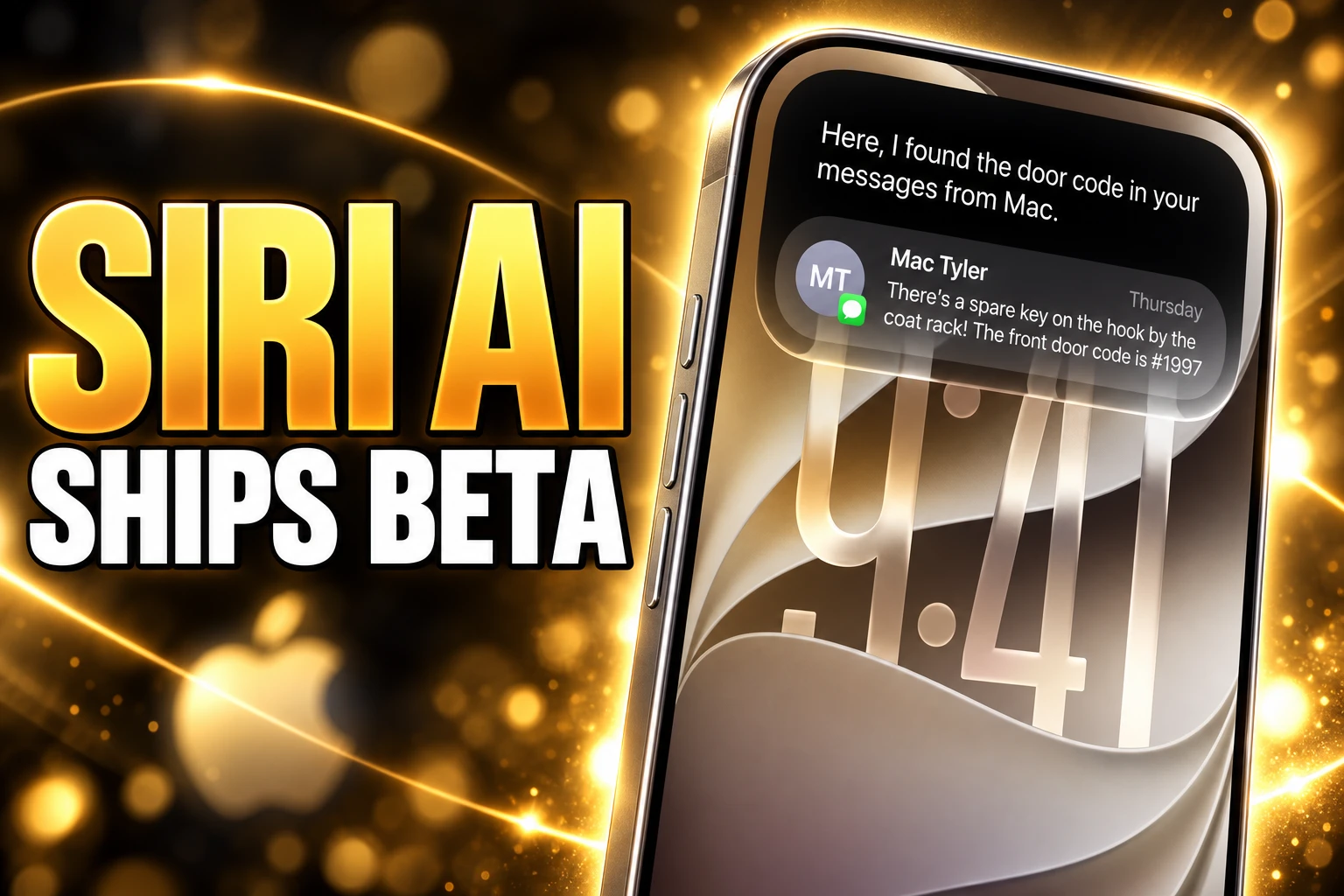
iOS 27 reaches iPhones on Monday, September 14, with Siri AI shipping as an English-only beta on a short list of devices. The assistant Apple rebuilt at WWDC on June 8 lands three months later still marked beta, still missing from iPhones in the European Union and China, and still absent on every iPhone older than iPhone 15 Pro.
Apple’s own product page now says Siri AI is rolling out in English, with usage limits that may apply. That is a narrower debut than the June keynote implied, and it is the bill coming due for a Siri upgrade first promised in 2024.
Siri AI Arrives Monday as an English Beta
Apple confirmed the date on September 9 at its Surprise and Shine event: iOS 27 is a free software update on Monday, September 14. iPadOS 27, watchOS 27, and macOS 27 are due the same day. The new iPhone 18 Pro and iPhone 18 Pro Max do not have to be in someone’s pocket for Siri AI to appear, because those phones do not ship until September 18, four days later.
THE MONDAY SHIP
- The date: iOS 27 becomes a public update on Monday, September 14.
- The assistant: Siri AI opens as a beta for supported devices set to English.
- The next wave: Apple has said French, Japanese, Korean, Portuguese, and Spanish follow in October.
- The hardware lag: New iPhones that include Siri AI in the box arrive on September 18.
The beta label is doing real work. Apple has been testing Siri AI since the June 8 developer beta and opened a public beta in July, so Monday is a wider door, not a finished product. People who install iOS 27 and hear the old Siri first should not assume the update failed; the new assistant can take a beat to appear, and Apple has not said whether it needs a separate opt-in after the OS finishes installing.
Who Gets the New Assistant on September 14?
iOS 27 itself runs back to iPhone 11, which is the widest iPhone software cut Apple has offered. Siri AI does not. Apple’s June availability list limits the assistant to iPhone 16 models and later, plus iPhone 15 Pro and iPhone 15 Pro Max. The same Apple Intelligence floor applies on iPad (M1 or later, plus iPad mini with A17 Pro), Mac (M1 or later, plus MacBook Neo with A18 Pro), Apple Vision Pro, and Apple Watch Series 9 or later, Ultra 2 or later, and SE 3 when a supported iPhone is nearby.
SIRI AI VERSUS IOS 27
| Where | iOS 27 or sister OS | Siri AI on September 14 |
|---|---|---|
| iPhone 11 through iPhone 15 (non-Pro) | Yes | No |
| iPhone 15 Pro, 15 Pro Max, iPhone 16 and later | Yes | English beta, outside the EU and China |
| iPhone and iPad in the 27 EU states | Yes | No, and no date |
| Apple Watch in the EU | watchOS 27 yes | No, because it needs a paired iPhone with Siri AI |
| Mac and Vision Pro in the EU | macOS 27 and visionOS 27 | Yes, on a supported language |
| China | OS update still ships | No Siri AI and no new Apple Intelligence features |
The extra on-device voices, the ones Apple says sound more expressive and let you change pace, need still newer silicon: iPhone Air and iPhone 17 Pro models and later, according to Apple’s iOS 27 release notes. A 15 Pro gets the conversational assistant. It does not get that voice layer.
Language is as hard a gate as the chip. Apple Intelligence already speaks a long list, including German, Italian, and Chinese. Siri AI does not ride that list on day one. English only. Five more languages in October. German, the largest EU tongue, is not among them, which is another way the Union stay-out feeds on itself.
The Heavy Lifting Still Goes to Google
Apple’s marketing copy talks about Apple Intelligence and Apple Foundation Models. It does not put Google on the iOS 27 page. After the June 8 keynote, Craig Federighi, Apple’s senior vice president of Software Engineering, told a press briefing the company had gone into a deep collaboration with Google and was using technologies behind the Gemini family of models. That is the same Siri overhaul that runs on Gemini Apple spent the summer trying to describe as an Apple product with a borrowed brain.
Federighi was blunt about what Apple is not shipping. He said the Gemini app is not Apple’s app, that none of that client code runs on iOS, and that Apple is not using the models Google deploys to its own customers. Simple requests, he said, can finish on the phone. When the system wants more intelligence, it calls models running in Private Cloud Compute, which Apple designed so a request is processed and then gone. For the hardest jobs, Apple extended that private-cloud setup onto Nvidia GPUs in Google’s cloud while repeating the same line: the request is not stored, and it is not open to Apple or anyone else.
We’re excited to introduce Siri AI, a dramatically more capable and conversational assistant designed to help users find information and get things done throughout the day. With access to broad world knowledge for up-to-date answers on virtually any topic, along with onscreen awareness and personal context understanding, Siri AI can help users take action across apps more naturally than ever.
Craig Federighi, senior vice president of Software Engineering, Apple newsroom, June 8, 2026
That privacy story is now the product. Siri AI can search Mail, Messages, and Photos, and it can act on what is on the screen. Apple says personal-context search reaches third-party apps only when a developer hooks into Spotlight, and it says outside experts can keep checking Private Cloud Compute. The architecture still means the heaviest answers leave the phone. People who wanted an assistant that never called a rival’s cloud do not get that on Monday.
Europe Installs iOS 27 Without the Star Feature
The June 8 DMA note is the document that still governs Monday. Apple will not ship Siri AI on iOS 27 or iPadOS 27 in the European Union, a block that covers Austria, Belgium, Bulgaria, Croatia, Cyprus, the Czech Republic, Denmark, Estonia, Finland, France, Germany, Greece, Hungary, Ireland, Italy, Latvia, Lithuania, Luxembourg, Malta, the Netherlands, Poland, Portugal, Romania, Slovakia, Slovenia, Spain, and Sweden. Because Watch Siri AI needs a paired iPhone that already has it, the Watch is out too. Mac and Vision Pro in the same countries can run it.
Apple’s account is that the Digital Markets Act, as the Commission reads it, would force the company to give any rival assistant direct access to private data and the ability to control other apps the moment Siri AI is live on iPhone. Apple proposed a middle layer it calls Trusted System Agent and offered to launch Siri AI in the Union while phasing that layer in over 18 months. The Commission, Apple says, refused every proposal. There is no timeline for Siri AI on iOS and iPadOS in the EU.
We’re deeply disappointed that our EU users won’t have Siri AI on iPhone or iPad when we share our new software releases later this year. Our hope is to eventually bring Siri AI to the EU, and we will continue to engage with EU regulators on a path forward. However, their refusal to engage constructively on solutions that preserve privacy and security means we do not currently have a timeline for Siri AI’s availability on iOS and iPadOS in the EU.
Craig Federighi, senior vice president of Software Engineering, Apple DMA update, June 8, 2026
Commission spokesperson Ricardo Cardoso has said nothing in the DMA stops Apple from introducing new products and services in the EU, and that Apple did not put forward DMA-compliant interoperability designs the Commission would accept. That fight is unchanged on the eve of the iOS 27 launch. Developers based in the Union also cannot test or use the new Siri AI features for apps on iOS 27, iPadOS 27, or watchOS 27, which has already pushed some app makers to leave the bloc just to check whether their integration works.
WHAT WE KNOW
- The iPhone block: Siri AI, the dedicated app, Camera Siri mode, expanded Visual Intelligence, and the new writing tools stay off EU iPhones and iPads on September 14.
- The Mac exception: EU users can still use Siri AI on macOS 27 and visionOS 27 when the system language is supported.
- China: Siri AI and the other new Apple Intelligence features stay off while Apple works through local rules.
WHAT IS UNCONFIRMED
- Opt-in: Apple has not said whether Siri AI needs a separate toggle after iOS 27 installs.
- Release time: No public hour has been set for the September 14 drop.
- EU date: Apple still has not named a quarter, let alone a week, for iPhone Siri AI in the Union.
The UK is not in Apple’s 27-state footnote, so English-language iPhones there are in the Monday beta. That split, Union phones on one side of a legal argument and British phones on the other, is going to be the first thing a lot of Europeans notice when the update lands.
A Dedicated App, Camera Mode, and Writing Tools
On a supported iPhone outside those blocked regions, Siri AI is a chatbot with a system hook, not only a voice overlay. You can still say “Hey Siri” or hold the side button. You can also swipe down from the Dynamic Island. On iPad and Mac, it sits inside Spotlight, and a control-click can send an image, a file, or selected text to the assistant. A dedicated Siri app keeps the thread, pins chats, and syncs history over iCloud so a conversation that starts on a Mac can continue on an iPhone.
Apple’s own demo prompt on the iOS 27 page is the clearest specimen of what it wants this to feel like: draft an email to Elton listing the Saturdays in November that are free from 12 to 3 p.m. to bring snacks, and include gluten-free options. That is calendar plus Mail plus a dietary constraint in one shot. Other examples Apple has used are a restaurant buried in Messages, a hotel confirmation lost in Mail, and photos from a recent trip.
WHAT SIRI AI IS SUPPOSED TO DO
- Personal search: Pull a fact out of Messages, Mail, Photos, or Notes without the user opening those apps.
- On-screen questions: Answer something about whatever is already in front of you, then keep the thread going.
- App actions: Draft mail, edit photos, add a reminder, or move a song into a playlist from a single request.
- Camera mode: Point the viewfinder, tap the shutter, and ask; Apple’s examples include splitting a bill with Apple Cash and reading nutrition off a plate of food.
- Writing: Generate a draft anywhere you type, then match the punctuation and tone you already use with that person in Mail and Messages.
Visual Intelligence also moves onto iPad (from the screenshot flow) and Mac (from a keyboard shortcut), and on Vision Pro you can look at a window or an object and ask. Image generation and some other cloud features still have daily caps because they run on server models; Apple says most iCloud+ plans raise those caps. None of that requires naming Google on the screen. All of it still depends on the three-layer stack Federighi described in June.
App Makers in the Union Cannot Test on iPhone
Siri AI is only as useful as the apps it can touch. Apple says third-party personal context needs a Spotlight integration, and systemwide actions still depend on what developers expose. That is a problem in the EU, where those same developers are barred from testing the new features on iPhone, iPad, and Watch. A shipping assistant that cannot be certified on the phones that need it is how a regulatory delay becomes a product delay for everyone who uses those apps, not only for people who live in the 27 states.
The iOS 27 release candidate has also started planting an Ask Siri command inside third-party apps, and developers looking at the build say there is no switch to remove it. If that holds in the public release, Siri AI is not only a home-screen app. It is a menu item other people’s software did not ask to host. That will matter more once the English beta is on tens of millions of phones and users start tapping Ask Siri from inside apps that were never designed as chat surfaces.
Speed Gains Reach Back to iPhone 11
Plenty of iOS 27 is unrelated to the assistant, and those pieces do reach the older phones that will never see Siri AI. Apple says iPhone and iPad apps launch up to 30 percent faster, photos load up to 70 percent faster after they are taken, and AirDrop transfers are up to 80 percent faster. File browsing from an external drive on iPad is up to 5x faster, and Vision Pro can join Wi-Fi up to 3x faster. A Liquid Glass slider in Settings lets people push the interface from ultra-clear to fully tinted, and Screen Time picks up new child-account tools, contact approvals, and time allowances for Entertainment, Games, and Social Media. Those iOS 27 features that missed the keynote are what an iPhone 12 in Paris actually gets on Monday.
Siri AI is the feature Apple used to close a two-year gap with Google and OpenAI, and it is the feature a 15 Pro in New York can try in English on September 14. The same update on a 15 Pro in Berlin is a faster phone with a prettier glass slider and the old Siri. Apple still has not said when that gap closes.

Instagram Plus Tests a Read-Only Mode That Cuts Stories

Altman Asks the Public to Accept Some AI Harm

Google Freezes OSS VRP Product Reports After AI Flood

AI Agents Make Payment Rails the Scarce Prize

Turkey’s Crypto Boom Now Runs Through Three Banks

Fable 5 Came Back Under a Commerce On-Off Switch

Google’s SpaceX GPU Lease Has a Sept. 30 Deadline

Plasma One’s XPL Locks Face a 1.81 Billion Cliff

DGO’s Rs 549 World Cup Pass Cost Fans Sleep and Data

Moonshot AI’s $30 Billion Ask Became a $35 Billion Close
-
 AI3 months ago
Fable 5 Came Back Under a Commerce On-Off Switch
-
 AI4 months ago
Google’s SpaceX GPU Lease Has a Sept. 30 Deadline
-
 CRYPTO4 months ago
Plasma One’s XPL Locks Face a 1.81 Billion Cliff
-
 APPS4 months ago
DGO’s Rs 549 World Cup Pass Cost Fans Sleep and Data
-
 AI4 months ago
Moonshot AI’s $30 Billion Ask Became a $35 Billion Close
-
 NEWS4 months ago
ColorOS 17 Device List Spans Oppo, OnePlus and Realme
-

 GAMING4 months ago
Xbox Cuts 3,200 Jobs After Five Years of Thin Returns
-

 GAMING4 months ago
The RTX 4050 Under Rs 70,000 Hides a Wattage Gap