
CRYPTO
Texas Orders BG Wealth Sharing Halt After Exit Fees
Texas ordered BG Wealth Sharing and DSJ Exchange to stop after a 12% exit tax and a $100 HQIEX swap followed earlier state warnings.

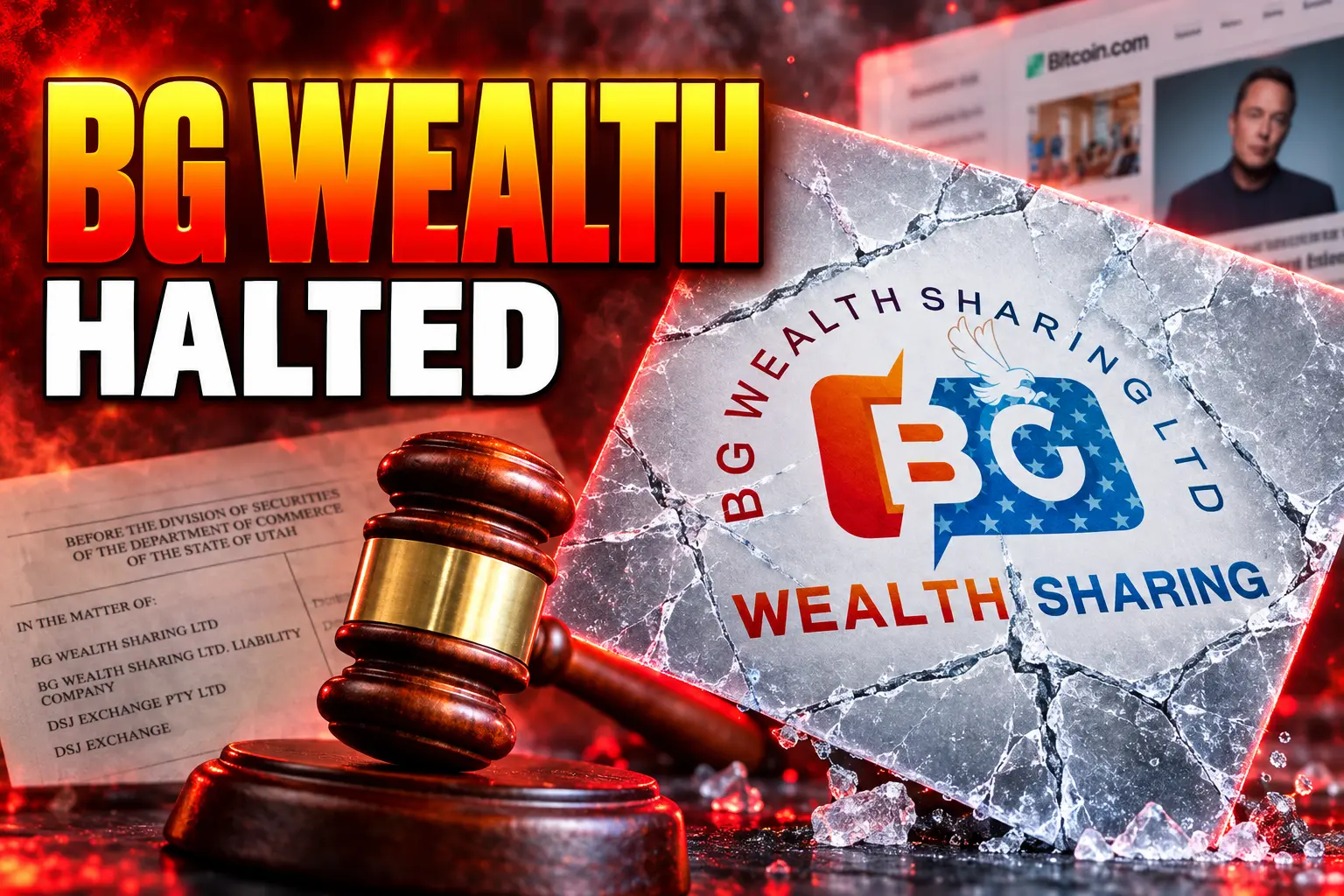
Texas issued an emergency cease and desist on June 3, 2026, against BG Wealth Sharing LTD and DSJ Exchange PTY Ltd over an alleged crypto pyramid scheme. The order also names BG Wealth Sharing Group LLC and two Texas promoters, Thaddious Thomas and Gagandeep Sarkaria.
By then the money was already moving. Withdrawals had been shut off. A 12% “exit tax” had been billed. Investors were being steered to a replacement platform called HQIEX.
Two Texas Promoters and a Pearland Meeting Room
The Texas State Securities Board’s emergency cease and desist order is numbered ENF-26-CDO-1897. Deputy Securities Commissioner Cristi Ramón Ochoa signed it after the Enforcement Division put up evidence of unregistered securities, unregistered dealer activity, and fraud in the offer of those securities.
BG Wealth Sharing LTD is a Colorado corporation formed on April 13, 2025, with papers listing Fong Sam International Accounting Firm at 1500 N. Grant St. in Denver. DSJ Exchange PTY Ltd is the purported crypto venue tied to the pitch. BG Wealth Sharing Group LLC is a Texas company. Thomas is its registered agent at 6601 Broadway St. in Pearland.
Thomas lives at 13612 Summer Cloud Ln. in Pearland, the order says. He formed the Texas company to promote the program and to seek occupancy papers for a physical site where pitches would be held. Sarkaria, served at 1109 Timberlake Ln. in Lewisville, ran in-person recruiting events and joined online presentations. In one of those talks she pointed to a FinCEN money-services filing as proof the operation was regulated. She also told audiences BG Wealth bought her a luxury SUV after she hit a recruiting rank.
WHO THE TEXAS ORDER NAMES
| Respondent | What the order says |
|---|---|
| BG Wealth Sharing LTD | Colorado corporation formed April 13, 2025 |
| DSJ Exchange PTY Ltd | Purported exchange for the trading codes |
| BG Wealth Sharing Group LLC | Texas company; Thomas is the registered agent |
| Thaddious Thomas | Pearland promoter seeking a meeting site |
| Gagandeep Sarkaria | Lewisville promoter running live events |
Justin Bontrager, an Enforcement Division attorney, is leading the Texas investigation. The order tells the respondents to stop offering securities in Texas, stop acting as dealers or advisers, stop fraud in any securities offer, and stop using sales copy that is materially misleading.
A 12% Bill Landed After Withdrawals Stopped
The trading story was passive income with little risk. The cash story was a series of gates. Investors who wanted their money were first told to pay a handling fee of about 20% of account value, framed as an anti-arbitrage and anti-money-laundering control.
In April 2026, BG Wealth demanded another 12% on each account, called taxes and transfer fees. Standard withdrawals had already been turned off. The extra charge had to come from outside money. On or around May 8, 2026, Sarkaria posted a video answering regulator warnings. Operators then told investors the fraud claims were DSJ’s fault and that accounts should move to HQIEX. The Board’s June 3 release says investors were told to pay a $100 fee to migrate their account onto that new venue.
Washington’s Department of Financial Institutions had already watched this turn. Its April 10, 2026 alert, updated May 4, said a firm that makes you deposit fresh funds to take money out is running an advance-fee play. On May 15 it warned that BG Wealth investors were being directed away from the DSJ Exchange toward HQIEX and told to put up more cash to “move.” People who had paid the prior tax still could not withdraw, the department said. Its tracker listed $254,000 in reported losses and noted those figures had not been verified.
THE THREE CASH GATES
- Handling fee: About 20% of account value, sold as an anti-arbitrage and anti-money-laundering charge.
- Exit tax: 12% more in April 2026, billed as taxes and transfer fees after withdrawals were disabled.
- Migration fee: $100 to shift a frozen DSJ balance onto HQIEX after other states moved.
- Outside cash: The extra amounts had to be paid from new funds, not from the locked balance.
Each warning became another reason to pay. That is the harm the Texas filing is documenting, not a rescue of the coins that had already left.
How the BonChat Codes Sold a Zero-Risk Trade
BG Wealth said it pooled money for short-term Bitcoin-linked trades and sent “AI-enabled” signals through BonChat, a messaging app. Codes went out about 12:00 p.m. and 6:00 p.m. Central Time. Investors typed them into DSJ. They did not pick strategies, set positions, or run their own analysis. The board says they had almost no control while the screen still looked busy.
Recruiting unlocked more codes, better “dynamic” signals, bonuses, and purported salaries. Level 1 members were told they would get extra daily signals. Monthly pay was pitched from about 30 USDT to about 1,000,000 USDT, depending on rank. Promotion bonuses ran from about 100 USDT to about 2,000,000. Recurring dividends were promised on top. Operators also claimed a ten-year exclusive deal that made DSJ the only trading venue.
Washington heard a simpler hook: 2000 USDT would pay 1500 USDT a month for life, with a “zero-risk” wrapper and a self-described professor, Stephen Beard, feeding the daily codes. On-chain investigator ZachXBT later wrote that Beard was a fictitious CEO and that ads also promised 1.3% to 2.6% daily returns, a different set of numbers from the ones Texas printed.
RETURN CLAIMS TEXAS PUT IN THE ORDER
- Win rate: A 99.6% trading success rate with principal protection.
- Monthly yield: Returns of at least 60%.
- Speed: Principal doubled in about 40 days.
- Risk: Little or no risk, plus “lifetime monthly income” and millionaire status in months.
Those figures lived on dashboards that, Texas says, showed profits that did not match real account values. Investors still could not get paid.
An SEC Filing Became a Sales Prop
On or about August 15, 2025, BG Wealth made an Exempt Reporting Adviser filing with the Securities and Exchange Commission. Texas says that paper is not approval, a license, or an endorsement. Respondents used it anyway to imply U.S. government backing. DSJ also waved a falsified certificate claiming SEC dealer and adviser registration, a FinCEN money-services registration, and a Form D that cited Rule 506(c) of Regulation D. None of those steps authorizes a crypto exchange or clears Texas securities law.
Bad actors often attempt to create a false sense of legitimacy by claiming government approval, regulatory registration, or official oversight. We continue to see an increase in these MLM type of schemes. Investors should be extremely cautious when confronted with promises of unusually high returns, particularly when those returns depend on recruiting others into the program.
Cristi Ramón Ochoa, Deputy Securities Commissioner, Texas State Securities Board
The securities were not registered in Texas. The respondents were not registered as dealers or agents. Any claimed exemption, the order says, fails because material facts were withheld: actual trading, custody of funds, who managed the book, the firm’s finances, and whether money was commingled or diverted.
Hawaii Caught the Pitch in a Public Library
Texas was not first. Hawaii’s Commissioner of Securities, Ty Y. Nohara, issued a preliminary cease and desist in the matter of BG Wealth Sharing LTD, Cranci Ilima Luci Hoopai, and Ligaya Joy Arcenas (formerly Ligaya Arcenas Buchacek), case SEB20260007, around May 5, 2026.
By April 9, 2026, the respondents had held an in-person presentation at a Nanakuli library meeting room at 89-070 Farrington Highway in Waianae. About 40 to 50 people sat through slides and banners that said “99.6% win rate,” “daily profits are compounded,” “capital increases within 2 months,” and “the world’s largest hedge fund.”
Hoopai, a Hawaii resident, said she started in October 2025 with $780, had made about $6,000 to $7,000, and was taking three payments every ten days for $3,600 a month. She used family testimonials. Arcenas, described as the presenter and a California resident, said she started in February 2025 with $333.84, had “withdrawn” more than $300,000, made $17,500 a day, and sat at Level 7. She offered $100 to anyone who joined that night with $500, said that amount would provide a “benefit for a lifetime,” and told the room anyone “can be a millionaire in 11 months.” Rank, she said, came from referring five new depositors and building teams under them.
The preliminary order calls those offers unregistered investment contracts and sets a $150,000 administrative penalty, $50,000 each, payable after a final order. It also seeks a bar from Hawaii securities work.
Utah’s Division of Securities had warned on March 10, 2026, that BG Wealth was not registered there and had falsely claimed SEC licensing. On June 1, two days before Texas filed, Utah issued its own emergency cease and desist naming BG Wealth Sharing LTD, a Utah LLC, DSJ Exchange, HQI Exchange, and local promoters Richard Chea and Sumana Chea. Chea wrote to Utah enforcement that, without admitting wrongdoing, “the referenced activity has been discontinued.” Division director Robert Cummings has called BG Wealth an international fraud and said the alleged violations can be charged as a third-degree felony. Alberta’s securities commission, on May 25, 2026, sent cease-and-desist letters to promoters and said U.S. law enforcement had seized bgwealthsharing.com in late April.
$41.5 Million Frozen as Wallets Emptied
The Texas filing is a stop order. It is not a tracing report. That work sat with ZachXBT, who on May 5, 2026, published a thread on the collapse.
1/ The $150M+ DSJ Exchange (DSJEX) / BG Wealth Sharing Ponzi scheme collapsed last week. From April 27 – May 3, illicit actors laundered $92M+ across chains to obscure the trail.
I helped lead an initiative with @Tether_to, @Binance Security Team, @OKX, & US law enforcement that… pic.twitter.com/h85hQ5IeRD
— ZachXBT (@zachxbt) May 5, 2026
He put the scheme at $150 million-plus, likely higher because it had run since 2025. U.S. law enforcement seized bgwealthsharing.com on April 23, 2026, he wrote, after 13 regulators across five continents had already warned. On May 2, a Beard video promised an IPO and demanded a 12% “tax” on balances “as part of the regulatory process,” with withdrawals already dead. From April 27 to May 3, he traced $93 million in outflows, $63 million to custody provider Cobo and $30 million to OKX, through Tokenlon swaps, bridges, and USDD wrapping. Timing work with Tether, Binance’s security team, OKX, and U.S. law enforcement froze $38.4 million in USDT on May 4 and another $3.1 million-plus at other desks, $41.5 million in all.
THE MONEY CALENDAR
- April 10, 2026: Washington posts its first public alert on BG Wealth and DSJ.
- April 23, 2026: U.S. law enforcement seizes bgwealthsharing.com.
- April 27 to May 3, 2026: $93 million in traced outflows leaves the hot wallets.
- May 2, 2026: A Stephen Beard video demands the 12% tax and talks up an IPO.
- May 4, 2026: Tether freezes $38.4 million; other desks freeze $3.1 million-plus.
- May 15, 2026: Washington warns that investors are being pushed onto HQIEX.
- June 1, 2026: Utah files an emergency order that names HQI Exchange.
- June 3, 2026: Texas files ENF-26-CDO-1897 against the firms and the two local promoters.
The Alberta commission put the trading question in one line: to date there is no evidence that any legitimate trading occurred on DSJ EX sites or apps. ZachXBT’s read of victim posts was that many still did not accept they had been scammed. He told U.S. victims to file at ic3.gov.
The 12% Script in September
Texas can stop a Pearland meeting and a Lewisville pitch. It cannot unwind a May wallet sweep by itself. The Pearland occupancy file and Sarkaria’s live events are how the program still tried to look local after the domains and the dashboards had failed.
The same 12% story kept traveling. In September 2026, new accounts were still selling that fee as a verification or recovery step and asking victims to write in for help getting funds out. That is the advance-fee pattern Washington described on May 4. Alberta also warned that social groups would rename themselves and sell fake recovery for a charge.
Ochoa’s office asked Texans who were solicited, or who put money in, to contact TSSB Enforcement. A cease and desist is a hard stop on the sales pitch. It is not a refund.
Frequently Asked Questions
What does a Texas emergency cease and desist actually do?
It is issued under Section 4007.104 of the Texas Securities Act and takes effect as official notice from the Deputy Securities Commissioner. It is an administrative stop on offers, unregistered dealer activity, and fraudulent sales copy. It is not a criminal conviction and it does not, by itself, seize coins or send money back to investors.
Did DSJ Exchange hold a U.S. crypto-exchange license?
No. Texas says DSJ filed a FinCEN Money Services Business registration on or about May 12, 2024, and a Form D that claimed Rule 506(c). The order states that a money-services registration is not FinCEN approval and that Rule 506(c) does not authorize a crypto exchange or satisfy Texas registration rules.
What is BonChat and why did regulators flag it?
BonChat is the messaging app BG Wealth used to push the trading codes. ZachXBT described it as a Hong Kong app used for recruiting and fake signals. Washington’s alert says legitimate investment firms generally do not talk to clients through WhatsApp, Telegram, Signal, or Bonchat, and that those private channels were how the daily codes arrived.
How can Texas residents report BG Wealth Sharing?
The Texas State Securities Board tells Texans to contact the Enforcement Division at (512) 305-8300 or enforceinfo@ssb.texas.gov. Justin Bontrager is the attorney assigned to the case. Federal complaints can be filed with the FBI’s Internet Crime Complaint Center. Do not pay another unlock fee, tax, or recovery charge to reach a frozen balance.
Disclaimer: This article is news reporting and analysis of public orders, regulator alerts, and on-chain claims. It is informational only and is not legal, investment, tax, or crypto-recovery advice. It does not tell anyone to buy, sell, hold, or chase funds on any platform, and it does not decide the legal liability of any named person or firm. Readers who think they have been harmed should speak with a licensed attorney in their state and, if needed, a qualified financial professional before sending more money or signing any recovery agreement. Figures and case statuses reflect the cited orders and statements as of the dates on those documents and may change if a later filing, freeze, or court action supersedes them.

Instagram Plus Tests a Read-Only Mode That Cuts Stories

Altman Asks the Public to Accept Some AI Harm

Google Freezes OSS VRP Product Reports After AI Flood

AI Agents Make Payment Rails the Scarce Prize

Turkey’s Crypto Boom Now Runs Through Three Banks

Fable 5 Came Back Under a Commerce On-Off Switch

Google’s SpaceX GPU Lease Has a Sept. 30 Deadline

Plasma One’s XPL Locks Face a 1.81 Billion Cliff

DGO’s Rs 549 World Cup Pass Cost Fans Sleep and Data

Moonshot AI’s $30 Billion Ask Became a $35 Billion Close
-
 AI4 months ago
Fable 5 Came Back Under a Commerce On-Off Switch
-
 AI4 months ago
Google’s SpaceX GPU Lease Has a Sept. 30 Deadline
-
 CRYPTO4 months ago
Plasma One’s XPL Locks Face a 1.81 Billion Cliff
-
 APPS4 months ago
DGO’s Rs 549 World Cup Pass Cost Fans Sleep and Data
-
 AI4 months ago
Moonshot AI’s $30 Billion Ask Became a $35 Billion Close
-

 NEWS4 months ago
ColorOS 17 Device List Spans Oppo, OnePlus and Realme
-

 GAMING4 months ago
Xbox Cuts 3,200 Jobs After Five Years of Thin Returns
-

 GAMING4 months ago
The RTX 4050 Under Rs 70,000 Hides a Wattage Gap