
AI
Firms That Cannot See AI Costs Are Pulling Agents
KPMG finds only 26% of U.S. giants see AI usage costs in real time, and nearly half of global firms have already delayed or scaled back agents.

KPMG’s U.S. pulse finds only 26% of billion-dollar firms have real-time sight of AI usage costs. Dashboards are common. Live meters are not.
A later global survey of 2,145 leaders shows what that gap does next. Forty-nine percent delayed or scaled back AI agents after costs outran expected value, and firms with a full cost view were five times more likely to report established ROI.
Only a Quarter of Big U.S. Firms Can See the Meter
KPMG LLP fielded its U.S. AI Quarterly Pulse between April 28 and May 25, 2026, among 204 C-suite and business leaders at companies with at least $1 billion in annual revenue. More than a third of that group sits above $10 billion. The headline from New York on June 24 is that only 26 percent have real-time visibility into what AI costs to run at scale.
Two-thirds (66%) already use monitoring dashboards, and 61% require approvals. Direct token or usage controls exist at only 36% of those firms. Thirty-five percent of the same leaders still call cost management and economic literacy, including token and inference pricing, a barrier. The U.S. sample plans to invest a weighted average of $202 million in AI over the next 12 months, almost unchanged from $207 million the quarter before.
KPMG International published a wider Global AI Pulse the same day. That study covers 2,145 senior leaders in 20 countries at companies with revenue of $50 million or more, or $100 million in the larger markets, also fielded from April 28 to May 25. In that group, 35 percent say they have full visibility into AI operating costs, and 42% have only a partial view. Twenty-three percent struggle with usage-based costs, and 33% cite a limited grasp of cost structures, including tokens, as a block on deploying agents.
HOW COST SIGHT COMPARES ACROSS KPMG’S SAMPLES
| Sample | Who can see the bill | What else the pulse shows |
|---|---|---|
| U.S. firms, $1B+ (204 leaders) | 26% real-time view | 36% have token or usage controls |
| Global firms, 20 countries (2,145 leaders) | 35% full operating-cost view | 40% have usage or token budgets |
| U.S. technology | 54% fully visible and monitored | Agents used to align shared KPIs (74%) |
| U.S. banking | 31% fully visible; 58% somewhat | $170 million planned over 12 months |
| U.S. asset management and private equity | 4% fully visible; 63% somewhat | $103 million planned over 12 months |
Asset managers and private-equity firms in the U.S. industry cut are almost flying without a gauge. Banking is only somewhat better, and it still plans $170 million of AI spend. Technology companies, which have lived through cloud invoices, are the only group in that cut where a majority says operating costs are fully visible.
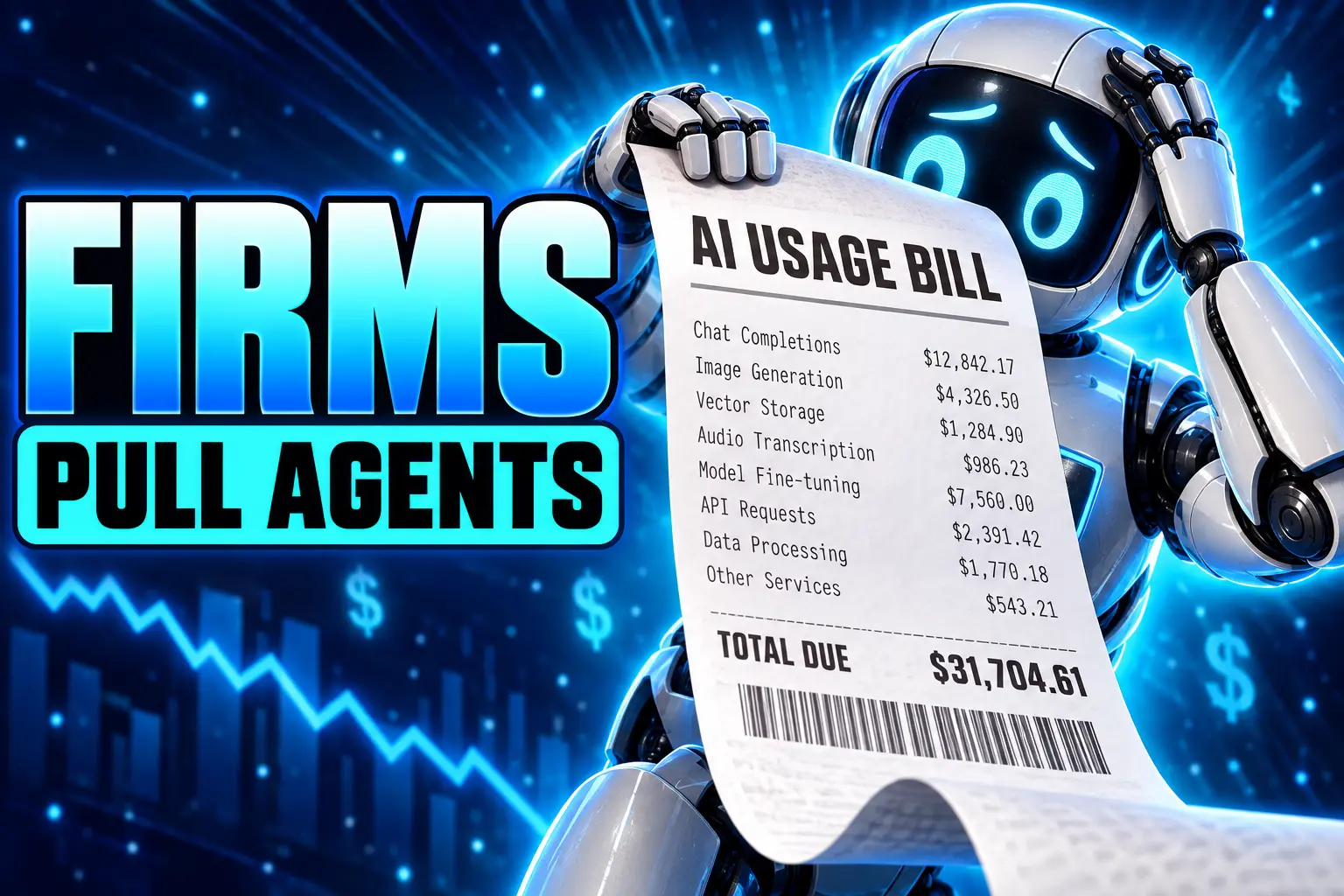
Why Token Bills Arrive After the Work Is Done
Seat licenses made software look like rent. Many AI products now bill like a meter. Providers charge for tokens, the units of text, data, reasoning, and interactions a model processes in a task. A licence still comes with a cap. Once staff blow through it, extra work is billed per token, and long agent runs chew through that cap faster than a chatbot Q&A.
WHAT A TOKEN IS ON THE INVOICE
- The unit: KPMG defines token economics as how AI is priced, consumed, and managed at scale, with tokens as the chunks of text, data, reasoning, and interaction a task burns.
- The lag: Finance often sees the number after the invoice, which is why a live dashboard is not the same thing as a real-time meter.
- The miss: A prompt that looks cheap can fan out into tool calls, retries, and cached context, so the job you approved is not the job you paid for.
Steve Chase, Global Head of AI and Digital Innovation at KPMG International, has already been inside that lag with clients. KPMG has worked with companies that used up annual token and cloud budgets in a few months, and one client saw token usage rise sixfold. Gil Luria, head of technology research at D.A. Davidson, put the finance reaction in plainer words: a lot of CFOs are going to see their Anthropic bill and freak out this quarter.
OpenAI’s Sam Altman heard the same complaint from customers at an Intelligence at Work event in early June. “People are really saying, you know, it’s kind of a meme now, but ‘My company spent my entire 2026 budget in Q1. Can you make this more efficient?’” he said. That worry, he added, went from something that never came up at the start of the year to, all of a sudden, a huge issue. He also said OpenAI’s top token user now burns about 100 billion tokens a month, against 100,000 a month for the firm’s heaviest user six and a half years ago, a level he described as about today’s global per-person average.
A $1,500 Monthly Cap on Claude Code and Cursor
When the meter is missing, companies reach for a ceiling. Uber Technologies exhausted its annual AI budget in four months, a fact its chief technology officer disclosed in April 2026. By early June an Uber spokesperson said the company was limiting all employees to $1,500 in monthly token spending per agentic coding tool, including Anthropic’s Claude Code and Cursor. Spend on one tool does not eat the budget for another. Each employee has a dashboard, and managers can approve overages.
“We think this is all a pretty straightforward way to responsibly encourage agentic AI adoption and experimentation at scale across the company,” the spokesperson said.
The cap landed after Uber had pushed staff to use AI hard, including internal usage leaderboards. Andrew Macdonald, Uber’s president and chief operating officer, has said it is very hard to draw a line between that usage and new consumer features. Walmart has limited staff use of an in-house workplace agent. Those moves match the global pulse: nearly half the sample had already questioned, delayed, or scaled back agent rollouts because expected costs began to outweigh the value generated.
HOW COMPANIES ARE CAPPING THE METER
- Uber’s rule: $1,500 a month per employee per agentic coding tool, tracked on an internal dashboard, with a path to exceed the cap by permission.
- Walmart’s limit: Staff use of an in-house workplace agent has been capped after adoption ran past what the company expected.
- Global pulse: 49% of large organizations delayed or scaled back AI agent deployments once costs started outweighing benefits.
- Budgets on paper: 40% of the global sample already have usage or token budgets, and 54% now require cost reviews in AI project approvals.
Planned AI spend is not collapsing around those caps. Global leaders still put a weighted average of $188 million against the next 12 months, against $186 million in the first quarter, and 79% still call AI a top investment priority, up from 74%. Seventy-nine percent say they would keep that priority even in a recession. The freeze is on unmetered agents, not on the line item.
The Firms That Can See Costs Report ROI
Only 7% of global leaders say they have established ROI from AI, even as 76% say the tools are already delivering meaningful business value, a 12-point rise from the first quarter, and 24% face investor pressure to prove the spend. Those two measures are not the same thing. Meaningful value, in KPMG’s wording, covers productivity, savings, revenue, and better decisions. Established ROI requires those outcomes plus tangible growth and opportunity.
Cost sight is where the split opens. Organizations with full visibility into AI operating costs are five times more likely to report established ROI than those without it, 15 percent against 3 percent. More than half of global leaders (53%) now have AI cost-monitoring dashboards, and 54% have put cost reviews inside approval loops. Forty percent have usage or token budgets. The U.S. sample shows the same hole in a harsher light: dashboards at 66%, real-time sight at 26%.
AI is now as much a financial management priority as it is a technology one. The real risk isn’t investing in AI but doing so without cost visibility and an understanding of the economics of AI. Organizations that have visibility into their costs and maintain strong oversight are the ones translating AI investment into real, measurable value.
Rob Fisher, Global Head of Advisory, KPMG International
Ownership tracks with the same gap. Only 24% of global respondents say the CEO or executive committee is ultimately accountable for AI-informed decisions, and 29% point to a named C-suite executive. Where that accountability is clear, established ROI runs at 14% against 4%, more than three times the rate, and 60% against 22% say they can future-proof their AI strategy. Seventy-five percent say the CEO already owns AI as a strategic priority, which is not the same as owning the outcomes. Chase called that split directly.
We’re seeing a clear divide between organizations with leadership accountability at the top and those without. These companies are seeing materially better results across the board such as greater confidence, higher value realization and established ROI.
Steve Chase, Global Head of AI and Digital Innovation, KPMG International
Agent load is rising underneath those numbers. In the U.S. pulse, 53% of organizations are deploying AI agents, near 55% the quarter before, but the share orchestrating multiple agents across workflows doubled from 9% to 18%. Those agents are being asked to align shared goals (64%), support joint decisions (49%), and automate cross-functional work (48%). Rahsaan Shears, AI Enterprise Transformation Leader at KPMG LLP, said agents are changing both the operating model and the economics, and that governance is what ties scale, performance, and value together. KPMG has separately argued that managing AI agents as a core skill will sit with those same executives. That only works if they can see what the agents cost.
One operator’s books show how fast the bill can run away from the output. In July, Chamath Palihapitiya said his company’s token costs were doubling every 45 days while downstream productivity was up 5% at most, and that more tokens were being burned for the next slice of improvement because the easy gains had already flattened. That is the pattern a live meter is supposed to catch and a year-end invoice never will.
Leaderboards Made Activity Look Like Adoption
Some firms tried to solve usage by scoring it. Amazon set a target for more than 80% of developers to use AI each week and tracked token consumption on internal boards tied to its Kiro developer platform and MeshClaw agents. Staff described colleagues running extra, non-essential jobs to climb those ranks, a habit now called token-maxxing. Amazon told employees the statistics would not go into performance reviews. One worker still said there was just so much pressure to use the tools. Dave Treadwell, a senior vice president, later took the leaderboard down, a tool built with good intentions that had started to reward volume.
The U.S. pulse found the same idea sitting in the C-suite. Forty-one percent of leaders say they would consider token-maxxing, with 22% opposed and 37% neutral. Edwige Sacco, Head of Workforce Innovation at KPMG LLP, treated that as a design error, not a culture win.
Token-maxxing presents a classic risk of incentivizing activity over outcomes. What starts as a productivity metric can quickly become a distraction. In the short term, it deteriorates value; in the long term, it undermines culture.
Edwige Sacco, Head of Workforce Innovation, KPMG LLP
The people who use the tools well already show up in the numbers. Forty-seven percent of U.S. leaders say employees who use AI effectively are already outperforming their peers. Employee resistance to agents has quadrupled in that sample, from 5% to 20%, and the reasons have shifted toward trust and ethics (53%) and workload (51%, up from 28%), while skills-gap fears eased. Access to lower-cost, high-fidelity models was the fastest-rising influence on global AI strategy, moving from 15% to 22%. The fight is no longer whether to buy a model. It is whether the next token is worth it.
The Linux Foundation Started a Token Meter Project
Buyers are now trying to write the missing standard in public. On June 3, 2026, the Linux Foundation announced its intent to launch the Tokenomics Foundation, a vendor-neutral home for open standards, benchmarks, and practices on AI infrastructure economics, in close partnership with the FinOps Foundation. Jim Zemlin, CEO of the Linux Foundation, said tokens have become the new unit of technology spend as generative and agentic workloads move from pilot to production. J.R. Storment, executive director of the FinOps Foundation, said token costs and efficiency have become a CEO-level concern, not an engineering footnote.
On August 4 the foundation launched with 30 initial members, among them IBM, JPMorganChase, Oracle, SAP, ServiceNow, Flexera, and a string of cloud-cost vendors. The roadmap covers shared language for AI ROI, vendor-neutral total-cost models, token cost telemetry in the FOCUS specification, and practitioner training. KPMG had already been listed among organizations that expressed support when the intent was announced in June. The work is the buyer-side answer to the 26% problem: agree on how to count, then argue about the bill.
FROM INVOICE SHOCK TO A SHARED METER
- April 2026: Uber’s chief technology officer says the company’s annual AI budget is already gone after four months.
- April 28 to May 25, 2026: KPMG fields the U.S. and global AI pulse surveys that later put real-time U.S. visibility at 26% and global full visibility at 35%.
- June 3, 2026: The Linux Foundation announces its intent to launch the Tokenomics Foundation with the FinOps Foundation as partner.
- June 24, 2026: KPMG publishes both pulses, including the finding that 49% of global respondents delayed or scaled back agents when costs outweighed benefits.
- August 4, 2026: The Tokenomics Foundation launches with 30 founding members and a brief to write open standards for measuring AI cost and value.
Forty percent of KPMG’s global sample already has usage or token budgets. The rest will still learn the number from a cap, or from the invoice.

Instagram Plus Tests a Read-Only Mode That Cuts Stories

Altman Asks the Public to Accept Some AI Harm

Google Freezes OSS VRP Product Reports After AI Flood

AI Agents Make Payment Rails the Scarce Prize

Turkey’s Crypto Boom Now Runs Through Three Banks

Fable 5 Came Back Under a Commerce On-Off Switch

Google’s SpaceX GPU Lease Has a Sept. 30 Deadline

Plasma One’s XPL Locks Face a 1.81 Billion Cliff

DGO’s Rs 549 World Cup Pass Cost Fans Sleep and Data

Moonshot AI’s $30 Billion Ask Became a $35 Billion Close
-
 AI4 months ago
Fable 5 Came Back Under a Commerce On-Off Switch
-
 AI4 months ago
Google’s SpaceX GPU Lease Has a Sept. 30 Deadline
-
 CRYPTO4 months ago
Plasma One’s XPL Locks Face a 1.81 Billion Cliff
-
 APPS4 months ago
DGO’s Rs 549 World Cup Pass Cost Fans Sleep and Data
-
 AI4 months ago
Moonshot AI’s $30 Billion Ask Became a $35 Billion Close
-

 NEWS4 months ago
ColorOS 17 Device List Spans Oppo, OnePlus and Realme
-

 GAMING4 months ago
Xbox Cuts 3,200 Jobs After Five Years of Thin Returns
-

 GAMING4 months ago
The RTX 4050 Under Rs 70,000 Hides a Wattage Gap