
COMPUTERS
Germany’s HMI Systems Market Will Grow 4-6% Through 2035
Germany’s HMI systems market is forecast to grow 4-6% annually through 2035. Siemens and Beckhoff lead; software and IEC 62443 reshape who wins the volume.

Germany’s HMI systems market is set to grow at a compound annual rate of 4 to 6 percent through 2035, with volume rising more slowly at 3 to 4 percent as the product mix shifts toward industrial PCs and software, according to a new market forecast for Germany’s HMI sector. Domestic suppliers Siemens and Beckhoff hold a combined installed-base share exceeding 50 percent of the national market by value. The growth tilts toward cybersecurity-certified, edge-capable HMIs. Commodity panels absorb the price pressure from Asian imports.
That tension shows up everywhere in the market. Asian brands including Delta, Kinco, and Weintek now undercut European-branded standard panels by 30 to 40 percent on landed price. Lead times for industrial-grade semiconductors run 20 to 30 weeks for parts with extended temperature ratings, an extension of 4 to 8 weeks compared with pre-2022 levels. Software subscriptions and cloud-connected HMIs are projected to approach 30 percent of total market value by 2035, up from 12 to 15 percent in 2026. The market keeps growing; software, security, and edge computing capture the new value.
Five Numbers That Define the 2026 Market
A new analysis of Germany’s HMI systems market sets the 2026 starting line for a decade IndexBox describes as moderate, technology-led expansion within a mature but innovation-driven ecosystem. Replacement of existing operator panels accounts for roughly 60 to 70 percent of annual demand in volume terms, which cushions the market against short-term capex swings. Premium and software-defined HMIs are projected to outpace basic panel categories and gain 5 to 10 percentage points of value share by 2035.
The fastest-growing application segment is electronics and semiconductor manufacturing, where demand is likely to rise at a compound annual rate of 7 to 9 percent as Germany expands domestic fab capacity and battery gigafactories. Hardware lifecycles of 7 to 12 years keep demand sticky, but they also delay technology refreshes once a panel is installed. Unit volumes are forecast to grow at a slightly slower 3 to 4 percent as the product mix tilts toward industrial PCs and software. The IndexBox report also flags semiconductor allocation and rising input costs for displays and touch sensors as supply-side pressures extending lead times by 4 to 8 weeks compared with pre-2022 levels.
The numbers also expose who is being squeezed. Asian brands including Delta, Kinco, and Weintek hold a combined 10 to 15 percent of German unit shipments but below 5 percent by value because their average selling prices are lower. The volume discount that OEMs and system integrators typically negotiate runs 15 to 25 percent off list, with service and validation add-ons contributing another 10 to 20 percent to project cost. The semiconductor bottleneck has raised component costs by an estimated 15 to 25 percent for some product lines, eroding distributor margins, while LCD panel pricing swung 10 to 15 percent year-on-year between 2022 and 2024. Standard panels absorb the price pressure; software and edge capability capture the new value.
- 3 to 4 percent: forecast compound annual unit volume growth for the German HMI systems market through 2035.
- More than 50 percent: combined Siemens and Beckhoff share of the German HMI market by value.
- 60 to 70 percent: share of annual German HMI demand accounted for by replacement of legacy panels.
- 25 to 30 percent: share of German HMI procurement going to automotive and automotive suppliers.
- 30 to 40 percent: landed price discount that Asian standard panels can offer against European equivalents.
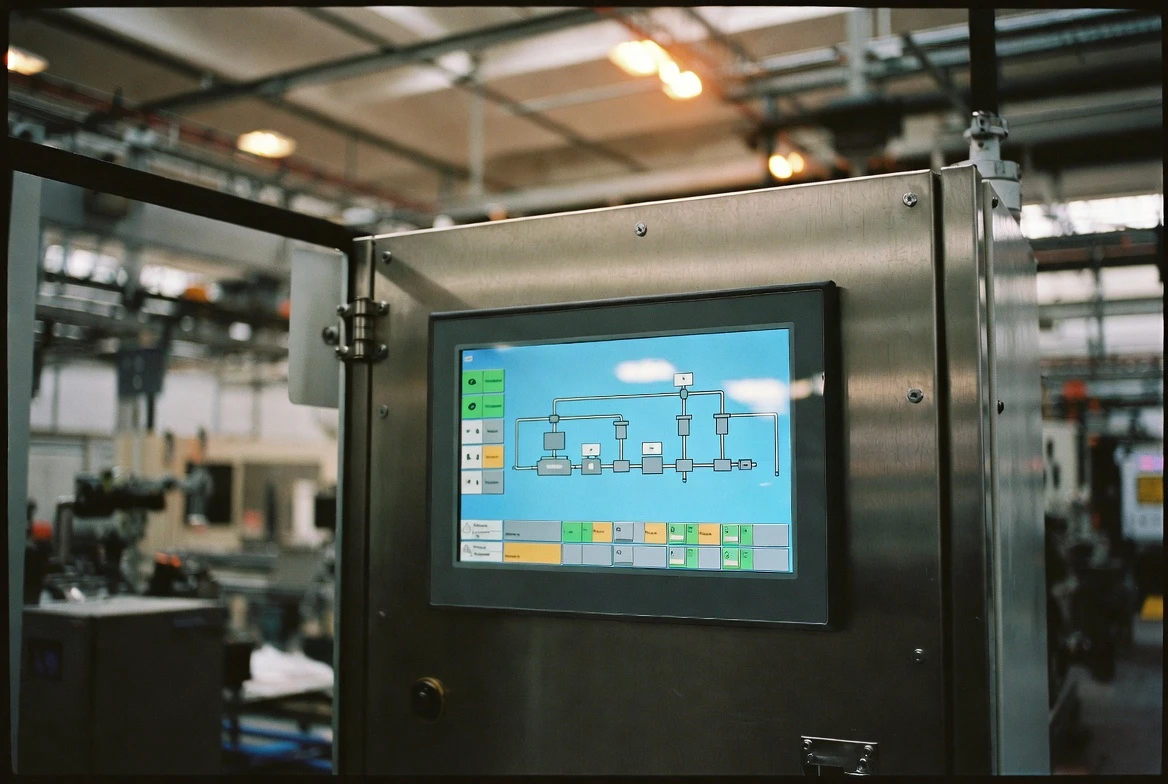
An HMI System at Work in a German Factory
An HMI, or human-machine interface, is the screen and software stack an operator uses to monitor and control a machine on a factory floor. In a German plant, the device might sit on a packaging line, a CNC tool, a robotic cell, or a process control skid, displaying live process values, alarms, and recipe selection on a colour touch panel. The category covers everything from basic text displays to industrial PCs running soft-HMI software, plus the runtime licences those systems depend on.
Germany’s industrial automation intensity is among the highest in the European Union, with a dense installed base of programmable logic controllers and robotic cells that each require an operator interface. That density creates a recurring procurement cycle, fed by capacity expansion in automotive, electronics, and machinery. Roughly one-third of all HMI units sold in Germany are ultimately integrated into machinery for export, which ties domestic demand to global manufacturing investment cycles. The country’s Industry 4.0 policy framework, with federal research funding and industry consortia, sustains a premium-priced segment for HMIs with IIoT connectivity, multi-protocol support, and condition monitoring.
Who Builds HMI Systems in Germany
Siemens sits at the top of the German HMI market through its Simatic product family, which ranges from basic panels to high-end industrial PCs integrated with the TIA Portal engineering environment. The company runs a major HMI assembly plant in Nuremberg that supplies both the domestic market and European export customers.
Beckhoff Automation holds a strong second position from North Rhine-Westphalia, with a TwinCAT-native panel line that excels in PC-based and soft-HMI configurations. The company manufactures its panel and embedded-PC lines in Verl, with additional contract assembly in eastern Europe. German speciality manufacturers including WAGO, Phoenix Contact, and Festo produce integrated HMI or display-connected controllers that blur the line between interface and control, typically serving application-specific niches such as building automation and valve terminals. Rockwell Automation, Schneider Electric, and Mitsubishi Electric maintain significant German presences through subsidiaries and local support centres, while Omron and Panasonic compete primarily in the mid-range original equipment manufacturer (OEM) segment. Asian brands Delta, Kinco, and Weintek together account for 10 to 15 percent of German HMI unit shipments but below 5 percent by value, according to the IndexBox report.
| Supplier | Origin | HMI product line |
|---|---|---|
| Siemens | Bavaria, Germany | Simatic panels and industrial PCs with TIA Portal integration |
| Beckhoff Automation | North Rhine-Westphalia, Germany | TwinCAT-native panels and embedded PCs |
| Rockwell, Schneider, Mitsubishi | Global, with German subsidiaries and support centres | Mid- and high-range panels and industrial PCs |
| Omron, Panasonic | Japan-based | Mid-range OEM panels |
| WAGO, Phoenix Contact, Festo | Germany | Integrated HMI or display-connected controllers |
| Delta, Kinco, Weintek | Asia | Low-cost 4-12 inch standard panels |
Competition is shifting fastest in software. Web-based and virtualised HMI software is displacing standalone hardware panels in greenfield installations, with browser-accessible interfaces projected to reach 20 to 30 percent of new unit placements by 2030. Subscription-based, cloud-connected HMI platforms are growing in parallel with hardware pricing.
German suppliers differentiate on engineering, firmware, and certification. Asian imports compete on panel price. Domestic production is not vertically integrated; design, firmware, final assembly, testing, and certification happen in Germany, while LCD modules, touch film, memory, and industrial-grade integrated circuits are imported from Japan, South Korea, Taiwan, and China. As of 2026, several manufacturers are investing in on-shoring of certain sub-assemblies, including PCB assembly for high-mix low-volume panels, a trend that may lift the domestic production share by 5 to 10 percentage points over the forecast decade.
HMI Pricing Across the Standard and Premium Tiers
Pricing in the German HMI market runs in clear tiers. A standard-grade operator panel, 7 to 10 inches with resistive touch, costs between 400 and 1,200 euros in a bare-unit configuration without software runtime or communication licences. That base tier accounts for the largest unit volume and absorbs most of the price competition from Asian imports. OEMs and system integrators commonly negotiate volume discounts of 15 to 25 percent against list prices. Service and validation add-ons, including custom firmware, protocol testing, and environmental chamber qualification, contribute another 10 to 20 percent to project cost.
Premium specifications push list prices higher. Capacitive touch, extended temperature ratings, certified safe-area electronics, or integrated fieldbus interfaces add 60 to 100 percent to the hardware price, landing in the 1,500 to 3,500 euro range. Industrial PC-based HMIs with high-performance processors, 15-inch or larger displays, and 24/7-rated assemblies command 3,000 to 8,000 euros, depending on memory, connectivity, and validation packages.
On the cost side, LCD panel pricing swung 10 to 15 percent year-on-year between 2022 and 2024, driven by supply shifts in South Korea and China. Semiconductor lead times for industrial-grade system-on-chips have stabilised but still run 20 to 30 weeks for parts with extended temperature ratings, forcing distributors to hold higher buffer inventories and adding an estimated 5 to 8 percent to working capital costs. The combined effect is tighter hardware margins for distributors and integrators, even as end-user demand for premium features rises. Procurement teams respond with multi-year framework agreements and second-source qualification.
| Tier | Specifications | List price range |
|---|---|---|
| Standard panels | 7-10 inch display, resistive touch, bare-unit | €400-€1,200 |
| Premium specifications | Capacitive touch, wide-format display, extended temperature, certified electronics, integrated fieldbus | €1,500-€3,500 |
| Industrial PC-based HMIs | 15-inch or larger display, high-performance processor, 24/7-rated assembly | €3,000-€8,000 |
Demand Concentrated in Four Verticals
Demand for HMI systems in Germany splits across industrial manufacturing, process industries, and energy or building automation. Industrial manufacturing is the largest segment, accounting for roughly 55 to 65 percent of system placements in 2026, followed by process industries at 20 to 25 percent and energy, infrastructure, or building automation at 10 to 15 percent. By end use, automotive and automotive-supplier plants are the single largest vertical at an estimated 25 to 30 percent of HMI procurement, driven by renovation cycles in high-mix assembly lines. Electronics and semiconductor manufacturing, including precision optics and battery cell production, is the fastest-growing application segment, with demand likely rising at a compound annual rate of 7 to 9 percent as Germany expands domestic fab capacity and battery gigafactories. Machine building accounts for another 20 to 25 percent of demand, with embedded panels going into packaging, printing, and metalworking tools.
The aftermarket and spare-parts channel, covering service, replacement, and lifecycle support, accounts for 15 to 20 percent of total market value because the cost of downtime makes backward-compatible replacements essential during line retrofits. Standard HMI panels of 4 to 15 inches make up the largest unit volume, estimated at 45 to 55 percent of total shipments in 2026, with industrial PC-based HMIs at 20 to 25 percent. Replacement of existing HMI equipment represents about 60 to 70 percent of annual demand in volume terms, making the market unusually resilient to short-term capex swings. The forecast period assumes a return to moderate industrial expansion after the post-pandemic correction, supported by fiscal incentives for digitisation and carbon-neutral manufacturing.
Germany Runs a Trade Surplus in HMI Systems
Germany is a net exporter of HMI systems, consistent with its broader automation equipment trade surplus. Export value is estimated at 1.3 to 1.6 times import value, driven by strong shipments of German-branded panels and industrial PCs to the rest of Europe, North America, and China.
The largest export markets for German HMI systems are the EU neighbour states France, Italy, and Austria, plus the United States, where German machine builders and integrators carry their preferred interface brands into project specifications. Domestic production supplies an estimated 60 to 70 percent of HMI units consumed in Germany by volume, with the balance met by imports. The two main production centres are Siemens’s Nuremberg plant and Beckhoff’s facility in Verl, both with additional contract assembly in eastern Europe. Components that drive the trade balance include LCD modules, touch film, memory, and integrated circuits imported from Asia.
Imports arrive primarily from China, accounting for 10 to 15 percent of domestic consumption by value, Japan at 5 to 8 percent, and intra-EU flows from the Netherlands and Poland, often representing re-exports of Asian-origin goods through European distribution hubs. Asian HMI makers price aggressively in the 4 to 12 inch segment, with landed prices that can undercut European-branded equivalents by 30 to 40 percent. Tariff treatment is governed by the EU’s Common Customs Tariff, with HMI systems typically classified under HS 8537 or 8543 and most imports from China subject to a 0 to 2 percent duty rate. Those imports remain subject to potential anti-circumvention reviews if disguised as other goods. Customs documentation increasingly requires a supplier’s declaration of conformity with EU EMC and safety directives.
Domestic supply is being re-engineered in small but visible ways. Since 2022, capacity constraints in microcontroller and power-management integrated circuit supply have limited output growth, with some panel variants facing a 4 to 6 week order backlog. Several manufacturers are now investing in on-shoring of sub-assemblies to reduce logistical risk, a shift that may lift the domestic production share by 5 to 10 percentage points over the forecast decade.
Why Regulation Is Reshaping HMI Procurement
Regulation in the German HMI market acts as a competitive filter, raising the cost of entry for low-cost importers. The baseline is the EU’s New Legislative Framework, which requires CE marking under the Machinery Directive 2006/42/EC, plus conformity with harmonised standards for electrical safety (EN 61131-2) and electromagnetic compatibility (EN 61000-6-2/4). For applications in explosive atmospheres, including chemical, pharmaceutical, and oil and gas sites, ATEX directive compliance 2014/34/EU is mandatory and adds 8 to 12 weeks of qualification lead time for certified hardware variants. In food and pharmaceutical processing, surface-cleanliness and wash-down protection standards (IP65-69K) are de facto requirements. Compliance with these standards is a hard prerequisite for participation in many tenders.
Cybersecurity is the new procurement filter. IndexBox reports that IEC 62443-4-2 certification is becoming a de-facto requirement for connected HMI devices in the automotive, chemical, and energy sectors, raising the technical barrier for low-cost importers. Many German end users already mandate IEC 62443-4-2 in tenders for new production lines, and non-compliance is a disqualifier in high-value contracts. The EU Cyber Resilience Act is expected to apply from 2027, imposing lifecycle security requirements on connected devices across the bloc.
The practical effect is a two-tier procurement environment. Premium-certified European suppliers capture the automotive, chemical, and energy markets where security and safety certification are non-negotiable, while Asian and other low-cost importers stay competitive in the 4 to 12 inch segment where certification costs weigh heaviest on already-thin margins.
| Standard | Scope | Procurement impact |
|---|---|---|
| Machinery Directive 2006/42/EC | All HMI systems sold in the EU | CE marking required |
| EN 61131-2 and EN 61000-6-2/4 | Electrical safety and electromagnetic compatibility | Baseline conformity |
| ATEX 2014/34/EU | Use in explosive atmospheres | Adds 8 to 12 weeks of qualification lead time |
| IEC 62443-4-2 | Industrial automation cybersecurity | De-facto tender requirement for connected devices |
| EU Cyber Resilience Act | Connected device lifecycle security | Applies from 2027 |
What 2035 Looks Like for the German HMI Market
IndexBox projects that the German HMI market will continue to expand steadily through 2035, with value migrating upward into software, edge computing, and security-certified panels. In volume terms, the market may grow by 40 to 55 percent, with the fastest growth in the high-end industrial PC segment at a compound annual rate of 7 to 9 percent. Software runtime licences are projected to grow fastest of all, at a compound annual rate of 9 to 12 percent.
The split between volume and value growth is the central story. Hardware lifecycles of 7 to 12 years mean replacement demand continues to anchor unit volumes, while greenfield projects in battery manufacturing, semiconductor fabrication, and hydrogen infrastructure provide incremental demand exceeding 10 percent of total shipments by 2030. By 2035, software subscriptions and cloud-connected HMIs could approach 30 percent of total market value, up from an estimated 12 to 15 percent in 2026. Premium and software-defined HMIs are projected to gain 5 to 10 percentage points of value share by 2035, though macroeconomic headwinds may cap growth at the lower end of the forecast range in some years.
Four identifiable opportunity vectors will shape investment and product strategy through 2035, anchored by legacy panel replacement, SME digitisation, edge AI integration, and cross-border service revenue. The most immediate is replacing ageing HMIs in the large installed base of pre-2015 machine tools and packaging lines, many of which lack Ethernet, USB, or web interfaces. A second sits in the SME sector, where roughly 40 to 50 percent of companies with fewer than 250 employees still rely on push-button panels rather than graphical HMIs, with KfW funding and EPI stimulus lowering the upgrade barrier.
A fourth opportunity is the cross-border service revenue from German-branded machinery operating in export markets, where remote monitoring and firmware updates create recurring revenue potential. Suppliers that combine hardware, software, and security lifecycle services sell into the premium tier.
- Legacy replacement. The largest installed base of pre-2015 machine tools and packaging lines still runs HMIs without Ethernet, USB, or web interfaces, creating a clear retrofit demand pool.
- SME digitisation. Roughly 40 to 50 percent of German companies with fewer than 250 employees still rely on push-button panels. KfW funding and EPI stimulus lower the upgrade barrier.
- Edge AI integration. HMIs that can host local analytics software for predictive maintenance or quality inspection are becoming edge nodes rather than mere displays.
- Cross-border service revenue. German-branded machinery operating in export markets creates recurring remote-monitoring and firmware-update revenue for suppliers with strong cloud and IoT partnerships.
Frequently Asked Questions
How big is the German HMI systems market?
The IndexBox report does not quote a euro value for the 2026 German HMI market; it instead forecasts 4 to 6 percent nominal value growth through 2035, against 3 to 4 percent unit volume growth. Manufacturing dominates placements, with process industries and energy or building automation following.
Who are the leading HMI suppliers in Germany?
Siemens leads through its Simatic product family and TIA Portal integration, with a major assembly plant in Nuremberg. Beckhoff Automation holds a strong second position via its TwinCAT-native panel line manufactured in Verl, with WAGO, Phoenix Contact, and Festo competing in integrated niches.
Why are Asian HMI panels gaining share in Germany?
Asian brands including Delta, Kinco, and Weintek focus on the entry-level 4 to 12 inch segment, where they can land prices 30 to 40 percent below European equivalents. Their unit share runs 10 to 15 percent of German shipments, but value share stays below 5 percent because their average selling prices are lower.
How is regulation shaping the German HMI market?
Connected HMI devices increasingly need IEC 62443-4-2 cybersecurity certification to win tenders in automotive, chemical, and energy. The bloc-wide EU Cyber Resilience Act will require lifecycle security on connected devices from 2027 onward.
What will the German HMI market look like by 2035?
IndexBox forecasts unit volumes up 40 to 55 percent across the decade, with software subscriptions and cloud-connected HMIs reaching roughly 30 percent of total market value, from 12 to 15 percent in 2026. Industrial PC-based HMIs and software runtime licences lead the growth, at 7 to 9 percent and 9 to 12 percent CAGR respectively.


South Korea Retail Investors Face Reckoning After KOSPI AI Rally Collapses

Surrey AI Maps Three Heart Attack Paths and Their Molecular Roots

Germany Locks Neutral Apple ATT Prompts Across Most of Europe

Apple’s 5% EU Fee Quietly Rewrites Alternative App Store Math

Apple’s EU Fee Truce Cuts Complexity but Leaves Rivals Fuming

Pixel 11 Pro Fold Trades Thinness for Durability and Seven-Year Stay

Mayo AI Flags HCM Obstruction From Everyday Ultrasound Videos

Indian Brands Quietly Scale Landmark Screens and Home Tech

Navin Vatsa Turns Grief Into a Lifetime of Quiet Seeing

Google Bets Pixel 11 Agentic AI Will Redefine Phones

Oracle Cuts 21,000 Jobs in a Year, Cites AI in 10-K Filing

Fable 5 and Mythos 5 Return as US Lifts Anthropic Export Controls

SpaceX’s Google Deal Turns a Rocket Company Into a Cloud Landlord

CD Projekt Red Co-CEO: Redemption Arc Isn’t Done, Witcher 4 in 2027

XPL Rallies 30% Ahead of Plasma One Card Tier Launch

Google Search Profiles Build a Follow Graph Inside Discover

DGO App Brings Rs 549 Mobile Pass for FIFA World Cup 2026 in Nepal

Moonshot AI Targets $30 Billion in China’s Fastest AI Funding Sprint

Oppo’s ColorOS 17 Eligibility List Leaves A-Series Buyers Behind

Microsoft Xbox Layoffs Start in July as Sharma Slams 3% Margin
-
 AI2 months ago
Oracle Cuts 21,000 Jobs in a Year, Cites AI in 10-K Filing
-
 AI2 months ago
Fable 5 and Mythos 5 Return as US Lifts Anthropic Export Controls
-
 AI2 months ago
SpaceX’s Google Deal Turns a Rocket Company Into a Cloud Landlord
-
 GAMING2 months ago
CD Projekt Red Co-CEO: Redemption Arc Isn’t Done, Witcher 4 in 2027
-
 CRYPTO2 months ago
XPL Rallies 30% Ahead of Plasma One Card Tier Launch
-
 NEWS2 months ago
Google Search Profiles Build a Follow Graph Inside Discover
-
 APPS2 months ago
DGO App Brings Rs 549 Mobile Pass for FIFA World Cup 2026 in Nepal
-
 AI2 months ago
Moonshot AI Targets $30 Billion in China’s Fastest AI Funding Sprint