
NEWS
England’s Three-Item Uniform Cap Is Already Closing Loopholes
England’s new school uniform cap limits branded kit to three items, or four with a tie, and ministers are already closing optional PE and supplier loopholes.

England’s state schools may now require only three branded uniform items, or four at secondary if one is a tie. That limit in the Children’s Wellbeing and Schools Act 2026 took effect on 1 September 2026.
On 4 September 2026, Education Secretary Lucy Powell said schools that treat branded sports kit as optional with no cheap alternative, or press parents into it, will face intervention. The count was never going to be the whole fight.
The Three-Item Cap Now in Force
Section 35 of the Act, which came into force on 1 September 2026, stops a relevant school in England requiring more than three branded items at primary, or more than three at secondary unless one of those items is a tie. Middle schools use the secondary limit for every pupil on roll.
A pupil is treated as required to have an item if they need it for general use, for travel to or from school, or to take part in any lesson, club, activity or event the school facilitates. That yearly total includes PE and after-school sport. A bag counts. A summer dress counts. Safety kit such as a high-visibility vest does not, and neither do Scout or Cadet uniforms.
THE LEGAL LIMIT FOR 2026 TO 2027
| Setting | Compulsory branded items | The tie rule |
|---|---|---|
| Primary | 3 or fewer | A tie sits inside the 3 |
| Secondary | 3, or 4 if one is a tie | The fourth item must be a tie |
| Middle school | Same as secondary, for all pupils | Same tie rule |
The Department for Education says some families will save up to £50 per child. A government survey found around 23% of secondary schools still had to change their lists to comply. Most primaries were already close. The Education Secretary can direct a school to rewrite its policy if it does not.
Supplier-Only Design Still Counts as Branded
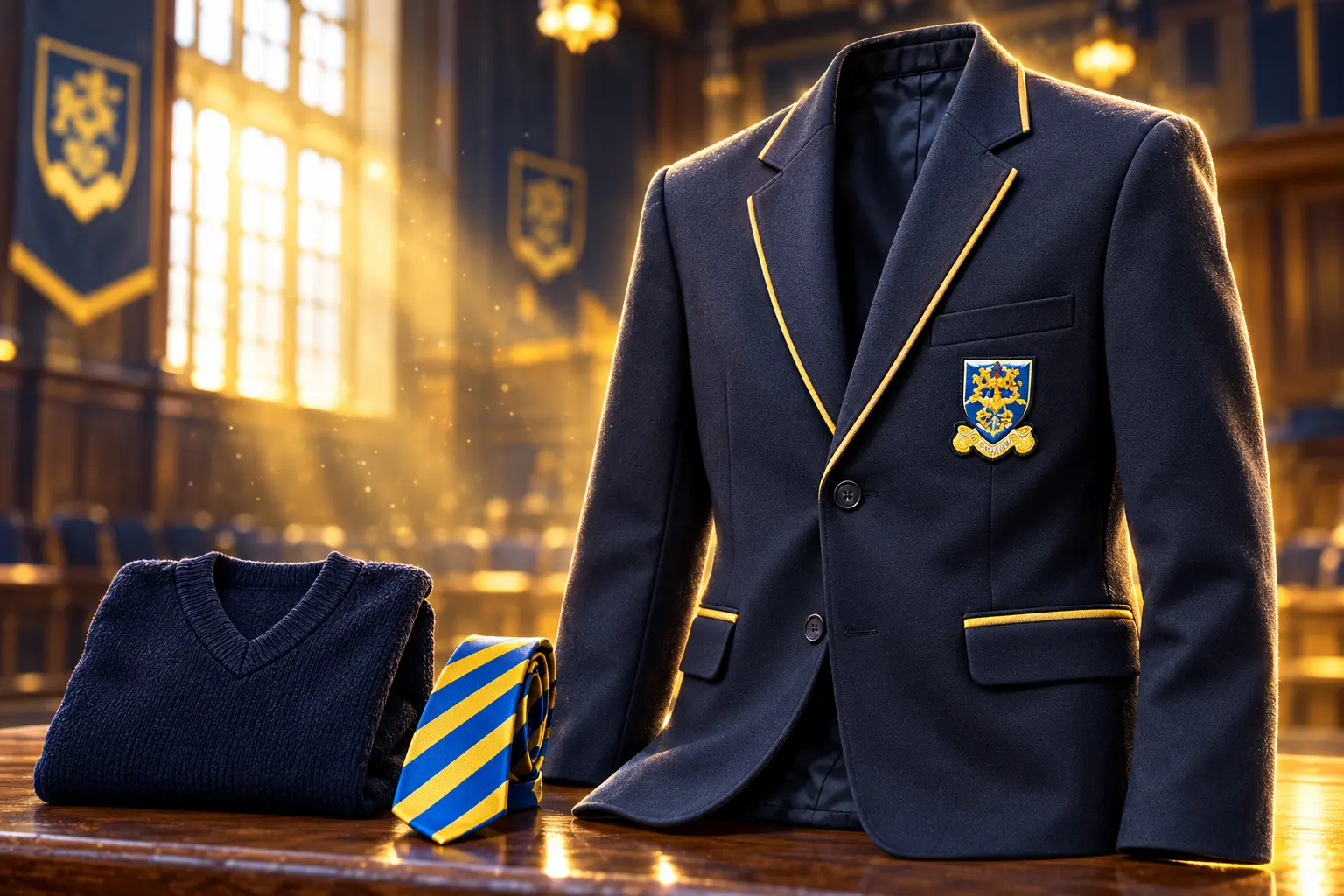
The trap in the old debate was the logo. Statutory guidance on what counts as a branded item is wider than a crest on a blazer. An item is branded if a name or logo makes it unique to the school or trust. It is also branded if colour, design, fabric or another distinctive feature means it can only be bought from the school’s appointed supplier.
BRANDED, IN PLAIN TERMS
- A logo or name: A blazer with the school shield sewn on is branded, even if the rest of the garment looks ordinary.
- A supplier-only cut: Trousers in a unique style sold by one shop are branded, with or without embroidery.
- A colour or trim lock: A sweatshirt with a year-group stripe that only one supplier stocks is branded.
- A generic staple: A navy skirt or grey cardigan sold in a range of shops is not branded, and schools can still set rules on colour, shade, fabric and fit.
The guidance walks through a secondary example that catches schools still writing seasonal lists. A pupil cannot be required to have a branded winter skirt and a branded summer dress if they are also required to have a branded blazer, tie and PE top, because that is five branded items for the year. If the school lets a pupil choose a branded skirt or branded trousers, that choice counts as one item.
Optional branded kit is still allowed, but only if a generic version is also permitted. The 4 September 2026 statement was aimed at schools that called an item optional while offering no cheap alternative, and at staff who steered families into branded PE. Powell put it without a hedge.
No family should be priced out by a school’s choice of uniform supplier or an insistence on branded items. We’ve been clear with schools. Three items for primary, four for secondary, no exceptions and no excuses. If schools try to work around that, we will step in.
Lucy Powell, Education Secretary, 4 September 2026
Prime Minister Andy Burnham, speaking the same day, said uniforms should not be charged at luxury prices when they are everyday essentials, and that the government would close loopholes used to overcharge parents. Save the Children polling cited in that statement found 47% of parents ranked uniform as their biggest back-to-school money worry. Dan Paskins, the charity’s executive director of UK impact, said nearly half of parents it polled named uniform costs as their main financial concern about the return to school.
What Co-op Academy Belle Vue Cut From Its List
Co-op Academy Belle Vue in Manchester dropped compulsory branded kit from seven items to three plus a tie. The academy put last year’s average branded bill at £101.94 with a pinafore and £83.95 without. This year’s branded average is £53.97, and the school says the figure will fall again after it switches supplier.
The items it removed are the branded blazer, branded pinafore, branded shorts and PE jogging bottoms. Parents now buy a branded jumper, a tie, and two branded PE tops for summer and winter. The jumper loses its year-group stripe so a sibling can inherit it. Linda Ubawike, who has three children at the school, said her uniform bill dropped by £70 this year, that more of the kit now comes from a supermarket, and that her son starting in September is getting the whole uniform for free.
Other lists have barely moved. Lorraine, a London parent of two secondary pupils, said several items remain compulsory, including a branded blazer, tie, branded polo shirt, branded shorts and two-toned PE socks, and that even plain grey trousers or a skirt still have to come from a school supplier. After growth spurts this summer she expected to spend more than £200 on branded items alone. A father in Oxfordshire said his daughter still needed seven branded items, three for the day uniform, three for PE and a summer polo, with no generic alternatives, and that the bill was £200.
King’s Oak Academy in Bristol, which runs from reception to Year 11, had already cut itself to one compulsory branded item, a PE T-shirt. A jumper, tie and shirt that together cost about £41 came off the required list. Pupils now wear a plain polo that changes colour by phase, a sweatshirt or cardigan, grey skirt or trousers, and black trainers, at about £10 to £25 depending on the shop. Optional iron-on badges are 50p from reception. Principal Katherine Ogden, a former PE teacher, wanted kit that was practical to move in and still let families buy a logo if they wanted one.
Single Suppliers Still Set the Price of What Is Left
Once a school is inside the cap, the remaining three or four items can still be the expensive ones, which is why the guidance tells governing boards to look at blazers and jumpers as a class, not only at the length of the list. Schools should consider sew-on badges so a parent can buy a plain garment anywhere. They should avoid specialist tailoring, custom colour fabrics, and piping that adds cost without a clear benefit. They should publish the policy on the website, including which items are compulsory, and make second-hand stock easy to find for current and prospective families.
Supplier contracts sit behind those choices. Governing boards should put cost and value for money first, including quality and how long a garment lasts, and they should avoid a single supplier unless more than one firm can bid and the contract is re-tendered at least every 5 years. The 4 September statement adds that schools will be expected to look for suppliers that offer payment plans. Production is planned 9 to 12 months ahead, with branded orders typically placed by December for the following summer, so a late rewrite of the list raises the price parents pay.
HOW THE UNIFORM CAP BECAME LAW
- 19 November 2021: Statutory guidance on the cost of school uniforms takes effect under the Education (Guidance about Costs of School Uniforms) Act 2021, telling schools to keep branded kit to a minimum without a hard cap.
- 29 April 2026: The Children’s Wellbeing and Schools Act 2026 receives Royal Assent after Labour’s manifesto pledge to limit branded uniform and PE kit.
- 29 June 2026: Mobile phone guidance becomes statutory under the same Act; schools are told to follow it from 1 September 2026.
- 6 July 2026: The Department for Education updates the uniform cost guidance and confirms the legal limit for the new school year, with extra steps on the price of individual items due in time for September 2027.
- 1 September 2026: Section 35 comes into force. The branded-item cap is now a legal duty, not advice.
- 4 September 2026: Ministers announce tighter rules on optional kit, branded sportswear pressure, payment plans and five-year contract reviews.
Parliament’s own briefing on how much uniforms cost in England notes that schools are not required to have a uniform at all, that governing boards still set the policy, and that the 2021 cost rules were already meant to stop kit becoming so expensive that a family would not apply. The 2026 cap is the first hard number on branded pieces.
Matthew Easter’s Case for Keeping More Branding
Specialist schoolwear shops spent the year arguing the cap is too low and badly timed. A Schoolwear Association survey of its members found 71% of specialist retailers said the schools they supply oppose or strongly oppose the policy, 53% said those schools were finding it quite difficult to adapt, and 63% were still getting questions about what a branded item even is. Chair Matthew Easter said branded kit reduces visible inequality and supports behaviour, and that the change would create division because families would fill the gap with fashion brands or with generic garments that wear out faster.
Pepe Di’Iasio, general secretary of the Association of School and College Leaders, struck a cooler note. He said schools are already trying to balance cost against identity, that keeping expensive fashion brands out of the playground still matters, and that the actual difference in cost is likely to be marginal for most families.
WHERE EXPERTS DISAGREE
- Ministers: Lucy Powell and Andy Burnham treat the cap plus supplier rules as a direct cut to family bills, with a government figure of up to £50 per child and a power to rewrite a school list that does not comply.
- Schoolwear Association: Matthew Easter says the cap was set too low, that specialist retailers face obsolete stock and weaker demand, and that cheaper generic kit and fashion PE will cost parents more over a full year.
- ASCL: Pepe Di’Iasio says most schools were already trimming lists, so the cash difference for a typical family will be small, while a common uniform still keeps designer sportswear out.
Frank Young, chief executive of Parentkind, backed the Act when it passed, saying millions of parents were stuck with school costs they had no option but to pay, and that limits on expensive uniform items would help households on middle incomes as well as those already under strain. That parent-side case is what the government is now trying to lock in by policing optional kit, not only by counting crests.
The Same Act Also Locked Phones Away All Day
Uniform is the cost rule. The same Act put mobile phone guidance on a statutory footing from 29 June 2026, with schools told to follow it from 1 September 2026. All schools should be mobile phone-free by default through lessons, the time between lessons, break and lunch. The rule covers phones and other smart tech with similar functions, including devices that send or receive messages or that record audio or video, which is how smartwatches come in.
Headteachers choose the method. Some schools use lockers so a pupil still has a phone for the walk home. Some take the handset in at the gate. Some require it switched off and out of reach. Bring-your-own laptops or tablets for classwork sit under a separate device policy, and that policy should not include phones. Sixth-form access can be limited to certain times and rooms, and not in front of younger pupils. Medical needs, including a phone tied to a glucose monitor, still get a reasonable adjustment.
WHAT THE PHONE RULE REQUIRES
- No access in the day: Pupils should not have use of a phone or similar smart device from the first lesson through lunch and back again.
- Staff example: Staff should not use a personal phone in front of pupils, except for defined school tasks such as rewards, sanctions or sign-in.
- Sanctions: Schools may confiscate a device, and staff are protected from liability for loss if they act lawfully and the penalty is proportionate.
- Contact home: Parents who need to reach a child during the day should go through the school office, not a pocket device.
The wider cost package sitting beside the cap is larger than a blazer. Free school meals now cover every child in a household on Universal Credit, a group the government puts at 3 million in total, with at least 500,000 more children eligible and a stated saving of up to £500 per child per year. Over 1,400 more schools are launching free breakfast clubs, taking the total to more than 2,700 and more than 680,000 children, put at up to £450 and 95 hours a year for a family that uses the club every day. Ministers add those two figures to cheaper uniform and call the combined cut almost £1,000 for many families. The uniform cap is the smallest slice of that sum, and the slice that still depends on how a school writes its list.
How to Check a School Uniform List Against the Law
Every relevant school should have a revised policy on its website, written so a parent of a new starter can see which items are compulsory and which are optional. Generic rules on colour, fabric and fit are allowed. A unique garment that can only be bought from one shop is not a generic rule, it is a branded item, and it uses up one of the three or four slots for the whole year, including PE.
WHAT TO CHECK ON THE SCHOOL WEBSITE
- The compulsory count: Add every branded piece required for the year, including PE tops, a book bag and a summer dress, and see whether the total sits at three, or four with a tie.
- The supplier test: If grey trousers or a skirt can only be bought from the school shop, treat them as branded even when there is no logo.
- The optional test: If a branded hoodie or hat is listed as optional, the policy should also say what unbranded version is allowed.
- Second-hand stock: Information on used uniform should be on the site and open to prospective families, not only to people already on roll.
- The 2027 price step: Schools have been told to cut the cost of high-price items such as blazers and jumpers in time for kit bought for September 2027, including simpler designs and sew-on badges.
If a list still reads like seven compulsory branded pieces, or if a “optional” PE top is the only way onto a school team, that is the gap Powell said she would step into. The Department has also said it will run a post-implementation review of the actual effect on bills, which is the test the cap has not yet sat.
Frequently Asked Questions
How many branded school uniform items can a school in England require?
A state-funded primary school can require three or fewer compulsory branded items for the school year. A secondary or middle school can require four if one of those items is a tie, and a middle school applies that secondary limit to every pupil, not only to the older year groups. If the policy lets a pupil choose a branded skirt or branded trousers, that choice counts as one item because the pupil only needs one of them to comply.
Do sew-on badges and loaned team kit count toward the cap?
If a school asks parents to sew or iron a badge onto a generic garment, that garment is treated as branded and uses a slot. Loaned or gifted kit that a pupil must wear for a lesson, club or match also counts; kit the school merely offers, and that a pupil can refuse in favour of a plain alternative, does not. Personal protective equipment and Scout or Cadet uniforms sit outside the cap.
Does the branded uniform cap apply in Scotland, Wales and Northern Ireland?
No. The Children’s Wellbeing and Schools Act 2026 uniform limit applies to relevant state-funded schools in England. Scotland, Wales and Northern Ireland set their own school uniform rules, and none of those administrations has put a statutory cap on branded items, though each publishes guidance that schools should keep costs down.
Can schools still sell extra branded kit if it is optional?
Yes, a school may still sell, loan or give extra branded items so long as wearing them is not required for participation and a generic equivalent is allowed. Football, rugby or hockey kit for a school-facilitated team sits inside the same yearly total if the pupil has to have it. Optional kit with no cheap alternative is the loophole ministers said they would close.
When do schools have to cut the price of blazers and jumpers themselves?
The item-count cap is in force for the 2026 to 2027 school year. Separate statutory advice tells schools, in time for parents buying kit for September 2027, to look at the price of each required item, especially blazers and jumpers, and to drop design choices that add cost without a clear benefit, including custom fabrics and intricate trim.
The cap is now a number in statute. Whether a family’s bill actually falls still depends on whether the three remaining items are a supermarket jumper or a single-shop blazer, and on whether PE stays inside that count when the first fixture list goes up.

Instagram Plus Tests a Read-Only Mode That Cuts Stories

Altman Asks the Public to Accept Some AI Harm

Google Freezes OSS VRP Product Reports After AI Flood

AI Agents Make Payment Rails the Scarce Prize

Turkey’s Crypto Boom Now Runs Through Three Banks

Fable 5 Came Back Under a Commerce On-Off Switch

Google’s SpaceX GPU Lease Has a Sept. 30 Deadline

Plasma One’s XPL Locks Face a 1.81 Billion Cliff

DGO’s Rs 549 World Cup Pass Cost Fans Sleep and Data

Moonshot AI’s $30 Billion Ask Became a $35 Billion Close
-
 AI4 months ago
Fable 5 Came Back Under a Commerce On-Off Switch
-
 AI5 months ago
Google’s SpaceX GPU Lease Has a Sept. 30 Deadline
-
 CRYPTO4 months ago
Plasma One’s XPL Locks Face a 1.81 Billion Cliff
-
 APPS5 months ago
DGO’s Rs 549 World Cup Pass Cost Fans Sleep and Data
-
 AI5 months ago
Moonshot AI’s $30 Billion Ask Became a $35 Billion Close
-

 NEWS5 months ago
ColorOS 17 Device List Spans Oppo, OnePlus and Realme
-

 GAMING4 months ago
The RTX 4050 Under Rs 70,000 Hides a Wattage Gap
-

 AI4 months ago
Boris Cherny’s Loops Still Demand a Higher Production Bar