
NEWS
The Honor 600 Pro Mirrors the iPhone 17 Pro. Its Trust Record Doesn’t
Honor’s 600 Pro copies the iPhone 17 Pro’s orange, camera bump, and lens triangle. The after-sales record across Australia and the UK is the harder story.

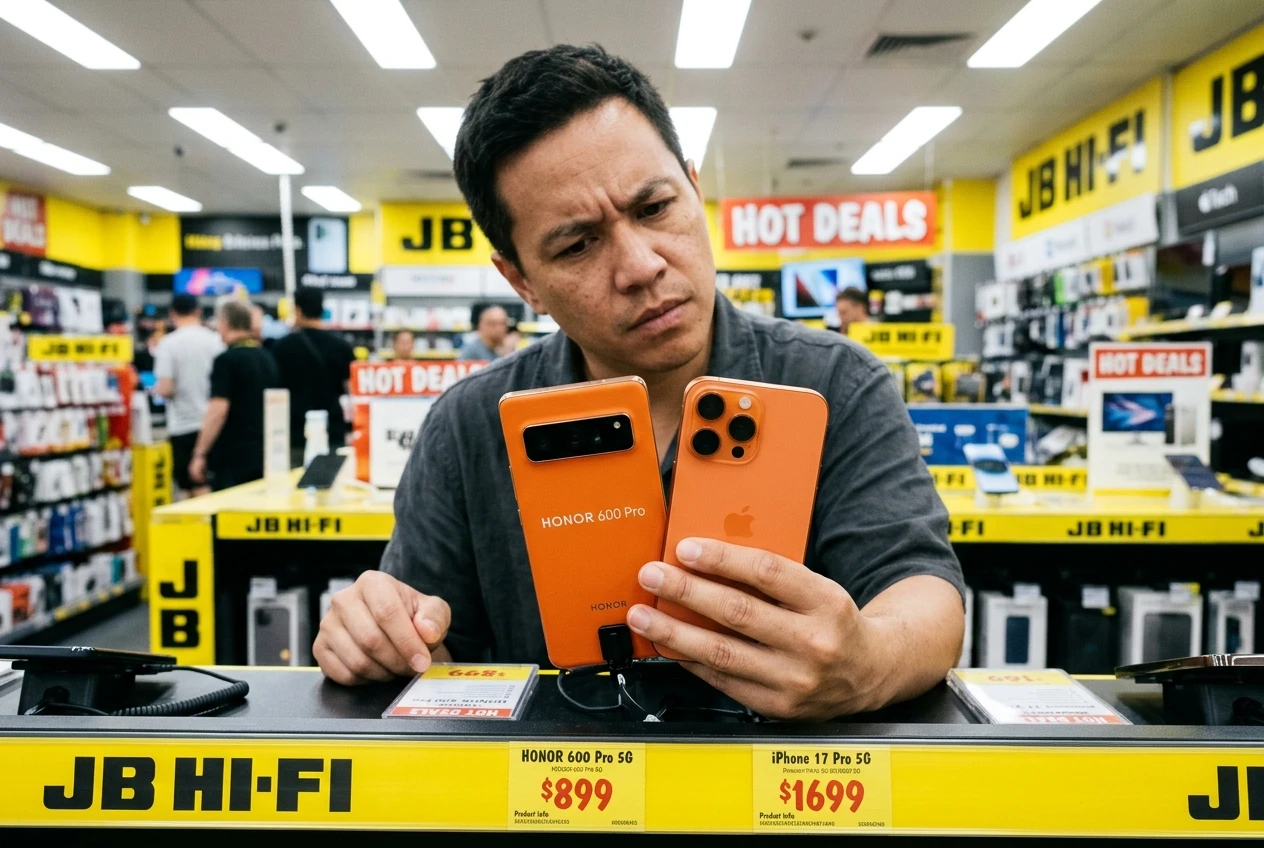
Honor put the 600 Pro on sale in Australia at A$1,499 with the same orange finish, full-width camera bump, and rear lens triangle Apple uses on the iPhone 17 Pro. TechRadar flagged the visual match in its review and noted a price that sits between the A$1,399 iPhone 17 and the A$1,999 iPhone 17 Pro. The base model Honor 600, without the Pro suffix, ships at A$999 in the same local retail channels.
Australian and UK reviewers have spent the last year describing the gap between the box on the shelf and the experience after the receipt. Trustpilot and ProductReview threads include multiple accounts of buyers being quoted hundreds of dollars for repairs on devices still inside Honor’s two-year warranty window. The launch on JB Hi-Fi and The Good Guys runs alongside those posts. The warranty pattern is the part of the offer that has been hardest for Honor to settle.
The Copy, Item by Item
The Honor 600 Pro takes Apple’s orange in the same shade Apple tied to its Pro line. The full-width horizontal camera module is Apple’s industrial design stamp, mirrored so directly that TechRadar called out the resemblance in its coverage headline. The three rear lenses sit in the same triangular layout Apple uses on the iPhone Pro. The colour set Black, Golden White, and Orange mirrors the Pro palette. The four design parallels cover the entire visible identity of the rear panel and the colour framing of the phone.
Channelnews catalogued the resemblance at four direct design cues shared with the iPhone 17 Pro. The build quality, the specification depth, and the after-sales service that an iPhone ships with sit on the other side of the design debt. Motorola and Samsung run their own design vocabularies in the same price tier.
Asked by TechRadar about the resemblance, Honor pointed to ‘familiar premium aesthetics’ balanced with its ‘own distinctive identity.’ The phrasing concedes the visual debt. The parts Honor built independently sit on the spec sheet: a 6.57-inch AMOLED screen with 0.98mm bezels, a 200-megapixel main camera, a 50-megapixel periscope telephoto with 3.5x optical zoom, and a 7,000mAh silicon-carbon battery. The Pro ships with 512GB of internal storage and runs the Snapdragon 8 Elite chipset.
- The orange finish, identical to Apple’s Pro-line signature colour.
- The full-width horizontal camera module, Apple’s industrial design stamp.
- The identical arrangement of the three rear lenses and sensors.
- The unibody framing and colour palette printed across Honor’s marketing material.
Where Honor Actually Comes From
Honor launched in 2013 as Huawei’s budget-focused smartphone sub-brand, the label Huawei used to sell cheaper devices that ran the parent’s software and design language at lower prices. The brand was set up to push Huawei’s volume share into the markets the parent couldn’t reach at premium-tier price points.
The arrangement held until late 2020, when US sanctions cut Huawei off from the smartphone chips and radio components Samsung and Motorola used freely. The local tech outlet reports Huawei had little choice but to spin the brand out as a standalone company, clearing the way for it to access US technology again. The buyer, per the divestment history that outlet compiled, was Shenzhen Zhixin New Information Technology. Shenzhen Zhixin is described there as a newly formed conglomerate of thirty Chinese companies with close government ties. A state-owned Shenzhen city entity holds a majority stake in the buyer.
Huawei founder Ren Zhengfei said at the time the move was designed to protect Honor and other stakeholders from the sanctions fallout Huawei itself was absorbing. Honor still publishes a clean-break narrative in its corporate communications. The question of whether the sale was genuinely an arm’s-length transaction keeps surfacing in Chinese-language business coverage. Honor’s Australian management team, as the same piece notes, includes executives who previously worked for the banned Huawei.
Honor’s Australian retail push has been a marketing spend described as heavy in the local outlet’s reporting. No Honor smartphone has yet secured FCC certification in the years since the divestment. The brand sells through grey-market importers rather than official US retail channels in 2026 listings.
- 2013: Honor launches as Huawei’s budget-focused smartphone sub-brand.
- Late 2020: US sanctions cut Huawei off from smartphone chips and radio components.
- Shenzhen Zhixin New Information Technology, a conglomerate of thirty Chinese companies with a state-owned majority, acquires Honor as a separate company.
- Huawei founder Ren Zhengfei says the spin-off is designed to protect Honor from the sanctions fallout Huawei itself was absorbing.
No FCC ID, No US Carrier Support
Channelnews reports that no Honor smartphone currently holds an active FCC ID certification, the radio authorization the United States Federal Communications Commission issues before a handset can be sold for use on US networks. Without it, Honor devices cannot connect to Verizon or US Cellular. Any US warranty claim has to go through Honor directly rather than through a carrier. The same piece notes that 2026 US retail listings for Honor handsets run almost entirely through grey-market importers and marketplace resellers, not official carrier or retail channels. Australian buyers face a different radio environment: Honor phones sit on JB Hi-Fi and The Good Guys retail pages and the brand is running a sustained Australian marketing push.
The FCC gap matters for anyone considering Honor for a US trip. It also frames the question of whether the carve-out from Huawei ever restored Honor’s standing in the US market. Australian retail, by contrast, has been the build market for Honor’s marketing spend since the carve-out.
Warranty Promises, Repair Quotes in the Hundreds
A channelnews tally of Trustpilot and PissedConsumer review aggregations spanning Australia, the UK, Ireland, New Zealand, and the Middle East found a familiar pattern. Multiple reviewers describe Honor advertising a two-year warranty and then being quoted repair fees in the hundreds of dollars for devices that failed inside that window. One Trustpilot customer told the platform the experience was serious enough to warrant escalation to an ombudsman.
A UK Trustpilot summary covering 84 ratings reached a similar verdict. Most customers came away disappointed. They cited customer service that was unhelpful and slow, alongside recurring hardware problems including screen delamination and dead pixels. A smaller group of reviewers on the same platforms did report solid battery life, capable performance, and responsive service. The negative pattern still dominates the aggregations the survey covered.
Two Australian accounts landed in the same period. One buyer detailed a drawn-out saga with Honor’s Saudi customer service team and a shipping agent that mishandled a return. Another had access to only a third-party service centre, was sold outdated stock, and had a device damaged further during an attempted repair. The retail counters in JB Hi-Fi and The Good Guys have no role to play in either of those outcomes.
The Australian Owner Who Warned Other Buyers
Among the most pointed public accounts is one by an Australian owner who reviewed the previous Honor 400 Pro 5G on ProductReview, the Australian consumer feedback site. He wrote that the phone was loaded with features for its price, then described build quality and after-sales service as problems.
Build quality and after purchase service were extremely poor. Phones costing a fraction of the $1,000 price tag often have superior glass and casing, and the overall experience was disappointing.
The Ford post is one of several in the same ProductReview thread warning Australian buyers about Honor’s warranty and service track record. The same period brought Australian accounts of phones marketed as global that would not properly function on Australian networks because they lacked VoLTE support, even when Honor’s advertising described them as fully compatible. A phone sold through JB Hi-Fi or The Good Guys can still fail to ring on the right network. The copy that ships on the design cannot fix either failure. Both stories are part of the same reviewer record, and that record is what an Australian buyer weighs before taking the box home.
What Honor’s Own Statement Admits
Honor told TechRadar the 600 series was designed to “balance familiar premium aesthetics with Honor’s own distinctive identity.” The phrasing is the company’s own attempt to walk the line between admitting the design debt and claiming original contribution. The full statement sits in the launch-day 600 Pro review that included Honor’s design statement as a direct quotation.
The hardware parts Honor built independently do stack up. The 600 Pro runs the Snapdragon 8 Elite chipset found in Samsung’s latest flagship line, ships with 512GB of internal storage, supports 80W wired charging and 50W wireless charging, and carries a 200-megapixel main camera backed by a 12-megapixel ultra-wide lens and a 50-megapixel periscope. The battery capacity alone, a 7,000mAh silicon-carbon cell in a slab phone, outguns most flagships Apple, Samsung, or Google sell. The same silicon-carbon advantage has been a focus of the brand’s Honor Magic V6 foldable launch earlier this year.
The pricing on the Australian market lands the 600 Pro in iPhone territory. The 600 Pro sits between the A$1,399 iPhone 17 and the A$1,999 iPhone 17 Pro on local price tags. The base Honor 600 lands at A$999, a price tier iPhones never compete in. The spec sheet offers a reason for the price. It does not deliver the warranty track record or the carrier recognition that justifies a premium-tier price tag in the first place.
The local Australian coverage breaks down the gap between the two price ladders in some detail. The Australian launch breakdown of the 600 series sets out the battery, the chip, and the camera alongside the iPhone 17 alternatives on the same Australian shelf. The 7,000mAh capacity is the headline number for Honor. Apple’s iPhone 17 Pro Max, per TechRadar, runs on a 5,088mAh battery. Raw capacity alone does not settle real-world endurance; the software tuning and screen timing factor in. Honor can claim the spec advantage, and the after-sales record sits in the Trustpilot and ProductReview sections covered above.
Why a Familiar Look Won’t Buy Familiar Trust
Motorola and Samsung, the rivals identified as Honor’s main contrasts, sell phones with their own design vocabularies, their own carrier relationships, and warranty systems that the Australian market has spent years rating. Their products do not need to look like an iPhone to land on a JB Hi-Fi shelf. Honor’s Australian retail push has been a price-led retailer subsidy campaign and a marketing spend described as heavy in the local outlet’s reporting.
At A$1,499, the 600 Pro is the phone asking the most from the brand’s reputation in Australia. The reviewer record on Trustpilot and ProductReview has been building since the 400-series push. The two-year warranty promise sits on top of that record. The retail-display image is the easier part of the case Honor has to make. The harder part comes from the ombudsman escalations and the third-party service counters threaded through the review aggregations.
The 600 Pro lands in Australian stores with the iPhone’s orange and the iPhone’s camera bump. The two-year warranty promise and the Trustpilot service record travel in the box separately. A retailer subsidy campaign can buy a launch window. Only the receipt from a real repair counter settles which one the customer ends up with.
Last updated July 3, 2026.
Frequently Asked Questions
Is the Honor 600 Pro just a copy of the iPhone 17 Pro?
The 600 Pro adopts the same orange finish, full-width horizontal camera module, and rear lens triangle Apple uses on the iPhone 17 Pro. The 600 Pro review that opened with the design parallel flagged the resemblance in its headline and noted the colour set and camera layout appear identical. Honor told TechRadar the design “balances familiar premium aesthetics” with the company’s “own distinctive identity.”
Does Honor still have ties to Huawei?
Honor was Huawei’s budget-focused smartphone sub-brand from 2013 until late 2020, when US sanctions forced Huawei to spin it out as a separate company. The local reporting channelnews compiled identifies the buyer as Shenzhen Zhixin New Information Technology, a consortium of thirty Chinese companies with a state-owned Shenzhen city entity holding a majority stake. Honor publishes a clean-break narrative in its corporate communications, and the brand’s Australian management team includes former Huawei executives.
Can Honor phones be used on US carriers like Verizon?
Channelnews reports that no Honor smartphone currently holds an active FCC ID certification, the radio authorization the US Federal Communications Commission issues before a handset can be sold for use on US networks. The same outlet notes that 2026 US retail listings for Honor handsets run almost entirely through grey-market importers and marketplace resellers rather than through official carrier channels.
What do customers say about Honor warranty support?
Channelnews surveyed Trustpilot and PissedConsumer review aggregations across Australia, the UK, Ireland, New Zealand, and the Middle East, and the recurring theme was two-year warranty coverage interrupted by repair quotes in the hundreds of dollars for in-warranty failures. A UK Trustpilot summary covering 84 ratings reached a similar verdict, citing slow and unhelpful customer service alongside recurring hardware problems including screen delamination and dead pixels.
How does the Honor 600 Pro compare to the iPhone 17 on price?
The Honor 600 Pro is priced at A$1,499 in Australian retail, between the A$1,399 iPhone 17 and the A$1,999 iPhone 17 Pro. The base model Honor 600 ships at A$999, a price point iPhones never compete in. The 600 Pro runs the Snapdragon 8 Elite chipset, ships with 512GB of internal storage, carries a 7,000mAh silicon-carbon battery, and a 200-megapixel main camera with a 50-megapixel periscope telephoto lens.


Google Opens Gmail to Voice and Gates Docs Live

Lenovo Prices the IdeaPad Vibe Against Apple’s $699 Neo

Xbox Caps Game Pass Cloud Gaming at 15 Hours

GTA 6 DualSense Controllers Follow Sony’s Usual $84.99 Script

South Korea Retail Investors Face Reckoning After KOSPI AI Rally Collapses

Surrey AI Maps Three Heart Attack Paths and Their Molecular Roots

Germany Locks Neutral Apple ATT Prompts Across Most of Europe

Apple’s 5% EU Fee Quietly Rewrites Alternative App Store Math

Apple’s EU Fee Truce Cuts Complexity but Leaves Rivals Fuming

Pixel 11 Pro Fold Trades Thinness for Durability and Seven-Year Stay

Oracle Cuts 21,000 Jobs in a Year, Cites AI in 10-K Filing

Fable 5 and Mythos 5 Return as US Lifts Anthropic Export Controls

SpaceX’s Google Deal Turns a Rocket Company Into a Cloud Landlord

CD Projekt Red Co-CEO: Redemption Arc Isn’t Done, Witcher 4 in 2027

XPL Rallies 30% Ahead of Plasma One Card Tier Launch

Google Search Profiles Build a Follow Graph Inside Discover

DGO App Brings Rs 549 Mobile Pass for FIFA World Cup 2026 in Nepal

Moonshot AI Targets $30 Billion in China’s Fastest AI Funding Sprint

Oppo’s ColorOS 17 Eligibility List Leaves A-Series Buyers Behind

Microsoft Xbox Layoffs Start in July as Sharma Slams 3% Margin
-
 AI2 months ago
Oracle Cuts 21,000 Jobs in a Year, Cites AI in 10-K Filing
-
 AI2 months ago
Fable 5 and Mythos 5 Return as US Lifts Anthropic Export Controls
-
 AI3 months ago
SpaceX’s Google Deal Turns a Rocket Company Into a Cloud Landlord
-
 GAMING2 months ago
CD Projekt Red Co-CEO: Redemption Arc Isn’t Done, Witcher 4 in 2027
-
 CRYPTO3 months ago
XPL Rallies 30% Ahead of Plasma One Card Tier Launch
-
 NEWS3 months ago
Google Search Profiles Build a Follow Graph Inside Discover
-
 APPS3 months ago
DGO App Brings Rs 549 Mobile Pass for FIFA World Cup 2026 in Nepal
-
 AI3 months ago
Moonshot AI Targets $30 Billion in China’s Fastest AI Funding Sprint