
AI
This Indian App Turns Your Phone Camera Into a Museum Guide
Eicon is a Chennai-built art recognition app that points your phone camera at a painting and shares artist, medium, and provenance details. Three New York museums at launch.

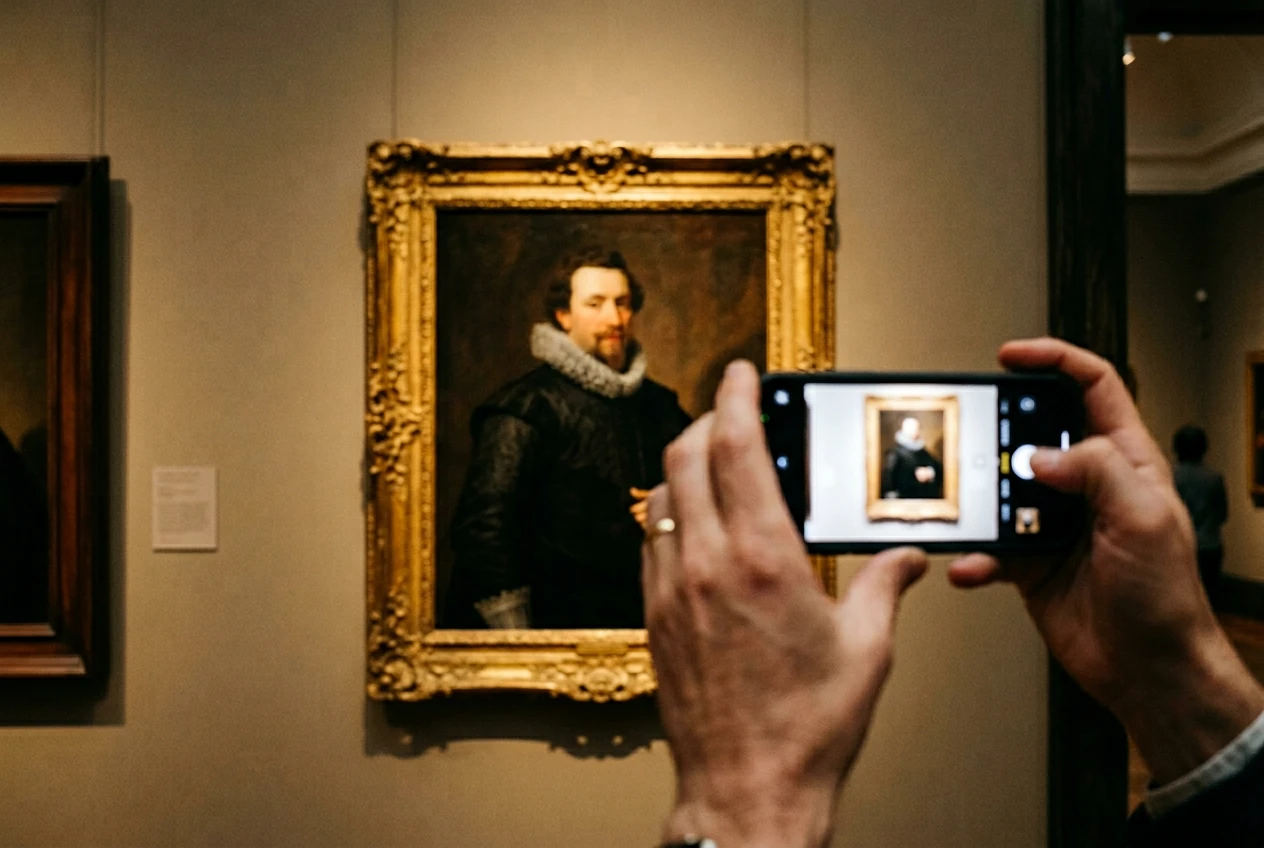
A Chennai-built art recognition app called eicon launched on June 10, 2026, and the gesture at its center is the same one a visitor has used on a museum wall for decades: point, look, read. Open the app, frame a painting, and the screen returns the title, the artist, the medium, the year, and a short institutional read on the work. The company behind it is Asign, also based in Chennai, and the launch coverage covered the Met, MoMA, and the Art Institute of Chicago.
The app’s most striking claim is its answer to the obvious question. If any visitor can already ask a chatbot to identify a painting and write a fluent paragraph about it, why bother with a dedicated app? The eicon chat box, surfaced in the launch coverage, returns a sharper answer than most pitch language. A general AI engine, the app argues, ‘aggregates information from across the internet without that institutional verification, so it can be less precise or outdated.’ The trade the app is offering is the trade a museum curator offers a visitor: provenance, accuracy, and stewardship of the work, not just a fluent paragraph.
Point the Camera, Get the Context
Eicon is built around a single gesture. Open the app, point the phone camera at an artwork, and the screen returns the title, artist, medium, year, and a short narrative on the work’s background. The app also accepts uploads, so a visitor can photograph a piece after the fact, jot personal notes, and keep a diary of their gallery visits over time. Founder Ashvin Rajagopalan describes the app as an art buddy that sits in your pocket and comes alive when you need it.
The eicon approach is closer to a digital companion than a static audio guide. The eicon app launch profile in Indian art press showed the app reading Van Gogh’s 1887 Self-Portrait With A Straw Hat at the Met, and explaining that the artist was his own “best sitter.” The same coverage showed eicon describing Vermeer’s The Love Letter at the Rijksmuseum Amsterdam as a study in middle-class interiors from the Dutch Golden Age, with a focus on “the quiet beauty found in everyday life.” Both reads are short, sourced to institutional records, and built for the kind of glance a museum visitor actually has time for. The diary layer is the one that doesn’t show up in competing apps, and the company is leaning into it. Rajagopalan said users can “upload pictures of the works they see and make individual notes like in a diary,” building a record of museum visits that doubles as a personal archive.
- Launched: June 10, 2026
- Museums covered at launch: 3 (Met, MoMA, Art Institute of Chicago)
- Data sourcing: Institutional records plus crowdsourced input
- Companion feature: Personal visit diary
The Anti-ChatGPT Argument
Eicon enters a market that, on paper, should not exist. Open ChatGPT, Gemini, or any general chatbot, name or photograph a painting, and the model will identify the work, walk through the artist’s biography, and gesture at the historical context. For most casual visitors, that is enough. The reason eicon exists, the company argues, is that for art specifically, the chatbot’s fluency is also its liability. The chatbot does not know which interpretation a museum has endorsed, which provenance details have been verified, or which catalog raisonné a given work appears in. The chatbot answers in a tone of authority it has not actually earned.
Think of it as the difference between asking a museum curator about a work they steward versus asking a search engine.
The line is the eicon app’s own answer, surfaced inside its chat box and quoted by Vandana Kalra, art critic at The Indian Express, in her June 10, 2026 coverage of the launch. The framing is sharper than most pitch language, and it sets the bar for how the app will be measured against the AI engines visitors can already use. Institutional verification is the claim. Three museum partnerships are the proof. Crowdsourced contributions are the open variable.
The claim has weight, but it has limits. A museum-curated audio guide has institutional knowledge of the works in its own collection, and it can describe those works with a confidence a search engine cannot match. What it cannot do is tell a visitor about a work that is not in its own database, and right now, eicon’s database is three museums wide. The institutional advantage is real. The institutional reach is not.
Built in Chennai, With a Gallery in the Same Family
Eicon comes out of Asign, a Chennai-based art technology platform. The same company runs art data services covering valuation, price discovery, and market analysis, and positions itself at the “intersection of art and technology,” per its Asign’s art platform and data services profile.
The founder behind it is Ashvin Rajagopalan, an art historian by training who also founded Chennai’s Ashvita’s art gallery. The Indian Express identifies him as the founder of eicon, Asign, and Ashvita’s, and he is the public voice of the app. Architectural Digest India’s profile of Asign frames the broader company as built on “credibility and innovation,” with art data intelligence running alongside the recognition app. That dual structure, a gallery on one side and a data and recognition product on the other, is unusual in this corner of the market.
Chennai is the home base, not a coincidence. The same city houses one of India’s most active contemporary art scenes, and Asign’s products are designed for that market first. The app’s English-language launch in New York museums is a deliberate choice of where an art-recognition product gets judged. New York also happens to be where most of the global art-recognition competition already lives.
The interesting question is whether the Chennai roots travel. Asign’s own pitch to galleries and collectors runs on trust, and the recognition app inherits that posture. A buyer using Asign’s valuation data wants institutional-grade numbers. A visitor using eicon wants institutional-grade context. The founder’s experience on both sides of that transaction is the throughline. It also means eicon is not a garage project. It is a launched product from a company with gallery relationships, an art data business, and a stated plan to expand the museum footprint from three to many.
Three Museums Today, Crowdsourcing Tomorrow
At launch, eicon’s coverage is narrow and specific. The app reads collections at the Metropolitan Museum of Art, the Museum of Modern Art, and the Art Institute of Chicago. Three museums is a thin shelf compared with global coverage from established players. The plan is to add institutions quickly, and Rajagopalan has been specific about the model.
The company will pull data from “museums and institutions themselves as well as crowdsourced information, where users will be allowed to contribute.” The crowdsourcing angle is significant. A recognized artwork, annotated by a visitor, becomes a new data point in the app. A corrected plaque, an updated provenance, or a translated label can travel through the user base rather than waiting for the next museum re-cataloguing cycle. The model is closer to Wikipedia’s contributor base than to a closed institutional database. Whether that approach preserves the “institutional verification” the company is selling is the live question, and the one the company has not yet answered publicly.
For now, the user in a museum in London, Paris, or Mumbai opens the app and finds nothing. The expansion plan is in motion. The launch coverage does not yet name which institution comes next.
The Camera-Scan Standard Smartify Already Set
Eicon is not the first app to do this. Smartify, the social enterprise that publicly launched in London in 2017 after a 2016 founding, has built its product on the same camera-scan gesture. The Indian Express frames eicon against that lineage. Smartify is the established player. Eicon is the late entrant trying to win on data sourcing and on the diary feature.
Smartify’s product has grown in the years since. By 2023, the platform added AI-driven personalisation, letting visitors build routes based on time, interest, and pace. By 2024, it had become a modular visitor engagement platform with wayfinding, content authoring, and analytics, per how Smartify grew from a 2016 prototype.
| Eicon | Smartify | |
|---|---|---|
| Founded / launched | Asign, launched June 10, 2026 | Founded 2016, public launch 2017 |
| Camera-scan recognition | Yes, with personal diary layer | Yes, with AI-personalised routes |
| Data approach | Institutional plus crowdsourced | Institutional partner content |
Both apps move the museum audio guide into the phone the visitor already carries. The difference is in what they put on top. Smartify’s pitch is a flexible interpretation layer the institution controls, and a visitor-led experience that adapts to time and interest. Eicon’s pitch is verified institutional context plus a personal diary no one else can edit. The two approaches are not mutually exclusive, but they are aimed at different parts of the museum visit. Smartify is for the institution. Eicon is also for the visitor who wants to keep what they saw.
The same gesture, phone raised, camera framing a painting, sits at the center of both products. The years of refinement, the partner relationships, and the size of the catalog behind the camera are where the contest plays out. Smartify has been at this since 2017. Eicon has Asign’s gallery and data infrastructure behind it, plus a different angle on provenance and personal records. The next twelve months of museum sign-ups will tell which model scales.
What’s Real, and What Three Museums Can’t Fix
Eicon is real and shipped. The app is live, the founder is identifiable, the institutional-data claim is articulated, and the three-museum launch is verifiable. The diary feature is genuinely uncommon in this product category. The anti-ChatGPT argument has a defensible position: art context that comes from a museum’s own records is more reliable than a paragraph assembled by a general-purpose model. None of this is vapor.
The constraints are equally real. Three museums is a small slice of the global art on view. Crowdsourced data, if it lands, will take years to mature. The institutional verification claim and the crowdsourcing claim pull in opposite directions, and the company has not yet published the rule for how the two will coexist.
The honest test for eicon is the state of the database in twelve months. Asign’s art data business gives the company runway that a standalone app launch would not have. The Chennai base gives it a gallery and collector network that most camera-scan apps do not. The launch floor is three museums. What grows from there is Asign’s to deliver.


Gemini 3.7 Flash Cuts Agent Costs While Pro Stays Delayed

OpenAI and Anthropic Slash Mid-Tier Prices as Chinese Models Bite

Quanta and Quantinuum Bet Manufacturing Will Unlock Quantum Scale

Xiaomi HyperOS 4 Turns Glass Looks Into an Agentic Ecosystem Bet

BGMI Smiling Pal Codes Hand Free Backpacks to Almost Nobody

European Sites Face Four Times the AI Scrapes With Worse Returns

Claude’s Invisible Watermarks Flag Light AI Edits Too

Indian Brands Crack the Beige Tech Moat With Real Design

AmBank’s Quiet Community Engine Wins Malaysia CSR Crown

India-Made iPhone 18 Pro Max Reaches US Buyers Day One

Fable 5 and Mythos 5 Return as US Lifts Anthropic Export Controls

Oracle Cuts 21,000 Jobs in a Year, Cites AI in 10-K Filing

SpaceX’s Google Deal Turns a Rocket Company Into a Cloud Landlord

CD Projekt Red Co-CEO: Redemption Arc Isn’t Done, Witcher 4 in 2027

XPL Rallies 30% Ahead of Plasma One Card Tier Launch

Google Search Profiles Build a Follow Graph Inside Discover

DGO App Brings Rs 549 Mobile Pass for FIFA World Cup 2026 in Nepal

Moonshot AI Targets $30 Billion in China’s Fastest AI Funding Sprint

Microsoft Xbox Layoffs Start in July as Sharma Slams 3% Margin

Oppo’s ColorOS 17 Eligibility List Leaves A-Series Buyers Behind
-
 AI1 month ago
Fable 5 and Mythos 5 Return as US Lifts Anthropic Export Controls
-
 AI2 months ago
Oracle Cuts 21,000 Jobs in a Year, Cites AI in 10-K Filing
-
 AI2 months ago
SpaceX’s Google Deal Turns a Rocket Company Into a Cloud Landlord
-
 GAMING2 months ago
CD Projekt Red Co-CEO: Redemption Arc Isn’t Done, Witcher 4 in 2027
-
 CRYPTO2 months ago
XPL Rallies 30% Ahead of Plasma One Card Tier Launch
-
 NEWS2 months ago
Google Search Profiles Build a Follow Graph Inside Discover
-
 APPS2 months ago
DGO App Brings Rs 549 Mobile Pass for FIFA World Cup 2026 in Nepal
-
 AI2 months ago
Moonshot AI Targets $30 Billion in China’s Fastest AI Funding Sprint