
AI
China’s National AI Fund Closes Kling’s $3 Billion Round
Kuaishou’s Kling AI filled a 20.447 billion yuan cap after China’s national AI fund joined, pricing the video unit at about $18 billion.

China’s national AI industry fund put RMB1.4 billion into Kuaishou’s Kling AI unit on August 31, filling a 20.447 billion yuan cap opened in July. The money prices the video model at about $18 billion after the investment. Kuaishou still holds about 68%.
July’s headlines put Tencent, Alibaba Cloud and Baidu on the same term sheet. Their cheques were real, and small. The last, largest new state cheque, and a Gulf fund plus Chinese film groups, are what actually finished the round.
Kuaishou Set a $3 Billion Ceiling in Hong Kong
Kuaishou disclosed Kling AI’s first external funding round to the Hong Kong exchange on July 2. The short-video company said Kling had taken in over 19 billion yuan ($2.80 billion), with room to bring the total to about $3 billion inside 60 days.
Initial investors committed $2.03 billion. Later joiners added about $766 million, taking the July bag to about $2.8 billion. Pre-money value sat at about $15 billion. A full $3 billion cheque book was built to land at about $18 billion post-money.
The vehicle is Beijing Kling, the company that now holds the model, the apps and the API contracts. Kuaishou moved an internal product line into that entity, sold a minority slice, and kept consolidation and control. It was a priced spin-out, not a cash scramble. The parent already sat on RMB117.7 billion in available funds at the end of the first quarter, before the raise.
THE KLING SPIN-OUT CLOCK
- May 12, 2026: Kuaishou tells the exchange it is assessing a Kling restructure that may bring in outside money.
- July 2, 2026: The company files the capital increase, names a long investor list, and opens a 60-day window up to 20.447 billion yuan.
- July 6, 2026: Tencent sells 272.9 million Kuaishou Class B shares and drops below the substantial-shareholder line.
- August 19, 2026: Kuaishou prints Kling’s second-quarter sales and the 3.0 Turbo launch.
- August 31, 2026: The China Artificial Intelligence Industry Investment Fund and Charoen Pokphand Robot join, and the cap is fully used.
April soundings had aimed at $20 billion. The July paper came in lower. The 60-day window ran from July 2 to August 31, and the last joiners used every remaining yuan of room.
Who Holds Kling After the Carve-Out?
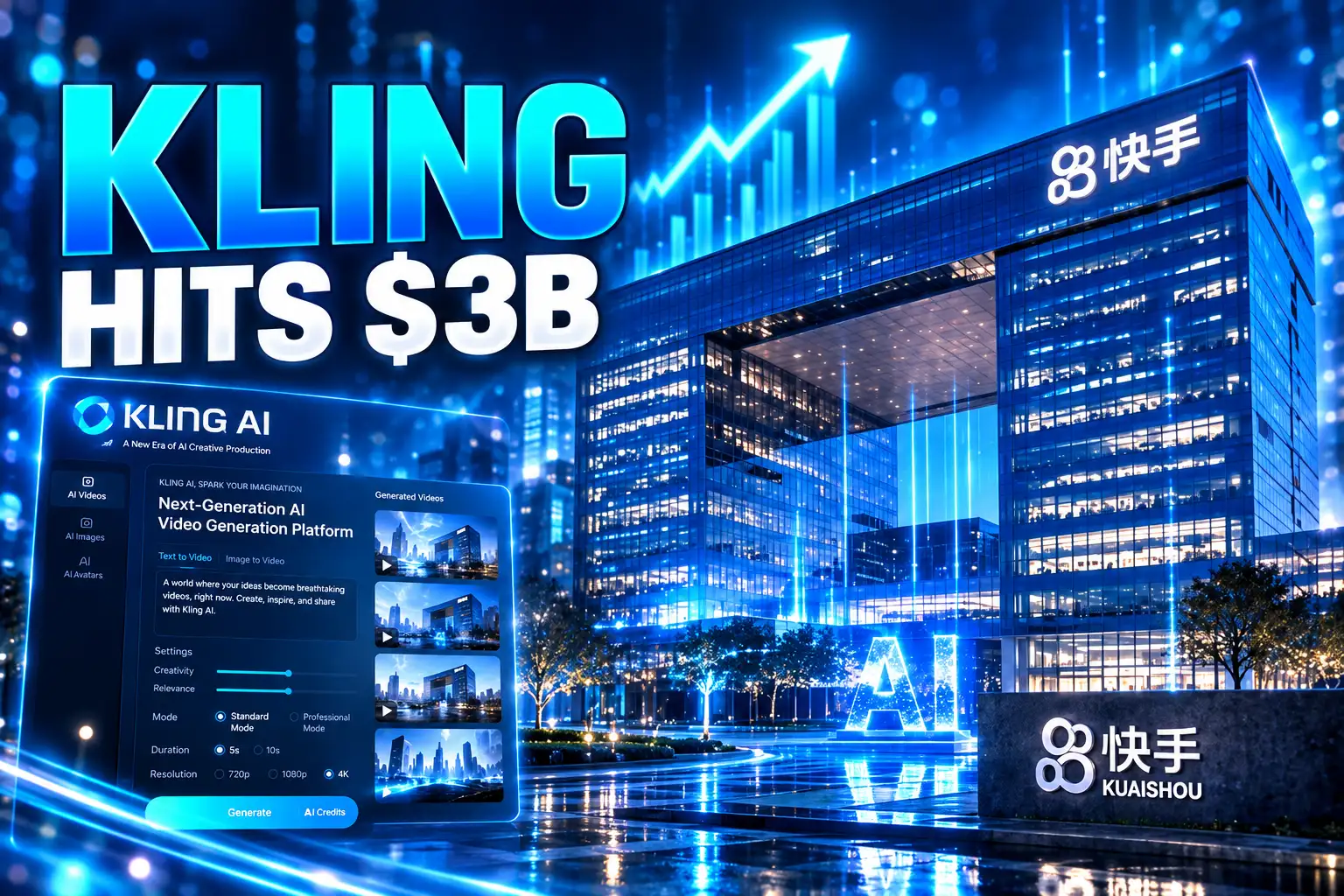
After the increase, Kuaishou keeps about 68% of Beijing Kling. Chairman Cheng Yixiao, chief technology officer Gai Kun and related parties hold about 14.5% through incentive platforms. Outside cash, at the full cap, is the rest of the book.
July’s roster mixed Chinese platforms, Beijing municipal funds, film groups and Abu Dhabi’s BlueFive Capital. Alibaba Cloud, Tencent and Baidu were on it. So were Huace Film & TV, Mango Investment, the Beijing Information Industry Development Investment Fund and the Beijing Artificial Intelligence Industry Investment Fund. CPE, Guofang, CITIC Securities, the Zhongguancun Science City Fund and CAS Investment sat in the lead group.
Those famous platform names do not dominate the register. After August 31, Shanghai Guofang Digital Technology is the largest named external holder at 1.38%. The national AI fund holds 1.14%. Hangzhou Alibaba Cloud Feitian holds 1.11%. Charoen Pokphand Robot holds 0.11%.
KLING’S REGISTER AFTER THE CAP FILLED
| Holder | Stake or role |
|---|---|
| Kuaishou | About 68%, still consolidates |
| Cheng, Gai Kun and incentive platforms | About 14.5% |
| Shanghai Guofang Digital Technology | 1.38%, largest named external |
| China AI Industry Investment Fund | 1.14%, last large state cheque |
| Hangzhou Alibaba Cloud Feitian | 1.11% |
| Charoen Pokphand Robot | 0.11% |
Alibaba Cloud’s slice sits beside Alibaba’s own HappyHorse video model. Tencent’s Kling stake sits beside a much larger sale of Kuaishou stock. The film names are the buyers who would actually feed generated shots into Chinese drama and variety pipelines.
Tencent Sold Kuaishou Shares a Few Days Later
On July 6, Tencent Mobility sold 272.9 million Kuaishou Class B shares at HK$43.25 each, raising about $1.505 billion. The block cut Tencent’s holding from 15.68% to 9.37%. Tencent ceased to be a substantial shareholder. The trade was all secondary. Kuaishou received nothing.
Kuaishou said the sale was not expected to have any material adverse effect on operations, and that Tencent remained confident in the company’s long-term prospects and would keep the business relationship. In the same filing it said it had already bought back 174.84 million Class B shares for HK$8.35 billion under a HK$16 billion programme.
The pairing is blunt on a spreadsheet. Tencent wrote a modest Kling cheque, then took more than a billion dollars out of the parent. For a holder that had been Kuaishou’s most important strategic shareholder, the AI unit became the piece worth keeping on the book. The short-video equity became the piece worth shrinking.
Investors Paid $18 Billion for a Unit That Lost Money Last Year
The July 2 Hong Kong exchange filing showed Kling with about RMB1.1 billion of 2025 revenue and a net loss of about RMB1.9 billion. Net assets at year end were negative RMB9 million. First-quarter 2026 sales were more than RMB650 million, up over 300% year on year. In March the annualized run rate was about $500 million. At $18 billion post-money, that is 36 times the March run rate.
Second-quarter sales kept climbing. Kuaishou said Kling generated over RMB850 million in second-quarter revenue, up more than 200% from a year earlier, and RMB1.5 billion in the first half. Group revenue in the quarter was RMB35.5 billion, up 1.4%. Live streaming fell 13.5% to RMB8.7 billion. Other services, which include Kling, rose 18.5% to RMB6.2 billion. Gross margin slipped to 51.6% from 55.7%. Adjusted net profit was RMB3.9 billion, an 11.0% margin. Available funds were RMB121.3 billion on June 30, 2026.
On the AI innovation front, we launched the Kling 3.0 Turbo model, reinforcing Kling AI’s global leadership in video generation. Meanwhile, commercialization maintained strong growth momentum, with Kling AI generating revenue of over RMB850 million in the second quarter, representing year-over-year growth of more than 200.0%.
Cheng Yixiao, Co-founder, Chairman and CEO, second-quarter 2026 results
Kling 3.0, shipped in February, added native 4K output, multi-shot control and spoken audio. Kuaishou later added 3.0 Turbo, plus Kling MCP and a command-line tool so software agents can batch jobs. Two Kling ads won one Silver Lion and two Bronze Lions at Cannes Lions 2026. The product is no longer a demo. The multiple still asks investors to pay up for a growth line that does not yet cover its own compute.
AI VIDEO ROUNDS NEXT TO KLING’S PRICE
| Company | Round | Amount | Valuation |
|---|---|---|---|
| Kling AI | First external, 2026 | 20.447 billion yuan cap | $18 billion post-money |
| Runway | Series E, February 2026 | $315 million | $5.3 billion |
| Luma AI | Series C, November 2025 | $900 million | $4 billion |
No other dedicated video-model firm has taken a cheque this size. Runway’s February round, the Western benchmark, was about one-ninth the cash and less than a third of the price. That gap is the bet: Chinese consumer volume, overseas API demand and a Hong Kong listing can grow Kling into the number on the term sheet.
ByteDance’s Seedance Made Waiting Costly
ByteDance released Seedance 2.0 in February, the same month Kling 3.0 landed. Camera moves and shot-to-shot consistency in those clips looked, to working prompt users, closer to a crewed take than to last year’s warping extras. Chinese indie teams started posting whole short films cut from generated shots. Hollywood’s worry about replacement labour stopped sounding abstract.
Kling cannot treat that as someone else’s problem. ByteDance already owns Douyin and TikTok’s distribution. Seedance rides that pipe. Kling has to win on the open web, on APIs, and inside Chinese studios that would rather not rent their pipeline from the Douyin owner. Huace and Mango did not join a fashion round. They joined a tools vendor their producers will either use or compete against.
Sora, the American comparison that launched Kling’s 2024 marketing, is no longer the pace-setter. The relevant rival sits across town, ships faster, and does not need a $18 billion sticker to fund the next training run. That is why a parent with RMB121.3 billion still wanted other people’s money on Kling’s books: GPU burn and a public clock, shared.
The National AI Fund Took the Final Slice
On August 31, Beijing Kling signed joinder agreements with the China Artificial Intelligence Industry Investment Fund Partnership and Charoen Pokphand Robot Limited. The national fund’s RMB1.4 billion cash subscription buys about 1.14%. The robot arm of Thailand’s Charoen Pokphand Group put in $19.29 million, about RMB131.45 million, for about 0.11%. Both received redemption rights. Kuaishou said the subscription limit was then fully used.
The national fund’s largest backer is the third phase of the National Integrated Circuit Industry Investment Fund, which holds 99.90% of it. That is Big Fund III, whose own heavy shareholder is the Ministry of Finance. A chip-industry vehicle is now on the cap table of a video model. Beijing municipal funds were already in from July. The closer is national industrial policy, not another social app.
WHAT THE AUGUST 31 JOINDERS LOCKED IN
- The cap: The 20.447 billion yuan subscription limit is fully used, with no more room under the July paper.
- The state cheque: RMB1.4 billion from the China Artificial Intelligence Industry Investment Fund for about 1.14%.
- The extra name: Charoen Pokphand Robot, $19.29 million, about 0.11%, with the same redemption rights.
- The listing hook: Redemption rights point at an initial public offering before October 2031, a hard stop rather than a hope.
Registered capital of Beijing Kling rises from 10 million yuan to about 96.1759 million yuan once the increase and staff schemes are fully counted. Some July investors raised their cheques on August 31. Others cut them. The net result was a full cap, not a bigger one.
A U.S. private equity firm had been in talks in June to lead at the same $18 billion post-money figure. The syndicate that closed is Chinese platforms, Chinese state funds, a Gulf firm, Thai industrial capital and Chinese entertainment groups. The listing talk in July was a Hong Kong process inside 12 months. The legal hook that survived into the joinders is the 2031 redemption date.
Kling now has a price, a state shareholder, a parent that still owns about 68%, and a product in a race with Seedance. The 20.447 billion yuan is in. The $18 billion tag lasts as long as that listing clock does.
Frequently Asked Questions
How much of Kling AI does Kuaishou still own?
Kuaishou keeps about 68% of Beijing Kling after the capital increase and still consolidates the unit. Cheng Yixiao, Gai Kun and related parties hold about 14.5% through share platforms, and Beijing Kling’s registered capital rises from 10 million yuan to about 96.1759 million yuan once the subscriptions and staff schemes are fully counted.
What exit rights did the August investors receive?
Both the China Artificial Intelligence Industry Investment Fund and Charoen Pokphand Robot were granted redemption rights under joinders to the shareholders’ agreement on August 31, 2026. Those rights are tied to Kling completing an initial public offering before October 2031, after which the cash they put in can be put back to the company if the listing has not happened.
When did Kling AI first launch?
Kuaishou opened Kling to public testing in June 2024, about two years before this round, inside its KuaiYing editor. The 3.0 model family followed on February 4, 2026, with native 4K, multi-shot storyboards and lip-synced audio, and the 3.0 Turbo cut arrived in the second quarter.
How does Kling’s round compare with Runway, Luma and Pika?
Runway’s February 2026 Series E raised $315 million at a $5.3 billion valuation, and Luma AI’s November 2025 Series C raised $900 million at $4 billion. Pika’s June 2024 Series B raised $80 million at about $465 million. Kling’s 20.447 billion yuan cap is larger than those three rounds combined, which is why the Hong Kong paper was described as the largest raise by an AI video-model firm.
Disclaimer: This article is news reporting and analysis of Kuaishou’s public filings and results. It is for information only and is not investment advice, a solicitation to buy or sell Kuaishou shares, or a recommendation on Kling AI’s private valuation. Readers who are considering any holding in Kuaishou, Kling or related funds should consult a licensed financial adviser who can review their own objectives and limits. Figures and ownership percentages reflect the cited Hong Kong filings and company results as published, and later joinders, redemptions or listings can change them.

Instagram Plus Tests a Read-Only Mode That Cuts Stories

Altman Asks the Public to Accept Some AI Harm

Google Freezes OSS VRP Product Reports After AI Flood

AI Agents Make Payment Rails the Scarce Prize

Turkey’s Crypto Boom Now Runs Through Three Banks

Fable 5 Came Back Under a Commerce On-Off Switch

Google’s SpaceX GPU Lease Has a Sept. 30 Deadline

Plasma One’s XPL Locks Face a 1.81 Billion Cliff

DGO’s Rs 549 World Cup Pass Cost Fans Sleep and Data

Moonshot AI’s $30 Billion Ask Became a $35 Billion Close
-
 AI4 months ago
Fable 5 Came Back Under a Commerce On-Off Switch
-
 AI4 months ago
Google’s SpaceX GPU Lease Has a Sept. 30 Deadline
-
 CRYPTO4 months ago
Plasma One’s XPL Locks Face a 1.81 Billion Cliff
-
 APPS4 months ago
DGO’s Rs 549 World Cup Pass Cost Fans Sleep and Data
-
 AI4 months ago
Moonshot AI’s $30 Billion Ask Became a $35 Billion Close
-

 NEWS4 months ago
ColorOS 17 Device List Spans Oppo, OnePlus and Realme
-

 GAMING4 months ago
Xbox Cuts 3,200 Jobs After Five Years of Thin Returns
-
 GAMING4 months ago
The RTX 4050 Under Rs 70,000 Hides a Wattage Gap