
AI
Meta Pocket Turns Game Ideas Into a Social Feed
Meta Pocket now lets U.S. users prompt AI mini-games into a ranked feed, after the indie Gizmo app that proved the idea shut the same day.

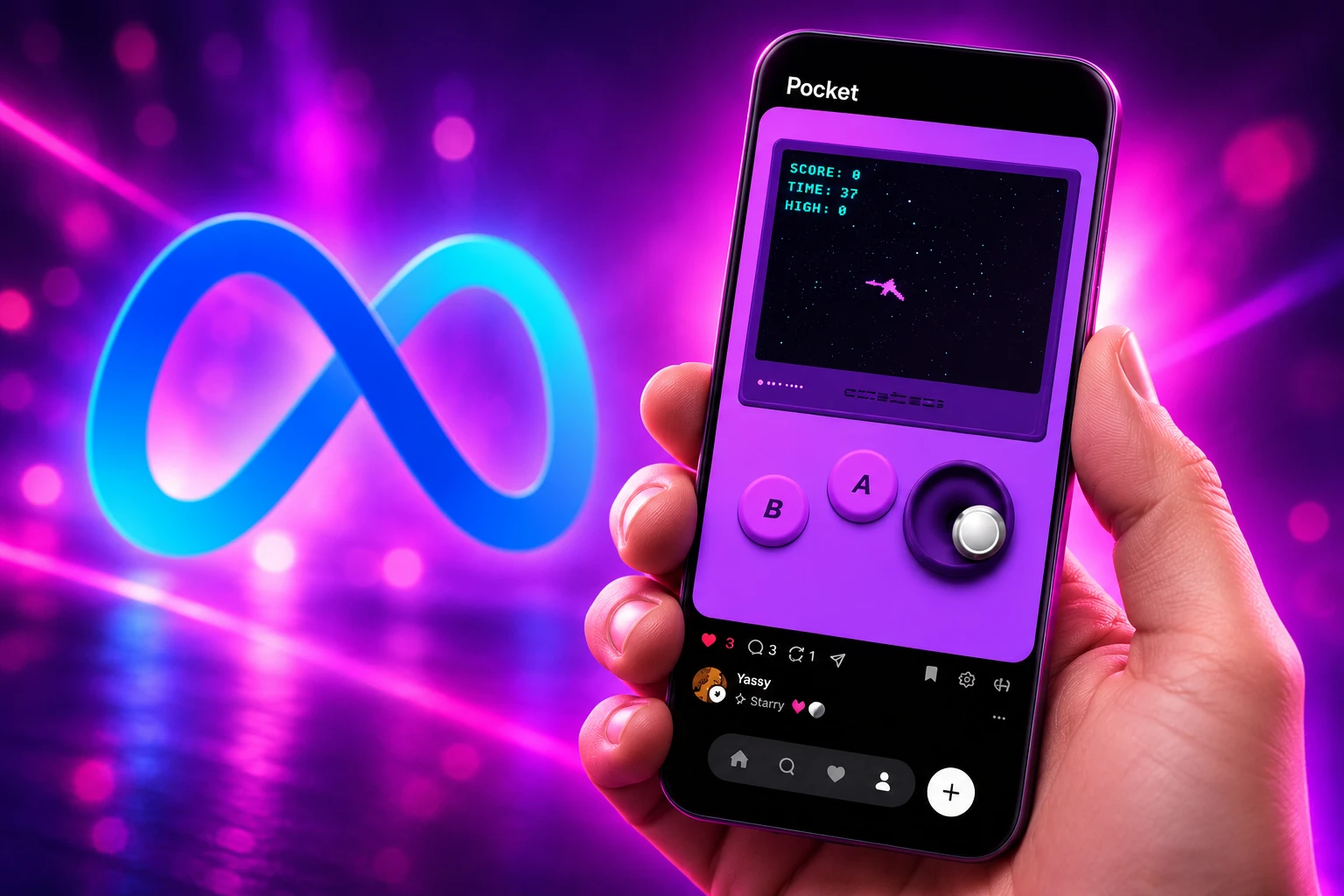
Meta opened Pocket to everyone in the United States on August 20, the same day it shut the indie app the new product was built from. Type a sentence, get a small game, then scroll more of them in a feed that looks like Instagram with extra buttons.
The pitch is “forget coding.” The working product is a ranked stream of playable posts, tied to a Meta login, that learns from every tap.
Pocket Turns a Prompt Into Something You Can Tap
Pocket is free on iPhone as Pocket: Make Gizmos on the App Store, and founder Josh Siegel said the same build is on Android. You sign in with a Meta account. Meta’s Help Center still warns that the app is not yet available everywhere, even after the U.S. opening.
The unit of content is a gizmo. Meta calls it an interactive, audio-visual AI-generated experience, and the store page says you make one by describing it. The feed is full of other people’s gizmos. Tap one and it loads in place. If you like it, you can save it, repost it, or remix it.
That is the same loop the company already runs for photos and short video, except the post can use the sensors on the phone. The Help Center’s page on how to create, share, and discover gizmos lists the inputs in plain language.
WHAT A GIZMO CAN USE
- Hands: Tap, swipe, or drag items on the screen.
- Motion: Tilt or shake the phone to steer what is happening.
- Sound: Play effects and clips of songs while you interact.
- Camera: Point the lens, or pull photos from the camera roll, if you grant access.
- Voice: Speak into the microphone if you grant that too.
The store copy pushes puzzles, selfie cameras, and quizzes as much as games. A gizmo does not have to be a high score. It can be a toy you hold up to your face. Recipients can open a shared link without installing Pocket, which is how a post leaves the app and still stays on Meta’s rails.
Apple rates the listing 13+, with user-generated content and social media in the rating, plus infrequent cartoon violence, crude humor, and horror. Early U.S. reviews sit at 4.9 stars from 587 ratings. Version 26.0 shipped on August 20. Version 29.0 followed in mid-September as a bug-fix build.
The Shutdown That Landed With the U.S. Launch
Pocket did not start in Menlo Park as a blank page. Reverse engineer Alessandro Paluzzi flagged the Play listing on July 2, after app tracker Appfigures dated the first store appearance to June 29, during a quiet Brazil test of the same app. The Android package name still reads com.facebook.gizmo.
Gizmo came from Atma Sciences, a New York startup whose whole team joined Meta Superintelligence Labs earlier in 2026. Meta took a non-exclusive license to the technology. It did not have to buy the company. On August 20, the company account said Atma was winding down, and that the team had been building a new app inside Meta.
Appfigures had logged 635,000 lifetime installs for Gizmo across iOS and Google Play, with 98% positive sentiment. That is a predecessor score, not a Pocket score. It is the proof that prompt-to-play already had people making things before Meta put a ranking engine on top.
FROM GIZMO TO POCKET
- Earlier in 2026: The Gizmo team joins Meta Superintelligence Labs and Meta licenses the tech.
- June 29, 2026: Pocket appears on the App Store and Google Play, limited at first to Brazil.
- July 2, 2026: Paluzzi posts the Play Store listing and the story breaks in public.
- August 20, 2026: Pocket opens to U.S. users as version 26.0, and Gizmo shuts the same day.
Siegel, who led the startup, posted the shutdown himself. The vision, he wrote, was “apps to make apps,” and the team would stay on that work inside Pocket.
It's bittersweet to shut down Gizmo, a labor of love by so many people for the last couple years, but I'm excited for Pocket and what's next.
Starting a company is something I wanted to do for a long time, and it was way more fun than I imagined. I owe everything to my… https://t.co/5KwjsgyAtb
— Josh Siegel (@jsiegz) August 20, 2026
A labor of love became a Meta surface in one morning. The people who liked Gizmo still get a prompt box. They no longer get an independent app.
How Pocket Picks the Next Gizmo in Your Feed
Open Pocket and it does not feel like a store. It feels like a feed. Meta’s own help page on how Pocket recommends content to you describes a ranking system that predicts what you will play next.
The system pulls posts from accounts you follow, posts like ones you already tapped, popular posts, and a curated slice it calls high quality. It then scores recency, likes, comments, bookmarks, views, and whether you have already seen a remix of the same post. Creators get spaced apart so the scroll does not stack one person.
You can dislike a post, block a profile, or report a gizmo under Community Standards. Those are the same levers Meta uses on Facebook and Instagram. They are not a game-quality filter. They are an attention filter.
Earlier this year, we shipped Instagram Instants. We also just launched Forum, a stand-alone Groups app, and Seller, a stand-alone Marketplace app. I expect it to become a lot easier to ship new apps. So we are planning to build out more ideas and use our recommendation systems to scale them.
Mark Zuckerberg, on Meta’s July earnings call
Pocket sits in that stack, beside the Meta AI app, the Vibes video experiment, and Muse, another standalone Meta AI app. The company can ship a new surface, then let ranking decide if anyone stays. A gizmo that holds a thumb is a successful post. A gizmo that does not hold a thumb disappears, even if the prompt was clever.
Some early reviewers already treat the feed as a substitute for Instagram, a scroll with a little more play in it. That is the product working as designed. Meta does not need Pocket to become a games company. It needs another reason to open a Meta app tonight.
What the Privacy Label Lists Beside the Fun
The Help Center is direct about the bargain. Your interactions with gizmos on Pocket will be used to improve AI at Meta. Age, gender, and interests from other Meta products can personalize those interactions. In some regions, AI use can also personalize content and ads. If the models cannot handle a prompt, Meta says it may share the message and your region with select partners.
Apple’s privacy label, filled out by Meta Platforms, lists a long haul linked to your identity. Location, contacts, photos, audio, search history, browsing history, identifiers, and usage data all appear. Coarse location and audio show up under advertising as well as under app functions.
DATA THE APP STORE TIES TO YOU
| Category | Examples Meta listed | Uses named on the label |
|---|---|---|
| Location | Coarse location | Ads, analytics, personalization, app functions |
| User content | Photos or videos, audio, support chats | Ads, app functions |
| History | Search history, browsing history | Ads, analytics, personalization |
| Identity | User ID, device ID, email, name, phone | Analytics, personalization, app functions |
| Behavior | Product interaction, crash and performance data | Analytics, personalization |
A prompt is not only a creative act. It is a labeled example of what someone wanted to play. A session of tilting the phone is a labeled example of what held them. Pocket is free because that loop has value even if nobody ever pays for a gizmo.
There is no separate Pocket identity. You cannot wander in as a guest. The same account that holds Facebook and Instagram holds the games you type into existence.
On Roblox, a Prompt Still Has to Earn Retention
Meta is not the only firm turning English into a playable object. On July 16, Roblox announced Build, a mobile tool that turns a text prompt into a basic game inside the Roblox app. Public alpha was set for July 28 in New Zealand, for age-verified users 9 and older, with publishing to a global audience for users 16 and older.
Roblox said its discovery systems rank on long-term retention and “doesn’t include AI slop.” If no one plays a generated game, no one finds it. That is a platform with a creator payroll talking. Roblox already pays developers through its existing exchange. Build is a wider on-ramp into that economy, with a public fear that junk will crowd the homepage.
Pocket has no public payout sheet. It has likes, comments, playlists, remixes, and a partner-shaped review on the App Store from someone who said Instagram and Facebook cross-posting was part of their posting requirements. Meta has not published terms for that program. The review is still a tell: the company is already treating Pocket like a social surface that should spill into the rest of the family.
THREE PROMPT-TO-PLAY DOORS
| Gizmo (shut Aug. 20) | Roblox Build | ||
|---|---|---|---|
| Who ships it | Meta | Atma Sciences | Roblox |
| How you make one | Text prompt in Pocket | Text prompt in Gizmo | Text prompt in the Roblox app |
| Where it lives | Ranked social feed | Independent discovery feed | Roblox catalog |
| Age gate | 13+ | Consumer app, now closed | 9+ alpha, 16+ to publish |
| Money on the page | Free, no public creator fund | Independent product | Existing Roblox creator payouts |
Pocket beat Build to a public store listing by more than two weeks, and it beat Build to a U.S. audience by a wider margin. The deeper split is economic. Roblox still needs human-made worlds that people replay. Pocket needs posts that people tap, remix, and hand to the ranker.
Remixes Survive After You Hit Delete
When you post a gizmo, you toggle whether others may remix it. If you allow remixing, Meta says anyone can reuse the post and its media “on, across and off Meta Products.” Deleting your post does not delete the remixes that already exist.
That is the lock. You can share a link that plays without the app. You cannot, in any official help page, export the thing as a file you take to another store. The code, if there is code you could read, stays inside Pocket. The playable object is a Meta post with extra sensors.
Vibe coding tools such as Cursor, Replit, and Lovable sell the dream of software you own. Pocket sells the dream of software you can show a friend in ten seconds. Those are different products. One ships a project. The other ships a feed item.
The Help Center line has not changed. Pocket is not yet available everywhere. In the countries where it is open, the next gizmo in the scroll is already being scored, remixed, and folded into Meta’s models, whether the prompt was a puzzle, a selfie lens, or a tiny game that lasts as long as a Reel.

Instagram Plus Tests a Read-Only Mode That Cuts Stories

Altman Asks the Public to Accept Some AI Harm

Google Freezes OSS VRP Product Reports After AI Flood

AI Agents Make Payment Rails the Scarce Prize

Turkey’s Crypto Boom Now Runs Through Three Banks

Fable 5 Came Back Under a Commerce On-Off Switch

Google’s SpaceX GPU Lease Has a Sept. 30 Deadline

Plasma One’s XPL Locks Face a 1.81 Billion Cliff

DGO’s Rs 549 World Cup Pass Cost Fans Sleep and Data

Moonshot AI’s $30 Billion Ask Became a $35 Billion Close
-
 AI4 months ago
Fable 5 Came Back Under a Commerce On-Off Switch
-
 AI5 months ago
Google’s SpaceX GPU Lease Has a Sept. 30 Deadline
-
 CRYPTO4 months ago
Plasma One’s XPL Locks Face a 1.81 Billion Cliff
-
 APPS5 months ago
DGO’s Rs 549 World Cup Pass Cost Fans Sleep and Data
-
 AI5 months ago
Moonshot AI’s $30 Billion Ask Became a $35 Billion Close
-
 NEWS5 months ago
ColorOS 17 Device List Spans Oppo, OnePlus and Realme
-

 GAMING4 months ago
The RTX 4050 Under Rs 70,000 Hides a Wattage Gap
-

 AI4 months ago
Boris Cherny’s Loops Still Demand a Higher Production Bar