
NEWS
Meta’s Arena Rebuilds Forecast and Hands Calls to Llama
Meta’s Arena prediction app would use play money and let Llama write and settle markets, a Forecast rebuild aimed at the feed rather than traders.

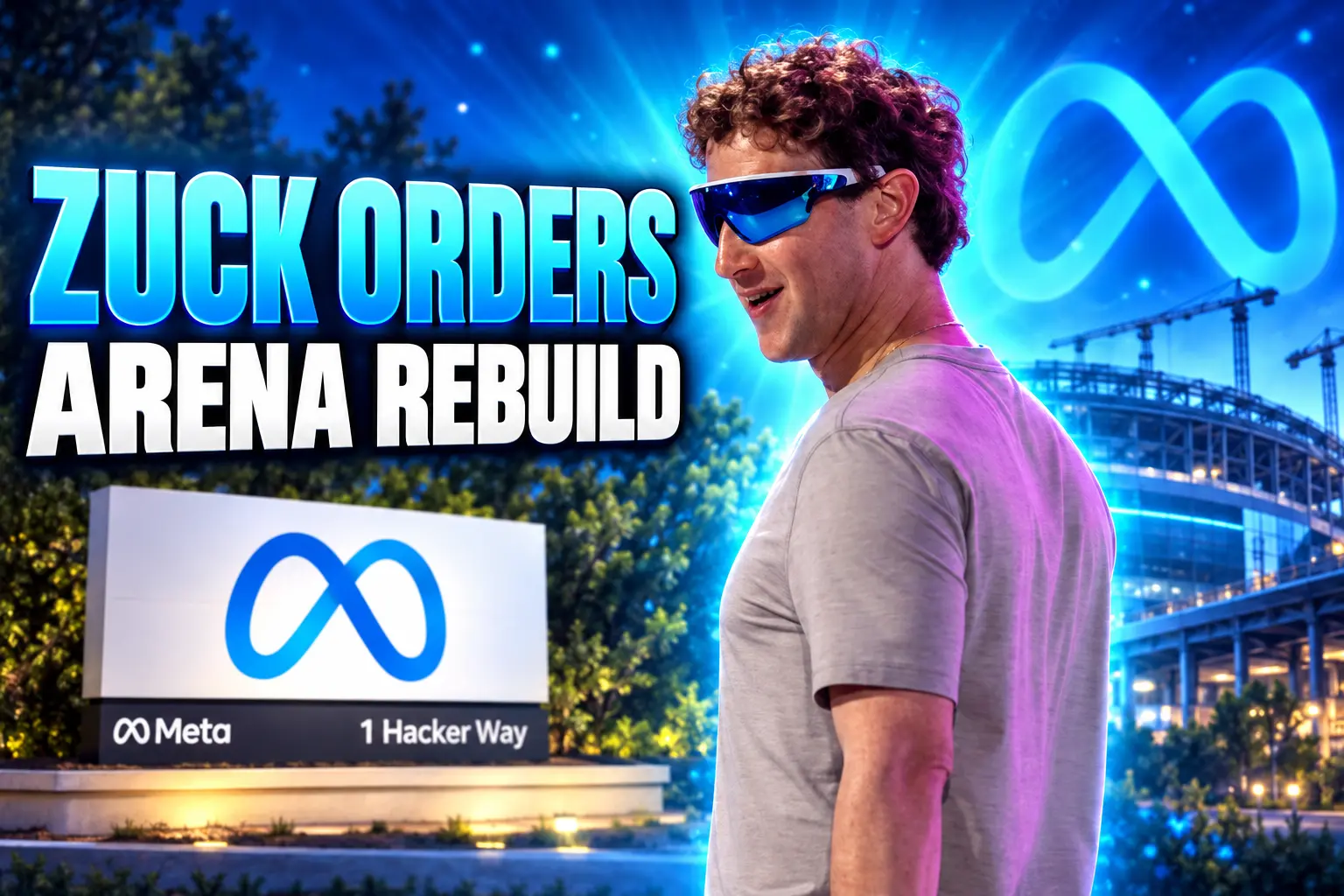
Mark Zuckerberg has ordered Meta to build Arena, a points-only prediction app that internal documents describe as a rebuild of Forecast. Llama would write the questions, push markets at users, and issue the yes-or-no call.
Employees said the project is experimental and a top priority, and that it may never ship. Meta declined to comment and has not set a public release date.
Zuckerberg Ordered a Rebuild of Forecast
This is Meta’s second try at a crowd market with fake stakes. Forecast came out of the New Product Experimentation group in June 2020, first as an iOS test, then as a public app in the United States and Canada that October.
Users spent virtual points to buy or sell outcomes, from Covid-19 vaccination rates to the Great British Baking Show. Rebecca Kossnick, the project lead, wrote that prediction markets “help push participants to be rational,” and that the company wanted a space where people with divergent views could find common ground.
By the October 2020 public launch, the test had logged more than 37,000 forecasts on hundreds of questions. Reviewers still mixed up whether the point was accuracy or chat. The app never left iOS. Kossnick left in March 2021 for a startup, and the product account went quiet.
FORECAST’S SHORT RUN
- June 2020: Facebook’s NPE team starts testing Forecast on iOS as a points market for world events.
- October 2020: The app opens to all users in the United States and Canada after more than 37,000 forecasts in testing.
- March 2021: Kossnick leaves Facebook; the Forecast account stops posting.
- October 15, 2021: Forecast sunsets. The product site said it began “as an experimental app to help us understand how crowdsourced wisdom can arrive at truth.”
Internal documents reviewed in June 2026 give a colder reason for the kill. They cite “the operational cost of manual question curation.” Humans had to write and vet every market. Arena, those documents say, is a “rebuild” of that app, with one of the working names still FBForecast.
Llama Would Write the Questions and Call the Winners
The cost fix is the model. Documents say Llama would pull questions from trending topics, make “personalized market recommendations,” and resolve each market in “near real time.” The wagering is binary, yes or no. The same system that writes the prompt would decide whether the event happened.
Kalshi and Polymarket do not work that way. One uses human review. The other uses an oracle with a challenge window. Arena’s papers describe no human appeal. At the scale Meta already reaches, a bad call would not stay inside a hobby app.
Ime Archibong, the Meta vice president of product leading Arena, did not pitch a trading venue. He pitched a format.
We believe that prediction markets are one of the more interesting new content types. With the right containers, the social conversation is the payoff as people aim to show off how good they are at predicting things to their friends.
Ime Archibong, Meta vice president of product, in an internal post
That line is the product. Points, Llama, and a standalone icon are the wrapper. The habit Meta wants is people coming back to see if they were right, then arguing about it in public.
The Points Trick Buys Meta Time With Regulators
Users would get a daily virtual allotment of play money and stake it on future events. Employees said real-money betting has not been ruled out. The first build keeps cash off the table.
Daniel Wallach, a gaming lawyer who follows the sector, said a no-cash launch gives Meta time to seek a federal license while courts sort the rest. He counted more than 30 pending lawsuits over whether these products are markets or gambling, and said a clear answer could take another year or two.
We’re clearly in legal limbo.
Daniel Wallach, gaming lawyer
Play money only stays a dodge if the points cannot be bought, sold, or cashed out. The legal heat returns the moment those tokens pick up a price. The design also strips out the thing that made the live platforms grow: people risking dollars they will miss.
WHAT WE KNOW
- The order: Zuckerberg dispatched a small team to build a smartphone app internally called Arena, separate at launch from Facebook, Instagram, WhatsApp, and Messenger.
- The stake: Documents describe a daily pile of play money, not cash, with real-money betting left open as a later option.
- The model: Llama would generate questions, recommend markets, and resolve yes-or-no outcomes in near real time.
- The test plan: A prototype would go to employees first, then a public build for iPhones and Android, with no date attached.
WHAT IS UNCONFIRMED
- A ship date: Employees said the app may never be released.
- Cash rails: No filing shows how, or whether, points would become money, a stablecoin, or a licensed book.
- Partner terms: Zuckerberg has asked executives to talk with Polymarket and Kalshi; all three firms declined to comment on what that would mean.
Event Horizon, a newsletter that tracks the sector, has counted more than 70 companies with prediction-market projects, including DraftKings, FanDuel, and Truth Social. Meta is the largest platform in that line, and the only one that can treat the whole category as a content test.
A 100 Million Target Aimed at Friends and Family
Employees said Zuckerberg’s target is 18- to 34-year-olds, and that Meta wants at least 100 million monthly active “predictors.” Executives have called the app “designed for everyone.” The markets on the board would cover sports, culture, entertainment, politics, and finance, with bets placed against friends and family.
That is a social graph with a scoreboard, not a trader terminal. Seed phrases and exchange accounts never enter the pitch. Facebook login and Instagram discovery would do the work that Polymarket cannot buy.
CFO Susan Li told investors Meta estimated 3.56 billion daily active people across the Family of Apps in March 2026, a slight dip from December that the company blamed on internet cuts in Iran and a WhatsApp block in Russia. Arena is one of several standalone experiments in that same push, including Meta Photos, an AI media app. The company has a long record of spinning up extra icons that never become daily habits.
Funneling even a sliver of that daily base into a prediction product would dwarf every book now running. Holding those people without real stakes is the unproven part, and Forecast already failed that test on a much smaller stage.
Real-Money Books Still Set the Pace
The platforms Arena is said to copy run cash. In 2025, Kalshi and Polymarket drew a combined $50 billion in trades. Market tallies for August 2026 put combined volume at $45.33 billion, down 14.5% from July, with Kalshi at $37.17 billion and Polymarket at $8.16 billion.
WHERE THE LIVE BOOKS STAND
| Platform | Stake and rails | August 2026 volume |
|---|---|---|
| Kalshi | CFTC-listed event contracts in fiat | $37.17 billion |
| Polymarket | USDC books, with a licensed U.S. return | $8.16 billion |
| Arena | Play-money points, Llama resolution (planned) | No public book |
Those dollars are not an abstract TAM slide. Kalshi lists Rotten Tomatoes score event contracts beside sports and macro prints. Polymarket still runs contracts on military strikes. A Congressional Research Service brief put sports at more than 85% of Kalshi’s volume. Kalshi’s CFTC-listed volume lead sits on that sports mix, and on a license Meta does not hold.
A points app will not pull the people already trading those contracts. It can, if it ships, mint a second audience that has never opened a derivatives account. That split is the whole competitive map: cash books keep the informed flow, Meta keeps the group chat.
The Feed Is Where Arena Is Meant to Land
Employees said Arena would start as its own app so Meta can see if anyone cares. They also described a later plan to fold prediction bets into Facebook group chats, Reels, Stories, and News Feed, and into Messenger.
SURFACES ON THE INTERNAL MAP
- Standalone app: The first public test, cut off from the main icons so the company can measure demand on its own.
- Group chats: Prediction bets dropped into Facebook and Messenger threads, where friends already argue about games and races.
- Reels and Stories: Short, disposable prompts sitting next to video and vanishing posts.
- News Feed: Markets treated as another unit in the scroll, beside links and ads.
That sequence copies a move Meta has run before. Instagram Stories took a format Snapchat had already proved. Reels did the same with short video. Threads did it with text. A points market that begins life off to the side can still become a feed object once the loop is cheap to run.
Archibong’s “right containers” are those surfaces. Llama makes the questions cheap enough to fill them. Play money keeps the lawyers off the first version. The distribution Meta can throw at a new icon is the part Polymarket and Kalshi cannot match, even after X struck a Polymarket deal in 2025.
Blumenthal and the CFTC Are Already Watching
The Commodity Futures Trading Commission published a proposed rule on event contracts on June 10, 2026, the same month Arena leaked. The notice would tighten how the agency tests contracts that involve gaming, war, terrorism, assassination, or conduct that is unlawful under state or federal law. Chairman Michael S. Selig said the proposal gives the Commission “a durable, transparent framework to identify the contracts Congress directed us to scrutinize while letting legitimate markets move forward.”
Play money keeps Arena outside that docket for now. A later cash switch would drop it into the same fight Kalshi is already in with states, and into the insider-trading probes that have followed Polymarket. The CFTC has also sued states that tried to treat listed event contracts as illegal sports books.
Sen. Richard Blumenthal, Democrat of Connecticut, answered the Arena leak on the day it landed. He tied the product to Instagram’s design and to bills he is pushing on kids’ safety and prediction markets.
Meta copied slot machines to addict kids to Instagram. Now Zuckerberg is turning his company into a prediction market. Meta’s business model is profiting from addiction—kids, gamblers, & more. Stop it through KOSA & my prediction markets bills. https://t.co/e9tG1X8Fho
— Richard Blumenthal (@SenBlumenthal) June 23, 2026
Meta can afford a long test. Forecast showed that a points market with human editors does not hold a crowd. Arena tries the same habit with a model in the editor’s chair and a path into the feed. The company has not said when, or whether, anyone outside Meta will get to try it.
Disclaimer: This article is news reporting and analysis of Meta’s unreleased Arena plans and of public prediction-market data. It is for information only and is not betting advice, investment advice, or legal advice. Readers who are considering event contracts, sports books, or any cash wager should consult a licensed financial, legal, or gambling professional in their jurisdiction before putting money at risk. Figures, product details, and regulatory statuses are taken from the company filings, internal descriptions, and official notices cited above and can change if Meta ships, shelves, or redesigns the app.

Instagram Plus Tests a Read-Only Mode That Cuts Stories

Altman Asks the Public to Accept Some AI Harm

Google Freezes OSS VRP Product Reports After AI Flood

AI Agents Make Payment Rails the Scarce Prize

Turkey’s Crypto Boom Now Runs Through Three Banks

Fable 5 Came Back Under a Commerce On-Off Switch

Google’s SpaceX GPU Lease Has a Sept. 30 Deadline

Plasma One’s XPL Locks Face a 1.81 Billion Cliff

DGO’s Rs 549 World Cup Pass Cost Fans Sleep and Data

Moonshot AI’s $30 Billion Ask Became a $35 Billion Close
-
 AI4 months ago
Fable 5 Came Back Under a Commerce On-Off Switch
-
 AI4 months ago
Google’s SpaceX GPU Lease Has a Sept. 30 Deadline
-
 CRYPTO4 months ago
Plasma One’s XPL Locks Face a 1.81 Billion Cliff
-
 APPS4 months ago
DGO’s Rs 549 World Cup Pass Cost Fans Sleep and Data
-
 AI4 months ago
Moonshot AI’s $30 Billion Ask Became a $35 Billion Close
-

 NEWS5 months ago
ColorOS 17 Device List Spans Oppo, OnePlus and Realme
-
 GAMING4 months ago
Xbox Cuts 3,200 Jobs After Five Years of Thin Returns
-
 GAMING4 months ago
The RTX 4050 Under Rs 70,000 Hides a Wattage Gap