
AI
Microsoft’s $37B AI Engine Leaves Figma and Infleqtion Far Behind
Three AI stocks: Microsoft’s $37B AI run rate, Figma’s $137.4M GAAP loss with 46% growth, and Infleqtion’s $33.6M TTM from government contracts.

Three AI stocks carry similar labels today, but the math behind each one looks nothing like the others. Microsoft’s AI business is already running at a $37 billion annual rate, Figma is adding AI features while still posting a GAAP operating loss of $137.4 million, and Infleqtion is selling $32.5 million of quantum hardware, mostly to governments. The “AI stock” framing hides three trades that share almost nothing beyond the abbreviation.
Each of the three reports a different combination of growth, profitability, and customer base. Microsoft is the cash-flowing infrastructure layer; Figma is the SaaS growth bet where AI is starting to lift the top line. Infleqtion is the outlier, a sub-$100 million revenue quantum name whose contracts depend on government defense buyers in the U.S. and U.K. Reading them as one group, as several newsletters and screeners still do, sets investors up to misjudge the risk on each. The numbers that matter sit below the label.
Microsoft’s AI Engine Is Already Producing Real Revenue
Microsoft’s fiscal third-quarter results, reported April 29, 2026, marked the first update to the company’s AI revenue run rate since January 2025, and the full figures are detailed in Microsoft’s Q3 fiscal 2026 earnings release. Total revenue rose 18% to $82.9 billion, beating the $81.4 billion consensus, and earnings per share climbed 23% to $4.27. The Intelligent Cloud segment that houses Azure grew 30% to $34.7 billion, with Azure itself up 40% in constant currency, the fifth consecutive quarter of acceleration. Microsoft Cloud revenue, which combines Azure with commercial Microsoft 365, LinkedIn, and Dynamics 365, reached $54.5 billion, up 29%.
- Azure growth (Q3 FY26): 40% in constant currency
- AI annual revenue run rate: $37 billion, up 123% YoY
- Microsoft 365 Copilot paid seats: more than 20 million
- Calendar 2026 capex forecast: roughly $190 billion
- Remaining performance obligations: $627 billion
The single most important disclosure was the AI annual revenue run rate: $37 billion, up 123% from the $13 billion Microsoft reported in January 2025. Microsoft 365 Copilot now counts more than 20 million paid seats, up from 15 million in January, though that still represents only about 4.4% of Microsoft’s commercial base. Trailing twelve-month revenue through March 31, 2026 came in at $318.273 billion, up 17.87% year-over-year.
That growth is being paid for. Capital spending in the quarter fell to $31.9 billion from $37.5 billion the prior quarter, a decline Microsoft had already flagged, and CFO Amy Hood told analysts on the call to expect capex above $40 billion in the current quarter. She guided to roughly $190 billion in capital expenditure for calendar 2026, with about $25 billion of that sum reflecting higher component prices tied to a global memory crunch driven by AI data center demand. OpenAI remains a meaningful contributor: a significant share of the $627 billion in remaining performance obligations on Microsoft’s balance sheet is tied to that relationship. The April restructuring ended OpenAI’s exclusive commitment to Azure while locking in Microsoft’s revenue-sharing arrangement.
Figma Is Monetizing AI Faster Than It Is Turning It Into Profit
Figma’s first-quarter 2026 results, released May 14 and detailed in Figma’s first-quarter 2026 results and raised guidance, painted a similar growth picture with a very different profit picture. Revenue grew 46% year-over-year to $333.4 million, accelerating from 40% in the fourth quarter of 2025 and 38% in the third quarter. The acceleration came alongside the rollout of AI products such as Figma Make, the company’s Model Context Protocol, and the relaunched Figma Weave video tool.
The GAAP result tells a different story. Loss from operations reached $137.4 million, a 41% negative operating margin, and GAAP net loss per share was $0.27. Non-GAAP operating income, which excludes stock-based compensation and acquisition costs, came in at $52.1 million, a 16% margin, with Free Cash Flow of $88.6 million, a 27% margin. Net Dollar Retention hit 139%, the highest in more than two years, and paid customers grew 54% to roughly 690,000. The market cap stood at $8.90 billion as of June 25, 2026, according to Yahoo Finance.
AI product adoption is showing up in the numbers. Approximately 60% of paid customers with more than $100,000 in annual recurring revenue used Figma Make on a weekly basis in the quarter, up from more than 50% the prior quarter. Pro teams that bought AI credit add-ons carried an average ARR more than three times that of teams that did not. The company also implemented AI credit limits across all seats starting March 18, 2026, the same release said.
Adoption is already broad: 95% of the Fortune 500 and 78% of the Forbes Global 2000 used Figma as of March 2025, per the company’s investor disclosures, with India the second-largest market by monthly active users. Management raised full-year 2026 revenue guidance to $1.422 to $1.428 billion, a 35% growth midpoint and a $55 million raise. Co-founder and CEO Dylan Field framed the AI thesis in the release: “When code is a commodity, design is the competitive edge: the craft, point of view, and human judgment that make a great product rise above the rest.” Second-quarter guidance calls for revenue between $348 and $350 million, 40% growth at the midpoint.
Infleqtion’s Quantum Story Lives Off Government Contracts
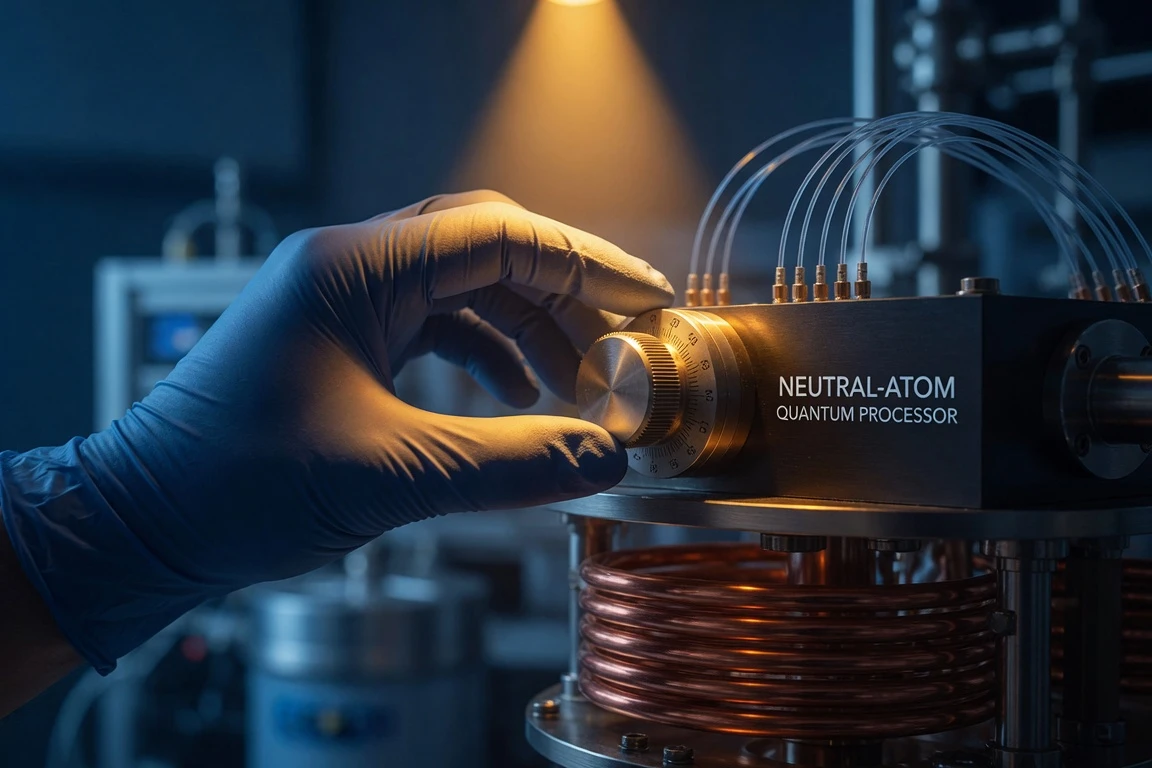
Infleqtion, a Louisville, Colorado based neutral-atom quantum company, sits at the smallest end of the AI exposure spectrum. The company reported $32.5 million in 2025 revenue and guided 2026 revenue to at least $40 million, numbers it disclosed on April 8, 2026 alongside a Q1 update, per Infleqtion’s 2026 revenue guidance and 2025 financial recap. The 2025 operating loss came in at $35.3 million, leaving the company GAAP unprofitable with no near-term path to break even. The market cap was $2.97 billion as of June 26, 2026, against $33.62 million of trailing twelve-month revenue and a price-to-sales multiple Yahoo Finance reports at 95.40.
Almost all of that revenue traces back to government and defense contracts, not enterprise software seats. The April 8 disclosure lists the live programs that anchor the 2026 outlook:
- A NASA Quantum Gravity Gradiometer Pathfinder mission, more than $20 million in contracted funding to date
- An ARPA-E ENCODE award worth $6.2 million, followed by a $3.9 million ARPA-E QC3 award in March 2026
- Delivery of the UK’s only operational 100-physical qubit quantum computing system at the National Quantum Computing Centre in March 2026
- A quantum-enabled precision timing system with Safran Electronics & Defense built around Infleqtion’s Tiqker optical atomic clock, available to defense, telecommunications, and critical infrastructure customers
Infleqtion also lists active collaborations with NVIDIA and customer relationships with the U.S. Department of War and the U.K. government. Contract concentration means the 2026 revenue line largely tracks agency budget decisions rather than enterprise sales cycles. The $40 million guidance is essentially a function of obligations and milestones on those programs.
Infleqtion trades on the NYSE under the ticker INFQ after a 2026 business combination. CEO Matthew Kinsella said in the April 8 release: “We are seeing growing demand for deployable quantum technologies in mission-critical applications, from precision timing and resilient navigation to large-scale quantum computing systems.” Total cash on the balance sheet was $443.54 million as of the most recent reported quarter, per Yahoo Finance. The 52-week trading range of $8.52 to $21.28 reflects how thinly the float trades and how much each contract award moves the model.
What the AI Label Actually Hides
| Company | Latest revenue | Latest GAAP result | Form of AI exposure | Market cap |
|---|---|---|---|---|
| Microsoft (MSFT) | $318.3B TTM through Mar 31, 2026 | Profitable, EPS $4.27 in Q3 FY26 | Infrastructure (Azure, Copilot, OpenAI tie-up) | $2.62T |
| Figma (FIG) | $333.4M in Q1 2026, +46% YoY | GAAP loss $137.4M, 41% negative op margin | Product feature (Make, MCP, Weave) | $8.90B |
| Infleqtion (INFQ) | $33.62M TTM, per Yahoo Finance | GAAP loss $35.3M in 2025 | Adjacency (quantum hardware, timing) | $2.97B |
Put the three companies on a single page and the AI stock label collapses. Microsoft’s trailing twelve-month revenue of $318.3 billion dwarfs Figma’s $333.4 million Q1 2026 figure and Infleqtion’s $33.62 million trailing twelve-month revenue. Only Microsoft is GAAP-profitable at the moment. The form of AI exposure differs across all three: infrastructure that already converts to dollars, a product feature that is just starting to monetize at scale, and a quantum adjacency that may eventually feed AI workloads.
The valuation gap captures the divergence. Microsoft trades at a market cap of $2.62 trillion against $318.3 billion of trailing twelve-month revenue. Figma trades at $8.90 billion against $1.16 billion of trailing twelve-month revenue, a price-to-sales ratio Yahoo Finance reports at 7.63. Infleqtion trades at $2.97 billion against $33.62 million of trailing twelve-month revenue, a price-to-sales ratio Yahoo Finance reports at 95.40. None of these multiples on their own is a verdict. Reading them together explains why calling all three AI stocks obscures more than it reveals.
What Could Break Each Trade
Each of the three carries a risk that does not show up in the AI framing. For Microsoft, the single largest open question is whether the roughly $190 billion of capital expenditure the company has guided for calendar 2026 produces Azure growth that outruns depreciation and supply costs, even as AI data center capex reshapes upstream supply chains through names like India’s $47 billion AI supplier cohort. CFO Amy Hood has guided to “modest acceleration” in Azure growth in the second half of calendar 2026, and Microsoft also restructured its partnership with OpenAI this April, ending OpenAI’s exclusive commitment to Azure.
For Figma, the test is whether AI features become a durable monetization engine or a margin drag. The company implemented AI credit limits across all seats on March 18, 2026, and more than 75% of Org and Enterprise users who had previously exceeded those limits continued paying for AI credits in April. New Pro team conversions grew more than 150% year-over-year in Q1 2026. If those conversions keep pace and AI credit add-ons keep attaching to larger teams, the GAAP loss narrows; if usage flattens, the loss widens.
For Infleqtion, the constraint sits in the contract pipeline. The company sells hardware, atomic clocks, and quantum computing systems to a small list of government and defense buyers, and the 2026 revenue line largely tracks the pace of agency obligations and program milestones. The NASA Quantum Gravity Gradiometer Pathfinder contract, two ARPA-E awards, and the UK 100-qubit system each represent a meaningful share of the $40 million 2026 outlook. A shift in U.S. or U.K. quantum budget priorities, or a delay in any of those programs, flows directly into the revenue number.
Disclaimer: This article is for informational purposes only and does not constitute financial advice. AI stocks carry significant risks including valuation volatility, execution risk on AI product roadmaps, and sensitivity to capital spending cycles. Consult a qualified financial professional before making investment decisions. Figures are accurate as of publication on June 27, 2026.


Workers Still Trust Judgment Over the AI Tools They Use

DigitalOcean’s $894 Million Backlog Rewrites the Old Cloud

Companies Froze Job Design and Called AI a People Problem

AI Capex Looks Unique Because the Chips Wear Out

Samsung Medison’s HERA Z10 Aims at the Sonographer Shortage

GPT-6 Astra Ships as OpenAI’s First Critical Cyber Model

Palms Sells Clean Air Without Ending Casino Smoking

OnlyFans Promo Bots on X Now Pass the Humanity Tests

Datamaran Drops the ESG Label After Winning the Argument

Xiaomi’s Own Chip Lands While Apple Argues Over Color

Oracle Cuts 21,000 Jobs in a Year, Cites AI in 10-K Filing

Fable 5 and Mythos 5 Return as US Lifts Anthropic Export Controls

SpaceX’s Google Deal Turns a Rocket Company Into a Cloud Landlord

CD Projekt Red Co-CEO: Redemption Arc Isn’t Done, Witcher 4 in 2027

XPL Rallies 30% Ahead of Plasma One Card Tier Launch

Google Search Profiles Build a Follow Graph Inside Discover

DGO App Brings Rs 549 Mobile Pass for FIFA World Cup 2026 in Nepal

Moonshot AI Targets $30 Billion in China’s Fastest AI Funding Sprint

Oppo’s ColorOS 17 Eligibility List Leaves A-Series Buyers Behind

Microsoft Xbox Layoffs Start in July as Sharma Slams 3% Margin
-
 AI3 months ago
Oracle Cuts 21,000 Jobs in a Year, Cites AI in 10-K Filing
-
 AI2 months ago
Fable 5 and Mythos 5 Return as US Lifts Anthropic Export Controls
-
 AI3 months ago
SpaceX’s Google Deal Turns a Rocket Company Into a Cloud Landlord
-
 GAMING3 months ago
CD Projekt Red Co-CEO: Redemption Arc Isn’t Done, Witcher 4 in 2027
-
 CRYPTO3 months ago
XPL Rallies 30% Ahead of Plasma One Card Tier Launch
-
 NEWS3 months ago
Google Search Profiles Build a Follow Graph Inside Discover
-
 APPS3 months ago
DGO App Brings Rs 549 Mobile Pass for FIFA World Cup 2026 in Nepal
-
 AI3 months ago
Moonshot AI Targets $30 Billion in China’s Fastest AI Funding Sprint