
NEWS
netiBIO Award Flags the Straw Problem Inside CBG Plants
netiBIO’s BBB award for biomass pretreatment shows why SATAT CBG plants still struggle to digest rice straw as blending already sits at 3 percent.

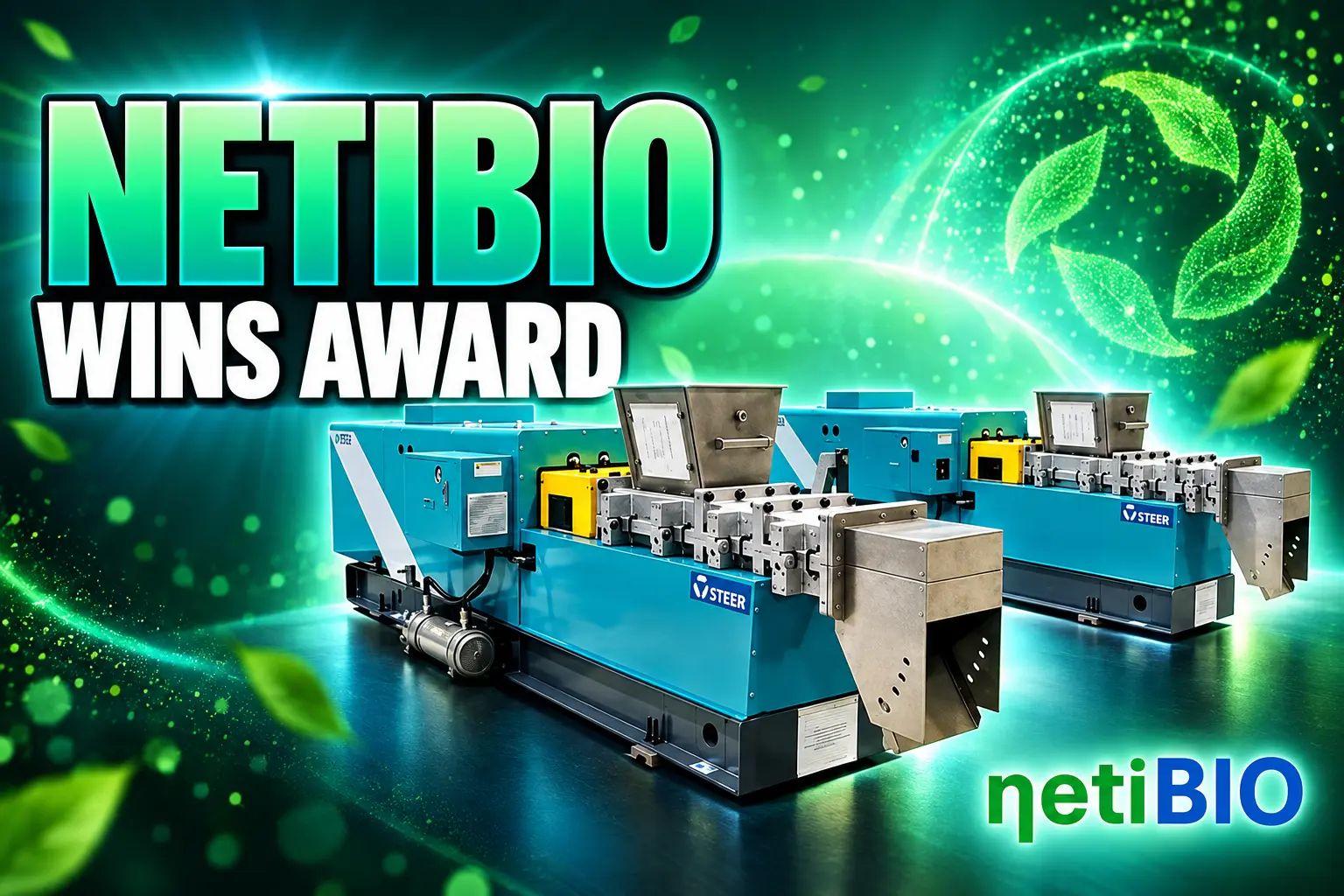
netiBIO, the bioenergy arm of Bengaluru materials firm STEER World, won a biomass pre-conditioning award at New Delhi’s BBB summit in May 2026. The trophy is for the unglamorous step most compressed biogas plants still skip: opening rice straw so a digester can actually eat it.
India is adding CBG capacity and has already cleared its first-year blending floor. The hard feedstock, woody crop waste with lignin wrapped around the sugars, has not got easier. That is the gap the award names.
The Award Names the Step SATAT Never Built
The prize, “Breakthrough Technology to Pre-Condition Biomass and Agri Residue for Value Creation in Bioenergy and Biofuels,” went to netiBIO at the 5th BBB International Expo and Summit, held 7-9 May 2026 at IICC Yashobhoomi. Rajaraman DC, chief business officer of STEER World’s bioenergy division, collected it from senior industry and policy figures on the bioenergy circuit.
The Indian Biogas Association staged the three-day meeting with Indus Exposium and Reveille Energy, with support from the Ministry of New and Renewable Energy and the Ministry of Road Transport and Highways. Bhupinder S. Bhalla, a former MNRE secretary, chaired it. The wrap-up from the organisers put more than 100 exhibitors and more than 3,000 business visitors on the floor.
Nitin Gupta, executive director and global CEO of STEER World, treated the plaque as a commercial point, not a science fair ribbon. He said better energy recovery from biomass already sitting in the country remains one of the most effective ways to make CBG projects pay. At the Alpha Series launch in October 2025 he had already put the bottleneck in plainer words.
India’s bioenergy sector is at a tipping point, but real success depends on overcoming the bottlenecks of feedstock pretreatment. With netiBIO Alpha, we are offering a Make-in-India solution purpose-built for India’s tough biomass: compact, efficient, and scalable.
Nitin Gupta, Executive Director and Global CEO, STEER World, at IBET 2025
STEER staff on the Yashobhoomi floor spent the week with EPC firms and plant owners, not with trophy hunters. The questions were about a pretreatment step that could be bolted onto units already built.
217 Plants Against a 5,000-Plant Goal
The Ministry of Petroleum and Natural Gas launched SATAT on 1 October 2018 to build a market for CBG from waste and biomass, with oil and gas marketers offering long-term CBG offtake agreements. The original sketch was 5,000 plants and 15 million tonnes of CBG a year.
The GOBARdhan Portal, as of 31 July 2026, listed 217 CBG plants commissioned, with nameplate output of about 1,773 tonnes per day. Of those, 180 sit under SATAT and the CBG-CGD synchronisation scheme. That is just over 4 percent of the 5,000-plant SATAT goal. Observer Research Foundation researchers flagged the same 217-versus-5,000 gap in early September 2026.
SATAT GOAL VERSUS THE JULY 2026 COUNT
| Metric | Original SATAT goal | Latest official figure |
|---|---|---|
| Plants | 5,000 | 217 commissioned (GOBARdhan Portal, 31 July 2026) |
| SATAT and sync plants | – | 180 |
| Output target / nameplate | 15 million tonnes a year | 1,773 tonnes per day |
| FY 2025-26 blending | 1 percent mandate | 1.05 percent (petroleum minister, Lok Sabha) |
| OGMC CBG procurement | – | 96.5 thousand tonnes in FY 2025-26 |
The count is moving. Union petroleum minister Hardeep Singh Puri’s own posts had 100 plants and 700 tonnes per day in May 2025, then 134 plants and about 930 tonnes per day in February 2026. The jump to 217 plants and 1,773 tonnes per day by the end of July is real. It is still a long walk from 5,000 plants, and nameplate tonnes are not the same thing as gas sold.
Oil and gas marketing companies bought about 96.5 thousand tonnes of CBG in FY 2025-26, more than twice the 42,800 tonnes Puri cited for FY 2024-25. Against a 15-million-tonne annual ambition, that offtake is still a thin slice.
Why Paddy Straw Starves a Digester
Rice stalks, wheat straw, bagasse and Napier grass are lignocellulosic: lignin armour around cellulose. Bugs in a wet digester reach the sugars slowly, methane comes late, and fibrous mats clog tanks that were sized for cattle dung or press mud. European farm plants often run on softer corn silage or hay. Indian SATAT units were asked to swallow paddy straw.
A 2024 technical review of agri-residue CBG found only two operating plants then using rice straw, Verbio’s Sangrur unit in Punjab and HPCL’s Budaun plant in Uttar Pradesh. The rest of the fleet leaned on dung, press mud and mixed waste, the feeds that actually move through a digester without a fight.
Manas Majumdar, oil and gas partner at PwC India, has said CBG growth has been muted less because India lacks waste than because of the quality and calorific content of what arrives, and the difficulty of aggregating volume in one place. Gupta, in a January 2025 interview, called pretreatment of rice and wheat straw the sector’s weak Indian kit, and said imported lines are often a poor fit for local stalks and expensive to keep running.
CBG operators have been chasing higher biogas yield from straw for the same reason the BBB jury carved out a pre-conditioning category. A plant that cannot open the fiber pays for a digester that sits half-fed.
Twin Screws From Plastics, Aimed at Rice Stalks
STEER World did not start as a biogas company. It is a materials-transformation house, headquartered at Peenya Industrial Area in Bengaluru, known for twin-screw compounding platforms used in plastics, pharmaceuticals, food and biomaterials. Gupta dates the firm’s screw work to a 1990s push after a technology that had sat still since the 1940s, including patented Fractional Geometry designs and alloy steel from its own foundry for high-wear barrels.
netiBIO is that hardware pointed at stalks. Gupta describes a bio-processor that applies shear and smear to lignocellulosic biomass such as rice stalks, breaking lignin so the mass shifts from water-repellent to water-loving and cellulose is exposed. The same kit, he said, is meant to run continuous enzymatic hydrolysis instead of batch cycles, and to turn bio-sludge into granulated fertilizer so plants spend less land on composting.
Rajaraman C, then chief operating officer, drew the contrast with Europe when the Alpha Series was shown at IBET 2025. “Unlike European conditions, India’s CBG projects require large-scale pretreatment of fibrous residues like paddy straw and Napier,” he said. “netiBIO Alpha bridges this critical gap with a small footprint, modular design, and low CAPEX/OPEX.”
Independent extrusion research is not a netiBIO trial, and should not be read as one. A 2024 Bioresource Technology paper on high-solids twin-screw pretreatment of forestry biomass reported biomethane gains of up to 190 percent versus a benchmark sample. Separate lab work has found that extrusion raised methane from corn straw under set moisture and screw-speed conditions. Those papers show why a compounding firm smelled a CBG product. They do not audit Alpha on a SATAT site.
What the Alpha Series Is Built to Process
The Alpha Series is a modular bio-processor STEER unveiled at IBET 2025, organised by the Indian Federation of Green Energy, with Union ministers including Nitin Gadkari and Hardeep Singh Puri on the programme. Launch materials market continuous throughput of up to 300 tonnes per day, a compact footprint, and a bolt-on fit for new or existing digesters, with optional digital monitoring. On the stand the machine ran Napier grass and paddy straw, the two Indian feeds European hay lines were never asked to chew.
A 2025 product sheet lists five frame sizes. The 100, 160 and 210 models are shown as available ranges. The 250 and 300 frames are marked under development, with the top unit listed at 8 to 12 tonnes per hour, which is 192 to 288 tonnes over a 24-hour run, under the marketed 300-tonne-a-day ceiling.
NETIBIO ALPHA FRAME SIZES
| Model | Throughput (tonnes per hour) | Product-sheet status |
|---|---|---|
| netiBIO 100 | 0.15 to 1.2 | Listed |
| netiBIO 160 | 1 to 2.5 | Listed |
| netiBIO 210 | 2.5 to 6.5 | Listed |
| netiBIO 250 | 6 to 10 | Under development |
| netiBIO 300 | 8 to 12 | Under development |
The same sheet names the mechanical idea: patented screw geometry for fiber engineering, a clam-shell barrel, segmented screw elements, and STEER’s wear alloy. It lists the stalks the line is supposed to condition.
FEEDS THE SHEET SAYS THE LINE CAN TAKE
- Paddy straw: The residue SATAT keeps promising and few plants have actually digested at scale.
- Napier grass: The energy crop shown live beside paddy on the IBET stand.
- Bagasse: Sugar-mill fiber already sitting next to press-mud CBG projects.
- Cotton and soya stalk: Other woody field waste the sheet groups with mixed agri residue.
Launch copy also claims shorter retention in the digester, lower running energy, and a farm-to-fuel income path that would give straw a price instead of a match. Those are vendor claims. STEER has not published an independent, plant-level methane audit alongside the BBB trophy.
The Blending Mandate Is Already at 3 Percent
Demand is no longer the soft variable. The National Biofuels Coordination Committee set a CBG blending obligation for CNG used in transport and PNG used in homes: 1 percent in FY 2025-26, 3 percent in FY 2026-27, 4 percent in FY 2027-28, and 5 percent from FY 2028-29. Puri told the Lok Sabha in early August 2026 that CBG sales in those two segments reached 1.05 percent in FY 2025-26, just over the 1 percent floor.
FY 2026-27 is already running, so city-gas firms are now shooting at 3 percent. Gupta, citing Indian Biogas Association work in that 2025 interview, said the obligation had been projected to pull about ₹37,500 crore of investment and about 750 CBG plants, and to cut LNG imports by about ₹10,000 crore a year if the gas actually appears.
On 6 August 2026 the government approved GOBARdhan, the National Circular Bioenergy Scheme, with an outlay of ₹23,731 crore (about $2.5 billion). The package is aimed at offtake, price, pipes, credit and feedstock, the boring parts that keep a 10-tonne plant idle even when the digester is sound.
THE SIX GOBARdhan GROWTH ENGINES
- Assured offtake: Buyers on the hook so a plant is not left with unsold bottles.
- Stable pricing: A floor that survives a season of cheap imported LNG.
- Capital assistance: Public money against the capex that stalled SATAT letters of intent.
- Pipeline infrastructure: A way to move gas besides trucking cascades to distant CNG pumps.
- Credit guarantee: Bankable paper for a sector lenders still treat as exotic.
- Ecosystem challenge fund: A pot for the gaps the first five miss, including aggregation kit.
THE POLICY DATES THAT NOW PRESS THE PLANTS
- 1 October 2018: SATAT launches with oil-marketer offtake as the demand crutch.
- October 2025: STEER unveils the netiBIO Alpha Series at IBET and runs paddy straw on the stand.
- 7-9 May 2026: BBB 2026 at Yashobhoomi; netiBIO takes the pre-conditioning award.
- FY 2025-26: Blending lands at 1.05 percent; marketers buy 96.5 thousand tonnes of CBG.
- 31 July 2026: GOBARdhan Portal shows 217 plants and 1,773 tonnes per day nameplate.
- 6 August 2026: Cabinet-level GOBARdhan scheme of ₹23,731 crore; Puri reports the blending miss-turned-make in the Lok Sabha.
Blending can be ordered from Delhi. Straw still has to be opened at the plant gate, or the extra demand shows up as a shortage, not as rural gas.
The Collection Window the Machine Cannot Fix
Equirus, in a September 2026 note, put India’s CBG potential at about 62 million tonnes a year from about 472 million tonnes of feedstock. Animal waste is the big slice, about 190 million tonnes of material for about 25 million tonnes of CBG, roughly 41 percent of that potential. Crop residue is next: about 150 million tonnes of paddy and wheat straw, cane trash and other field waste for about 20 million tonnes of CBG. The same note gives the harvest a collection window of about 45 days.
A twin-screw line in Peenya can shear lignin once the bales arrive. It cannot gather those bales across a district in six weeks, store them through the monsoon, or beat pellet and ethanol plants to the same stack. Gupta has said scattered residue and a weak supply chain are as hard as the chemistry. GOBARdhan’s aggregation money is an admission of that, not a footnote.
netiBIO’s award is a precise trophy. It honours a machine that tries to make SATAT’s toughest feed behave. The blending clock is already on 3 percent, 217 plants are running against a 5,000-plant sketch, and the straw still has a 45-day window in which someone has to pick it up.

Instagram Plus Tests a Read-Only Mode That Cuts Stories

Altman Asks the Public to Accept Some AI Harm

Google Freezes OSS VRP Product Reports After AI Flood

AI Agents Make Payment Rails the Scarce Prize

Turkey’s Crypto Boom Now Runs Through Three Banks

Fable 5 Came Back Under a Commerce On-Off Switch

Google’s SpaceX GPU Lease Has a Sept. 30 Deadline

Plasma One’s XPL Locks Face a 1.81 Billion Cliff

DGO’s Rs 549 World Cup Pass Cost Fans Sleep and Data

Moonshot AI’s $30 Billion Ask Became a $35 Billion Close
-
 AI4 months ago
Fable 5 Came Back Under a Commerce On-Off Switch
-
 AI4 months ago
Google’s SpaceX GPU Lease Has a Sept. 30 Deadline
-
 CRYPTO4 months ago
Plasma One’s XPL Locks Face a 1.81 Billion Cliff
-
 APPS4 months ago
DGO’s Rs 549 World Cup Pass Cost Fans Sleep and Data
-
 AI4 months ago
Moonshot AI’s $30 Billion Ask Became a $35 Billion Close
-

 NEWS4 months ago
ColorOS 17 Device List Spans Oppo, OnePlus and Realme
-

 GAMING4 months ago
Xbox Cuts 3,200 Jobs After Five Years of Thin Returns
-

 GAMING4 months ago
The RTX 4050 Under Rs 70,000 Hides a Wattage Gap