
AI
Huang’s Seoul Dip Call Paid Late and Only in Part
Jensen Huang called Nvidia’s June rout a buying opportunity in Seoul. The stock fell further, then earnings paid a thin gain while SK hynix co-design stuck.

Nvidia chief Jensen Huang told reporters in Seoul on June 8 that a global AI stock rout was a gift, a chance to buy shares at a discount. He said it beside SK Group chairman Chey Tae-won, minutes after the two companies locked a multi-year pact to co-design memory for Nvidia’s next machines.
The tape did not take his word for it. Nvidia kept falling for three weeks, then needed an earnings print in late August before the equity call showed a gain, and even that gain was thin by Sept. 11.
Huang Told Seoul to Treat the Rout as a Sale
Friday, June 5, had already taken a bite out of the AI trade. Nvidia fell 6.2% that session, from a $218.42 close on June 4 to $204.87, as rate-hike fears hit long-duration chip stocks. South Korea’s Kospi tumbled when Seoul opened on June 8, and SK hynix, the memory name Huang had come to court, was sliding with it.
Huang had spent the week looping the city, from a pork-belly dinner in Hongdae where he and Chey handed out “HBM Chips” snacks to a Monday briefing at SK Seorin Building in Jongno. Asked what investors should make of the drop, he declined to soothe them with a bottom call and instead told them to shop.
We’re at the beginning of it, and whatever happened to the stock market, you should be very happy because now you can buy at a discount.
Jensen Huang, Nvidia CEO, briefing in Seoul, June 8, 2026
“Everybody should be very excited,” he added. He called AI a foregone piece of world infrastructure, “just like the internet was infrastructure for the world,” and said the industry was in year one of a build that would run at least another decade. Chey, standing with him, put the commercial relationship in one line: SK hynix would be Nvidia’s largest memory supplier, and Nvidia would be SK hynix’s biggest customer.
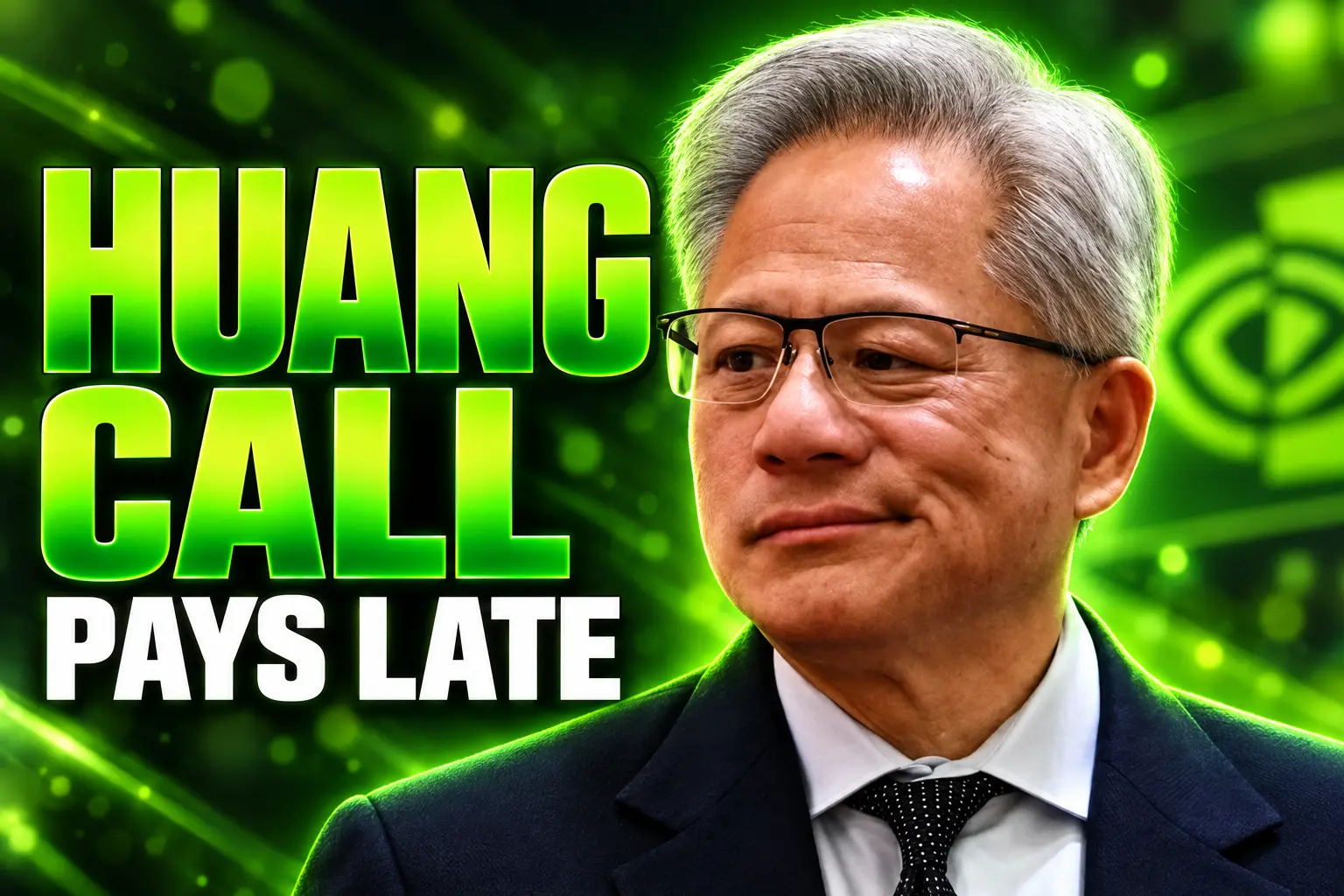
Did Jensen Huang’s June Dip Call Pay Off?
Only in part, and not on his timetable. Nvidia’s June 8 close of $208.41 sat $1.54 under that day’s open of $209.95. By June 29 the stock had an intraday low of $189.59, 9.7% below the June 8 open, before closing June at $199.87, down 7.1% for the month. Anyone who took the Seoul remark as a timing signal sat underwater into July.
THE NVIDIA TAPE AFTER SEOUL
| Date | Nvidia close | What the session did |
|---|---|---|
| June 5, 2026 | $204.87 | Down 6.2% from June 4’s $218.42 close |
| June 8, 2026 | $208.41 | Huang’s briefing day; open $209.95, low $205.77 |
| June 29, 2026 | $194.75 | Intraday low $189.59, 9.7% under the June 8 open |
| Aug. 26, 2026 | $209.43 | Q2 report after the close |
| Aug. 27, 2026 | $227.73 | Up 8.7% on the print |
| Sept. 11, 2026 | $218.29 | Up 4.7% from the June 8 close |
The only clean win versus that June 8 close arrived after Nvidia reported, not after Huang spoke. Shares jumped 8.7% on Aug. 27, then faded. The Sept. 11 close of $218.29 is 4.7% above $208.41 and still under the May 14 high of $235.47. The Seoul “sale” got cheaper before it got better.
SK hynix Took a Co-Design Seat on Nvidia’s Roadmap
The contract he signed that morning did not need a bounce in Santa Clara. SK hynix and Nvidia announced a multi-year technology partnership to advance memory for what both companies now call AI factories, built to cover the long design cycles and heavy plant spending that high-bandwidth stacks require. Huang put the industrial case in the release: advanced memory is essential to those factories’ performance, and the two firms would co-develop the next generation from training through agentic and physical AI.
He was blunter in the room. “Without SK hynix, today’s AI industry would not have advanced this remarkably,” he said, adding that the joint business was already in an enormous boom. The Seoul memory co-design agreement runs at least two years and is written to be extended. It puts SK hynix on four named Nvidia lines at once, which is a wider seat than a one-generation supply order.
WHERE SK HYNIX NOW DESIGNS WITH NVIDIA
- Vera Rubin systems: Memory for Nvidia’s AI supercomputers, including HBM4, as that platform ramps into full production.
- Vera CPUs: DRAM for the standalone Vera processor, taking the partnership beyond GPU stacks.
- RTX Spark PCs: Memory for Nvidia’s personal AI machines, the “personal AI” slice of the release.
- Jetson Thor robots: Memory for physical-AI computing, the line Huang tied to Korea’s factory base.
Samsung and Micron were already cleared to ship HBM4 for Vera Rubin, so this was not an exclusive tap. It was a co-design seat plus a supply claim across Nvidia’s next stack, which is the part of the Seoul trip that still binds even if the stock thesis wobbles. SK hynix also said it would run Nvidia CUDA-X tools and PhysicsNeMo on its own simulation codes, and build fab digital twins in Omniverse, tying the memory maker’s plants to Nvidia’s software as well as to its orders.
August Earnings Finally Paid the Equity Call
Demand did what Huang said it would do. Nvidia’s newsroom posted second-quarter revenue of $96.2 billion for the period ended July 26, up 106% from $46.7 billion a year earlier and up 18% from the $81.6 billion first quarter that had already been on the board when he spoke in Seoul. Data center revenue was $89.0 billion, up 117%. Gross margin sat at 75.0%. GAAP earnings were $2.46 a share, with non-GAAP at $2.22.
Q2 FY2027, THE PRINT THAT MOVED THE TAPE
- Revenue: $96.2 billion, up 106% year on year and 18% from the prior quarter.
- Data center: $89.0 billion, including a hyperscale bill of $48.7 billion and $40.3 billion from AI clouds, industrial, and enterprise accounts.
- Outlook: $108.0 billion of third-quarter revenue, plus or minus 2%, with no China data-center compute in the guide.
- Cash back: About $26.0 billion returned in the quarter, with $99.0 billion still authorized for buybacks, and a $0.25 dividend due Oct. 1.
“AI has reached its inflection point. It’s doing useful work. Its tokens are productive and profitable. Now, compute is revenue,” Huang said in the release, a harder claim than June’s infrastructure sermon. Vera Rubin, he added, was in full production. Hopper shipments to China were less than 1% of data-center revenue in the quarter, which is why the China-zero guide did not gut the run-rate and why the stock still twitches on export headlines.
NEWS: NVIDIA announces financial results for second quarter fiscal 2027.
➡️ Revenue of $96.2 billion, up 106% from a year ago
➡️ Data Center revenue of $89.0 billion, up 117% from a year agoRead more: https://t.co/fQUiuBUsOU
— NVIDIA Newsroom (@nvidianewsroom) August 26, 2026
That Aug. 27 pop is the session that made the Seoul quote look clever. It was the quarter, not the sound bite, that pulled Nvidia back through $208.41.
SK hynix Shares Gave Back the June Spike
The other ticker in the briefing room had a louder June and a meaner hangover. SK hynix was already under pressure the morning Huang spoke, with prints described in Seoul as briefly under 2 million won as the Kospi broke down. By June 17, Korea Exchange records show the stock closed at 2,521,000 won and traded as high as 2,539,000 won, a spike that trapped anyone who heard “discount” and then waited for a pullback that did not arrive in time.
On Sept. 11, SK hynix closed at 1,812,000 won, about 28% below that June 17 close. The memory name Huang was standing next to was the one that actually offered a sale in June, then spent the next quarter giving the sale back. Nvidia, the stock he was selling as cheap, never made that kind of round trip; it chopped, printed, and ended 4.7% higher. The partner that needed his order book ran farther in both directions.
That split is the part of the Seoul trip the equity sound bite hid. Huang was in town because HBM, not a multiple, was the constraint on Vera Rubin. Locking co-design with the supplier that already fills most of those stacks protects Nvidia’s rack even if Samsung and Micron keep a slice of HBM4. SK hynix gets a demand signal that stretches past one GPU generation, into CPUs, PCs, and robots. Shareholders in either name were left to underwrite a different bet than the one he described at the microphone.
A Founder Calling His Own Stock a Bargain
Take the quote as market color and it is a founder doing what founders do. Huang’s wealth is Nvidia stock. A public “buy the dip” on a red Monday costs him nothing if he is wrong on timing and helps him if the tape turns. The objection wrote itself in the first hour: of course the chief executive told people to buy the company that is his fortune. One reply put it as a joke about a CEO promoting his own shares; another said the real discount would be under $100, not $208.
That skepticism had a point about price and almost none about product. The June 5 drop came after Nvidia had already posted an $81.6 billion quarter. The next print was $96.2 billion. Guidance now sits at $108.0 billion. The people who treated Huang as a tape reader got a 9.7% hole and a 4.7% gain. The people who treated him as a man scrambling to secure HBM for a platform he said was entering full production got the contract that was actually signed.
Talking his book does not make the book false. It does mean the quote was never a research note. It was a salesman, in a partner’s tower, telling a frightened room that the goods were on sale while he was busy reserving the scarce input those goods require.
On Sept. 10 He Asked the Room to Admit He Was Right
At Goldman Sachs’s Communacopia conference on Sept. 10, Huang was asked about his older call that AI infrastructure spend would hit $3 trillion to $4 trillion by 2030. He did not hedge. “I just think we should just take a pause and acknowledge that I was right,” he said, then walked through why he thought he knew: generative computers replace retrieval, Moore’s law no longer deflates the bill, and the industry has to co-design across chips, packages, and racks. On growth, he repeated the number he had put on the earnings call. “We could grow 70% year-over-year, and we are confident about that.”
He also dropped a figure that sits next to the June panic: about $400 billion of venture money went into AI-native firms in six months, and those firms, as he defined them, spend two-thirds of what they raise on compute. That is the demand story he was already telling in Jongno, minus the invitation to buy the dip. Unconstrained demand, he said, would point to growth over 100%; 70% is the rate he will own if supply, power, and memory hold him back.
Nvidia closed Sept. 11 at $218.29, 4.7% above the close he called a discount and still short of May’s $235.47 high. The memory pact is in force, Vera Rubin is in production, and the next guide assumes $108.0 billion with China compute at zero. He is still on the same side of the wager. The tape, again, will keep its own score.
Disclaimer: This article is news reporting and analysis of public remarks, company releases, and market prices, and it is for information only. It is not investment advice, a recommendation to buy or sell Nvidia, SK hynix, or any other security, and it is not a prediction of future returns. Readers should consult a licensed financial adviser or other qualified professional who can consider their own holdings, time horizon, and risk limits before acting. Figures and statuses reflect the cited company filings, newsroom releases, and exchange prices as of the dates named above and will change with later prints, guidance, and trading.

Instagram Plus Tests a Read-Only Mode That Cuts Stories

Altman Asks the Public to Accept Some AI Harm

Google Freezes OSS VRP Product Reports After AI Flood

AI Agents Make Payment Rails the Scarce Prize

Turkey’s Crypto Boom Now Runs Through Three Banks

Fable 5 Came Back Under a Commerce On-Off Switch

Google’s SpaceX GPU Lease Has a Sept. 30 Deadline

Plasma One’s XPL Locks Face a 1.81 Billion Cliff

DGO’s Rs 549 World Cup Pass Cost Fans Sleep and Data

Moonshot AI’s $30 Billion Ask Became a $35 Billion Close
-
 AI4 months ago
Fable 5 Came Back Under a Commerce On-Off Switch
-
 AI4 months ago
Google’s SpaceX GPU Lease Has a Sept. 30 Deadline
-
 CRYPTO4 months ago
Plasma One’s XPL Locks Face a 1.81 Billion Cliff
-
 APPS4 months ago
DGO’s Rs 549 World Cup Pass Cost Fans Sleep and Data
-
 AI4 months ago
Moonshot AI’s $30 Billion Ask Became a $35 Billion Close
-

 NEWS4 months ago
ColorOS 17 Device List Spans Oppo, OnePlus and Realme
-
 GAMING4 months ago
Xbox Cuts 3,200 Jobs After Five Years of Thin Returns
-
 GAMING4 months ago
The RTX 4050 Under Rs 70,000 Hides a Wattage Gap