
GADGETS
Oppo Bubble Joins Honor and Insta360 in a Screen Bet
Oppo’s CNY 499 Bubble is one of three magnetic rear screens this year, an optional bet against Xiaomi’s built-in flagship display.

Oppo put the Bubble on sale in China on May 29, 2026, at CNY 499 (about $73), a 27.5 g magnetic disc that previews the rear camera. Honor shipped a round puck the same week. Insta360 had already sold a larger wired one in April.
Xiaomi is still taking the other side of that wager. The 18 Pro series is set for a China launch in September 2026 with another screen built into the camera deck, after the company said people tapped app cards on last year’s rear display more than 4 million times a day.
The Puck Is a Viewfinder First
Oppo’s listing calls it the Bubble Mag E-Badge. The job that pays for the badge is on the back of the phone. Stick it on, and the disc shows the rear camera view in real time, so a selfie can use the main camera instead of the weak front one.
The hardware is a 7 mm circular AMOLED touchscreen, 1.73 inches across at 466×466, with a 550 mAh cell charged over USB-C. A magnetic ring is in the box because Oppo’s own phones still do not carry charging magnets. Pairing is wireless. Bring a supported ColorOS handset within 20 cm and a card pops up; past 1 metre, that card does not appear.
Oppo lists live preview and a shutter out to 10 metres, with on-screen zoom at 0.6x, 1x, 2x and 3.5x, depending on the lenses in the phone. When someone else holds the handset, the subject can still see framing on the puck. The same disc also plays wallpapers, 3-second motion photos, and MP4 clips from 1 to 5 seconds, up to 20 files in a carousel, plus tap-reactive pet animations.
THE OPPO LAB BATTERY RUN
- Static carousel, medium: Up to 25.33 hours with still images looping at medium brightness.
- Static carousel, high: Up to 16.08 hours at high brightness on the same still-image loop.
- Live camera, medium: Up to 9.66 hours with the phone’s 1x rear camera and a shutter every 10 seconds.
- Live camera, high: Up to 8.54 hours on that same camera test at high brightness.
Those figures are Oppo Lab tests, not a promise for a day of vlogging. The camera numbers assume a click every 10 seconds, which is a slow shoot. A group photo on a tripod fits that pattern. A talking-head clip does not.
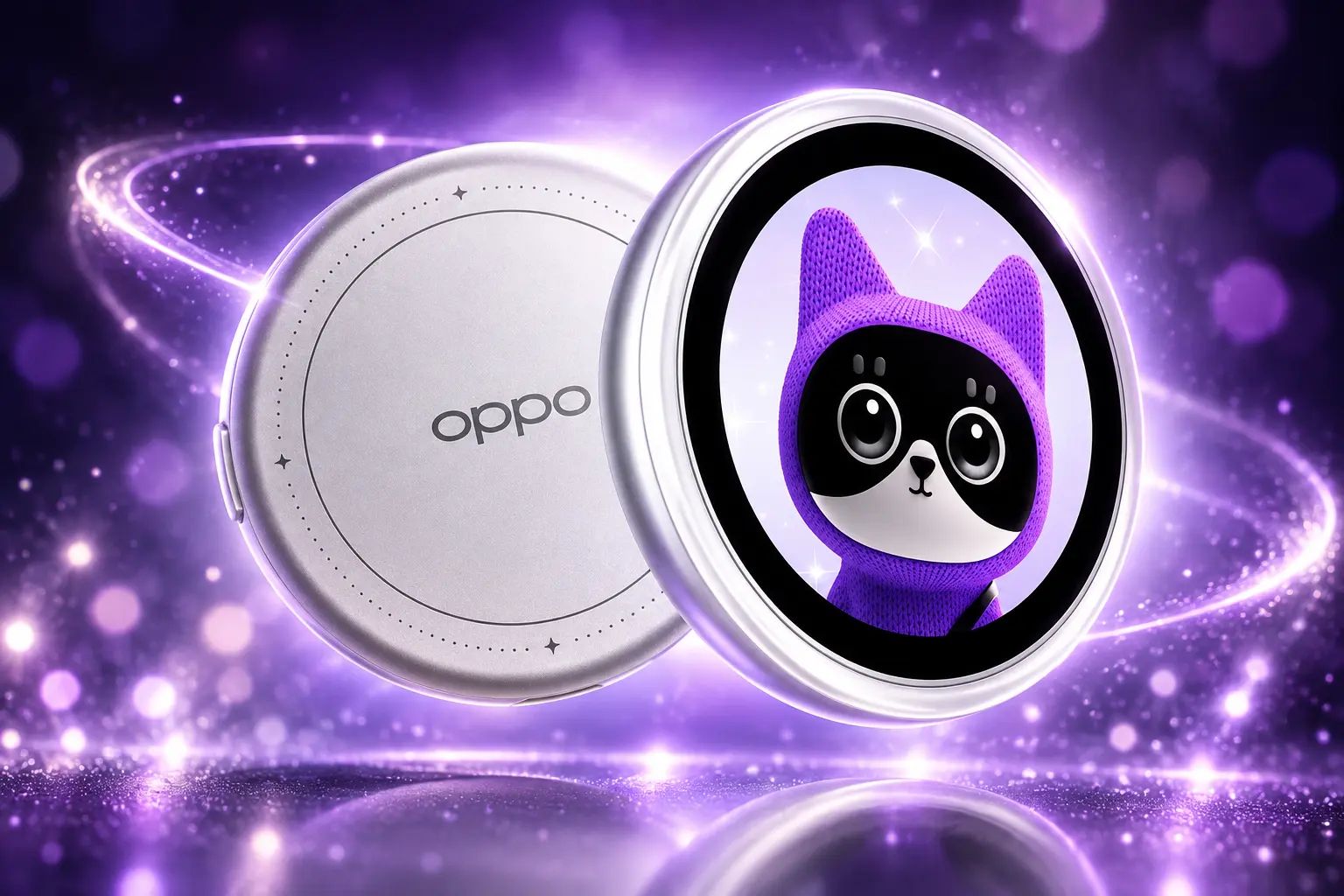
Oppo, Honor and Insta360 Split the Same Job
Three add-ons landed in a single season, and they do not agree on what a rear screen is for. Oppo and Honor built round wireless badges that can hang off a bag. Insta360, a camera company, built a 3.5-inch wired monitor and left the battery out.
THE MAGNETIC SCREEN LINEUP
| Product | Screen | How it links | Price |
|---|---|---|---|
| Oppo Bubble | 1.73-inch AMOLED, 27.5 g | Wireless, 10 metres | CNY 499 |
| Honor Magic Mini Yao | 1.73-inch AMOLED, 34 g | Wireless, 4-level fill light | Not listed in English materials |
| Insta360 Snap | 3.5-inch LCD, 7.3 mm thick | USB-C cable, about 30 ms | $79.99, $89.99 with light |
| Xiaomi 17 Pro rear panel | 2.7-inch LTPO AMOLED | Built into the camera deck | Included in the phone |
Honor’s puck, teased on May 21, 2026 for the Honor 600 launch on May 25, looks like Bubble’s cousin. A kit sold for the 600 Pro lists the same 1.73-inch 466×466 AMOLED, 7 mm thick, 59 mm across, with Bluetooth 5.3 and a 540 mAh cell. The extra is light: 18 LEDs in four levels, plus a hardware button, a Douyin scroller, a timer, and a few mini games. Oppo stayed on preview, wallpaper, and pets. Honor added a lamp.
Insta360 Snap went on sale on April 8, 2026, weeks before either phone brand. The standard model is $79.99. The light model, co-developed with Amiro, is $89.99 and 8.2 mm thick, with 3 colors and 5 brightness steps. China list prices sit at 499 yuan and 599 yuan, the same yuan number Oppo chose. The Snap plugs into USB-C, mirrors the phone, and works in third-party camera apps. It is a monitor. The round pucks are badges that can also monitor.
Xiaomi Built the Screen Into the Flagship
Xiaomi already tried a tiny rear panel on the Mi 11 Ultra in 2021 and came back larger. The 17 Pro carries a 2.7-inch LTPO AMOLED at 572×904, 120 Hz, and 3,500 nits, set into the camera island. The Pro Max uses a 2.9-inch panel at 596×976. That glass can show a clock, notifications, music, a selfie viewfinder, AI wallpapers, and a panda pet named Pangda. A China-only case even turns it into a tiny game pad.
Xiaomi has cited more than 4 million daily interactions with app cards on last year’s rear display, and more than 3.5 million wallpapers added each day. Those are company figures, not third-party audits, but they were enough for the firm to keep the panel. The 18 Pro series is confirmed for a China launch in September 2026, again with a screen in the Leica camera module, and a teaser that simply says “Generating.”
Every Pro buyer pays for that glass, in weight and in price, whether they use it or not. Oppo’s bet is the opposite. Keep the phone ordinary. Sell the second screen to people who want it. Honor did the same on a mid-range 600. Insta360 did it without selling a phone at all.
Moto Mods Already Ran This Experiment
Phone makers have snapped extra hardware onto the back before, and most of it died when the next chassis changed.
THE SECOND-SCREEN TIMELINE
- 2016: Motorola ships the Moto Z and Moto Mods, magnetic backs for speakers, batteries, and a Hasselblad zoom block. The Z line holds the same footprint for years to keep the mods alive, then the program fades by 2020.
- 2019 to 2020: LG sells a Dual Screen folio with a second OLED for about $200, tied to a handful of V and G phones, then leaves the mobile business.
- October 2020: Apple puts MagSafe magnets in the iPhone 12. Wallets and chargers stick. The standard holds because Apple does not resize the ring every year.
- 2021: Xiaomi puts a small rear display on the Mi 11 Ultra. It stays a curiosity.
- April 8, 2026: Insta360 Snap goes on sale as a MagSafe-friendly 3.5-inch viewfinder.
- May 25, 2026: Oppo launches Bubble with the Reno 16. Honor puts the Yao screen next to the Honor 600.
- June 30, 2026: Oppo opens a China iPhone SKU of Bubble, shipping July 6, for iPhone X and later on iOS 15.
- September 2026: Xiaomi confirms the 18 Pro series still carries a rear screen.
Moto Mods failed in part because only Moto Z owners could buy in, and new phones could not change shape. MagSafe worked because the magnet ring became a default. Bubble still needs a ring sticker or a case on Oppo hardware. Snap ships a ring for Android phones that lack MagSafe. The physics is ready. The phones, on Android, often are not.
Why Insta360 Wired the Screen to USB-C
Insta360’s own FAQ is blunt about why a camera brand built a phone add-on. The rear camera is the good camera, and people do not use it on themselves because they cannot see it.
Why would a camera company build a smartphone accessory? Because at Insta360, we focus on the imaging experience, not just the camera. Our mission has always been to help people better capture and share their lives. We observed that while the smartphone is the most universal creative tool, its most powerful asset, the rear camera, is often unused for selfies and vlogs because of how phones are designed.
Insta360, Snap product FAQ
The cable is the other half of that argument. Insta360 claims latency as low as 30ms on 4K60 with the native iPhone camera, and it sells the lack of a battery as a feature: 7.3 mm thick, no pairing, no charge anxiety. Ten minutes of continuous shooting with the light model, more than 200 stills, draws about 6 percent from the phone. Live streaming is not recommended.
The cost sits in the port. Snap needs USB-C with DisplayPort Alt Mode on Android, and on iPhone it needs iPhone 15 or later, excluding iPhone 16e, iPhone 17e, and iPhone Air. Lightning iPhones are out, adapters included. Touch on iPhone also requires the Accessibility Zoom toggle, a workaround that can leave the UI looking huge until a three-finger double-tap. Oppo’s wireless 10-metre remote has none of that port drama, and none of that 30 ms claim.
The Oppo Bubble Price in India
China remains the home market at CNY 499. Oppo has not posted a U.S. or U.K. launch. A separate iPhone SKU, announced on June 30, 2026, matches that China price and ships from July 6 for iPhone X and newer on iOS 15. Buyers in Japan posted working iPhone setups within days. Physical magnets are not the same as software. The original ColorOS unit can sit on a MagSafe iPhone and still do nothing useful.
India sale posts in early July listed the puck at ₹7,999. OPPO Nepal is still using it as a Reno 16 sweetener: a Bubble the company values at Rs. 15,999, offered at Rs. 9,999 to the first 40 Reno16 buyers, valid through September 30, 2026.
🫧 Unbox the fun with the 𝗢𝗣𝗣𝗢 𝗕𝘂𝗯𝗯𝗹𝗲!
Get the 𝗢𝗣𝗣𝗢 𝗕𝘂𝗯𝗯𝗹𝗲 𝗠𝗮𝗴 𝗘-𝗕𝗮𝗱𝗴𝗲, worth Rs. 15,999/-, for just 𝗥𝘀. 𝟵,𝟵𝟵𝟵/- with your Reno16 purchase.
🎁 Exclusive for the first 40 Reno16 customers
📅 Valid until September 30, 2026#OPPOBubble #OPPO pic.twitter.com/8AxQj1UsUk— OPPO Nepal (@OPPONepal) September 23, 2026
IN THE CHINA BOX
- The disc: 7 mm AMOLED puck with a 550 mAh cell and USB-C.
- The ring: A stick-on magnet so phones without built-in magnets can hold it.
- The case: A shell that turns the puck into a bag charm or key ring when it is not on the phone.
Global Oppo pages still name the Reno 16 series and Find X9 series as the core match, with more ColorOS models possible over the air. Early Reno 14, Reno 15, and Find X8 support was part of the China launch set. Nearby devices get automatic pairing with ColorOS phones when they sit close enough for the pop-up card.
An Update Already Broke Some Units
The wireless design makes Bubble a software product. That is the part of the bet that already looks shaky. In late July, an iOS developer who had been happy with the iPhone SKU said a later update stopped part of the touch surface from working and left the interface lagging, and told other buyers not to update. A reply in that thread said another unit was faulty and not working at all. Oppo’s public help page for the accessory is thin. A round screen with its own little OS is another thing that can fail after you already paid.
Snap’s cable looks crude next to a 10-metre remote, until you notice there is no firmware to brick. Honor’s lamp and Douyin remote add reasons to keep the puck on the desk even when nobody is taking a photo. Oppo leaned on pets, badges, and a hanging case, the “electronic badge” pitch that Chinese social posts already use for round screens. Those extra uses may be what keeps a $73 disc out of a drawer. They are also what needs updates.
Xiaomi does not have to win that argument with a charm. The 17 Pro’s rear glass is on the phone whether the owner wanted a viewfinder or not, and the 18 Pro is keeping it. Oppo, Honor and Insta360 are asking people to spend extra and then keep caring. Through September 30, Oppo is still paying some Reno 16 buyers to give the puck a try. That is what an open bet looks like, four months after launch.

Instagram Plus Tests a Read-Only Mode That Cuts Stories

Altman Asks the Public to Accept Some AI Harm

Google Freezes OSS VRP Product Reports After AI Flood

AI Agents Make Payment Rails the Scarce Prize

Turkey’s Crypto Boom Now Runs Through Three Banks

Fable 5 Came Back Under a Commerce On-Off Switch

Google’s SpaceX GPU Lease Has a Sept. 30 Deadline

Plasma One’s XPL Locks Face a 1.81 Billion Cliff

DGO’s Rs 549 World Cup Pass Cost Fans Sleep and Data

Moonshot AI’s $30 Billion Ask Became a $35 Billion Close
-
 AI4 months ago
Fable 5 Came Back Under a Commerce On-Off Switch
-
 AI4 months ago
Google’s SpaceX GPU Lease Has a Sept. 30 Deadline
-
 CRYPTO4 months ago
Plasma One’s XPL Locks Face a 1.81 Billion Cliff
-
 APPS4 months ago
DGO’s Rs 549 World Cup Pass Cost Fans Sleep and Data
-
 AI4 months ago
Moonshot AI’s $30 Billion Ask Became a $35 Billion Close
-
 NEWS4 months ago
ColorOS 17 Device List Spans Oppo, OnePlus and Realme
-

 GAMING4 months ago
Xbox Cuts 3,200 Jobs After Five Years of Thin Returns
-
 GAMING4 months ago
The RTX 4050 Under Rs 70,000 Hides a Wattage Gap