
AI
RAYS 2026 Speakers Warn AI Threatens Indigenous Storytelling
Speakers at RAYS 2026 in Kuching warned that AI and social media threaten Indigenous cultural authenticity, even as those tools can revive languages.

At the Rainforest Youth Summit 2026 in Kuching, speakers from Panama, Hong Kong and Borneo told delegates that the real casualty of AI-driven storytelling is not factual accuracy but cultural authenticity. The summit ran from 24 to 26 June in Sarawak, Malaysian Borneo, under the theme “Youth: Many Ways, One Planet.” Three speakers, each from a different angle, put the question plainly.
The concern that surfaced alongside the climate brief was a warning that the same phones, platforms and AI tools now used to share the rainforest’s story are also reshaping who gets to tell it. Sarawak was the room, but the test is regional.
What the Speakers Saw at RAYS 2026
RAYS 2026 placed Indigenous knowledge and youth leadership at the centre of climate conversations, but a strand of the programme pushed into a different question: what happens to a culture when anyone with a smartphone can narrate it. Sessions ranged across climate governance, biodiversity, and intergenerational leadership, with regional delegates joining Sarawak-based organisers on stage. The theme “Youth: Many Ways, One Planet” framed the week. The storytelling question ran through all three days, and the framing came from the warnings three RAYS speakers delivered in Kuching.
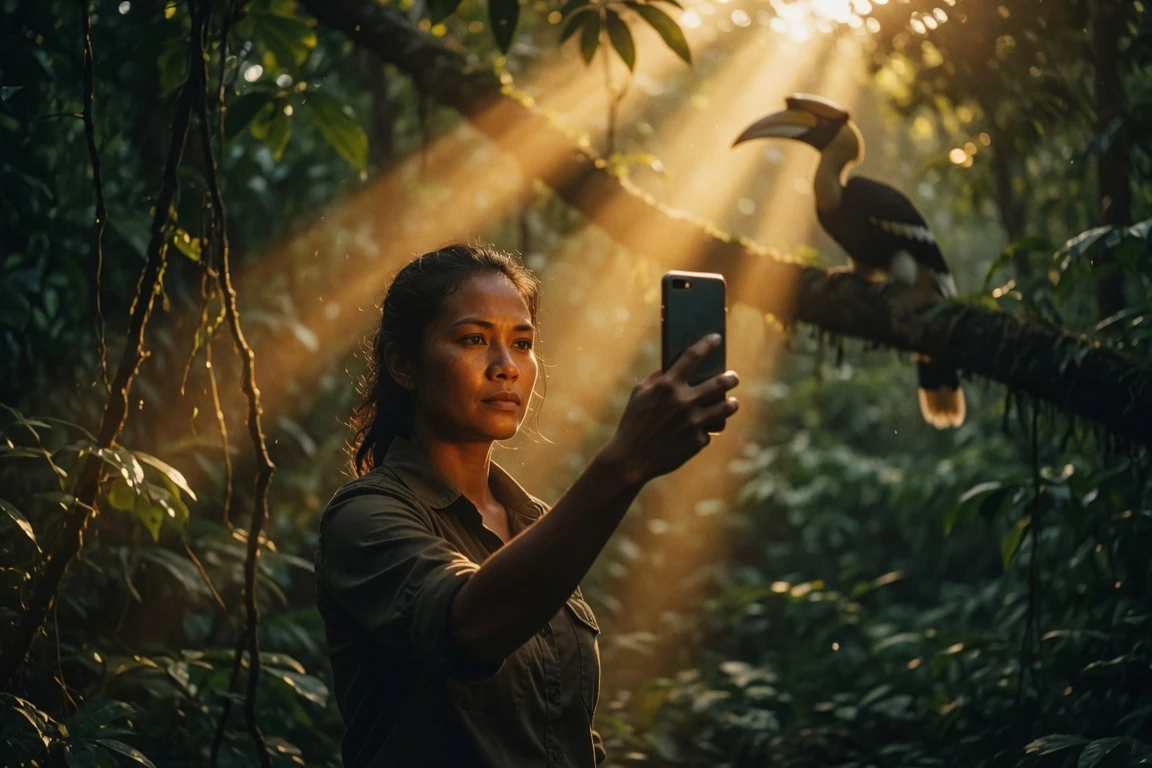
For Diwigdi Valiente, the risk starts with the device in every hand. Valiente is an Indigenous and coral conservation professional from Panama’s Guna community, currently Senior Program Manager at the Wildlife Conservation Society and founder of Burwigan, an Indigenous-led organisation promoting climate awareness, as detailed on Diwigdi Valiente’s speaker profile at RAYS 2026. “With a phone and social media, anyone can tell a story today,” he said.
His point was about who uses the technology, and what they know before they press record. “But if people do not understand how to respect traditions, we risk losing authenticity and seeing culture appropriated or misrepresented,” he said. Valiente framed cultural protection and environmental protection as the same project, because in many Indigenous communities the knowledge that guides conservation lives inside the songs, chants and oral records that digital platforms now recirculate. His warning sat as the thesis for the rest of the week.
RAYS 2026 at a glance
- Dates: 24 to 26 June 2026
- Location: Kuching, Sarawak, on the ancestral lands of the Iban, Bidayuh, Orang Ulu and Malay communities
- Scale: 700+ delegates from 11 ASEAN member states
- Programme strands: Ways of Knowing, Living with the Earth, Power and Responsibility
- Theme: “Youth: Many Ways, One Planet”
Tsui’s Warning on Deepfakes and Climate Narratives
Tori Tsui, an environmental campaigner and senior advisor to the Fossil Fuel Non-Proliferation Treaty initiative based in Hong Kong, took the threat framing further. She described social media and AI as forces that have already redrawn who gets heard in the climate fight. Her concern was the machinery now aimed at the climate story itself, and she is documented on Tori Tsui’s speaker profile at RAYS 2026.
We are living in a time of deepfakes, misinformation and censorship. The question is whether technology amplifies authentic voices or instead fuels propaganda against climate action while creating new ways to extract, commodify and profit from cultures and communities.
Tsui made the remark on the second day of RAYS 2026 in Kuching. Her framing holds both halves at once. Social media and AI have given marginalised communities a platform and an audience they had not previously had, while also arming the actors who want to drown those voices out, and the asymmetry, in her telling, is who has the resources to flood the feed. For Sarawak and Borneo, where rainforest coverage travels globally before it travels locally, that asymmetry matters. Tsui’s framing sits inside a wider AI accountability moment, with three accountability fronts that converged in June 2026.
Why Sarawak and Borneo Carry the Test Case
Sarawak sits at the meeting point of three of the story’s pressure points: deep Indigenous knowledge traditions, accelerating digital adoption, and a global audience already watching its forests. The RAYS site opens by acknowledging that the summit takes place on the ancestral lands of the Iban, Bidayuh, Orang Ulu and Malay communities, each of which carries oral histories that double as ecological records. The question of who tells those histories to the outside world is not abstract, and the structure is laid out on the official RAYS 2026 programme and mission.
Valiente’s framing lands directly on this region. He argued that protecting nature and protecting culture are the same act, because the stories that bind communities to a forest are also the stories that guide how the forest is used. When those stories travel outward without their keepers, the forest follows a different author.
The RAYS programme acknowledges the same dynamic in three strands: Ways of Knowing, Living with the Earth, and Power and Responsibility. Each strand places the question of how knowledge travels next to the question of who decides what it means. For delegates from across ASEAN, Sarawak offered a working case rather than a parable. The Kelabit filmmaker Sarah Lois Dorai gave that case a local name, in a story about hornbills and what younger Sarawakians have never seen.
Her example carries the question into a single scene. The second frame came from the same stage, and it cuts the other way.
AI’s Other Edge in Language Revival
Valiente’s argument has a second edge, and it cuts the other way. AI could be used to revive Indigenous languages that are losing fluent speakers. When a language disappears, the observation built into it goes with it.
Valiente’s claim is not sentimental. He frames language archives as infrastructure for the next generation of conservation work. Traditional songs, chants and stories often encode generations of detail about wildlife, forest governance and seasonal change. When those records lose their original speakers, the conservation knowledge inside them loses shape. Sarawak’s oral traditions hold exactly that kind of record, and the speakers are getting older.
AI tooling has begun to make that archive work cheaper, from speech-to-text models to translation systems built on smaller language corpora. The promise is real, and so is the warning Valiente carried into the same session. The tools that can archive a language can also flatten it, if the community that owns it is not in the loop. That tension framed the next set of talks on the floor.
Hornbill Songs as Ecological Record
Dorai offered the working example. She told the room about traditional songs describing hornbills gathering in large numbers, scenes that many younger Sarawakians have never witnessed themselves. The songs doubled as records of what the canopy used to look like.
These stories show us what the world once looked like. Without them, we lose not just language, but our memory of the landscape.
Dorai is an award-winning Kelabit filmmaker. She spoke on the third day of RAYS 2026 at a session on cultural continuity and storytelling. Her example lands harder because Sarawak still has hornbills, but fewer of them, and the social memory of their gatherings now lives mostly with older singers. Filmmaking cannot replace oral tradition, and Dorai did not claim it could. A camera can document what it sees, but the song that describes the canopy carries detail the camera cannot catch.
The Three Questions Every Young Storyteller Must Answer
Dorai pressed her point into a test for the next generation. The same device in the hand can build understanding or destroy it, she said. The deciding factor is the discipline of the person using it.
She gave the discipline a short shape, in three questions every storyteller should ask before publishing.
- Am I the right person to tell it?
- Who benefits from it?
- Does it honour the community where it comes from?
Those three questions form a working filter for any project that touches an Indigenous community. They reject appropriation and flattening, and they leave room for outsiders to earn their way in. Sarawak was the example, but the test travels. The next cohort of regional storytellers will decide how often the filter holds under pressure from feeds built for speed.
The Stakes Beyond Sarawak for ASEAN’s Storytellers
RAYS delegates came from every ASEAN member state, and the framing in Kuching was deliberately regional. The summit’s own mission statement ties youth, Indigenous knowledge and biodiversity into a single ask. Cultural authenticity, in that framing, sits inside the climate brief rather than beside it.
The economic framing matters too. Stories detached from their communities become products, and the communities that generated them rarely see the return. ASEAN’s response to that, so far, has been uneven. Dorai closed her session with the line the room could repeat: “We have the power to build, and we have the power to destroy. We must always choose to build.” RAYS 2026 ran from 24 to 26 June in Kuching. The work it pointed at runs longer than that.
Frequently Asked Questions
What was the Rainforest Youth Summit 2026?
The Rainforest Youth Summit 2026, known as RAYS 2026, ran from 24 to 26 June in Kuching, Sarawak, under the theme “Youth: Many Ways, One Planet.” It drew more than 700 young leaders, Indigenous advocates, scientists and creatives from all 11 ASEAN member states.
Who spoke about AI and cultural authenticity at RAYS 2026?
Three speakers carried the cultural-authenticity theme. Diwigdi Valiente, a Panamanian Indigenous conservationist from the Guna community and Senior Program Manager at the Wildlife Conservation Society, warned of appropriation risks from phone-driven storytelling. Tori Tsui, a Hong Kong climate campaigner and senior advisor to the Fossil Fuel Non-Proliferation Treaty initiative, named deepfakes and misinformation as the new climate-story problem. Sarah Lois Dorai, an award-winning Kelabit filmmaker, gave the warning a local shape through her work on traditional hornbill songs.
Can AI help preserve Indigenous languages?
Valiente argued at RAYS 2026 that AI tools could help revive disappearing Indigenous languages, because those languages carry generations of ecological observation in songs, chants and oral records. The same tools, he warned, can flatten a language if the community that owns it is not in control of the work.
What test did RAYS 2026 set for young storytellers?
Sarah Lois Dorai summed up the test in three questions: Am I the right person to tell it? Who benefits from it? Does it honour the community where it comes from? The questions came up across multiple RAYS 2026 sessions as a working filter for any storytelling project that touches an Indigenous community.


Companies Froze Job Design and Called AI a People Problem

Xiaomi’s Own Chip Lands While Apple Argues Over Color

Pixel 11 Trails Galaxy Phones That Last as Long

Tecno Camon Slim 5G Repeats Artist Colors on New 5G Hardware

Bushel Finds Farm AI Living in the Office

AI Made Feature Moats Cheap and Left Trust Standing

OpenAI’s Research Intern Arrives With a Warning Attached

Robinhood Prices XRP Into a Two-Cent 9 a.m. Bet

Japan’s First Atom Quantum Computer Runs on Infleqtion’s QPU

Pride and Soul Follows Konami’s Locked 2026 Core Formula

Oracle Cuts 21,000 Jobs in a Year, Cites AI in 10-K Filing

Fable 5 and Mythos 5 Return as US Lifts Anthropic Export Controls

SpaceX’s Google Deal Turns a Rocket Company Into a Cloud Landlord

CD Projekt Red Co-CEO: Redemption Arc Isn’t Done, Witcher 4 in 2027

XPL Rallies 30% Ahead of Plasma One Card Tier Launch

Google Search Profiles Build a Follow Graph Inside Discover

DGO App Brings Rs 549 Mobile Pass for FIFA World Cup 2026 in Nepal

Moonshot AI Targets $30 Billion in China’s Fastest AI Funding Sprint

Oppo’s ColorOS 17 Eligibility List Leaves A-Series Buyers Behind

Microsoft Xbox Layoffs Start in July as Sharma Slams 3% Margin
-
 AI3 months ago
Oracle Cuts 21,000 Jobs in a Year, Cites AI in 10-K Filing
-
 AI2 months ago
Fable 5 and Mythos 5 Return as US Lifts Anthropic Export Controls
-
 AI3 months ago
SpaceX’s Google Deal Turns a Rocket Company Into a Cloud Landlord
-
 GAMING3 months ago
CD Projekt Red Co-CEO: Redemption Arc Isn’t Done, Witcher 4 in 2027
-
 CRYPTO3 months ago
XPL Rallies 30% Ahead of Plasma One Card Tier Launch
-
 NEWS3 months ago
Google Search Profiles Build a Follow Graph Inside Discover
-
 APPS3 months ago
DGO App Brings Rs 549 Mobile Pass for FIFA World Cup 2026 in Nepal
-
 AI3 months ago
Moonshot AI Targets $30 Billion in China’s Fastest AI Funding Sprint