
AI
SambaNova Lands $11 Billion After Intel Walked Away
SambaNova closed $1 billion at $11 billion after Intel passed on a $1.6 billion buy and Vista locked a $3.5 billion compute order.

SambaNova closed $1 billion of Series F money on July 8 at an $11 billion valuation. General Atlantic led the round, and JPMorganChase signed on the same day to run SN40 and SN50 systems on premises.
The mark landed after Intel passed on buying the company for about $1.6 billion, and after Vista Equity Partners booked a $3.5 billion compute order that still uses NVIDIA GPUs for the first stage of inference.
The First Close Prices SambaNova at $11 Billion
SambaNova announced the first close of $1 billion from Paris during RAISE, with the company valued at $11 billion post money. Seligman Ventures, T. Rowe Price Associates, and Capital Group put in large checks. BlackRock, Battery Ventures, Cambium Capital, Intel Capital, the Qatar Investment Authority, Vista Equity Partners, and several family offices joined.
Rodrigo Liang, SambaNova’s co-founder and chief executive, tied the price to serving, not training. “SambaNova’s $11 billion valuation highlights the central role that fast inference now plays in the enterprise AI stack,” he said. Martín Escobari, co-president of General Atlantic, said the firm was backing inference demand running ahead of supply.
The company posted the Paris close from its own account the same afternoon.
LIVE from Paris 📍 SambaNova has completed our first close of $1B Series F financing round, valuing the company at $11B! @RodrigoLiang chatted with @CNBC Squawk Box to share more about our financing news and what this means for us in the future.
Watch here:… pic.twitter.com/NdXjBD6Rtx
— SambaNova (@SambaNovaAI) July 8, 2026
Liang told interviewers a second close was due in the following weeks. Through early August, SambaNova still described the Series F as an $11 billion financing and did not publish a second-close notice. Proceeds, the company said, go to capacity, chips, systems, and software for enterprises, neo-clouds, and sovereign buyers.
SAMBANOVA’S MARKS SINCE 2021
| Date | Event | Check or mark |
|---|---|---|
| April 2021 | Series D, SoftBank Vision Fund 2 | $676 million at more than $5 billion |
| December 2025 | Intel acquisition talks | About $1.6 billion including debt |
| February 24, 2026 | Series E, Vista and Cambium | More than $350 million, about $2 billion |
| July 8, 2026 | Series F first close, General Atlantic | $1 billion at $11 billion |
The July figure is more than five times the February mark and almost seven times the Intel talks. It also sits above the 2021 peak that was set when cheap money, not booked inference, did the work.
Intel Walked Away From a $1.6 Billion Buy
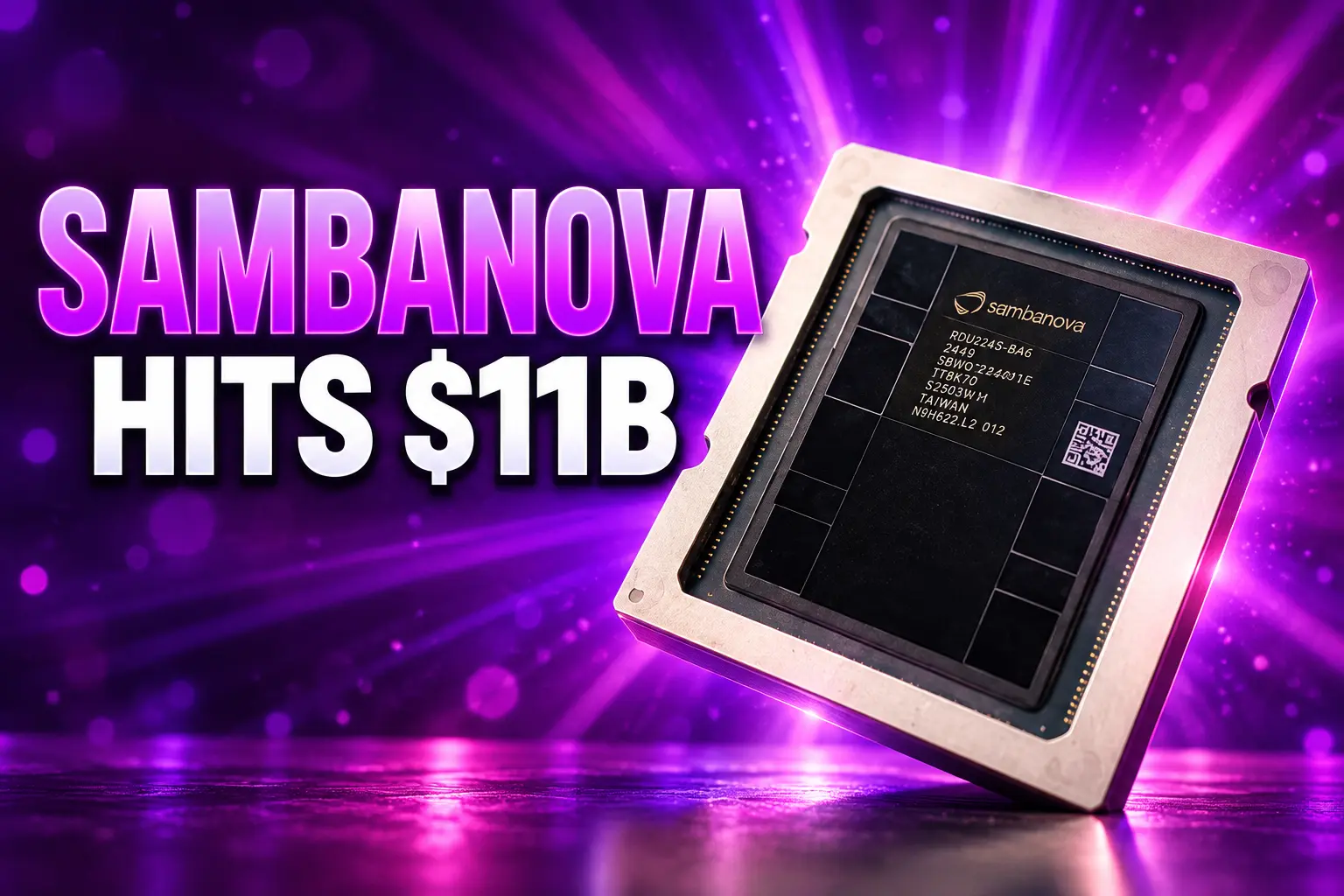
Lip-Bu Tan is Intel’s chief executive and SambaNova’s chairman, a seat he has held since 2017. Walden International, the firm he founded, led SambaNova’s $56 million Series A in 2018. Intel Capital has been in the cap table since the Series B years. In late 2025 the two companies signed a non-binding term sheet for a sale at about $1.6 billion including debt. Those talks ended. Intel put money into the February round instead and rolled into the Series F.
Intel said Tan recused himself from the SambaNova talks. Kevork Kechichian, who runs Intel’s data center group, handled the company’s side. Corporate records in April showed Intel moving to lift its holding toward 9%, which would be worth about $990 million on an $11 billion mark. That is a large paper gain on a minority slice. It is still far less than owning the whole company at the December price.
THE EIGHT MONTHS THAT REPRICED THE COMPANY
- December 2025: Intel and SambaNova sign a non-binding term sheet near $1.6 billion including debt, then the talks stall.
- February 24, 2026: SambaNova raises more than $350 million, unveils the SN50, and announces a multi-year Intel sales and product tie-up.
- April 8, 2026: The pair publish a split-stage design for agent workloads, due for customers in the second half of 2026.
- June 3, 2026: Vista and Cambium launch Vector Core Compute at Computex with a live Los Angeles site.
- July 8, 2026: SambaNova completes the $1 billion first close at $11 billion and names JPMorganChase as an inference partner.
- August 4, 2026: Mohsen Moazami joins as vice chair of global strategy, after leading Groq’s international business through a $20 billion NVIDIA transaction.
That sequence is why a $10 billion target with Intel’s CEO in the chair aged so fast. The live figure is $11 billion, and Intel is a customer and a holder, not the buyer.
Vista’s $3.5 Billion Order Does the Heavy Lifting
Vista is a software buyout firm, not a semiconductor house. As of December 31, 2025 it managed more than $110 billion. With Cambium Capital it led the February round, then on June 3 it launched Vector Core Compute, an inference cloud built to sit near customers rather than in a handful of desert campuses. Vista’s own statement put a $3.5 billion compute commitment behind SambaNova. Liang later said the order runs over three years, and he called VC2 the largest commercial deployment in SambaNova’s history.
THE THREE-CHIP STACK INSIDE VC2
- Intel Xeon: Orchestration and execution, routing work across silicon as agent jobs move from prompt to tool calls.
- SambaNova SN40 RDUs: Decode, the token-by-token stage the company says its dataflow chips were built to run.
- NVIDIA Blackwell GPUs: Prefill, the burst that turns a long prompt into a key-value cache before decode starts.
The Los Angeles site was live at launch. Chicago, Seattle, and Phoenix were already in development, with a map aimed at 50-plus U.S. metros. Together AI, which said it serves 400 trillion tokens a month, is the first commercial customer. Vista reserved early access for more than 90 portfolio companies that reach 2.5 million enterprise customers and 750 million users.
Robert F. Smith, Vista’s founder and chief executive, framed the constraint as cost of running agents, not model quality. Landon Downs, Cambium’s co-founder, said a single chip type would not cover every stage of an agent job. That is the offtake logic under the $11 billion mark: a software owner with a captive customer list pre-bought SambaNova silicon, then still rented NVIDIA for the opening burst.
Prefill Stays With NVIDIA, Decode Goes to the RDU
On April 8 SambaNova and Intel published the production blueprint VC2 is already running. The design uses GPUs for prefill and RDUs for decode, with Intel Xeon 6 as both host CPU and the chip that compiles code, calls tools, and runs agent actions. SambaNova is standardizing SN50 cards on Xeon 6. Earlier SN40 systems used AMD as the host. The mixed rack is due to enterprises, clouds, and sovereign programs in the second half of 2026, inside rooms that already handle ordinary air-cooled gear.
The winning pattern we’re seeing is GPUs to start the job, Intel Xeon 6 to run it, and SambaNova RDUs to finish it fast.
Rodrigo Liang, CEO and co-founder, SambaNova
Kechichian said the data center software stack is built on x86 and runs on Xeon, and that future jobs will need a mix of compute. Ian Cutress, who runs the More Than Moore research shop, put the same split in plainer words: one chip no longer does everything. Liang has said in interviews that inference already fills 70 to 80 percent of racks, and that many token clouds print revenue without enough margin. His answer is a one-rack minimum for models that can force other providers into 10 to 20 racks, including a DeepSeek-class 1.5 trillion parameter job.
That pitch leaves NVIDIA inside the building. VC2’s own diagram keeps Blackwell on prefill. SambaNova’s July demo at RAISE paired one NVIDIA H200 rack for prefill with one 16-chip SambaRack SN50 for decode on MiniMax M2.7, a setup Artificial Analysis timed as the fastest run of that model. The $11 billion check is a bet that decode can be a paid specialty while NVIDIA keeps the opening move.
What the SN50 Claims Against a Blackwell GPU
The SN50 is SambaNova’s fifth-generation Reconfigurable Dataflow Unit, shown on February 24 with the Series E. The company says it delivers a max speed 5 times faster than competitive chips and runs agent jobs at a 3 times lower total cost than GPUs. Its own footnote on Llama 3.3 70B, FP8, 1K input and 1K output, puts SN50 at 895 tokens per second per user against 184 tokens per second on an NVIDIA B200. That ratio is 4.86 times, which is the 5X claim. A second footnote averages throughput across Llama 70B, GPT-OSS 120B, and DeepSeek 671B to support the 3X cost line.
Each SN50 node, on the product sheet, carries 1,600 TFLOPS at BF16 and 3,200 TFLOPS at FP8 on TSMC 5 nm, with 432 MB of on-chip SRAM, 64 GB of HBM2E, and up to 512 GB of DDR5. A SambaRack SN50 holds 16 chips and can scale to 256 accelerators. The company says the part has five times the compute and four times the network bandwidth of the prior generation, and that it can host models above 10 trillion parameters with context windows above 10 million tokens. Peter Rutten at IDC said the chip is meant to run in existing power and air-cooled rooms.
SoftBank Corp. is the first named SN50 customer, for inference in its Japan data centers. Hironobu Tamba, who heads next-gen technology development at SoftBank, said the bank wants GPU-class speed with tighter cost and control. SN50 was due to ship to customers later in 2026; the April Intel note put production systems in the second half of the year. September sits inside that window, and SambaNova has not posted a volume-ship flag beyond the MiniMax demos.
JPMorganChase and SoftBank Want Racks on Premises
The July close came with a bank logo, not only a cloud logo. JPMorganChase picked SambaNova as an inference partner and will deploy SN40 and SN50 systems for on-premises jobs. Darrin Alves, the bank’s infrastructure-platforms chief, put the bar on control as much as speed.
At JPMorganChase, AI infrastructure has to meet a very high bar for performance, control and reliability. We’re excited to deploy SambaNova’s RDU architecture and looking forward to testing its speed and security for on-prem inference in our demanding enterprise AI workloads.
Darrin Alves, CIO, Infrastructure Platforms, JPMorganChase
Liang has said banks want mixed iron and do not want to live only in public clouds. SambaNova’s own cloud exists, and Liang has also said the company does not intend to become a hyperscaler in the Groq or Cerebras sense. The money is in selling racks and software to people who already operate rooms, including sovereign clouds in Europe, the UK, Australia, Japan, and the Gulf. First Data and Saudi First Data joined the February round on that sovereign line.
On August 4 the company hired Mohsen Moazami as vice chair of global strategy and partnerships, reporting to Liang. Moazami had been president of international at Groq and sat in the office of that CEO through Groq’s $20 billion strategic deal with NVIDIA. SambaNova is recruiting from the shop that chose to sell. It is also hiring against the same NVIDIA that still owns prefill inside VC2.
Memory Supply Can Cap How Fast the Racks Land
An $11 billion mark on a first close does not ship HBM. The SN50 still uses 64 GB of HBM2E per chip, plus SRAM and DDR5. Any tight market in high-bandwidth memory hits SambaNova the same way it hits GPU builders, and some rival designs have tried to dodge HBM altogether. SambaNova has not disclosed current revenue. The $3.5 billion Vista order is a commitment, not cash in the door, and the second close Liang flagged in July has not been posted.
WHAT WE KNOW
- The close: $1 billion raised on July 8 at $11 billion post money, led by General Atlantic, with JPMorganChase named as an on-premises partner.
- The offtake: Vista and Cambium’s VC2 carries a $3.5 billion compute commitment to SambaNova and runs NVIDIA, Intel, and SambaNova in one production design.
- The miss: Intel’s $1.6 billion talks ended; Intel is a holder near 9%, a host-CPU partner, and a customer.
WHAT IS UNCONFIRMED
- Second close: Liang said more investors would come in within weeks of July 8; no later close notice is on the company’s newsroom.
- Revenue: Bookings were called a record for 2025, but SambaNova has not published a current sales figure against the $11 billion mark.
- SN50 volume: SoftBank is first in line and MiniMax demos are public; a broad production ramp in the second half of 2026 is still a schedule, not a reported ship count.
The $11 billion price assumes those racks land on time, that HBM2E holds, and that banks and PE clouds keep paying for decode while NVIDIA keeps the first hop. SN50 is due in that same half of 2026, into rooms that still light Blackwell for prefill.
Disclaimer: This article is news reporting on a private financing and product roadmap, and it is for information only. It is not investment advice, a solicitation to buy or sell securities, or a recommendation of SambaNova, Intel, NVIDIA, Vista Equity Partners, General Atlantic, or any other firm named here. Readers who are considering an allocation to private tech companies, funds, or listed chip stocks should consult a licensed financial adviser who can review their objectives and risk limits. Figures, stakes, shipping windows, and round status reflect company statements and other sources as dated in the piece and can change as a second close, customer deployments, or chip supply move.

Instagram Plus Tests a Read-Only Mode That Cuts Stories

Altman Asks the Public to Accept Some AI Harm

Google Freezes OSS VRP Product Reports After AI Flood

AI Agents Make Payment Rails the Scarce Prize

Turkey’s Crypto Boom Now Runs Through Three Banks

Fable 5 Came Back Under a Commerce On-Off Switch

Google’s SpaceX GPU Lease Has a Sept. 30 Deadline

Plasma One’s XPL Locks Face a 1.81 Billion Cliff

DGO’s Rs 549 World Cup Pass Cost Fans Sleep and Data

Moonshot AI’s $30 Billion Ask Became a $35 Billion Close
-
 AI4 months ago
Fable 5 Came Back Under a Commerce On-Off Switch
-
 AI4 months ago
Google’s SpaceX GPU Lease Has a Sept. 30 Deadline
-
 CRYPTO4 months ago
Plasma One’s XPL Locks Face a 1.81 Billion Cliff
-
 APPS4 months ago
DGO’s Rs 549 World Cup Pass Cost Fans Sleep and Data
-
 AI4 months ago
Moonshot AI’s $30 Billion Ask Became a $35 Billion Close
-

 NEWS4 months ago
ColorOS 17 Device List Spans Oppo, OnePlus and Realme
-

 GAMING4 months ago
Xbox Cuts 3,200 Jobs After Five Years of Thin Returns
-
 GAMING4 months ago
The RTX 4050 Under Rs 70,000 Hides a Wattage Gap