
AI
SanDisk Drops 14% as the AI Memory Trade Finally Takes a Hit
SanDisk (SNDK) fell 14.13% to $1,745 on July 2, the year’s biggest AI memory reversal. Bank of America hiked its target to $2,500 the same morning.

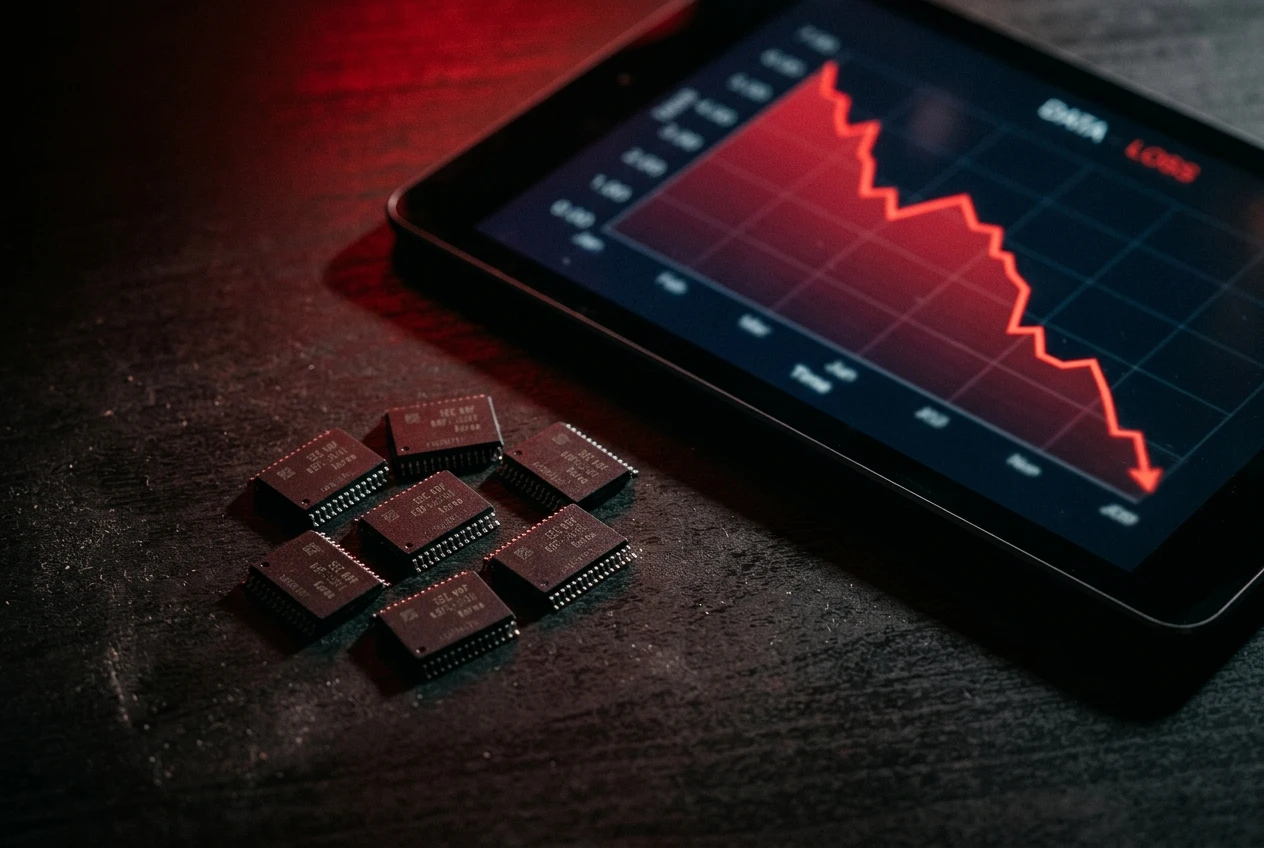
SanDisk (NASDAQ: SNDK) closed at $1,745 on Thursday, July 2, 2026, after falling 14.13% in a single session. The drop marked the year’s biggest reversal for an AI memory supercycle that has lifted the stock 4,841.8% in twelve months. Profit-taking hit a name that had been the S&P 500’s top performer of 2026, and the rotation now spreading through semiconductors met its highest-flying member first.
Semiconductor stocks led the broader selloff on Thursday, with the iShares Semiconductor ETF (SOXX) dropping 5.6% and a two-day loss of nearly 12%. SanDisk traded between $1,693.00 and $2,052.54 across the session, a 21.24% intraday swing, on volume of 17 million shares worth approximately $29.44 billion. Friday is a stock market holiday for Independence Day, leaving Monday as the next opportunity for the tape to react.
Profit-Taking Hit One of 2026’s Biggest Winners
Through the first half of 2026, no stock in the S&P 500 had run harder than SanDisk. The closing market wrap from July 2 described the stock as the index’s top performer of the year so far, with a 635% year-to-date gain entering the session. The Motley Fool had pegged the year-to-date move at 759% as of July 1, before the slide. Both numbers left the shares sitting well above where most valuation frameworks would place them.
The 14.13% move did not arrive in a vacuum. The same session pulled the iShares Semiconductor ETF (SOXX) down 5.6% on Thursday and nearly 12% across two sessions. Micron, up 240% year-to-date, fell 5.5% on the same day. The trigger, The Motley Fool reported, was a rotation out of AI chip names and back into AI software.
SanDisk remains a member of a memory complex that has lifted Micron 240% and the broader chip ETF complex more than 88% year-to-date, even after Thursday’s two-day 12% sector drop. The same AI demand backdrop is what bulls at Bank of America, Citigroup, and Mizuho point to when defending higher price targets. The setup heading into Monday is the same tape, the same demand story, and a meaningfully lower stock price.
The Valuation Picture Was Already Crowded
SanDisk’s P/E ratio sat at 60.65x on the day of the drop. The same-day P/E ratio and GF Score data showed it well above the stock’s own five-year median of 34.41x and close to a two-year peak of 75.94. The composite GF Score read 46 out of 100, with a perfect 10/10 on financial strength offset by weaker marks on valuation and momentum. The market cap sat around $258.42 billion at the same time. The data sits squarely in overvalued territory by historical standards.
The same source flagged $8.9 million of insider share sales over the prior three months and no insider buys. Late June coverage from 24/7 Wall St. added a monthly RSI reading of 99.14, a level the publication described as overbought.
- 14.13% one-day drop on July 2, 2026
- $1,745 close, down from $2,032.22 the prior session
- 4,841.8% rally over the prior year, per 24/7 Wall St.
- 60.65x P/E ratio vs 34.41x five-year median
- $8.9 million in insider sales over the prior three months, no buys
The AI Memory Trade Is Not Dead
The bull case rests on more than momentum. SanDisk’s fiscal Q3 2026 report on April 30, 2026 delivered EPS of $23.41 against a $14.66 consensus, revenue of $5.95 billion (up 251% year-over-year), and gross margin expansion to 78.4% from 22.5% a year earlier. Datacenter revenue jumped 645% year-over-year to $1.467 billion. Management retired $650 million in debt and now operates with zero long-term debt, all of which appears in the Q3 FY26 results and $1,704 Sell target write-up.
Q4 FY26 guidance pointed to revenue of $7.75 billion to $8.25 billion and non-GAAP EPS of $30 to $33. CEO David Goeckeler framed Q3 as the moment the company’s business model changed, citing multi-year customer commitments backed by firm financial contracts. The Wall Street targets that followed are spread, not clustered. Bulls at Bank of America, Citigroup, and Mizuho keep price targets at or above $2,200. 24/7 Wall St.’s June note carried a $1,704.60 Sell target with 90% model confidence.
Fundamental inflection point.
David Goeckeler, CEO of SanDisk, on the company’s Q3 FY26 results, as reported by 24/7 Wall St.
Before Thursday’s open, Bank of America raised its one-year price target on SanDisk from $2,100 to $2,500 while maintaining a Buy rating, citing a strong-for-longer dynamic in NAND supply and demand. The same-morning coverage of the price hike noted that B of A’s analysts expect NAND demand to remain very strong into 2027.
Supply Discipline Sets This NAND Cycle Apart
The setup bulls point to is structural. TrendForce reported in late May 2026 that major NAND flash suppliers will add virtually no new production capacity in 2026. Coverage of the Q1 2026 print from Astute Group showed enterprise SSD revenue rising 86% quarter-on-quarter as hyperscale AI infrastructure spending accelerated. The demand backdrop is the AI server buildout, the same one that has been pulling the rest of the memory complex higher for most of 2026.
The combination of restrained supply and an AI-driven storage demand spike is the core reason this cycle reads differently from prior NAND boom-bust loops. Older cycles were defined by suppliers racing to add capacity when prices firmed, then drowning margins when the new wafer output hit the market. This time, the wafer discipline looks closer to a managed scarcity.
AI training and inference clusters need fast local storage for datasets and checkpoints, which puts NAND flash and enterprise SSDs inside the same growth story as GPUs, even when the spotlight stays on accelerators. The same supply discipline that kept NAND prices firm through 2025 and the first half of 2026 could persist into 2027 and 2028, by analyst expectation.
| Driver | Period | Figure | Source |
|---|---|---|---|
| Major NAND supplier capacity | 2026 | Virtually no new capacity | TrendForce (May 25, 2026) |
| Enterprise SSD revenue | Q1 2026 | +86% QoQ | Astute Group |
| SanDisk datacenter revenue | Q3 FY26 | +645% YoY to $1.467B | 24/7 Wall St. |
| SanDisk gross margin | Q3 FY26 | 78.4% vs 22.5% prior year | 24/7 Wall St. |
Wall Street Is Split Down the Middle
The price targets tell two stories at once. 24/7 Wall St. carries a $1,704.60 target with a Sell rating and 90% confidence, citing a 4,841.8% one-year rally that left the shares well above its proprietary multiples. Citigroup sits at $2,500, Mizuho at $2,200, and the Street high at $3,250, per the same June 26 write-up. Bank of America’s pre-drop hike to $2,500 added a third $2,500 handle. The median bull target now sits below SanDisk’s Tuesday close and well above Thursday’s print.
Targets across the five-bank, two-publication set span from a Sell at $1,704.60 to a Street-high $3,250, a range wide enough to cover more than a 90% move from the current price. A stock trading at $1,745 with targets ranging from $1,704 to $3,250 is not a market that has converged on a single view of risk and reward. It is a market deciding, in real time, whether the AI memory trade is in a healthy reset or in the early innings of a deeper unwind.
The Chart Has Flipped Bearish
The post-drop sell-signal downgrade from StockInvest.us placed SNDK as a Sell candidate on July 2, 2026, citing sell signals from both short- and long-term moving averages. The site’s data puts first resistance at $1,881.51, with further layers at $1,963.60 and $2,090.71.
First support sits at $1,562.34, then $1,409.98 and $1,406.32. A break below $1,562 would put the next reference at $1,410, a zone that has not been in play since the early part of SanDisk’s run. The session itself carried a 21.24% intraday swing between $1,693.00 and $2,052.54, a range that signals active two-way risk rather than one-way liquidation.
SanDisk’s broader technicals were already flashing warnings before Thursday. 24/7 Wall St.’s late-June note flagged a monthly RSI of 99.14 and a Morgan Stanley valuation flag. Thursday’s session was the first time those warnings met a tape willing to act on them.
| Level | Price | Distance from close |
|---|---|---|
| R3 (resistance) | $2,090.71 | 19.81% above |
| R2 (resistance) | $1,963.60 | 12.53% above |
| R1 (resistance) | $1,881.51 | 7.82% above |
| Close | $1,745.00 | July 2, 2026 |
| S1 (support) | $1,562.34 | 10.47% below |
| S2 (support) | $1,409.98 | 19.20% below |
| S3 (support) | $1,406.32 | 19.41% below |
Frequently Asked Questions
Why did SanDisk stock fall 14% on July 2, 2026?
SanDisk fell 14.13% to $1,745 on July 2, 2026 as part of a wider semiconductor selloff, with the iShares Semiconductor ETF down 5.6% on the same session. The trigger was a rotation out of AI chip stocks and back into AI software names.
Was the AI memory thesis broken by the drop?
No source says so. SanDisk’s Q3 FY26 print on April 30, 2026 showed EPS of $23.41 against $14.66 consensus, revenue of $5.95 billion (+251% YoY), and datacenter revenue up 645% year-over-year to $1.467 billion. Bank of America raised its price target from $2,100 to $2,500 the morning of the drop.
What is SanDisk’s current valuation?
Per GuruFocus data published July 2, 2026, SanDisk’s P/E ratio is 60.65x against a five-year median of 34.41x. GF Score reads 46/100, with $8.9 million in insider share sales over the prior three months and no insider purchases.
Where does SanDisk go from here technically?
After Thursday’s 14.13% slide, StockInvest.us lists the first support level at $1,562.34, with $1,409.98 and $1,406.32 stacked below that. First resistance comes in at $1,881.51, followed by $1,963.60 and $2,090.71. The site moved SNDK to Sell candidate status on July 2.
What are analysts saying about SanDisk?
Targets span $1,704.60 (24/7 Wall St., Sell rating) to $3,250 (Street high). Citigroup and Bank of America sit at $2,500, Mizuho at $2,200. The spread reflects the gap between valuation-focused bears and AI-memory-cycle bulls.
Disclaimer: This article is for informational purposes only and does not constitute financial advice. Stock prices and analyst targets can change rapidly. Past performance, including the 4,841.8% one-year rally cited here, does not guarantee future results. Readers should consult a qualified financial professional before making investment decisions. Figures are accurate as of publication.


Nintendo Already Tested These NES Remakes, With Mixed Results

South Korea’s Crypto Framework Bill Hinges on a Bank Standoff

Court of Appeal Restores Imo APP Ahead of 2027 Polls

Vivo’s X300 Costs $647, but No US Carrier Sells It

Super Micro’s Bargain Stock Price Rests on One Hidden Customer

Resident Evil’s Remake Profits Just Vindicated Capcom’s Pragmata Bet

XRP Stalls Near $1 While Ripple’s Own Stablecoin Surges

WhatsApp Web’s Free Calling Update Takes Aim at Zoom

Hiya Toys’ Fox Figure Ships the Same Year as Persona 6

ARRI Hands Honor Its First-Ever Smartphone Camera Deal

Fable 5 and Mythos 5 Return as US Lifts Anthropic Export Controls

SpaceX’s Google Deal Turns a Rocket Company Into a Cloud Landlord

CD Projekt Red Co-CEO: Redemption Arc Isn’t Done, Witcher 4 in 2027

Oracle Cuts 21,000 Jobs in a Year, Cites AI in 10-K Filing

XPL Rallies 30% Ahead of Plasma One Card Tier Launch

DGO App Brings Rs 549 Mobile Pass for FIFA World Cup 2026 in Nepal

Google Search Profiles Build a Follow Graph Inside Discover

Moonshot AI Targets $30 Billion in China’s Fastest AI Funding Sprint

Microsoft Xbox Layoffs Start in July as Sharma Slams 3% Margin

Oppo’s ColorOS 17 Eligibility List Leaves A-Series Buyers Behind
-
 AI4 weeks ago
Fable 5 and Mythos 5 Return as US Lifts Anthropic Export Controls
-
 AI2 months ago
SpaceX’s Google Deal Turns a Rocket Company Into a Cloud Landlord
-
 GAMING1 month ago
CD Projekt Red Co-CEO: Redemption Arc Isn’t Done, Witcher 4 in 2027
-
 AI1 month ago
Oracle Cuts 21,000 Jobs in a Year, Cites AI in 10-K Filing
-
 CRYPTO2 months ago
XPL Rallies 30% Ahead of Plasma One Card Tier Launch
-
 APPS2 months ago
DGO App Brings Rs 549 Mobile Pass for FIFA World Cup 2026 in Nepal
-
 NEWS2 months ago
Google Search Profiles Build a Follow Graph Inside Discover
-
 AI2 months ago
Moonshot AI Targets $30 Billion in China’s Fastest AI Funding Sprint