
CRYPTO
Senate Democrats Demand Probes into Trump’s $1.4 Billion Crypto Haul
Senate Democrats are demanding hearings into Trump’s $1.4 billion crypto income, citing UAE ties and national security risks as a crypto bill nears a vote.

Five of the Senate’s most senior Democrats want Republicans to investigate whether Donald Trump’s crypto ventures, which generated at least $1.4 billion in 2025, threaten U.S. national security. Bloomberg News first reported the letter Friday, the latest escalation in a fight over the president’s crypto fortune that has simmered since a Wall Street Journal report on his family’s business ties surfaced in January.
Congress has about three weeks left to finish the crypto industry’s top legislative priority before an August recess, and the same disclosure fueling the senators’ letter is the issue analysts now call the bill’s biggest obstacle.
Five Senators, One Letter, and a $1.4 Billion Number
The letter came from Sens. Elizabeth Warren of Massachusetts, Richard Blumenthal of Connecticut, Gary Peters of Michigan, Dick Durbin of Illinois and Ron Wyden of Oregon. Each is the top Democrat on a committee with a plausible claim to jurisdiction over the president’s businesses.
- Elizabeth Warren, ranking member of the Senate Banking Committee
- Richard Blumenthal, ranking member of the Permanent Subcommittee on Investigations
- Gary Peters, ranking member of the Senate Homeland Security Committee
- Dick Durbin, ranking member of the Senate Judiciary Committee
- Ron Wyden, ranking member of the Senate Finance Committee
“President Trump’s new financial disclosures reveal the Trump family crypto ventures generated the vast majority of his income, about $1.4 billion in the first year of his second term alone,” the senators wrote. They asked their Republican counterparts to examine the influence of “the UAE or unknown third parties” on the president’s actions.
Republicans control every one of those five committees. None have scheduled a hearing.
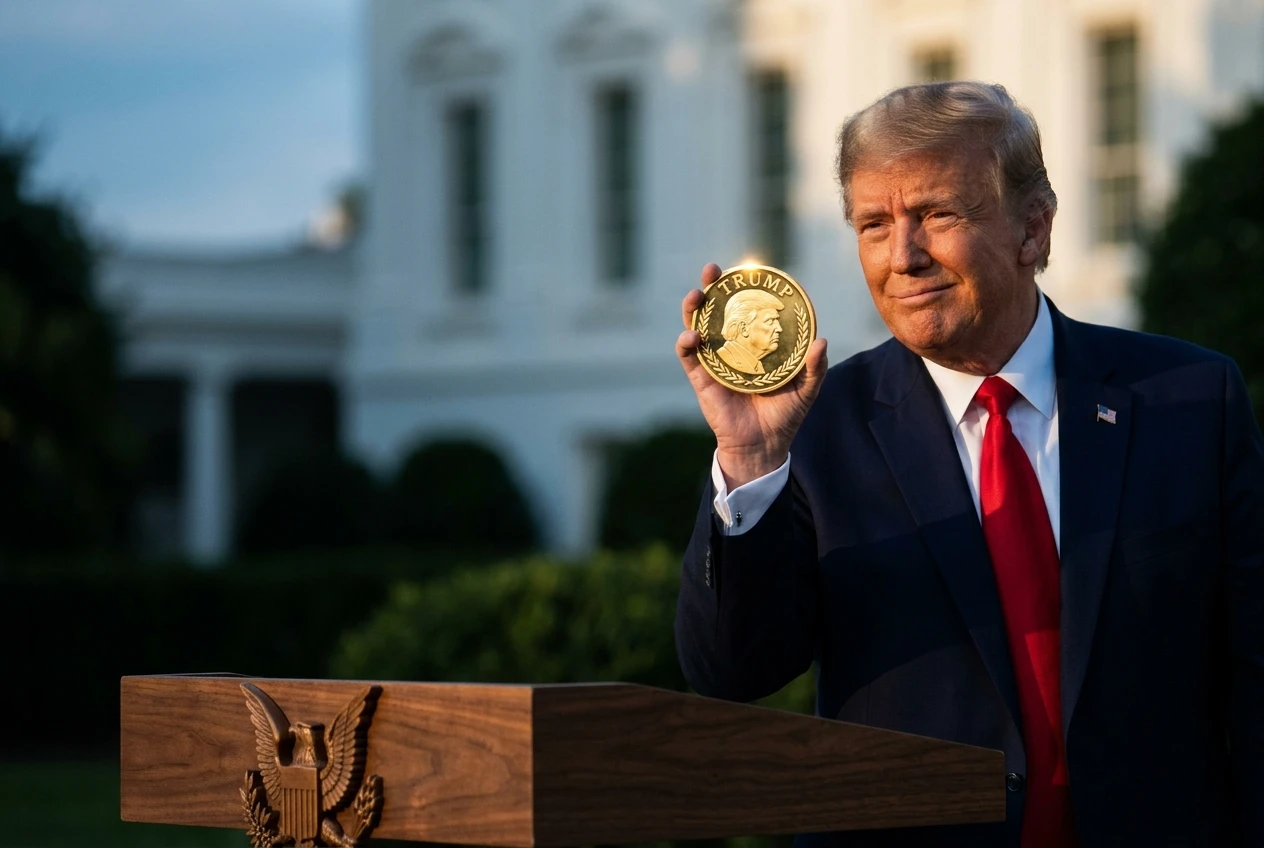
Where Trump’s Billion-Dollar Crypto Windfall Came From
Trump’s 2025 financial disclosure runs 927 pages, longer than the filings of his three immediate predecessors combined. Barack Obama’s final disclosure ran eight pages. Joe Biden’s ran eleven. Vice President JD Vance’s latest filing runs seventeen.
Crypto dwarfed every other line item.
| Income Source | Amount Reported | What It Covers |
|---|---|---|
| $TRUMP memecoin royalties | About $636 million | Licensing payments through CIC Digital LLC, described in the filing as “Celebration Coins” |
| World Liberty Financial | About $594 million | Token and equity sales tied to the crypto venture Trump co-founded with his sons |
| Stablecoin Holdco equity sale | About $197 million | Tied to an entity linked to the UAE’s Sheikh Tahnoon bin Zayed Al Nahyan |
| Total crypto income, 2025 | At least $1.4 billion | The largest single income category in the entire filing |
Trump’s traditional businesses still performed well. Revenue at his golf courses and resorts climbed 15% to more than $500 million, with Mar-a-Lago alone bringing in $77 million and the Trump National Doral club in Florida reporting $121.8 million. Crypto still outran all of it combined.
“What strikes me as remarkable is how many pies Trump has his fingers in,” said Douglas Brinkley, a history professor at Rice University. “There is no precedent to compare it with. No president in the 20th or 21st century has had something that’s vaguely comparable.”
The $TRUMP token tells its own story inside the story. It hit a peak of $74.24 within a day of its January launch. By the time the disclosure became public on June 30, it traded at $1.67, according to Coinbase data cited by CBS News. Trump’s royalties came from licensing fees, not from holding the token as its price fell.
Why Does the UAE Keep Showing Up in This Story?
Because the same foreign government Democrats flagged in June over a separate $500 million crypto investment is the one named again in July. A group tied to the United Arab Emirates (UAE) bought a 49% stake in World Liberty Financial days before Trump’s inauguration, and the administration has since eased export rules the UAE wanted loosened.
The Wall Street Journal first reported in January that Sheikh Tahnoon bin Zayed Al Nahyan, the UAE’s national security adviser, backed the group that acquired the stake. The deal closed roughly four days before Trump returned to the White House.
Months later, the administration rescinded Biden-era chip export restrictions, letting the UAE import up to three or four times as many advanced Nvidia chips as before. The same window included a separate, multibillion-dollar U.S. arms sale to the UAE, cleared despite a congressional hold tied to the war in Sudan.
- Confirmed: A UAE-linked group tied to Sheikh Tahnoon bin Zayed Al Nahyan holds a 49% stake in World Liberty Financial, purchased four days before Trump’s inauguration.
- Confirmed: The administration later eased Biden-era export limits, letting the UAE import several times more advanced Nvidia chips than before.
- Unconfirmed: Whether the crypto stake influenced the chip decision or the separate arms sale; the White House denies any link.
- Unconfirmed: The identities of additional “third parties” the senators say hold undisclosed stakes in the venture.
The same investment wave had a casualty. Shares in a 93% collapse in an AI-linked financial stock followed the Trump family’s $500 million crypto payday, wiping out investors who had piled into the trade. The Center for American Progress, a policy think tank, has called the broader arrangement a likely violation of the Constitution’s emoluments clause, an argument the White House rejects outright.
The White House Calls It a Decade-Old Attack Line
White House spokesperson Anna Kelly rejected the senators’ letter within hours. “This is the same, tired narrative that Democrats have pushed against President Trump, his family, and his administration for a decade,” Kelly said. “There are no conflicts of interest.”
Trump has made a similar case himself.
I tell my kids, stay away from as much as you can stay away from, but they also have a life.
The president said that in a CNBC interview at the White House, adding that there was “nothing illegal” or “wrong” with his family’s crypto ventures. He has said his son Eric Trump oversees the assets and that outside firms manage his investments.
Senate Judiciary Chair Chuck Grassley, a Republican from Iowa, addressed the pressure in a letter dated July 9, a day before the Democrats sent theirs. He wrote that he has “consistently held the same approach to my oversight during administrations of both political parties,” and argued Democrats never scrutinized Joe Biden and his family’s dealings as closely.
Ethics Rules Are the Clarity Act’s Last Roadblock
Congress has been trying to pass a comprehensive crypto rulebook for more than a year. The House already passed its version of the Digital Asset Market Clarity Act, known as the CLARITY Act, which would split oversight of digital assets between the Securities and Exchange Commission and the Commodity Futures Trading Commission. The Senate Banking Committee advanced its own version 15 to 9 in May, with two Democrats, Ruben Gallego of Arizona and Angela Alsobrooks of Maryland, joining every Republican on the panel.
The measure builds on last year’s GENIUS Act, which set rules for stablecoins specifically. Crypto firms including Coinbase, Circle and Ripple have pushed hard for Clarity’s passage. Banks, labor unions and law enforcement groups oppose it, warning it could pull deposits out of the banking system and make illicit transactions harder to trace.
Ethics language is what’s left unresolved. Ian Katz, managing partner at the research firm Capital Alpha, wrote in a note that Trump’s disclosures “won’t be helpful to the ongoing negotiations,” calling ethics the “biggest substantive obstacle” still standing in the bill’s way.
One idea on the table would let state attorneys general sue federal officials who violate ethics provisions, or sue exchanges that list tokens backed by a sitting official. It is a direct response to the exact arrangement Democrats are describing in their letter.
Now the Senate Math Gets Harder
The Republican margin that has to carry the CLARITY Act across the finish line just got thinner. Sen. Lindsey Graham of South Carolina died over the weekend at 71, narrowing the chamber’s Republican majority to 52 to 47.
Graham held no formal role in crypto policy. He never sat on the Banking Committee, and the bill has been steered mainly by Sen. Tim Scott of South Carolina and Sen. Cynthia Lummis of Wyoming. Trump used Monday’s remarks to call for the bill’s passage in Graham’s honor, adding fresh political pressure to an already tight calendar.
- May 14, 2026: The Senate Banking Committee advances the CLARITY Act 15 to 9.
- June 23, 2026: The same five Democrats first demand hearings, focused on the $500 million UAE investment.
- June 30, 2026: Trump’s 927-page financial disclosure becomes public, putting his crypto income at $1.4 billion.
- July 9, 2026: Grassley responds in writing, defending his committee’s oversight record.
- July 10, 2026: The five senators send a second letter, this time tied to the new disclosure.
- July 13, 2026: The Senate returns from break, and Trump invokes Graham’s death to push the bill.
- August 7, 2026: Congress’s summer recess begins, the deadline lawmakers say the bill must beat.
Miss that window and the bill likely restarts from scratch if November’s midterms shift control of either chamber.
Three Weeks, One Deadline
A draft merging the Senate Banking and Agriculture committees’ work could emerge as soon as next week, according to people briefed on the talks. Wyden has already signaled support for the developer protections in that draft, a small sign of bipartisan life.
CFTC Chairman Michael Selig isn’t waiting on Congress either way. “We’re so close. We have to get this done,” he told Fox Business host Maria Bartiromo.
The odds have moved. Prediction markets put the bill’s chances of becoming law this year at 59% to 72% a month ago. Investor Kevin O’Leary now puts it closer to a coin flip.
The broader market gives Congress little cover either way. Digital assets have posted three straight quarterly losses through the middle of 2026, the longest slide since the 2022 bear market, as institutional money has rotated toward AI stocks instead.
Trump has other crypto wins already banked this year, including a central bank digital currency ban tucked into his housing bill. The CLARITY Act would be the bigger prize, and it is the one now tangled up with his own balance sheet.
Whether or not the Senate ever holds that hearing, the industry’s own bill still has to clear a Congress asking exactly who profits from crypto, and how much.
Frequently Asked Questions
What Is World Liberty Financial?
World Liberty Financial is a cryptocurrency venture launched in September 2024 by Trump’s sons and the sons of Steve Witkoff, the U.S. special envoy to the Middle East, with Trump listed as co-founder emeritus. The disclosure shows Trump personally holds 15.75 billion WLFI tokens, the governance token the venture issues alongside its USD1 stablecoin.
What Would the CLARITY Act Actually Change?
It would swap years of regulation by enforcement for one statutory framework, and backers say it would also speed up tokenization, the practice of moving assets like bonds and real estate onto blockchain rails. The bill never names Bitcoin or Ethereum directly, but its classification rules would still decide how every other digital asset gets traded and disclosed.
How Much Has Trump Made from Crypto Since Taking Office, Beyond the 2025 Figure?
Reuters has separately estimated the Trump family generated at least $2.3 billion in crypto-related profits since he returned to the presidency, a figure that extends beyond the single calendar year covered in the June disclosure.
What Did the Democrats’ Earlier June Letter Say?
In a letter dated June 23, the same five senators demanded sworn testimony about the reported $500 million UAE investment in World Liberty Financial, asking administration officials to explain under oath what they knew about payments to the families of the president and his Middle East envoy.
What Other Crypto Moves Has Trump Made This Year?
Separately, Trump has a central bank digital currency ban tucked into a housing bill carrying its own 10-day signing clock, on top of executive actions easing crypto rules since he took office. Democrats say the pattern makes their case: crypto policy and the president’s personal finances keep moving in the same direction.


Sony’s 10 Percent Disc Drop Leaves the 2028 Cutoff Intact

Chip Allocation Sidelines the Base iPhone 18 This Fall

Miami-Dade Fights the Vice City Brand It Already Wears

IFA 2026 Awards Put Tecno Ahead of Flagship Phones

USB-C Gadgets Made the Junk Drawer Rechargeable

Pixel 11 Pro Asks $1,099 for a Light Google Locked

The iPhone Ultra Sells Two Retired Minis as One Foldable

Google Opens Gmail to Voice and Gates Docs Live

Lenovo Prices the IdeaPad Vibe Against Apple’s $699 Neo

Xbox Caps Game Pass Cloud Gaming at 15 Hours

Oracle Cuts 21,000 Jobs in a Year, Cites AI in 10-K Filing

Fable 5 and Mythos 5 Return as US Lifts Anthropic Export Controls

SpaceX’s Google Deal Turns a Rocket Company Into a Cloud Landlord

CD Projekt Red Co-CEO: Redemption Arc Isn’t Done, Witcher 4 in 2027

XPL Rallies 30% Ahead of Plasma One Card Tier Launch

Google Search Profiles Build a Follow Graph Inside Discover

DGO App Brings Rs 549 Mobile Pass for FIFA World Cup 2026 in Nepal

Moonshot AI Targets $30 Billion in China’s Fastest AI Funding Sprint

Oppo’s ColorOS 17 Eligibility List Leaves A-Series Buyers Behind

Microsoft Xbox Layoffs Start in July as Sharma Slams 3% Margin
-
 AI2 months ago
Oracle Cuts 21,000 Jobs in a Year, Cites AI in 10-K Filing
-
 AI2 months ago
Fable 5 and Mythos 5 Return as US Lifts Anthropic Export Controls
-
 AI3 months ago
SpaceX’s Google Deal Turns a Rocket Company Into a Cloud Landlord
-
 GAMING3 months ago
CD Projekt Red Co-CEO: Redemption Arc Isn’t Done, Witcher 4 in 2027
-
 CRYPTO3 months ago
XPL Rallies 30% Ahead of Plasma One Card Tier Launch
-
 NEWS3 months ago
Google Search Profiles Build a Follow Graph Inside Discover
-
 APPS3 months ago
DGO App Brings Rs 549 Mobile Pass for FIFA World Cup 2026 in Nepal
-
 AI3 months ago
Moonshot AI Targets $30 Billion in China’s Fastest AI Funding Sprint