
AI
Sony’s PlayStation 6 Wager Puts AI Frame Generation in Charge
Sony’s PS6 leaks point to AI frame generation and PSSR upscaling to hit 4K 120 FPS as memory costs force a delay past 2027. The strategy, the risks, the prices.

Sony’s next PlayStation is shaping up to be the first console whose identity is built less around what its graphics chip can draw than around what its AI can invent. A wave of leaks tied to hardware tipster Moore’s Law Is Dead points to the PlayStation 6 leaning on AI frame generation to reach a stable 4K at 120 FPS target without paying for the kind of raw GPU horsepower that would push the retail price past the ceiling Sony believes the market will bear. The strategy looks like a clean bet on efficiency. The cost of placing it is the same memory crunch that has already pushed the console’s launch window into question.
Reports since late 2025 have put the PS6’s release somewhere between late 2027 and 2029, with Sony itself telling investors on May 8, 2026 that the company has not picked a date or a price. Inside that uncertainty, one engineering decision keeps surfacing: the consoles that ship in 2027 and 2028 will run hot on software, light on silicon, and lean on the same AI upscaling class that already powers the PS5 Pro.
The leak itself does not name the PS6 in a single sentence. The picture emerges from internal Sony themes that hardware leaker Tom of Moore’s Law Is Dead discussed on the Broken Silicon podcast, with a separate VFI document surfacing alongside it. Read together, they describe a console whose advertised frame rate will be, in significant part, synthesized rather than rendered.
How Video Frame Interpolation Works
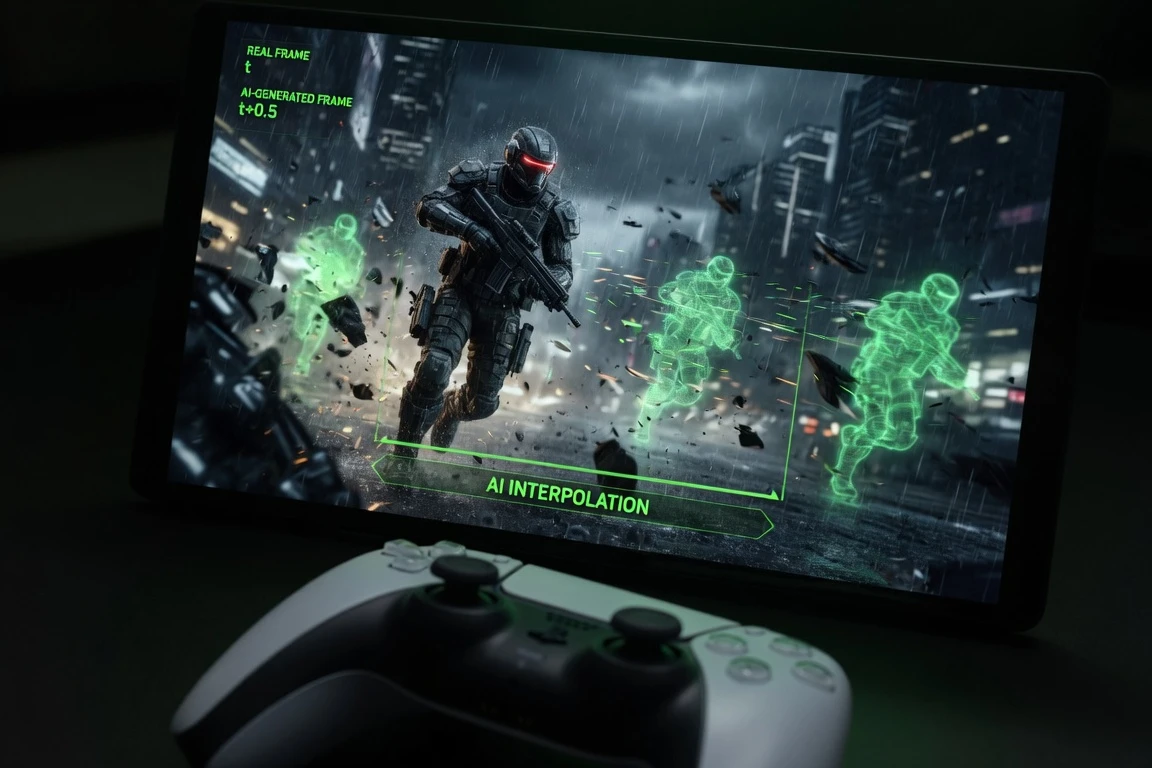
Video frame interpolation is the algorithmic half of what the leaks describe. Instead of asking the GPU to draw every frame from scratch, the system generates extra frames between the ones the GPU actually produces. Two adjacent real frames feed a neural network, the network predicts what the missing frame in the middle should look like, and the console outputs that prediction as if it were rendered. The eye sees a smoother image. The GPU does a fraction of the work.
The technique sits next to super resolution, the other half of the strategy. PSSR, the PlayStation Spectral Super Resolution upscaler on the PS5 Pro, is an AI library that analyzes game images pixel by pixel as it upscales them. Sony shipped an upgraded PSSR to PS5 Pro in 2026, with Resident Evil Requiem the first title to use it, and the company has said PSSR has been used to boost the effective resolution of over 50 titles on PS5 Pro to date. The VFI piece is the next step in the same family: PSSR sharpens the image, VFI doubles or triples the frame count, and the two together give the console a perceived performance jump without a proportional silicon cost.
The leaked Sony document captured the strategy in a single internal line, a line the rest of this article keeps returning to. Sony’s F2F (face-to-face) notes say consoles are cost-constrained, that machine learning and AI for super resolution and VFI are needed for both consoles and low-end discrete GPUs, and that low-power operation is a priority because of potential EU legislation. The bet is right there in that line: pay for smart software, not for brute-force silicon.
The Document Behind the Leak
The claims that have moved through gaming outlets in 2026 originate with a single episode of the Broken Silicon podcast, hosted by Moore’s Law Is Dead’s Tom. The episode is a walkthrough of an internal Sony face-to-face document Tom says he had access to, with a separate VFI patent leak that followed alongside it.
Major Sony F2F themes were: Consoles are cost-constrained. ML/AI for SR and VFI needed for console/low-end dGPU. Low Power (potential threats from EU legislation).
Tom’s read on the document, as reported on the Broken Silicon podcast leak on PS6 VFI and AI upscaling, is that Sony is trying to make the PS6 feel like a 4K 120 FPS machine by combining AI upscaling, ray tracing improvements, and generated frames. He also added the same caveat the source itself requires: the documents are older, and even Tom said he does not know what Sony finally decided. Sony has not commented publicly on any of it, and previous leaks that have piled on top of this one, including references to Zen 6 CPU cores, RDNA 5 graphics, and GDDR7 memory, also remain unconfirmed.
The reasonable way to read the document is as a window into Sony’s planning, not a blueprint. It tells readers what Sony’s engineers were telling each other. It does not tell readers what shipped.
Project Amethyst Is Already Building the Path
Whether or not the PS6 uses AI frame generation in the form the leak describes, Sony and AMD have been publicly working on the same family of techniques for over a year. The joint program is called Project Amethyst, first announced in December 2024, and its lead system architect Mark Cerny has been doing most of the public talking.
In a March 2026 video, Cerny and AMD senior vice president Jack Huynh detailed three building blocks pointed at the next console. Neural Arrays let compute units share screen-space tasks for upscaling and denoising. Radiance Cores are a dedicated hardware block for unified light transport that handles ray tracing and path tracing in real time. Universal Compression is an evolution of AMD’s delta color compression that squeezes data on the way to memory. Cerny chose his words carefully in that video, calling the technologies early and saying they exist in simulation rather than in silicon, but the direction is clear: more AI, more compression, less reliance on a fat memory bus.
The closer-to-ship piece of this strategy is the PSSR upgrade that hit PS5 Pro in 2026. The same week the AI-frame-generation leak made the rounds, Sony confirmed an upgraded PSSR is rolling out globally to PS5 Pro players, with the Resident Evil Requiem launch as the first title. In a quote carried on PlayStation’s announcement of the upgraded PSSR upscaler, Capcom’s Masaru Ijuin, senior manager of the engine development support section in Capcom’s R&D foundational technology department, tied the upgrade directly to the new PSSR’s ability to handle detail too intricate for the previous version.
The upgraded PSSR has allowed us to elevate our expressiveness by successfully processing these details and textural particularities, which are traditionally difficult to upscale because of their intricacy. We hope you will experience this unprecedented level of horror and visual fidelity, and the new gameplay feel it delivers.
That is a video game engine team crediting an AI upscaler with making hair strands and beard fibers visible at the level the artists drew them. It is also the first public evidence that the path Sony is taking with PSSR is the same one the PS6 leaks describe, just with frame generation layered on top.
Why a Memory Crisis Forced the Strategy Shift
AI frame generation is the bet. The reason Sony is making it is the cost of the alternative. DRAM and NAND prices have moved off the normal cycle and into a structural reallocation toward AI accelerators and high-bandwidth memory, with consumer electronics downstream of the squeeze. The phrase in industry coverage is RAMmageddon.
Bloomberg, in a February 2026 report summarized by Bloomberg’s memory-shortage reporting on the PS6 launch window, said people familiar with Sony’s thinking told the outlet the company is considering a PS6 launch slip to 2028 or 2029. The data points behind the warning read like a stress test on every consumer electronics launch planned for 2027.
| Memory class | 1Q26 QoQ contract change | Source |
|---|---|---|
| Conventional DRAM | 90 to 95 percent increase | TrendForce 1Q26 forecast |
| PC DRAM | Crossed 100 percent for the first time on record | TrendForce 1Q26 forecast |
| Server DRAM | About 90 percent | TrendForce 1Q26 forecast |
| NAND | 55 to 60 percent | TrendForce 1Q26 forecast |
Two industry voices put the structural framing on the record. Micron EVP of operations Manish Bhatia told Bloomberg the current situation is the most significant disconnect between demand and supply in terms of magnitude as well as time horizon that the industry has experienced in 25 years. Lenovo CEO Yang Yuanqing told investors during an earnings call the same week that the structural imbalance between supply and demand is not simply a short-term fluctuation.
Inside Sony, the same wall shows up in the numbers. CFO Lin Tao told investors on the FY2025 earnings call that Sony will base FY2026 PS5 hardware sales on the volume of memory it can buy at reasonable prices, a procurement statement disguised as a forecast. The PS5 shipped 1.5 million units in the January to March 2026 quarter, down from 2.8 million a year earlier, a year-over-year drop of roughly 46 percent, after Sony pushed through its second price increase in 12 months. 20 percent of global DRAM wafer capacity in 2026 is being absorbed by AI infrastructure, and 1 GB of HBM consumes 4x the wafer capacity of standard DRAM, with GDDR7, the memory class the PS6 needs, eating 1.7x the standard amount. A related internal read on how the memory crunch hit PS5 hardware sales walks through the same procurement line. The math pushes a console that has to ship 30GB of GDDR7 directly into the same bidding war that hyperscalers are winning.
The Trade-Off AI Frame Generation Demands
AI frame generation is not free. The PS6 design reportedly tightens the memory bus from PS5’s 256 bits down to between 160 and 192 bits and leans on compression and the new AI blocks to make up the gap. Leaker KeplerL2, who broke the PS5 Pro before its reveal, says the console is being designed around 30GB of GDDR7 on a 160-bit bus, with hardware tipster Tom putting the same configuration on the table across multiple breakdowns. The headline number is bandwidth: 640 GB/s through a 160-bit memory bus, with a reported target TBP around 160 watts.
The other reported design move is to ask the AI to do work the silicon is no longer being paid to do. Moore’s Law Is Dead told a video game industry audience that the PS6 will deliver over a 10-fold increase in ray tracing performance over the base PS5, with AI performance rising by a multiple of magnitudes, and that the console will not be measured against last-gen metrics. The framing on Moore’s Law Is Dead on the PS6’s 10x ray-tracing target is that frame rate, not raw teraflops, is the metric the next console will be judged on.
The counter-view sits in the same room. Video game journalist Destin Legarie, responding to MLID’s claims on X, argued that if the PS5 is still pacing 2 to 3 million behind PS4 global sales, next-gen won’t be some mega graphical leap, and that most people aren’t in a rush for a $1,000 PS6 or Xbox Helix. Sony has not adjudicated the dispute, and the leaker’s own 10x figure is a projection rather than a benchmark. The visible 4K at 120 FPS image in a PS6 game will, by design, include a meaningful share of frames that were never rendered natively. The 10x ray-tracing figure is also an MLID projection, not a benchmark.
- 30GB of GDDR7 memory on a 160-bit bus (KeplerL2)
- 640 GB/s of memory bandwidth (KeplerL2)
- Over 10x ray-tracing performance over base PS5 (Moore’s Law Is Dead)
- AI performance rising by a multiple of magnitudes (Moore’s Law Is Dead)
A Three-SKU Lineup Could Hedge the Risk
If a single PS6 is hard to price into a memory squeeze, the leak circuit’s answer is three of them. The same MLID reporting that surfaced the VFI document also describes a three-SKU lineup pointed at different price points, with the silicon named after a constellation.
- Orion (flagship PS6): eight Zen 6c gaming cores plus two Zen 6 LP OS cores, 40 to 48 RDNA 5 compute units, 30GB GDDR7, 160-bit bus, 640 GB/s bandwidth, target TBP around 160 watts
- Canis (PS6 handheld): four Zen 6c cores, 16 RDNA 5 compute units, 24 to 36GB memory, 1.20 GHz portable clock and 1.65 GHz docked; MLID estimates the Canis APU costs Sony roughly $46.80 to manufacture, against $81.50 for the die-shrunk PS5 chip
- Canis in a box (PS6 S): the same handheld silicon in a small-form-factor home console at a projected $299 to $399 price band
The same pattern showed up in Sony CEO Hiroki Totoki’s May 8, 2026 remarks, when he told investors the company is running simulations that include changing business models. MLID’s pricing model puts the three-device spread at $350 to $1,000, with the high end assuming no tariff protection. The official line is that none of this is confirmed: Sony has not acknowledged a handheld at all, the prices are projections, and the only thing on the record is that Sony is openly telling investors the business model is in play.
Where the Launch Window Now Stands
The leak and the launch slip are the same story. The leaked internal document says consoles are cost-constrained, and Sony’s CEO is telling investors the company has not decided when the next one ships.
Totoki’s full quote on the call: We have not yet decided on at what timing we will launch the new console, or at what prices. So we would like to really observe and follow the situation. The memory price is also expected to be very high in the financial year 2027, because there will still be a shortage of supply. The publisher Embracer Group wrote in a 2026 annual report that it expects a PS6 launch slip to 2028 or later, while Take-Two CEO Strauss Zelnick told The Game Business that he does not see the memory situation affecting the delivery of consoles to the market, a view that runs against the Bloomberg reporting and against Sony’s own public hedging. Totoki’s May 8 admission that PS6 timing and price remain open is the most current word from Sony itself. The one thing the company has committed to is that the AI architecture work is real: Project Amethyst is in simulation today, Cerny said, with an eye on a future console in a few years’ time. The bet is on what the software can do. The schedule, by Sony’s own telling, is the part still being decided.
Frequently Asked Questions
Will the PS6 use AI frame generation?
Leaks from Moore’s Law Is Dead say yes. The internal Sony F2F document that surfaced on the Broken Silicon podcast calls ML/AI for super resolution and VFI needed for consoles and low-end discrete GPUs. Sony has not confirmed the strategy publicly, and MLID’s own caveat is that the documents are older and that even he does not know what Sony finally decided.
What is video frame interpolation (VFI)?
VFI is a form of frame generation. The system takes two adjacent rendered frames, asks a neural network to predict the frame in between, and outputs the prediction as if it were drawn natively. PSSR, the AI upscaling tech already on PS5 Pro, is the related technology that sharpens individual frames; VFI is the piece that adds more of them.
When will the PlayStation 6 launch?
Most credible leaks point to late 2027 or early 2028. Bloomberg reported in February 2026 that Sony is considering a slip to 2028 or 2029, and Sony CEO Hiroki Totoki told investors on May 8, 2026 that the company has not decided on a launch date. Embracer Group, in a 2026 annual report, expects the console to slip to 2028 or later.
How much will the PS6 cost?
Leaker pricing models cluster between $599 and $799 for the base unit, with a higher-end SKU at $899 or above if Sony absorbs the full cost of 30GB of GDDR7. A baseline $499 launch price, the level the original PS5 hit in 2020, looks unlikely given current memory prices, and Sony’s CFO has already tied FY2026 PS5 sales to the volume of memory Sony can buy at reasonable prices.
Is AI frame generation the same as DLSS or PSSR?
PSSR is Sony’s own AI upscaling tech, and Sony and AMD have been co-developing the next generation of it under Project Amethyst since December 2024. The frame-generation piece is the next layer on top of the same family of techniques, and it is the layer the PS6 leaks describe.


Lenovo Prices the IdeaPad Vibe Against Apple’s $699 Neo

Xbox Caps Game Pass Cloud Gaming at 15 Hours

GTA 6 DualSense Controllers Follow Sony’s Usual $84.99 Script

South Korea Retail Investors Face Reckoning After KOSPI AI Rally Collapses

Surrey AI Maps Three Heart Attack Paths and Their Molecular Roots

Germany Locks Neutral Apple ATT Prompts Across Most of Europe

Apple’s 5% EU Fee Quietly Rewrites Alternative App Store Math

Apple’s EU Fee Truce Cuts Complexity but Leaves Rivals Fuming

Pixel 11 Pro Fold Trades Thinness for Durability and Seven-Year Stay

Mayo AI Flags HCM Obstruction From Everyday Ultrasound Videos

Oracle Cuts 21,000 Jobs in a Year, Cites AI in 10-K Filing

Fable 5 and Mythos 5 Return as US Lifts Anthropic Export Controls

SpaceX’s Google Deal Turns a Rocket Company Into a Cloud Landlord

CD Projekt Red Co-CEO: Redemption Arc Isn’t Done, Witcher 4 in 2027

XPL Rallies 30% Ahead of Plasma One Card Tier Launch

Google Search Profiles Build a Follow Graph Inside Discover

DGO App Brings Rs 549 Mobile Pass for FIFA World Cup 2026 in Nepal

Moonshot AI Targets $30 Billion in China’s Fastest AI Funding Sprint

Oppo’s ColorOS 17 Eligibility List Leaves A-Series Buyers Behind

Microsoft Xbox Layoffs Start in July as Sharma Slams 3% Margin
-
 AI2 months ago
Oracle Cuts 21,000 Jobs in a Year, Cites AI in 10-K Filing
-
 AI2 months ago
Fable 5 and Mythos 5 Return as US Lifts Anthropic Export Controls
-
 AI3 months ago
SpaceX’s Google Deal Turns a Rocket Company Into a Cloud Landlord
-
 GAMING2 months ago
CD Projekt Red Co-CEO: Redemption Arc Isn’t Done, Witcher 4 in 2027
-
 CRYPTO3 months ago
XPL Rallies 30% Ahead of Plasma One Card Tier Launch
-
 NEWS3 months ago
Google Search Profiles Build a Follow Graph Inside Discover
-
 APPS3 months ago
DGO App Brings Rs 549 Mobile Pass for FIFA World Cup 2026 in Nepal
-
 AI3 months ago
Moonshot AI Targets $30 Billion in China’s Fastest AI Funding Sprint