
GAMING
Sony Says PS6 Price And Launch Date Still Undecided As DRAM Crisis Deepens

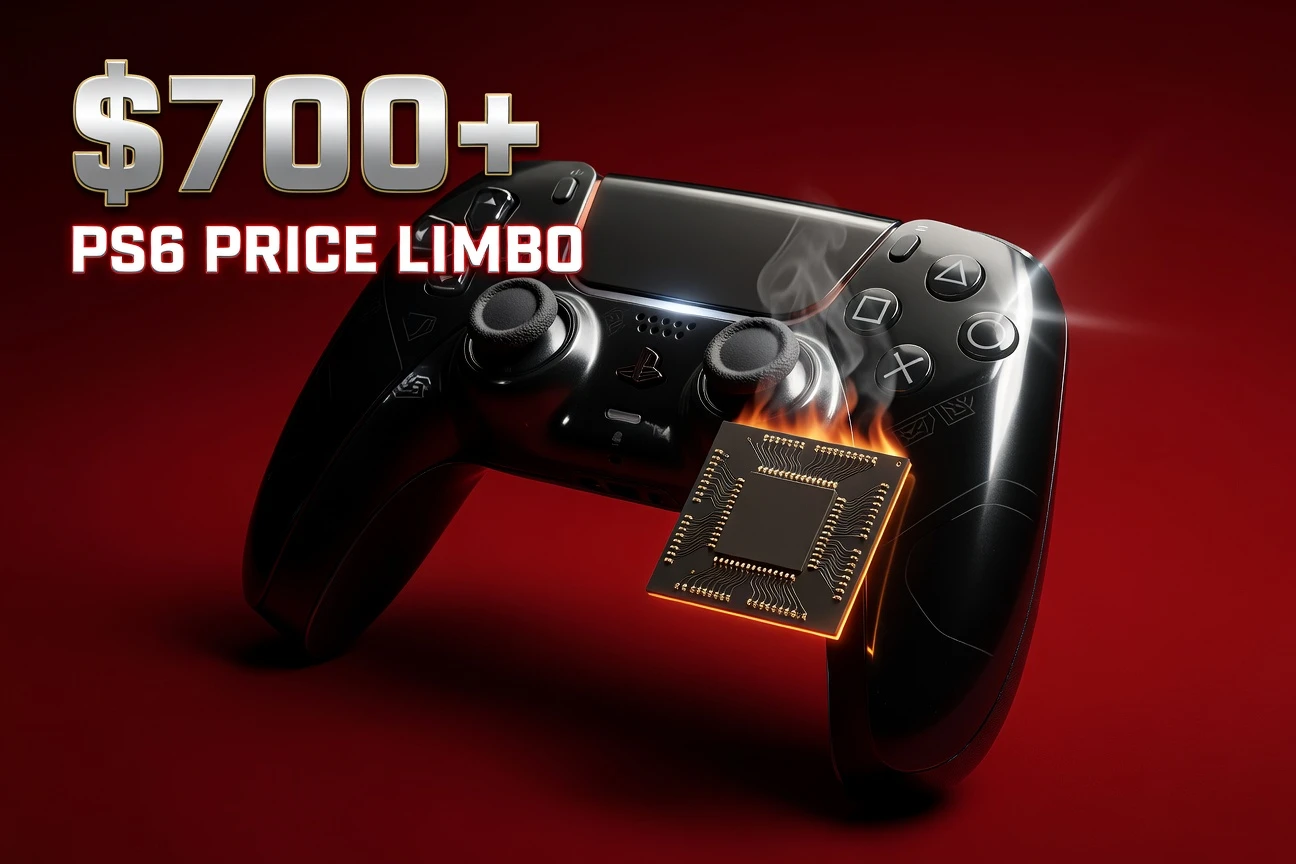
Sony Group president and CEO Hiroki Totoki told investors on May 8, 2026 that the company has not picked a launch date or a price for the PlayStation 6, blaming a memory market that has gone vertical on AI data center demand. The admission landed during the Q&A portion of Sony’s FY2025 earnings briefing transcript, the same call where Sony booked record group sales of 12.48 trillion yen and a record G&NS operating profit of 463.3 billion yen. The contrast tells the story. Sony has never made more money on PlayStation. It also has never been less sure when the next one ships.
This isn’t corporate coyness about a date already inked on a war room calendar. Totoki said memory pricing in the fiscal year ending March 2027 is still expected to run hot because supply will not catch up, and Sony is now war-gaming pricing, timing, and even the business model itself.
What Totoki Actually Said On The Call
The questioner asked whether component costs would hit PS6 plans. Totoki’s reply, delivered through a translator, did not hedge. He said Sony has not decided on launch timing or price, and that the company wants to watch the situation. He flagged FY2027 memory pricing as the primary concern.
We have not yet decided on at what timing we will launch the new console, or at what prices. So we would like to really observe and follow the situation. The memory price is also expected to be very high in the financial year 2027, because there will still be a shortage of supply.
That language matters because of who is saying it. Six months out from a console reveal, a CEO does not talk about observing a situation. Totoki, who has run Sony’s group strategy across two restructurings, is signaling that the planning window is still open. Sony has secured enough components for the rest of calendar 2026 and has, in his words, agreed to a certain extent on prices for those parts. Beyond that, the math is unsettled.
Totoki added one more line that shifted the conversation. He said Sony is running simulations that include changing business models. He did not elaborate. Push Square’s Push Square write-up of the May 2026 PS6 remarks noted the phrasing was unusually open-ended for an earnings call.
The Memory Math That’s Driving Everything
The DRAM market in 2026 is not a normal cycle. It is a structural reallocation of fab capacity toward AI accelerators and HBM, and consoles are downstream of the squeeze. TrendForce’s upgraded 1Q26 memory pricing forecast revised conventional DRAM contract prices up to a 90 to 95 percent quarterly increase, with PC DRAM crossing 100 percent quarter over quarter for the first time on record.
Server DRAM ran roughly 90 percent. NAND moved 55 to 60 percent. Those are not consumer numbers. Those are the numbers Sony’s procurement desk sees when it tries to lock GDDR7 for a 2027 console run.
- 20 percent of global DRAM wafer capacity in 2026 is being absorbed by AI infrastructure, per TrendForce’s December 2025 wafer allocation analysis, with HBM and GDDR7 leading the draw.
- 1 GB of HBM consumes 4x the wafer capacity of standard DRAM. GDDR7, the memory class PS6 needs, eats 1.7x.
- 2Q26 contract prices are projected to rise another 58 to 63 percent quarter over quarter even as end-market shipments wobble.
- SK Group chairman Chey Tae-won has publicly said the shortage will persist into 2030, well past any reasonable PS6 launch window.
Why The 46 Percent Cliff Matters More Than The Headline Numbers
Sony shipped 1.5 million PS5 units in the January to March 2026 quarter. That’s down from 2.8 million in the same quarter a year earlier, a roughly 46 percent year over year drop, per the Q4 FY2025 Sony Group transcript on Seeking Alpha. Lifetime PS5 shipments now sit at 93.7 million.
That cliff has a cause. Sony pushed through its second PS5 price increase on April 2, 2026, lifting the disc edition to $649.99, the Digital Edition to $599.99, the PS5 Pro to $899.99, and the PlayStation Portal to $249.99. Cumulative price growth since the November 2020 launch hit roughly 28 percent in five and a half years. Consoles do not normally get more expensive over time. This one has, twice.
CFO Lin Tao said on the call that Sony will base FY2026 PS5 hardware sales on the volume of memory it can buy at reasonable prices, and that there is no plan to raise the PS5 price again. Read that sentence carefully. It is a procurement statement disguised as a forecast. Sony is no longer demand-constrained on PS5. It is supply-constrained, and the supply that matters is RAM.
How The Market Read The PS6 Decision Tree
The data point Sony is sitting on is not a secret. Outside analysts have been writing about it for months, and their conclusions converge.
- January 27, 2026: MST Financial senior analyst David Gibson published a Sandstone Insights Japan note arguing Sony’s existing memory inventory protects it short term, but rising costs hit hard in the fiscal year ending March 2027, and there is a high likelihood the PS6 launches after 2028.
- February 2026: Bloomberg’s PC Gamer summary of the Bloomberg AI memory crisis report cited people familiar with Sony’s thinking who said the company is now considering a 2028 or even 2029 PS6 debut. A 2029 launch would make the PS5 era the longest console generation in PlayStation history.
- March 2026: Sony pushed through the second PS5 price increase. Circana retail data showed US PS5 hardware unit sales hit a 2026 high in the week ending April 4 as buyers raced ahead of the cutoff.
- May 8, 2026: Totoki tells the FY2025 earnings call no PS6 date or price has been chosen. The company adds that FY2026 G&NS guidance includes increased investment in next-generation platform development.
That is the public record. Inside that record sits a quieter signal: Sony’s FY2026 G&NS operating income guidance of 600 billion yen is essentially flat against the FY2025 ex-one-time-items baseline, because next-gen platform investment is climbing. Sony is spending more on PS6 even as it refuses to date it.
The dissenting voice is Take-Two CEO Strauss Zelnick. Speaking to The Game Business, Zelnick said, “We don’t see it affecting the delivery of consoles to the market,” referring to both PS6 and Microsoft’s Project Helix. As the publisher behind GTA 6, Zelnick has unusual visibility into platform timing. His confidence cuts against Bloomberg’s reporting and Gibson’s note, and the gap between those two readings is the live debate inside the industry.
The Architecture Sony Is Already Designing Around
The other half of the PS6 story is silicon, and that part is moving on schedule. Lead system architect Mark Cerny and AMD senior vice president Jack Huynh have spent 2026 publicly trailing Project Amethyst, the joint machine-learning graphics program first announced in December 2024.
In a March 2026 video, Cerny and Huynh detailed three building blocks pointed at the next console: Neural Arrays, which let compute units share screen-space tasks for upscaling and denoising; Radiance Cores, a dedicated hardware block for unified light transport that handles ray tracing and path tracing in real time; and Universal Compression, an evolution of AMD’s delta color compression that squeezes data on the way to memory.
That third one is not coincidence. Universal Compression exists because GDDR7 bandwidth is expensive, and Sony’s reported PS6 design has tightened the memory bus from PS5’s 256 bits to somewhere between 160 and 192 bits, leaning on compression and AI to make up the gap. HotHardware’s Project Amethyst PS6 path tracing breakdown walked through the path tracing implications and noted how aggressively the architecture trades raster performance for ray tracing throughput.
Overall, of course, it’s still very early days for these technologies. They only exist in simulation right now, but the results are quite promising and I’m really excited about bringing them to a future console in a few years’ time.
That was Cerny in the March 2026 video, choosing his words carefully. Simulation, not silicon. A few years’ time, not Holiday 2027. The architectural ambition is enormous. The schedule is not committed.
How A Multi-SKU Strategy Changes The Pricing Conversation
If Sony is genuinely simulating new business models, the most credible version on the leak circuit is a multi-SKU launch. Hardware tipster KeplerL2, who leaked the PS5 Pro before its reveal, has said both a flagship PS6 and a PS6 handheld are still on track for Holiday 2027. Moore’s Law Is Dead pushed further in April 2026, claiming three devices: a flagship PS6 with an “Orion” chip, a budget PS6 Lite with a “Canis” chip, and a PS6 handheld also on Canis.
MLID’s pricing model floated a $350 to $1,000 spread across the three units, with the higher end assuming no tariff protection. None of this is confirmed. Sony has not acknowledged a handheld at all, even though Bloomberg reported in November 2024 that a PS5-compatible portable prototype already existed.
Here is where Totoki’s “changing business models” line becomes interesting. A three-SKU lineup gives Sony a way to price discriminate around the memory squeeze. The flagship absorbs premium GDDR7 costs and ships at a price that recovers margin. The Lite ships with less memory and a smaller chip and protects the install base. The handheld carves out a portable category Sony has not had since the PS Vita went off sale in 2019.
What Microsoft Is Doing In Parallel
Microsoft is on the same calendar. Project Helix alpha development kits are due to ship in early 2027, with the console expected later that year, and Xbox CEO Sarah Bond’s team is reorganizing around the launch. Oton Technology covered the recent Asha Sharma Xbox leadership reshuffle around Project Helix, which folded four CoreAI executives into the gaming org. If both Sony and Microsoft hit Holiday 2027, it would be the first head-to-head console launch since 2013.
If Sony slips to 2028, Microsoft inherits a year of clear air. That asymmetry is part of why Sony’s silence is loud. The longer Totoki refuses to commit, the more strategic ground Microsoft picks up by default.
The Price Bracket Sony Is Now Boxed Into
Sub-$600 for the base PS6 looks essentially impossible at this point. The PS5 disc edition already costs $649.99. The PS5 Pro sits at $899.99. A successor priced below the current generation would be the first time in PlayStation history that has happened, and it would happen during a once-in-a-generation memory squeeze.
| Console | Launch Year | Original US Price | Current US Price (May 2026) |
|---|---|---|---|
| PS5 Digital Edition | 2020 | $399.99 | $599.99 |
| PS5 Disc Edition | 2020 | $499.99 | $649.99 |
| PS5 Pro | 2024 | $699.99 | $899.99 |
| PS6 Flagship (analyst range) | 2027 to 2029 | $700 to $799 | n/a |
The realistic floor for a flagship PS6 now sits at roughly $700, with most analyst models clustered between $700 and $799 depending on memory pricing at procurement. A premium SKU pushing toward $899 is plausible if Sony absorbs full GDDR7 cost. The supply chain pressure is global. Oton Technology recently reported on the PCB price spike after the Saudi strike, which has added another layer of cost to every console assembled in 2026.
None of these prices is what Sony wanted. The whole point of the $499 PS5 launch was to seed the install base before pulling the lever on services revenue. The same playbook at $700 is a different game. Pull the launch price too high and the install base never reaches the size that justifies the first-party studio investment Sony has been making since the Bungie acquisition.
That is the bind Totoki is describing when he talks about simulations. Every model collides with the same memory curve. Every workaround costs something elsewhere.
The PS6 will arrive. Sony has been increasing next-gen platform investment line items quarter after quarter, and the Project Amethyst architecture is real silicon being shaped now. What Totoki signaled on May 8 is that the date and the sticker are still negotiable, and the negotiation is happening with a memory market that doesn’t care about console release calendars. The next real signal will come when Sony tells investors how much GDDR7 it has under contract for FY2027. Until then, every Holiday 2027 prediction is a guess dressed up as a leak.


South Korea Retail Investors Face Reckoning After KOSPI AI Rally Collapses

Surrey AI Maps Three Heart Attack Paths and Their Molecular Roots

Germany Locks Neutral Apple ATT Prompts Across Most of Europe

Apple’s 5% EU Fee Quietly Rewrites Alternative App Store Math

Apple’s EU Fee Truce Cuts Complexity but Leaves Rivals Fuming

Pixel 11 Pro Fold Trades Thinness for Durability and Seven-Year Stay

Mayo AI Flags HCM Obstruction From Everyday Ultrasound Videos

Indian Brands Quietly Scale Landmark Screens and Home Tech

Navin Vatsa Turns Grief Into a Lifetime of Quiet Seeing

Google Bets Pixel 11 Agentic AI Will Redefine Phones

Oracle Cuts 21,000 Jobs in a Year, Cites AI in 10-K Filing

Fable 5 and Mythos 5 Return as US Lifts Anthropic Export Controls

SpaceX’s Google Deal Turns a Rocket Company Into a Cloud Landlord

CD Projekt Red Co-CEO: Redemption Arc Isn’t Done, Witcher 4 in 2027

XPL Rallies 30% Ahead of Plasma One Card Tier Launch

Google Search Profiles Build a Follow Graph Inside Discover

DGO App Brings Rs 549 Mobile Pass for FIFA World Cup 2026 in Nepal

Moonshot AI Targets $30 Billion in China’s Fastest AI Funding Sprint

Oppo’s ColorOS 17 Eligibility List Leaves A-Series Buyers Behind

Microsoft Xbox Layoffs Start in July as Sharma Slams 3% Margin
-
 AI2 months ago
Oracle Cuts 21,000 Jobs in a Year, Cites AI in 10-K Filing
-
 AI2 months ago
Fable 5 and Mythos 5 Return as US Lifts Anthropic Export Controls
-
 AI2 months ago
SpaceX’s Google Deal Turns a Rocket Company Into a Cloud Landlord
-
 GAMING2 months ago
CD Projekt Red Co-CEO: Redemption Arc Isn’t Done, Witcher 4 in 2027
-
 CRYPTO2 months ago
XPL Rallies 30% Ahead of Plasma One Card Tier Launch
-
 NEWS2 months ago
Google Search Profiles Build a Follow Graph Inside Discover
-
 APPS2 months ago
DGO App Brings Rs 549 Mobile Pass for FIFA World Cup 2026 in Nepal
-
 AI2 months ago
Moonshot AI Targets $30 Billion in China’s Fastest AI Funding Sprint