
AI
SRKK AI Bets the IPO Pop on a Microsoft-Led Indonesia Push
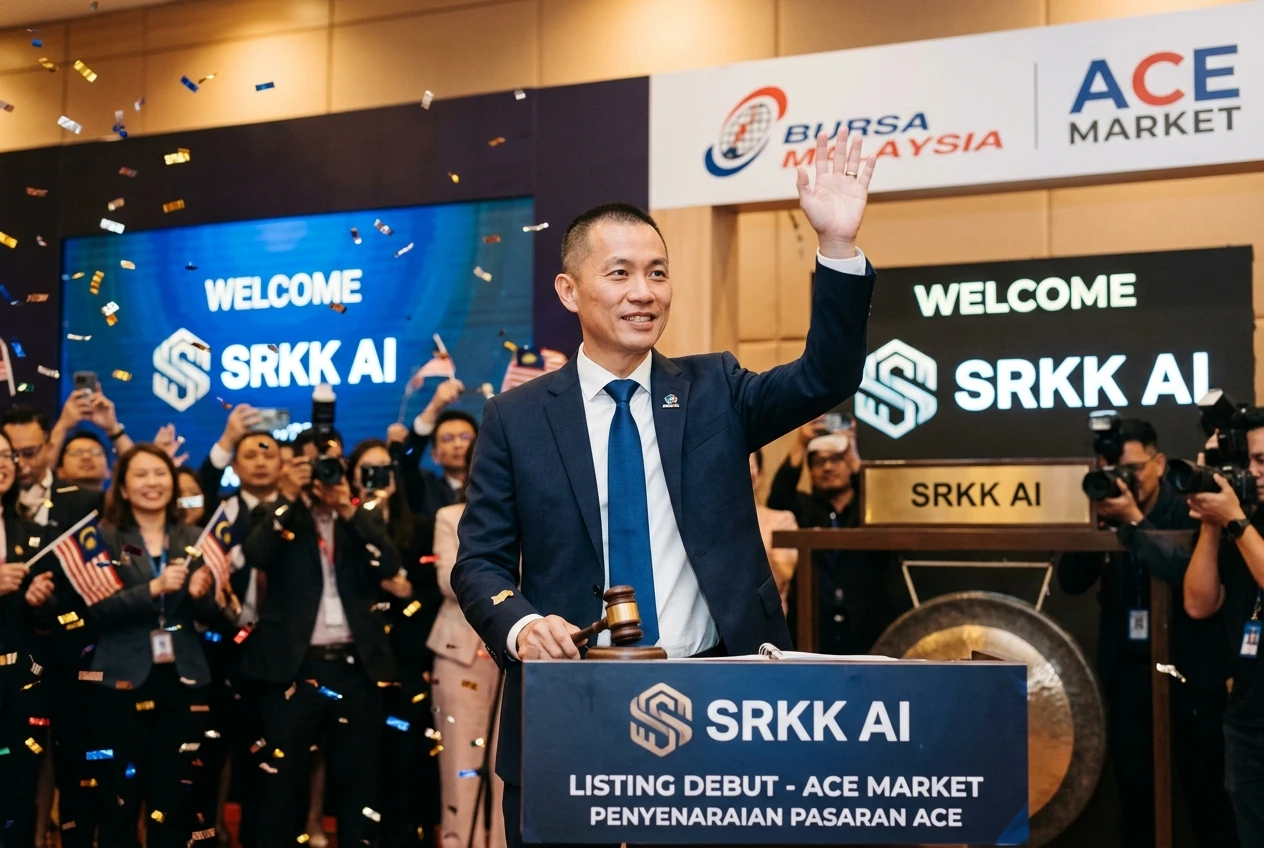
SRKK AI’s ACE Market debut popped 88% on July 9 as CEO Yew Lip Sin tied its Indonesia expansion to a 20-year Microsoft partnership and a Jakarta office.

SRKK AI Bhd opened 88% above its IPO price on Bursa Malaysia’s ACE Market on July 9, debuting at 60 sen versus the 32 sen offer price as 43 million shares changed hands in the first 15 minutes. The stock touched 61.5 sen before easing to 57.5 sen, lifting SRKK AI’s market capitalisation to RM163 million by the close of the opening gong. Demand had been there all week: retail applications hit RM1.4 billion, which the company said ranks among the largest for a public retail tranche in 2026.
Behind the opening pop sat a quieter second story: Indonesia. CEO Yew Lip Sin used his listing-day press conference to frame SRKK AI’s entry into Indonesia as a partner-rail play built on two decades inside Microsoft’s ecosystem, with a Jakarta office targeted within weeks and a proof-of-concept project with an unnamed large Indonesian conglomerate already secured. The capital earmarked for the Jakarta move is modest, with the rest of the regional growth budget funded through existing resources.
SRKK AI Listed 88% Higher, Then Sold Investors on Microsoft
SRKK AI Bhd’s market debut on July 9 came into a market that has been pulling back on AI-linked equities through 2026. The Edge Markets reported that the listing helped the company ride out what its chief strategy officer, Alex Lam, called a “global downturn of stocks linked to artificial intelligence.” The opening pop put a market capitalisation on the company that no one had pencilled in six months earlier. Investors still need to size whether the 88% first-day action reflected Microsoft’s credential, regional momentum, or thin-float mechanics.
- 60 sen: opening price (versus the 32 sen IPO price set on June 29)
- 61.5 sen: intraday high; 57.5 sen last at the 15-minute mark
- RM163 million: market capitalisation 15 minutes into trading
- 43 million shares: volume traded before the second bell
- 312.3 times retail oversubscription against 14.2 million shares available
The capital arithmetic under the listing explains the thin float. SRKK AI itself received RM20.48 million in fresh capital from a 64 million-share public issue, against RM4.16 million flowing to founder and joint selling shareholders Joel Resources Sdn Bhd and Five Loaves Sdn Bhd for the 13 million-share offer for sale. The arrangement left the listing fully placed, the retail portion oversubscribed, and the float thin enough that retail flows can swing the price sharply on day two. TA Securities, the deal’s principal adviser, sponsor, underwriter, and placement agent, kept the structure conservative enough that no secondary placement is on the calendar. The retail-heavy demand pulled the offer price to the top of the range, and the float remains thin enough for second-day price action to stay sharp.
What the open did not buy was certainty about whether the Indonesia plan converts to revenue at Microsoft’s pace or waits for it. The numbers underneath it stay in the prospectus.
Twenty Years and Six Designations in the Microsoft Partner Stack
Microsoft has been SRKK’s anchor vendor for over two decades, per SRKK AI’s six-designation milestone announcement as the first Malaysian partner to earn all six Microsoft Solution Partner designations under the Microsoft AI Cloud Partner Program. That status covers Microsoft’s full specialty stack: infrastructure, data and AI, modern work, security, business applications, and digital and app innovation. Yew framed the depth of the relationship as the single biggest reason SRKK AI wins contracts at all.
At the listing, Yew told reporters the partner relationship was the company’s anchor in the region. “We realised [at an early stage] that being with a very established vendor or software platform provider like Microsoft helped us a great deal when delivering value to our customers,” he said. SRKK AI sits inside Microsoft’s channel programme as a direct-bill Cloud Solution Provider, which means it sells Microsoft cloud subscriptions to corporate clients and bills them in its own name. The customer base it services through those rails sits at over 1,600 in the financial year ended Dec 31, 2025, per The Edge Malaysia. SRKK AI also resells to other vendors and serves government-linked companies, resellers, and other service providers in Malaysia and Singapore through the same channel.
Where the RM20.48 Million Is Going
The IPO prospectus puts SRKK AI’s strategic priorities on the page, and the largest line items are not the ones most cited in the listing chatter. Three growth-investment categories each take a share of the fresh proceeds: AI initiatives, an in-house Security Operations Centre, and Indonesia expansion. The rest of the pool funds working capital, branding, and the listing itself. The split shows where SRKK AI is investing for the next three years and where it is paying for the act of going public.
- RM4.00 million: AI initiatives, including the AI Lab and the AI Academy
- RM3.70 million: in-house Security Operations Centre
- RM1.84 million: Indonesia expansion
- RM1.80 million: branding and marketing
- RM4.64 million: working capital
- RM4.50 million: listing expenses
AI-enabled solutions contributed RM11.8 million, or approximately 11%, of the group’s revenue in FY2025, per The Edge Malaysia. The company is funding a category that today generates approximately 11% of revenue, while the rest of the income mix is dominated by cloud subscriptions, managed services, and recurring maintenance. The allocation also signals where SRKK AI will not compete: chip design, hyperscale data centres, and the layer that funds them.
Yeoh was clear about that. Asked about cloud diversification, he said SRKK AI is not looking to broaden into other cloud platforms at this stage, and the complementary partnerships the COO did name are with Kaseya, Hewlett-Packard, and Sangfor Technologies. The AI Lab roadmap, by contrast, is built inside Microsoft Azure, putting SRKK AI close to where Microsoft itself is investing the most capital in Southeast Asia, in Jakarta as well as Kuala Lumpur. It also leaves the SOC investment exposed to a market where Microsoft, AWS, and a growing roster of managed security vendors are already competing.
TA Securities, the IPO’s principal adviser, sponsor, underwriter, and placement agent, set a dividend policy for the company that targets at least 20% of consolidated profit after tax. Listed on the ACE Market, the smaller-cap tier of Bursa Malaysia, SRKK AI inherits the volatility that comes with it. Micro-cap listings on that board have a history of sharp second-day moves, and the company’s Q1 2026 net profit of RM1.32 million on revenue of RM31.42 million is the figure that will frame future quarterly disclosures. The IPO’s overhang of new shares also means the float is thin enough that prices can move quickly on retail flows. Of the original 64 million new shares, all are now listed alongside 13 million existing shares sold down via the offer for sale.
A Jakarta Office Within Weeks of Listing
For Indonesia, SRKK AI’s playbook is barely a chapter old. Yew told the post-listing press conference that the company has secured a proof-of-concept project with a large Indonesian conglomerate, though the customer’s identity and sector were not disclosed. He also said the company has identified office space around 1km from the Malaysian Embassy in Jakarta and has already identified a person to lead its Indonesian operations. A local team, Yew said, will be important to bridge language and market differences between Malaysia and Indonesia, particularly for customer-facing engagements.
The Jakarta office is expected to be operational within weeks of the listing. Of the RM20.48 million IPO fresh-proceeds pool, RM1.84 million is being channelled into the Indonesia expansion, with the rest of the regional growth budget funded from existing resources rather than fresh equity. The sum looks small for a country the size of Indonesia, and Yeoh was blunt about why: capital is not the bottleneck when Microsoft is opening doors.
Yeoh’s framing is a structured one. The company is not looking to broaden into other cloud platforms at this stage, and the complementary partnerships the COO did name are with Kaseya, Hewlett-Packard, and Sangfor Technologies. On the Microsoft side, SRKK AI continues to operate as a direct-bill Cloud Solution Provider, billing Microsoft cloud subscriptions to its own customers and managing them on its own balance sheet. The Azure-aligned stack it sells is what most of the Jakarta POC will be built on.
Malaysia is the template SRKK AI is cloning from. The customer base hit over 1,600 in the financial year ended Dec 31, 2025, per The Edge Malaysia, with revenue drawn from cloud service subscriptions, maintenance and support contracts, and software and hardware rentals, alongside project-based consulting. Microsoft’s broader enterprise-AI play, embodied in embedded AI engineers inside enterprise customers, is the commercial pattern the Indonesia expansion is lining up against.
It is also a market where Microsoft’s footprint is rising fast. Avanade separately announced its own investment and expansion into Indonesia, citing Microsoft expertise in its own corporate materials. Local system integrators and managed-service partners across Kuala Lumpur, Jakarta, and Singapore are reaching for the same Microsoft-channel opportunities, and the POC contract SRKK AI has not yet named will be tested against that cohort. The Jakarta office is being launched into an unusually busy regional channel, with Microsoft’s Indonesia infrastructure backing all of it. SRKK AI enters the contest with a 20-year Microsoft tenure that the rest of Microsoft’s channel is still building, alongside a six-solution designation set no other Malaysian partner holds today.
The Cloud Region Already Waiting in Jakarta
Three Microsoft moves over the past two years frame the regional bet SRKK AI is making. They share a single counterparty: Microsoft’s own capital deployment in Southeast Asia.
- April 30, 2024: Microsoft announces a US$1.7 billion Indonesia cloud and AI commitment, spanning new cloud and AI infrastructure, AI skilling, and developer support.
- May 27, 2025: Microsoft opens Indonesia Central, the company’s first Indonesia cloud region, described at launch as AI-ready hyperscale cloud infrastructure.
- 2025 to 2026: Microsoft commits RM9 billion to Malaysia, cited by SRKK AI’s own newsroom as the macro environment its local partner base is recruited into.
For SRKK AI, those dates are not the news; the listing is. But the listing is being read, by Microsoft and by Microsoft’s Indonesian customers, against that backdrop. Indonesia Central is what an Azure-aligned Indonesian POC will be built on, and Microsoft customers with Indonesian data-residency needs now have a domestic cloud option. The US$1.7 billion investment is what Microsoft-credentialed partners like SRKK AI get pulled into first when multinational customers begin scoping cloud work in Jakarta. The RM9 billion Malaysia line is what underwrites Microsoft’s enterprise-AI deployment push in Kuala Lumpur, the place SRKK AI’s existing six-solution designation customers work from.
Microsoft’s Indonesia Central cloud region is the substrate a Jakarta POC will sit on, and the company’s US$1.7 billion commitment funds the partner channel that recruits and integrates local firms like SRKK AI to run on top of it. SRKK AI’s role is to scope, integrate, and run the customer engagement. Yew’s framing at the post-listing press conference was that Microsoft “has been providing sales leads and introducing potential opportunities in the region,” supported by SRKK AI’s technical capabilities within Microsoft’s partner ecosystem. The Indonesian capital allocation of RM1.84 million reflects that SRKK AI brings the integration team and Microsoft brings the cloud and the sales pipeline. The Jakarta POC will be the first concrete test of whether the partnership model holds in Indonesia the way it has in Malaysia.
What the ‘AI’ Label Is Actually Built On
Lam did not wait for the criticism to surface on its own. He framed the rebuttal before any retail investor asked. The criticism, he said, has been an open refrain in prospectus commentary: that SRKK AI is using the AI label without the AI numbers to back it.
Alex Lam is SRKK AI’s chief strategy officer, speaking at the post-listing press conference on July 9. His answer was that AI and non-AI components together have built the company a solid base of revenue, recurring revenue, and profit margins. For the first quarter ended March 31, 2026, SRKK AI made RM1.32 million in net profit on revenue of RM31.42 million, per The Edge Malaysia. AI-enabled solutions contributed RM11.8 million, or approximately 11%, of the group’s revenue in the financial year ended Dec 31, 2025. The recurring base Lam referenced is real, and the AI mix is still approximately 11% of revenue.
Disclaimer: This article is for informational purposes only and is not investment advice. Investing in IPOs and small-cap equities carries significant risk, including the loss of principal. Figures are accurate as of publication and may change. Consult a licensed financial professional before making any investment decision.


South Korea Retail Investors Face Reckoning After KOSPI AI Rally Collapses

Surrey AI Maps Three Heart Attack Paths and Their Molecular Roots

Germany Locks Neutral Apple ATT Prompts Across Most of Europe

Apple’s 5% EU Fee Quietly Rewrites Alternative App Store Math

Apple’s EU Fee Truce Cuts Complexity but Leaves Rivals Fuming

Pixel 11 Pro Fold Trades Thinness for Durability and Seven-Year Stay

Mayo AI Flags HCM Obstruction From Everyday Ultrasound Videos

Indian Brands Quietly Scale Landmark Screens and Home Tech

Navin Vatsa Turns Grief Into a Lifetime of Quiet Seeing

Google Bets Pixel 11 Agentic AI Will Redefine Phones

Oracle Cuts 21,000 Jobs in a Year, Cites AI in 10-K Filing

Fable 5 and Mythos 5 Return as US Lifts Anthropic Export Controls

SpaceX’s Google Deal Turns a Rocket Company Into a Cloud Landlord

CD Projekt Red Co-CEO: Redemption Arc Isn’t Done, Witcher 4 in 2027

XPL Rallies 30% Ahead of Plasma One Card Tier Launch

Google Search Profiles Build a Follow Graph Inside Discover

DGO App Brings Rs 549 Mobile Pass for FIFA World Cup 2026 in Nepal

Moonshot AI Targets $30 Billion in China’s Fastest AI Funding Sprint

Oppo’s ColorOS 17 Eligibility List Leaves A-Series Buyers Behind

Microsoft Xbox Layoffs Start in July as Sharma Slams 3% Margin
-
 AI2 months ago
Oracle Cuts 21,000 Jobs in a Year, Cites AI in 10-K Filing
-
 AI2 months ago
Fable 5 and Mythos 5 Return as US Lifts Anthropic Export Controls
-
 AI3 months ago
SpaceX’s Google Deal Turns a Rocket Company Into a Cloud Landlord
-
 GAMING2 months ago
CD Projekt Red Co-CEO: Redemption Arc Isn’t Done, Witcher 4 in 2027
-
 CRYPTO2 months ago
XPL Rallies 30% Ahead of Plasma One Card Tier Launch
-
 NEWS3 months ago
Google Search Profiles Build a Follow Graph Inside Discover
-
 APPS2 months ago
DGO App Brings Rs 549 Mobile Pass for FIFA World Cup 2026 in Nepal
-
 AI3 months ago
Moonshot AI Targets $30 Billion in China’s Fastest AI Funding Sprint