
GAMING
Razer’s Hammerhead V3 X HyperSpeed Earbuds Hit Xbox and PS5
Razer’s V3 X HyperSpeed earbuds ship as separate Xbox and PlayStation editions at $99.99 each, with a charging case doubling as a wireless receiver.

Razer has launched the Hammerhead V3 X HyperSpeed earbuds in two console-specific versions, an Xbox edition and a PlayStation edition, each priced at $99.99 / €109.99 on the company’s site. The earbuds bring the case-as-wireless-receiver trick to a price tier below the older V3 HyperSpeed.
Both editions pair gaming-grade 2.4 GHz HyperSpeed Wireless with Bluetooth 5.3 and ship with platform-tuned spatial audio. The V3 X HyperSpeed slots in below the V3 HyperSpeed and drops the active noise cancellation that model carries. Razer frames the new pair as the cheapest HyperSpeed option built specifically for console gamers.
Two Versions, One Feature List
The Xbox and PlayStation editions look identical and share nearly every spec. Razer built the SKUs as two products because each console’s spatial stack runs on its own pipeline. Windows Sonic on Xbox and 3D Audio on PlayStation run on separate software stacks. Razer shipped two versions, one SKU per console, of the same earbud design.
Buyers who own both consoles will have to pick. Razer lists cross-compatibility on PC through the HyperSpeed Case and on any Bluetooth-enabled phone or tablet. The platform-tagged spatial audio only activates on the intended console. The PlayStation version works on PS5, PS4, PC, Steam Deck, Nintendo Switch, and any Bluetooth device. The Xbox SKU treats the Microsoft console as the priority and adds PC plus Bluetooth as secondary paths.
Both editions support 2.4 GHz HyperSpeed Wireless on the same band and Bluetooth 5.3 in the same radio. They share the HyperSpeed Case hardware, the same 25-hour case top-up figure, and the same 11 mm dynamic drivers. The configuration difference between the two SKUs sits in the spatial codec the earbuds route audio through.
The Case That Doubles as a Receiver
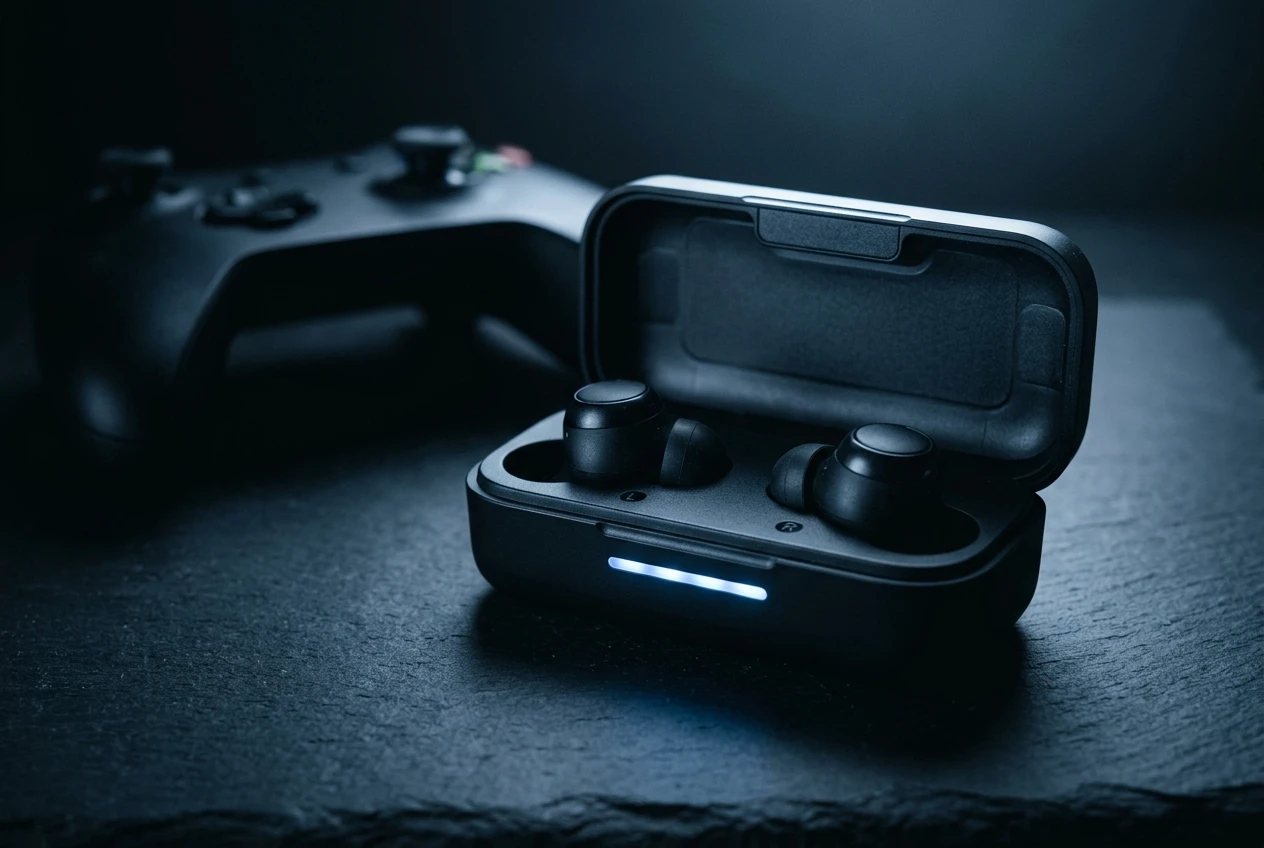
The HyperSpeed Case is the most unusual part of the V3 X HyperSpeed. Open it and the case contains a 2.4 GHz wireless receiver that pairs with a console, PC, or supported handheld when plugged in via USB. The earbuds sit in the case during this link setup, which lets the case handle the wireless hop while the buds charge. Once paired, the earbuds drop out of the case and run on the established 2.4 GHz connection. Razer designed the case to act as the bridge between a USB-A or USB-C port and the earbuds.
Razer ships this dual-radio design under the SmartSwitch Dual Wireless name. SmartSwitch lets users hop between a HyperSpeed link to a console and a Bluetooth link to a phone without dropping the audio stream. The same hardware sells on the older V3 HyperSpeed. The V3 X HyperSpeed inherits the case design at the lower price.
The case is pocket-sized. Photos on Razer’s product page show a slim rectangular housing roughly the size of a pack of cards, with a thin LED bar along the front edge indicating pairing and charging status. Razer does not publish an exact weight or capacity figure for the case.
USB-C passthrough is included. Earbuds can play audio from a console while the case is plugged in, which removes the need to pause for a top-up during a long session.
Spatial Audio, Per Console
Spatial audio is the reason Razer built two SKUs. Windows Sonic on Xbox and Sony’s 3D Audio on PlayStation are console-native spatial pipelines that wrap standard stereo audio in positional metadata, and they run on different software stacks. THX Spatial Audio on PC adds a third option for Windows 11 users with Razer Synapse installed. Each SKU ships pre-configured for one console, and the THX profile turns on automatically when the earbuds talk to a Windows PC.
The Xbox edition pairs with any device that can output Windows Sonic, including Xbox Series X|S, Xbox One consoles, and Windows 11 PCs. The PlayStation edition pairs natively with PS5 and falls back to standard stereo on PS4. On PC, both editions default to THX Spatial Audio when Synapse is running.
Buyers who want to use the earbuds on a console that does not match the SKU still get audio, but only in stereo. The Razer support FAQ for the V3 X HyperSpeed does not confirm whether each SKU supports the other console’s spatial codec. Razer published a touch-control layout on the product page that goes deeper than the standard media set. Users can tap, double-tap, or hold to switch tracks, raise and lower volume, mute the microphone, and toggle the earbuds between HyperSpeed and Bluetooth:
- Single tap (L or R): play or pause a track
- Double tap (R): next track. Double tap (L): previous track
- Double tap and hold two seconds (R): volume up. Same gesture (L): volume down
- Long press two seconds (L or R): mute or unmute the microphone
- Triple tap (L or R): toggle between Bluetooth 5.3 and 2.4 GHz HyperSpeed Wireless
- Single tap during a call: answer or end. Double tap: reject or switch calls
Battery and Build, At a Glance
Razer rates the V3 X HyperSpeed at up to 10 hours of battery on a single charge and an additional 25 hours through the case, for a combined ceiling of 35 hours. The V3 HyperSpeed case total reaches 40 hours per its product page, while earbud-only battery figures for the older model are not listed on Razer’s US site. The pair refills over USB-C. A 10-minute top-up rate is not officially tested by Razer.
The housing carries an IPX4 splash-resistance rating for sweat and rain. Each earbud runs an 11 mm dynamic driver, supports a 20 Hz to 20 kHz frequency response, and ships with 102 dB sensitivity. Razer does not list a weight for either the buds or the case.
The full spec sheet reads as follows.
| Feature | V3 X HyperSpeed spec |
|---|---|
| Connection | 2.4 GHz HyperSpeed Wireless + Bluetooth 5.3 |
| Battery (earbuds) | Up to 10 hours per charge |
| Battery (with case) | Up to 35 hours total |
| Charging case | 2.4 GHz receiver and charger, USB-C passthrough |
| Spatial audio | Windows Sonic (Xbox SKU), 3D Audio (PlayStation SKU), THX Spatial Audio (PC) |
| Water resistance | IPX4 |
| Drivers | 11 mm dynamic |
| Frequency response | 20 Hz to 20 kHz |
| Sensitivity | 102 dB |
| Impedance | 32 Ω |
| Input power | 25 mW |
| Controls | Touch with multi-gesture support |
| MSRP | $99.99 (US) / €109.99 (EU) |
Where This Sits in Razer’s HyperSpeed Line
The V3 X HyperSpeed lands as the lowest-priced HyperSpeed-branded console earbud on Razer’s current price list. The V3 HyperSpeed is the all-purpose HyperSpeed sibling, priced above the new X variant at $129.99. The new X variant targets a clearer gap, price-sensitive console gamers who do not need ANC. The older Hammerhead Pro HyperSpeed is mentioned in Razer’s family documentation without a current US price on the same product page.
The trade from V3 HyperSpeed to V3 X HyperSpeed is active noise cancellation, Bluetooth 6.0, and total case battery. The V3 HyperSpeed adds ANC and the newer Bluetooth standard, and does not ship with per-console native spatial audio. The V3 X HyperSpeed trades those features for platform-tuned spatial audio at the lower price.
The two HyperSpeed models compare as follows.
| Feature | V3 X HyperSpeed | V3 HyperSpeed |
|---|---|---|
| Connection | 2.4 GHz + Bluetooth 5.3 | 2.4 GHz + Bluetooth 6.0 |
| Active noise cancellation | No | Yes |
| Battery (with case) | Up to 35 hours | Up to 40 hours |
| Spatial audio | Per-console native + THX on PC | THX Spatial Audio (PC) |
| US MSRP | $99.99 | $129.99 |
Specs in the table come from Razer’s official pages for both HyperSpeed models. The V3 X HyperSpeed product listing and the V3 HyperSpeed product listing carry the same numbers, with driver and frequency figures drawn from the V3 X HyperSpeed support FAQ.
Razer positions the V3 X HyperSpeed as the entry point into the line, with the V3 HyperSpeed above it at $129.99. The older Hammerhead Pro HyperSpeed is mentioned in Razer’s family documentation without a current US price on the same product page.
Price, Availability, and Who It Is For
The V3 X HyperSpeed for Xbox and the V3 X HyperSpeed for PlayStation are listed on Razer’s site at the same MSRP and are in stock as of the announcement day. Amazon, Best Buy, and Razer’s regional storefronts carry the earbuds, with retailer listings split across console SKUs. Razer’s other Dual Wireless products remain a separate purchase path. Razer treats the two SKUs as a single launch event rather than two separate reveals.
Razer frames the earbuds as console-gaming first and Bluetooth all-day second. The case-as-receiver trick and platform-specific spatial audio are the headline features. The trade-off is real: buyers get a lower entry price, console-tuned spatial audio, and a USB-C passthrough case. They trade away the active noise cancellation and Bluetooth 6.0 of the older V3 HyperSpeed.
A first-time wireless gaming earbud buyer on a single console gets a low-friction entry at the new SKU’s price. Owners of both consoles face a SKU-split decision. Buyers who want active noise cancellation plus cross-platform listening today pick the V3 HyperSpeed at $129.99 within the same family.


South Korea Retail Investors Face Reckoning After KOSPI AI Rally Collapses

Surrey AI Maps Three Heart Attack Paths and Their Molecular Roots

Germany Locks Neutral Apple ATT Prompts Across Most of Europe

Apple’s 5% EU Fee Quietly Rewrites Alternative App Store Math

Apple’s EU Fee Truce Cuts Complexity but Leaves Rivals Fuming

Pixel 11 Pro Fold Trades Thinness for Durability and Seven-Year Stay

Mayo AI Flags HCM Obstruction From Everyday Ultrasound Videos

Indian Brands Quietly Scale Landmark Screens and Home Tech

Navin Vatsa Turns Grief Into a Lifetime of Quiet Seeing

Google Bets Pixel 11 Agentic AI Will Redefine Phones

Oracle Cuts 21,000 Jobs in a Year, Cites AI in 10-K Filing

Fable 5 and Mythos 5 Return as US Lifts Anthropic Export Controls

SpaceX’s Google Deal Turns a Rocket Company Into a Cloud Landlord

CD Projekt Red Co-CEO: Redemption Arc Isn’t Done, Witcher 4 in 2027

XPL Rallies 30% Ahead of Plasma One Card Tier Launch

Google Search Profiles Build a Follow Graph Inside Discover

DGO App Brings Rs 549 Mobile Pass for FIFA World Cup 2026 in Nepal

Moonshot AI Targets $30 Billion in China’s Fastest AI Funding Sprint

Oppo’s ColorOS 17 Eligibility List Leaves A-Series Buyers Behind

Microsoft Xbox Layoffs Start in July as Sharma Slams 3% Margin
-
 AI2 months ago
Oracle Cuts 21,000 Jobs in a Year, Cites AI in 10-K Filing
-
 AI2 months ago
Fable 5 and Mythos 5 Return as US Lifts Anthropic Export Controls
-
 AI3 months ago
SpaceX’s Google Deal Turns a Rocket Company Into a Cloud Landlord
-
 GAMING2 months ago
CD Projekt Red Co-CEO: Redemption Arc Isn’t Done, Witcher 4 in 2027
-
 CRYPTO2 months ago
XPL Rallies 30% Ahead of Plasma One Card Tier Launch
-
 NEWS3 months ago
Google Search Profiles Build a Follow Graph Inside Discover
-
 APPS2 months ago
DGO App Brings Rs 549 Mobile Pass for FIFA World Cup 2026 in Nepal
-
 AI3 months ago
Moonshot AI Targets $30 Billion in China’s Fastest AI Funding Sprint