
NEWS
Gatchalian’s School Phone Ban Stops at the Classroom Door
Gatchalian revived a classroom smartphone ban after Tacloban, but the attack was planned on Messenger and games, hours DepEd already treats as phone-free.

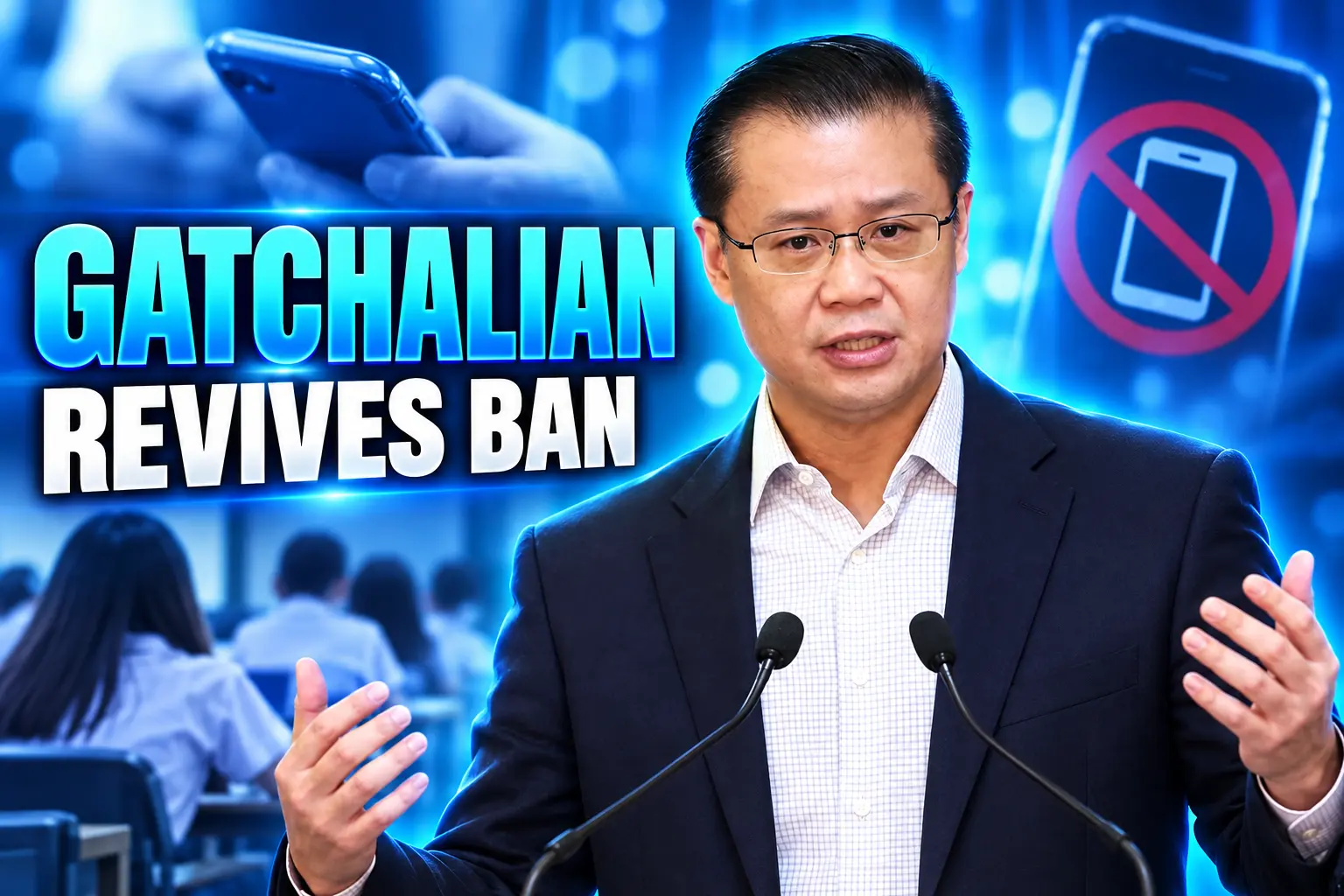
On July 1, 2026, Senate President Sherwin Gatchalian revived a classroom smartphone ban after the Tacloban shooting killed 3 students and injured 20. His vehicle is Senate Bill 627, which would keep Kindergarten to Senior High devices off during class in public and private schools. The Department of Education already bars gadget use during lessons in public schools, and his own bill lets a student touch a phone when danger is in the room.
The two suspects, 14 and 15, had talked through the attack on Facebook Messenger and around a violent sandbox game. A lockbox in first period does not close those tabs at night.
Senate Bill 627 Stops at the Classroom Door
Gatchalian’s proposed Electronic Gadget-Free Schools Act would order DepEd to write rules that keep mobile phones and other gadgets unused during class hours from Kindergarten through Senior High. The ban would cover public and private campuses. Teachers and other faculty would lose their phones during designated teaching hours too, so the rule is not only a student pouch policy.
He first ran a version in the 19th Congress as Senate Bill 2706, then refiled after South Korea moved first on classroom phones. The 20th Congress copy reached the Senate records on July 15, 2025. If it ever becomes law, it takes effect 15 days after publication even before the implementing rules are out.
The July 1 revival was not a quiet committee tweak. Gatchalian tied it to a Batangas public school that had just suspended face-to-face classes over a shooting threat, to a foiled February plot in Laguna, and to the Tacloban dead. He also folded in a separate demand to keep minors aged 16 and below off social media.
His office account put the two asks on the same card: a social media ban for minors, and a class-hours gadget ban so students “stay focused on their studies.”
Bukod sa pagsusulong ng social media ban para sa mga menor de edad, isinusulong din natin ang Electronic Gadget-Free Schools Act.
Ipinagbabawal nito ang paggamit ng smartphones at iba pang electronic devices sa oras ng klase upang matiyak nating nakatutok sila sa pag-aaral.… pic.twitter.com/sWgcVQSbp8
— Win Gatchalian (@WinGatchalian74) July 1, 2026
WHERE THE BILL STILL ALLOWS A PHONE
- Directed lessons: Teacher-led presentations and other class activities can put a device back in a student’s hands.
- Health needs: Learners with specific medical conditions may keep a gadget for that purpose.
- Emergencies: Phones are allowed during emergencies and when there is a perceived threat or danger, including some work off campus.
That last carve-out is the tell. The same incidents used to sell the confiscation are the incidents in which the bill says the phone may come out.
The Tacloban Attack Lived in After-Hours Chats
On June 22, 2026, two students opened fire at San Jose National High School in Tacloban City. Investigators later used the aliases Nash and Rod. Three students were killed and 20 were injured. Early talk ran to bullying and to two handguns. The digital trail pointed somewhere else.
Saddiq Basha, writing for the Global Network on Extremism and Technology, laid out pre-attack Facebook Messenger exchanges in which the pair discussed what would happen to them as minors. Investigators said they had been planning since late April 2026. One had posted videos with firearms. One had been playing GoreBox, a sandbox game built around graphic weapons. Nash changed into a KMFDM shirt, a costume echo of older mass-shooter lore. None of that work required a phone on a desk during math.
Cybercrime Investigation and Coordinating Center Undersecretary Renato Paraiso told a July inquiry that recovered chats showed both suspects inside the transnational network known as 764, which grooms minors toward sexual abuse and violence. Those logs have not been released. At the same Senate hearing, Senator Risa Hontiveros flagged a Facebook account under the name Sedykh Ryazanov that interacted with profiles linked to Nash and, after the attack, told him to wipe Discord, Reddit, and Telegram. She called the user a suspected adult groomer and said the National Bureau of Investigation still had to validate the lead.
WHERE EXPERTS DISAGREE
- Paraiso’s read: Chat logs, in his account, put both Tacloban suspects inside 764 as active, groomed participants.
- The public file: Basha notes that 764 involvement remains unverified without the chats, and that Hontiveros’s post-attack comment cannot by itself prove direction before June 22.
- The wider net: The Philippine National Police reported rescuing 24 minors tied to True Crime Community circles that officials lumped with 764, which shows a domestic scene even if Tacloban never gets a clean label.
Gatchalian still used the dead in Tacloban to push phones out of class. On July 1 he said safety came first, then focus.
Maliban sa pagtiyak sa kaligtasan ng ating mga mag-aaral, isinusulong din natin ang smartphone ban sa mga paaralan upang matiyak nating nakatutok sila sa pag-aaral at hindi sila naaabala.
Sherwin Gatchalian, Senate President, July 1, 2026 statement
Focus is a classroom argument. Tacloban was a night-and-weekend argument. Treating them as one policy lets a pouch stand in for a grooming investigation.
DepEd Already Restricts Gadgets During Lessons
On the same Wednesday Gatchalian revived Senate Bill 627, DepEd reminded every region that portable electronic devices are already barred during instructional hours in public schools. DepEd Order No. 6, series of 2026, the Guidelines on Ensuring a Safe and Motivating Learning Environment, covers learners and personnel. Social media, games, content creation, and vlogging during class are listed as off-limits. The same order allows devices for class platforms, digital resources, teacher-authorized group work, and for communication in disasters, medical crises, or other immediate safety problems.
So the July showdown was not between a phone-filled public classroom and a sudden ban. It was between an existing DepEd restriction and a statute that would harden it, add private schools, and put teachers under the same clock.
THREE PHONE RULES, THREE REACHES
| Rule | Who it covers | When phones are off | Status as of late September 2026 |
|---|---|---|---|
| DepEd Order No. 6, s. 2026 | Learners and personnel in public schools | Instructional hours, with class and emergency exceptions | In force; restated on July 1, 2026 |
| Senate Bill 627 | K to Senior High students and teachers, public and private | Class hours, with lesson, health, and emergency exceptions | Did not reach the floor as a stand-alone act |
| Senate Bill 2426 gadget clause | Public and private schools inside a national safety framework | Instructional hours, with learning, health, safety, and other authorized uses | Passed the Senate 17-0 on September 21, 2026 |
The honest case for a class-hours rule is sitting in the OECD’s PISA 2022 note on the Philippines, which found that 41 percent of Filipino 15-year-olds got distracted by digital devices in most or all mathematics lessons, against an OECD average of 30 percent. Another 37 percent said classmates’ devices pulled them off the work, against 25 percent across the OECD. That is a lesson-time problem. It is not a 764 problem.
DepEd had already given the Senate a violence count that also fails to map onto a pouch: at least 103 bullying cases that escalated into campus violence between November 24, 2022, and April 7, 2025. Those fights can start in a comment thread at 9 p.m. just as easily as they can start under a desk.
What a Phone Pouch Cannot Intercept
A collected handset during period one cannot see the channels that actually sat under Tacloban and the plots Gatchalian listed beside it. The mismatch is mechanical, not moral.
THE CHANNELS A CLASS POUCH NEVER SEES
- Facebook Messenger: The Tacloban pair used it to talk through charges and timing before June 22.
- GoreBox: A violent sandbox game that the Cybercrime Investigation and Coordinating Center moved to block after the shooting, not a classroom app.
- Roblox: Seven students in Laguna were allegedly recruited in February by foreign handlers through the game, months before the July revival.
- Discord, Reddit, Telegram: The suspected groomer account told Nash to delete those after the attack, which is an after-hours hygiene tip, not a lesson-time one.
Interior Secretary Jonvic Remulla later described online handlers who flatter insecure students with the promise of glory, and he grouped Tacloban with campus attacks in Zamboanga and Cotabato. Roblox chats around a later shooting followed the same pattern of looking at game logs only after blood was on the floor. Taking phones out of a homeroom does not log those servers.
Parents still buy the devices Gatchalian wants idle, because a locked campus is also a place they cannot see. The bill answers that fear by promising emergency use. A phone in a teacher’s drawer is a weak panic button. The exemption admits the need; the confiscation delays the reach.
Seventeen Votes for Cameras, Detectors, and a Gadget Clause
By September, the stand-alone gadget bill was no longer the thing on the floor. On September 21, 2026, the Senate passed Senate Bill 2426, the Comprehensive School Safety Act, with 17 yes votes, no no votes, and no abstentions. Senator Bam Aquino sponsored it. Gatchalian, a co-author, said the gadget limits inside it reflected his earlier proposal. Senator Joel Villanueva described an amendment that bars mobile phones and other devices during instructional hours except for legitimate learning, emergencies, and other authorized uses.
The rest of that bill is hardware and process: a National School Safety Framework under DepEd, local School Safety Plans updated every 3 years, CCTV in classrooms and common areas, metal detectors and bag checks when a risk assessment calls for them, counseling with the Department of Health, police visibility with the Department of the Interior and Local Government, and anonymous reporting. Education Secretary Sonny Angara had already backed converting DepEd’s campus-security drive into statute so the money would not depend on a memo.
Gatchalian’s line on passage stayed with the dead, not with PISA. “Hindi karahasan ang dapat maging kapalit ng ating hangaring makapag-aral ang bawat bata,” he said. Violence, in that framing, is the price of showing up to school. A phone pouch is a small clause in a bill about cameras and drills.
FROM A GADGET BILL TO A SAFETY STATUTE
- July 15, 2025: Senate Bill 627 is received as Gatchalian’s gadget-free schools refile for the 20th Congress.
- Early 2026: DepEd Order No. 6 restricts portable devices during instructional hours in public schools.
- February 2026: Police describe a foiled Laguna school plot involving 7 students allegedly recruited through Roblox.
- June 22, 2026: Two students shoot San Jose National High School in Tacloban; 3 students are killed and 20 are injured.
- July 1, 2026: Gatchalian revives Senate Bill 627 and a social media age bar; DepEd restates Order No. 6 the same day.
- July 9, 2026: The Senate Committee on Basic Education, with Senator Bam Aquino presiding, hears school-safety and gadget bills together.
- September 21, 2026: Senate Bill 2426 passes 17-0 with gadget limits written into a national safety framework; the Batang Ligtas Senate version also clears 17-0 that day.
- September 30, 2026: The Senate ratifies the Batang Ligtas bicameral report on platform duties for online sexual abuse and recruitment into violence.
DepEd also pointed to 10,000 new school counselor posts for School Year 2026-2027, a staffing answer that sits closer to grooming and bullying than a zipper case does. The House and the President still have to act on the safety bill before any of that framework is law.
Under 16 on Gatchalian’s Bill, Under 18 on the One That Moved
The other half of the July 1 package was never a pouch. Gatchalian’s Social Media Safety for Children Act, Senate Bill 2066, would keep children aged 16 and below off social platforms, force stricter age checks than an email, and go after autoplay, pings, and recommendation loops. He told dzBB the influence of social media on children had become extremely strong. He wanted facial checks, not a typed birthday.
What actually advanced was Senate Bill 2424, the Child Online Safety and Protection Act, sponsored by Senator Robinhood Padilla and co-sponsored by Gatchalian. By October 2, 2026, the Senate had approved it on second reading. That draft, as described after the vote, would require platforms that are mainly for social posting and interaction to keep anyone under 18 from opening or using an account, to verify age, and to keep a Philippine representative. Fines run from P5 million to P20 million per violation, plus P100,000 for each extra day out of compliance, with the Department of Information and Communications Technology on the hook for its own penalties in the same band if it fails to police the rule.
The same draft, as described, does not cover email, private messaging, or online games that are not mainly social networks, and it also spares educational and news tools. Messenger and GoreBox, the two named pipes under Tacloban, sit in those gaps. An age wall on TikTok and Facebook pages can still leave the chat and the game open. Age-assurance that demands government ID would also pull anonymous adult speech into the same net, which is a separate fight from whether a 14-year-old should have a public account.
Banning a child’s login does not by itself lift an adult groomer off Roblox or a Discord server. The Batang Ligtas report, ratified on September 30, 2026, is the closer fit to that adult: local legal officers for platforms, faster takedowns, and a wider brief on recruitment into violence as well as sexual abuse. Hontiveros authored the Senate side. That is platform duty. It is not a pencil case.
On July 9, Gatchalian told the basic education hearing that phones, laptops, and iPads bring benefits and also harm, and that the point of a gadget rule was more time for friends, reading, and study. That is a school-culture pitch. It can stand on the PISA distraction figures without Tacloban. Once he put the Tacloban dead behind a class-hours ban, he asked a pouch to do work that lives on Messenger after dismissal.
If Senate Bill 2426 becomes law, the phone rule Gatchalian wanted will arrive as a clause beside cameras and bag checks, with the same emergency hole the July bill already had. Students will still be told to pocket a device when a threat is no longer theoretical. The planning that produced June 22 did not need that bell schedule, and a lockbox in homeroom will not hear it.

Instagram Plus Tests a Read-Only Mode That Cuts Stories

Altman Asks the Public to Accept Some AI Harm

Google Freezes OSS VRP Product Reports After AI Flood

AI Agents Make Payment Rails the Scarce Prize

Turkey’s Crypto Boom Now Runs Through Three Banks

Fable 5 Came Back Under a Commerce On-Off Switch

Google’s SpaceX GPU Lease Has a Sept. 30 Deadline

Plasma One’s XPL Locks Face a 1.81 Billion Cliff

DGO’s Rs 549 World Cup Pass Cost Fans Sleep and Data

Moonshot AI’s $30 Billion Ask Became a $35 Billion Close
-
 AI4 months ago
Fable 5 Came Back Under a Commerce On-Off Switch
-
 AI5 months ago
Google’s SpaceX GPU Lease Has a Sept. 30 Deadline
-
 CRYPTO5 months ago
Plasma One’s XPL Locks Face a 1.81 Billion Cliff
-
 APPS5 months ago
DGO’s Rs 549 World Cup Pass Cost Fans Sleep and Data
-
 AI5 months ago
Moonshot AI’s $30 Billion Ask Became a $35 Billion Close
-

 NEWS5 months ago
ColorOS 17 Device List Spans Oppo, OnePlus and Realme
-

 GAMING4 months ago
The RTX 4050 Under Rs 70,000 Hides a Wattage Gap
-

 AI4 months ago
Boris Cherny’s Loops Still Demand a Higher Production Bar