
GAMING
Fuse Games Stakes Its Debut on Galactic Racer
Fuse Games bets its unpaid debut, Star Wars Galactic Racer, on an October 6 launch built around Sebulba and a punishing campaign.

October 6, 2026 is when Fuse Games ships Star Wars: Galactic Racer, a $59.99 racer that puts Sebulba back on a track. The Guildford studio, about 75 people and still unpaid, is sending out its first game on PlayStation 5, Xbox Series X|S, and PC.
The June story trailer from Summer Game Fest sold Shade’s grudge, a new arena called Derven Acos, and the Dug who cheated through Mos Espa in the same breath. Fuse is asking full price for a runs-based campaign, not a garage to complete.
Sebulba Races Again on Tatooine and Beyond
Darius Pax founded the Galactic League. Kestar Bool, the crooked champion, now runs it by scaring other pilots. Pax brings in Shade, a mysterious racer with a personal score against the Bool family, and the official plot copy pairs Shade with engineer Hibi and “a certain legendary podracer.”
That podracer is Sebulba. Fuse’s June 5 story trailer puts him in the paddock talk around Shade’s rise, then cuts to pods running off the Mos Espa Circuit. The game is set after the Empire’s fall, with the New Republic still shaky, so the Dug from The Phantom Menace walks into a later age as a legend rather than a movie-tie-in boss.
Arcade mode does not make you wait for that legend. A Play Days hands-on session of about an hour put a writer on the Tatooine track from Episode I, in Sebulba’s seat, with the split-engine tick that the film made famous. Campaign players meet pods as they go. Arcade players can jump into them from the first session, including online events built around that class.
Trailer watchers treated the clip as a wreck reel and a cameo hunt, which fits the studio’s past. Fuse was built by people who spent years making crashes feel like the point. The story sell is Shade versus Bool. The footage that travels is a pod kissing stone at speed.
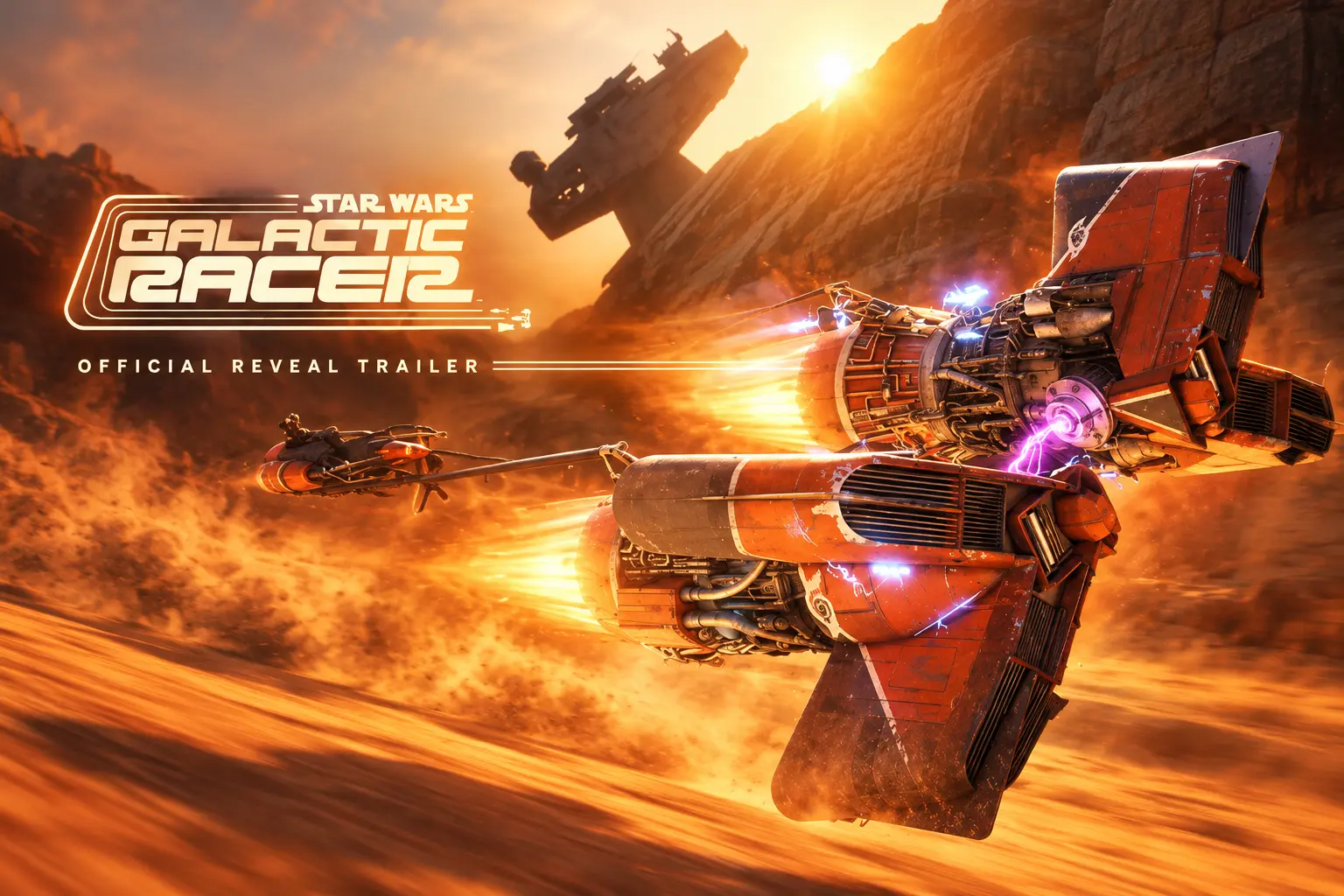
Derven Acos Mixes Every Planetary Condition
Derven Acos is not another desert loop with a new skybox. Fuse describes it as a custom arena built for the league, packing every planetary condition from the tour into one gauntlet. It is the showpiece at the end of a run, which is why the trailer opens by welcoming pilots there, then promising that losers get wiped.
Each planet’s paddock is a walkable pit between races, where other pilots trade stories, throw challenges, and sometimes help. Hibi’s workshop sits in those paddocks. Shade fits parts earned on track or bought from her, chasing stat boosts and abilities before the next event. The downtime is short on purpose: you talk, you wrench, you roll out.
The tour itself spans six worlds. The Play Days build already showed Jakku’s scarred flats, the forests of Lantaana, and frozen Ando Prime, a name older racing fans will clock from the 1999 N64 game. Tracks are large, busy with Star Wars clutter, and meant to be learned over repeated attempts rather than cleared once in a linear cup.
A 75-Person Studio Has Not Made Money
Matt Webster, Fuse’s CEO, left Electronic Arts after 32 years, nearly two of those decades inside Criterion, the Burnout and Need for Speed studio EA bought in 2004. In January 2023 he founded Fuse in Guildford with Steve Uphill, Pete Lake, Andrei Shires, and Alan McDairmant. Creative director Kieran Crimmins, who led Need for Speed Unbound, is part of that same Criterion line.
They already knew Lucasfilm. At Criterion the group built vehicle work for Star Wars Battlefront, including the Endor speeder chase, the Rogue One X-wing VR mission, and Starfighter Assault in Battlefront II. Webster has said they could call and ask why the galaxy had gone so long without a dedicated racer. The last one, Racer Revenge, shipped in 2002.
Criterion itself has moved onto Battlefield. Fuse went the other way, and it did so as a small independent. Webster told an interviewer on August 19, 2026 that access to funding had been hard, that people called the 2023 startup brave, and that the company was still pre-revenue. The core team is about 75, kept small on purpose, with outside studios filling gaps instead of hire-and-fire waves.
THE FUSE BET
- Headcount: About 75 people on the core team, with trusted partners in the stand-ups and the code.
- Founded: January 2023 in Guildford, first game now going on sale.
- Money in: None yet, as of that August 19 interview, three and a half years after opening the doors.
Engine: Unreal Engine 5, which Webster said none of the founders knew when they started.
They built the game on that unfamiliar engine in the window from a January 2023 start to an October 2026 ship date. Webster called that stretch an achievement and said they did it without the usual swell-and-cut of a big-studio headcount.
We started Fuse in January 2023. Three and a half years later, we’ve built a studio, we’ve built a team, we’ve built a video game on an engine that none of us knew. It feels like an achievement.
Matt Webster, CEO, Fuse Games
He also said racing games have lived on car collection for about 20 years, and that Fuse wanted that ladder ripped up. The replacement is a tour you can lose.
Crash Too Many Times and the Tour Ends
Star Wars: Galactic Racer’s campaign is a Galactic Tour in three acts, shuffled each time you enter, with branching events and no way to undo a pick. Finish well and you spend upgrades on Afterburner, battery, cornering, and Ramjet, plus a trait tied to your chassis. Crash too often, or miss a top-3, and the League Entry Token is gone. You go back to qualifiers.
Some meta progress stays, including Galactic Credits and a slice of earlier perks, so the next tour starts stronger. The wipe is still the point. Webster named Hades, Returnal, and Slay the Spire as the structure he wanted, because racing already lives on replay and most modern racers give you a rewind. Fuse is filling the 24-year Star Wars racing gap with a run you can throw away, not a trophy cabinet.
THE TOUR RULES
- Entry token: You need a League Entry Token to start a tour, and losing it dumps you back to qualifiers.
- Fail state: Too many crashes, or a finish outside the top 3, ends that run.
- What carries: Credits and some perks return; the tour itself resets, with new event picks.
- Combat on track: Afterburner is a reusable boost. Ramjet is a hotter shove that can dump a rival and can overheat your own craft.
- No rewind: Webster’s line is that consequence is the feature, because a rewind button kills it.
The story still aims at Kestar Bool after a wipe. You do not lose the grudge. You lose the tour, which is a softer blow for the plot and a harder one for the evening you just spent. That mix is the product Fuse is putting on a shelf at full price.
Landspeeders, Skim Speeders, and Podracers
Campaign racing starts in three chassis, each with its own bad habit. Podracers sit beside them as the class the trailer is selling, unlocked in the story and available immediately in Arcade. Online play supports up to 12 racers. Secret Mode lists the whole product as 1-12 players.
THE FOUR CRAFT CLASSES
| Class | How it behaves | Signature trait |
|---|---|---|
| Landspeeder | Heavier body, built to drift and to shove | Drift |
| Speeder bike | Strong in a straight line, twitchy in corners | Kinetic Burst |
| Skim speeder | Hard banks, closer to a TIE fighter, easy to lose | Knife Edge |
| Podracer | Arcade from the first session, story as you earn it, Tatooine included | Split-engine pods, Sebulba in Arcade |
Bumping rivals off the course is taught, not treated as dirty. Ramjet exists to make that shove expensive for you as well, which is the Burnout habit wearing Star Wars bodywork. Photo-mode talk from preview days is less useful than this: the handling split is the mode, and podracing is one class inside it, not the whole box.
Cross-platform play is listed on the Steam pre-purchase page, next to online PvP and full controller support. That is how a 12-racer grid is supposed to fill after launch week, when the Star Wars surge thins and the ranked list has to stand on its own.
When Does Star Wars Galactic Racer Launch?
Star Wars: Galactic Racer launches on Tuesday, October 6, 2026 for PlayStation 5, Xbox Series X|S, and PC, with the Standard Edition at $59.99 (£49.99 / €59.99). Pre-orders are open in Standard, Deluxe, and Collector form, and a Deluxe upgrade goes on sale at launch for anyone who starts on the base game.
EDITIONS AND STREET PRICE
| Edition | Price | What is in the box |
|---|---|---|
| Standard | $59.99 | The base game, plus a pre-order livery and multiplayer banner |
| Deluxe | $79.99 | Three Kor Sarun craft (Darc X landspeeder, Ciza T speeder bike, Rak S skim speeder), three arcade events, extra livery and banner packs, digital art book, steel case on physical copies |
| Collector | $159.99 | All Deluxe digital items, a Darc X model, a Kestar Bool banner, two pilot patches, a physical art book, steel case and slip cover |
Physical Standard and Deluxe discs are for PS5 and Xbox. The Collector’s Edition is physical across PS5, Xbox, and PC. Pre-order cosmetics change by platform. That is a lot of SKUs for a first game from a 75-person room that has not booked a dollar.
HOW THE DATE WAS SET
- January 2023: Webster and four Criterion alumni open Fuse Games in Guildford and start work on a premium console and PC game.
- December 12, 2025: Star Wars: Galactic Racer is revealed at The Game Awards with a 2026 window.
- February 12, 2026: A State of Play slot shows the first stretch of gameplay.
- April 30, 2026: Secret Mode locks October 6 and opens pre-orders at $59.99.
- June 5, 2026: The Summer Game Fest story trailer adds Sebulba, Derven Acos, and the Shade-Bool plot.
- October 6, 2026: The game launches on PS5, Xbox Series X|S, and PC.
Webster already mapped the autumn around that Tuesday. Control Resonant and Silent Hill: Townfall are both dated September 24. GTA 6 is due November 19. He said October used to be called a murderers’ row when he was still inside big publishers, and that Fuse holds a “healthy sense of confidence” with a “realistic view on how things may turn out.”
The racing audience he wants is smaller than a shooter audience, and he is fine with that. Genres cycle, he said, and as more people play games, even thin niches get large enough to fund a full-price disc. The counter is sitting in his own interview: the studio has not made money, the engine was new to them, and the campaign punishes players who buy Star Wars games to cruise.
Pre-orders are open. The Deluxe upgrade arrives at launch. Webster still puts it the way producers did when he was at EA, that good games find a way, and that Fuse is hoping.

Instagram Plus Tests a Read-Only Mode That Cuts Stories

Altman Asks the Public to Accept Some AI Harm

Google Freezes OSS VRP Product Reports After AI Flood

AI Agents Make Payment Rails the Scarce Prize

Turkey’s Crypto Boom Now Runs Through Three Banks

Fable 5 Came Back Under a Commerce On-Off Switch

Google’s SpaceX GPU Lease Has a Sept. 30 Deadline

Plasma One’s XPL Locks Face a 1.81 Billion Cliff

DGO’s Rs 549 World Cup Pass Cost Fans Sleep and Data

Moonshot AI’s $30 Billion Ask Became a $35 Billion Close
-
 AI4 months ago
Fable 5 Came Back Under a Commerce On-Off Switch
-
 AI5 months ago
Google’s SpaceX GPU Lease Has a Sept. 30 Deadline
-
 CRYPTO4 months ago
Plasma One’s XPL Locks Face a 1.81 Billion Cliff
-
 APPS4 months ago
DGO’s Rs 549 World Cup Pass Cost Fans Sleep and Data
-
 AI5 months ago
Moonshot AI’s $30 Billion Ask Became a $35 Billion Close
-

 NEWS5 months ago
ColorOS 17 Device List Spans Oppo, OnePlus and Realme
-

 GAMING4 months ago
Xbox Cuts 3,200 Jobs After Five Years of Thin Returns
-

 GAMING4 months ago
The RTX 4050 Under Rs 70,000 Hides a Wattage Gap