
NEWS
Unilever’s 50,000-Creator World Cup Push Is a 39-Day Beta Test
Unilever is running 50,000 creators, three House of Fresh hubs, and a 24/7 social newsroom across the FIFA World Cup 2026 to test a CEO-backed social-first pivot.

Unilever has put 50,000 creators, three invite-only content hubs, and a 24/7 social newsroom behind its FIFA World Cup 2026 activation as the tournament’s official personal care sponsor. The CPG conglomerate is activating more than 35 brands across 120 markets, with 180 limited-edition products on retail shelves, for what the company calls its biggest sports partnership to date.
It is also a live test. The 39-day tournament is the first full deployment of a social-first marketing strategy that Unilever CEO Fernando Fernandez unveiled in March 2025, one that pushes the company’s influencer spend toward half of its total ad budget. The playbook is built to live on after the final whistle at MetLife Stadium, with the Women’s World Cup in Brazil next summer already on the calendar.
The Scale Behind Unilever’s Biggest Sports Partnership
The five-year partnership with FIFA was signed in 2023 and covers the men’s, women’s, and esports competitions. Unilever’s own announcement lays out the scale: 48 teams will play 104 matches over 39 days, with live programming and streaming expected to reach 6 billion fans globally. About 10 million people are set to attend matches in person across the United States, Canada, and Mexico.
The commercial context is just as large. A Forbes analysis puts total advertiser spend at the tournament at $10.5 billion globally, more than the $5.7 billion advertisers spent across the entire 2025-2026 NFL season. FIFA itself is on track to bring in about $8.9 billion from broadcasting, sponsorships, ticketing, and hospitality, up nearly 20% from the $7.5 billion it earned in Qatar.
Unilever’s role inside that ecosystem is the personal care category, which spans deodorants, body wash, skincare, and oral care. The activation leans on the company’s four power brands in the space: Dove, Dove Men+Care, Rexona (sold as Degree in the U.S.), and Axe (called Lynx in many markets). Smaller promotions feature Dr. Squatch, Paula’s Choice, Vaseline, Liquid IV, LUX, Pepsodent, and Closeup.
How Unilever Built Its Creator Hub Network
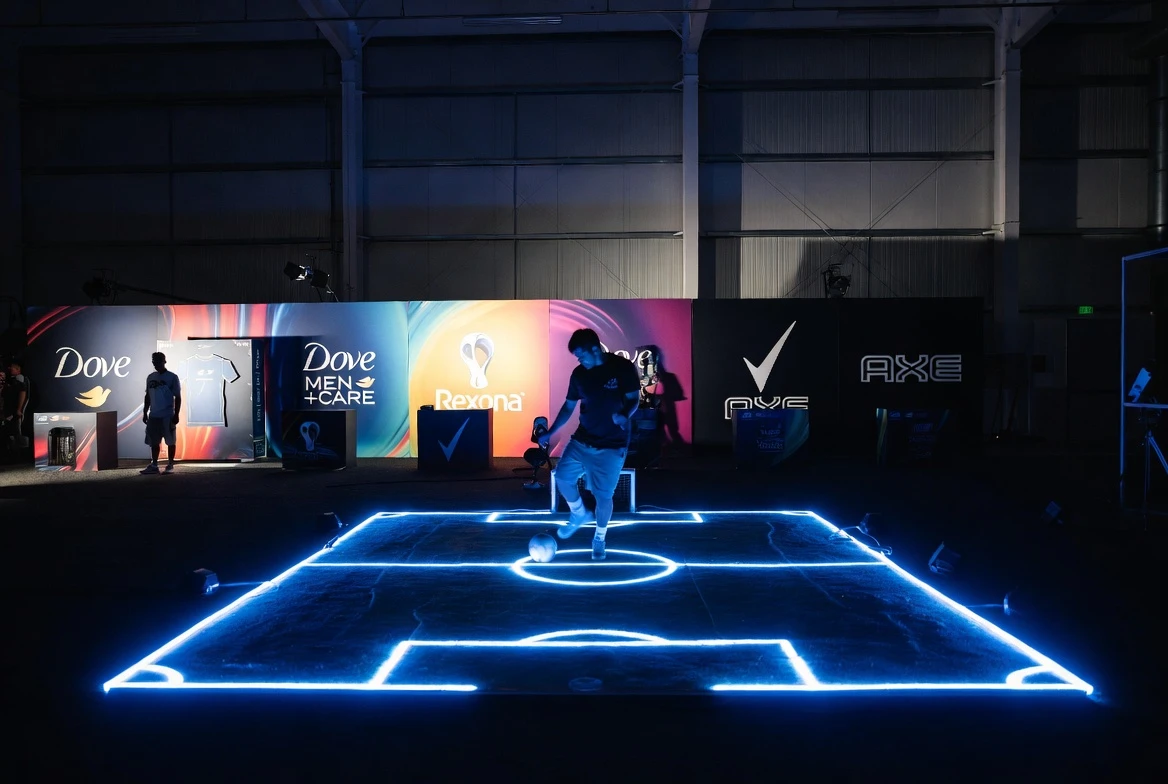
Unilever’s flagship in-person activation is House of Fresh, an invite-only creator hub that opened in New York and Mexico City before the tournament, with a third location planned for Miami during the quarterfinals. The spaces are designed for content creation first and product sampling second. Visitors can design custom soccer jerseys, pose for photos that get turned into collectible Panini trading cards, put charms on phone slings, and play on a small indoor LED soccer pitch. There are manicurists on hand and stations for sampling deodorant sticks.
According to a tour of the New York creator hub, between 200 and 250 creators pass through the space each day. The roster is a deliberate mix of mega-creators, mid-tier talent, and nano-influencers. Not all of them have paid deliverables. Sarah Potter, Unilever Personal Care’s influencer and media director, said the nano-creators were the ones driving credibility online.
The NYC content cycle alone crossed a billion views in its first week, driven in part by a paid appearance from Roberto Carlos, the former Brazil defender. Other athletes attached to Unilever’s creator push include Daniel Sturridge, Christian Pulisic, Vinicius Jr., Florian Wirtz, and Enzo Fernandez. Pulisic’s name appears on a locker inside the stadium activation at New York New Jersey Stadium, where Unilever also runs a misting station and a Panini card booth that mirrors the creator hub.
The vetting is strict. Unilever’s team invites guests based on aligned values and rejects those whose audience does not match a brand. The hubs are not consumer-facing; there is no live broadcast or open-door access. The goal is to seed social posts that travel further than any TV spot Unilever could buy.
A Newsroom Built for Real-Time Match Reaction
Backing the House of Fresh hubs is The Locker Room, a 24/7 social media command center staffed by Unilever creators, community experts, and football strategists in New York City, London, São Paulo, and other cities. The team monitors every match and every moment, then turns them into TikTok and YouTube content in real time.
This tournament is so, so vast, and there’s so much opportunity, so we created very clear swim lanes for each of our territories [and brands]. We’re planning to be super agile or reactive, to be able to respond to what’s going on and tap into cultural conversations.
Afke Van de Klashorst, vice president of integrated brand experience for Unilever Personal Care, said the operation is built to keep brand voices distinct across the four power brands. Rexona owns the first three days at House of Fresh (June 13-16), Dove Men+Care takes over on June 18, and Dove on June 21. Axe runs its own rotation around them, and the larger Locker Room newsroom stitches the brand voices together under one 24/7 operation.
Underpinning the whole push is an AI Content Studio that has produced more than 18,000 assets for 120 multi-brand, multi-market campaigns. The supply chain team, using data and AI-driven forecasting, locked production cutoffs for the 180 limited-edition products early enough to hit shelves before the opening whistle.
Four Power Brands, Four Match-Day Angles
Each of Unilever’s lead brands has been assigned a single repeatable angle that ties to a product promise and a fan ritual.
| Brand | Campaign | Match-Day Angle |
|---|---|---|
| Dove | #KeepHerConfident / The Game is Ours | Next generation of female football fans and players |
| Dove Men+Care | Care for your skin like you care for the game | Skin and body care through sweat, hugs, tears, and last-minute penalties |
| Rexona / Degree | It won’t ever let you down | 24/7 odour protection tied to match-day emotions |
| Axe / Lynx | Smell your best when you look your worst | Grassroots fan culture, supporter humour, costumes |
Dove is the women’s-sports anchor. Its Game is Ours campaign opens with a film built from the sounds of girls playing football, designed to seed on social, out-of-home, and beyond. Dove Men+Care is positioned around the physical toll of the sport. Rexona owns the sweat-and-emotion lane. Axe goes for the grassroots fan aesthetic, with content built around supporters in costume and at home viewing parties. The creators attached to each brand lane span sports fandom, sportscasters, athletes, and lifestyle, fashion, and beauty talent.
The Corporate Pivot Underlying the Whole Push
The World Cup activation is the first full deployment of a marketing strategy Unilever CEO Fernando Fernandez outlined in March 2025. His pledge at the time: move roughly half of Unilever’s digital ad budget into social, work with 20 times more influencers than before, and put an influencer in every ZIP code and municipality of major markets like Brazil and India. The company’s influencer marketing spend is set to rise from about 30% to 50% of total ad spend.
We are seeing this as a muscle we’ve established that is going to stick with us. It’s going to be something that we will implement in all of our work going forward.
Van de Klashorst said the World Cup is being run as a beta test for a model the company intends to keep. The institutional pressure behind the pivot is real. Unilever is in the middle of a multi-year restructuring that has already seen it spin off its food and ice cream businesses. Its Chief Growth and Marketing Officer, Esi Eggleston Bracey, departed earlier this year, with former beauty and wellbeing CMO Leandro Barreto stepping into the top marketing job.
The tournament also feeds a longer FIFA pipeline. The partnership runs through 2027, with the Women’s World Cup in Brazil next summer on the schedule. Gotham FC of the NWSL is already in the fold under a multi-year Dove deal signed in February of last year, reportedly one of the largest back-of-kit sponsorships in the league.
The U.S. Audience Math Behind the Bet
The gamble has one obvious constraint. The U.S. is the largest media market in the world and the co-host of this tournament, but American interest in soccer remains modest. A YouGov survey of 1,000 adults cited by a Forbes analysis of tournament spending found that only 21% of U.S. adults watched the 2022 World Cup, and fewer than one-third said they were very (13%) or somewhat (16%) interested in the 2026 event. About 54% said they were not interested at all.
The opening data points are more encouraging. The U.S. Men’s National Team drew an average of 18 million viewers for its June 12 opener against Paraguay, up 132% from the 2022 opener. By June 11, the tournament had logged more than 58 billion YouTube views, with brand videos making up 7.5% of that total. Axe Mexico had 241 million views; Rexona had 172 million, per Tubular Labs.
The numbers point to a split audience. Global reach through the 6 billion fan base and the social creator network is where Unilever’s model earns its keep. The U.S. linear-TV math is harder, with Fox charging $5 million to $15 million minimums for U.S. games and $25 million for the final. The creator-led push is Unilever’s way of buying attention outside that linear auction, in places where younger and more diverse audiences already spend their time. For related reading on crypto brands that locked in FIFA roles for this tournament, see our earlier coverage.
Frequently Asked Questions
What is Unilever’s role in the FIFA World Cup 2026?
Unilever is the Official Personal Care Sponsor of the FIFA World Cup 2026. The five-year partnership was signed in 2023 and covers men’s, women’s, and esports competitions, including the FIFA Women’s World Cup 2027 in Brazil.
How many brands and creators is Unilever running?
Unilever is activating more than 35 brands across 120 markets with 180 limited-edition products in retail. The creator program is built around more than 50,000 influencers producing content over the 39 days of the tournament.
What is House of Fresh?
House of Fresh is Unilever’s invite-only creator hub, with locations in Mexico City, New York, and Miami. The spaces include an indoor LED soccer pitch, custom jersey stations, Panini trading card photo booths, and product sampling areas designed for social content creation.
What is The Locker Room?
The Locker Room is a 24/7 social media command center staffed by Unilever creators, community experts, and football strategists in multiple cities. It produces real-time reactive content across TikTok, YouTube, and other platforms.
What is Unilever’s social-first marketing strategy?
It is a corporate pivot announced by CEO Fernando Fernandez in March 2025 that moves Unilever’s influencer marketing investment from about 30% to 50% of total ad spend. The World Cup activation is the first full deployment of that model at global scale.


Workers Still Trust Judgment Over the AI Tools They Use

DigitalOcean’s $894 Million Backlog Rewrites the Old Cloud

Companies Froze Job Design and Called AI a People Problem

AI Capex Looks Unique Because the Chips Wear Out

Samsung Medison’s HERA Z10 Aims at the Sonographer Shortage

GPT-6 Astra Ships as OpenAI’s First Critical Cyber Model

Palms Sells Clean Air Without Ending Casino Smoking

OnlyFans Promo Bots on X Now Pass the Humanity Tests

Datamaran Drops the ESG Label After Winning the Argument

Xiaomi’s Own Chip Lands While Apple Argues Over Color

Oracle Cuts 21,000 Jobs in a Year, Cites AI in 10-K Filing

Fable 5 and Mythos 5 Return as US Lifts Anthropic Export Controls

SpaceX’s Google Deal Turns a Rocket Company Into a Cloud Landlord

CD Projekt Red Co-CEO: Redemption Arc Isn’t Done, Witcher 4 in 2027

XPL Rallies 30% Ahead of Plasma One Card Tier Launch

Google Search Profiles Build a Follow Graph Inside Discover

DGO App Brings Rs 549 Mobile Pass for FIFA World Cup 2026 in Nepal

Moonshot AI Targets $30 Billion in China’s Fastest AI Funding Sprint

Oppo’s ColorOS 17 Eligibility List Leaves A-Series Buyers Behind

Microsoft Xbox Layoffs Start in July as Sharma Slams 3% Margin
-
 AI3 months ago
Oracle Cuts 21,000 Jobs in a Year, Cites AI in 10-K Filing
-
 AI2 months ago
Fable 5 and Mythos 5 Return as US Lifts Anthropic Export Controls
-
 AI3 months ago
SpaceX’s Google Deal Turns a Rocket Company Into a Cloud Landlord
-
 GAMING3 months ago
CD Projekt Red Co-CEO: Redemption Arc Isn’t Done, Witcher 4 in 2027
-
 CRYPTO3 months ago
XPL Rallies 30% Ahead of Plasma One Card Tier Launch
-
 NEWS3 months ago
Google Search Profiles Build a Follow Graph Inside Discover
-
 APPS3 months ago
DGO App Brings Rs 549 Mobile Pass for FIFA World Cup 2026 in Nepal
-
 AI3 months ago
Moonshot AI Targets $30 Billion in China’s Fastest AI Funding Sprint