
NEWS
Australia and Vanuatu Sign the Nakamal Agreement Without a China Veto
Vanuatu and Australia signed the Nakamal Agreement in Canberra today. It bars foreign military bases but drops the China veto Australia first drafted.

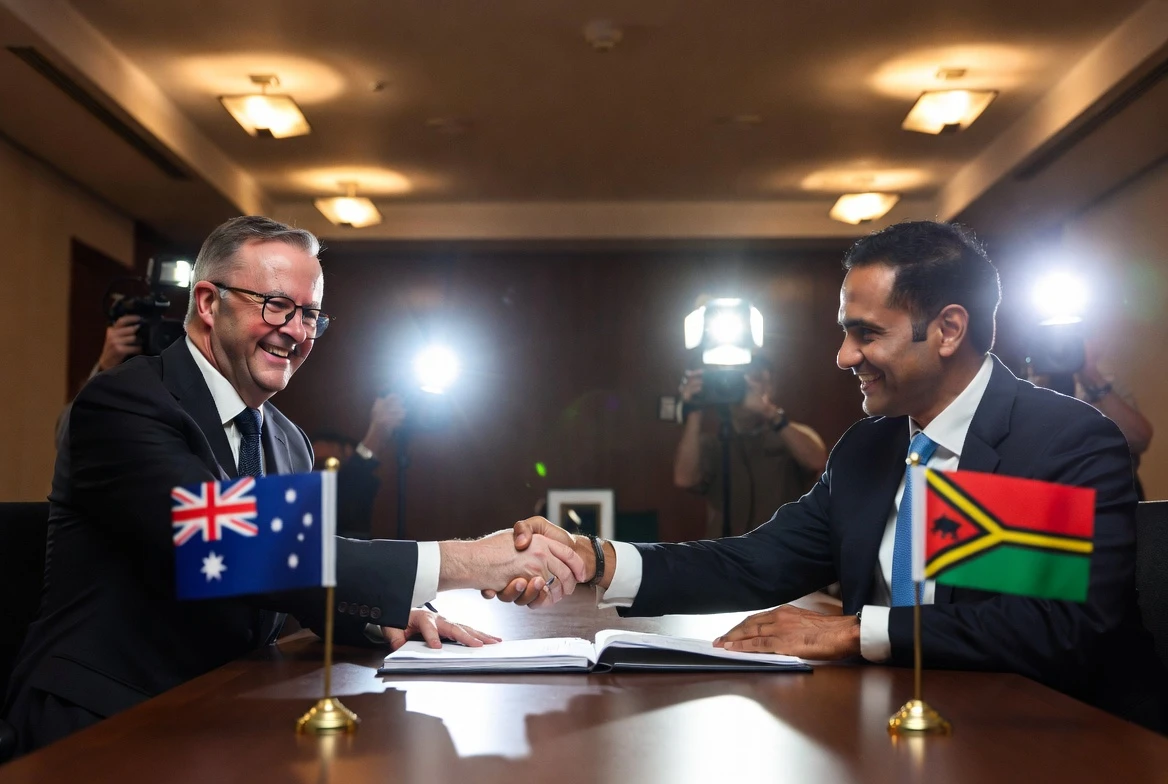
Anthony Albanese and Vanuatu’s Prime Minister Jotham Napat put their signatures on the Nakamal Agreement in Canberra on Monday, a sweeping pact that bans any foreign military base on the Pacific island while locking Australia in as Vanuatu’s “longstanding primary policing partner.”
The deal, almost ten months in the making, commits Australia to channel roughly $500 million in economic support into Port Vila’s priorities over a longer window than the decade originally floated. It also obliges Vanuatu to “consult Australia on proposed third party engagement in Vanuatu’s critical infrastructure” and to keep that infrastructure “free from militarisation, any form of foreign interference or unauthorised access.” Albanese framed the signing as a win for Pacific sovereignty. Napat called it a “shared commitment to continuing to strengthen the comprehensive partnership between our two countries.”
What Albanese and Napat Signed in Canberra
The text seen by AFP states bluntly that “to reinforce Pacific collective security and sovereignty, Vanuatu shall not permit its territory to be used for any foreign military base or infrastructure.” But the version signed today is materially lighter than the one senior ministers initialled at the top of Mount Yasur last year. The original draft would have “blocked” third-party involvement in Vanuatu’s ports, airports and telecommunications. The signed text “consults” instead.
The Prime Ministers signed under the name “Nakamal,” a Bislama word for a communal meeting place. Getting here took almost ten months. Napat pulled out of a planned signing ceremony in Port Vila late last year, citing sovereignty concerns. Vanuatu’s cabinet only green-lit the compromise draft last month, and the Albanese government ticked it off earlier in June.
The agreement now runs across humanitarian assistance and disaster relief, defence, policing, border security, biosecurity, cyber security, maritime and aviation safety, and information sharing. A new joint security dialogue will steer the rollout. Both governments have promised the text will be made “publicly available.” The total envelope is the $500 million figure attached to last year’s initialling, though the funding window is now longer than a decade and exact numbers will land in Australia’s mid-year budget update.
Around $500 million flows in economic support. Australian primacy on law and order is cemented. And the no-foreign-base clause lands in writing. That is more than the bare text reads like, but less than the version Canberra first took up the volcano.
The Veto Australia Had to Drop
When Penny Wong, Richard Marles and Pat Conroy climbed Mount Yasur with their Vanuatu counterparts in August 2025, the deal was framed as transformational. The original language, as reported by ABC News, would have given Australia the ability to “block” any third-party involvement in Vanuatu’s critical infrastructure where regional security interests were at stake. The working assumption inside the bureaucracy was that this principally meant China.
Napat refused to sign in that form. The compromise replaced the blocking verb with a consultative one. The signed text says Vanuatu’s infrastructure “must remain free from militarisation, any form of foreign interference or unauthorised access” and that Vanuatu “will consult Australia on proposed third party engagement in Vanuatu’s critical infrastructure.” That is consultation, not veto. Asked at the joint press conference, Napat put it bluntly: “We give very strict attention to all our critical infrastructure.”
Where the Signed Text Lands
- Foreign military base on Vanuatu territory: banned in writing in the agreement text.
- Third-party involvement in critical infrastructure: Vanuatu must consult Australia, with no veto trigger.
- Policing partner: Australia is the “longstanding primary policing partner”; Vanuatu keeps its policing ties with China.
- Humanitarian disaster response: Vanuatu comes to Australia, New Zealand and France first.
- Australian funding: roughly $500 million over a longer window than a decade.
Policing, the China Door That Stays Open
Beijing began formal policing cooperation with Vanuatu in 2023, dispatching training teams, drones, patrol boats and vehicles to the Vanuatu Police Force. China also funded the expansion of a wharf at Luganville, on Espiritu Santo island, in the footprint of what was once the largest US military base in the South Pacific. The Nakamal Agreement recognises Australia as Vanuatu’s “primary policing partner” and says future policing requests to countries outside the Pacific Islands Forum will receive “priority” consideration from Canberra. It does not require Vanuatu to downgrade its policing relationship with Beijing.
Albanese, asked what certainty the deal gave Australia on the military-base question, did not hedge. He framed the no-base clause as the deal’s core deliverable.
What this does do is to provide certainty for Australia that there will be no foreign military base.
Speaking to reporters in Canberra after the ceremony, Albanese framed the no-base clause as the deal’s core deliverable. But certainty on the base question does not extend to policing. Vanuatu’s choice of foreign police partners, of training offers and of whose hardware sits on which dock sits outside the new text. China has, in the words of one former senior Australian diplomat who served in Port Vila, played a long and patient game on the island. That patient game continues regardless of the document signed today.
Luganville and the Wharf That Started the Worry
To understand why Australia cares about a single Pacific island nation, walk down to the waterfront at Luganville on the island of Espiritu Santo. In the 1940s the United States built what was then the largest military base in the South Pacific there, codenamed ‘Buttons’ after a nearby point. The base closed, the war ended, and the wharves rotted. In 2014 the China Export-Import Bank extended a concessional loan worth about $54 million and a Chinese-built contractor raised a 360-metre wharf in roughly the same footprint.
The wharf was, on paper, a commercial project to bring cruise ships into Luganville’s harbour. China’s foreign ministry described any talk of a military use of the facility as “ridiculous” at the time. Both Beijing and Port Vila denied reports in 2018 that any long-term security arrangement was on the table. Australia and the United States were not convinced, and US Navy personnel inspected the site ahead of a regional exercise. The contested history of the Luganville wharf project has since been cited in US-China policy documents and in Australian cabinet submissions on Pacific posture.
That is the strategic geography the Nakamal Agreement is buying certainty against. Canberra does not believe China has a base at Luganville today. It believes, the way the Lowy Institute’s Australia-Vanuatu reading of the bilateral relationship argues, that the contest is being played on the same infrastructure Beijing is courting. The Nakamal’s foreign-base prohibition is the first time that contest has been reduced to a written line.
Beijing’s navy has made repeated port calls to Vanuatu. The Nakamal clause does not stop them. What it does is to make a permanent facility politically impossible without breaking a written commitment Port Vila has just signed.
Solomons in Slow Motion
In April 2022 Solomon Islands signed a security pact with Beijing that the country’s own opposition said it had not seen the text of. Subsequent reporting, including a CSIS analysis of the Solomon Islands framework agreement, described the arrangement as permitting “enormous PRC inroads into Solomon Islands” and turning the island nation into “a Pacific flashpoint.” Chinese police maintain a presence there as a result.
Vanuatu walked right up to that precedent twice in 2025. In August, senior Australian and Vanuatu ministers stood on top of an active volcano and initialled what was supposed to be a stronger pact with a blocking clause on Chinese investment. Then Napat pulled out of the Port Vila ceremony. The cabinet green-light for the compromise only arrived last month, and only after the “block” language had been replaced with “consult.”
That sequence, not the document signed today, is what makes the Namele Agreement the actual pivot point. ABC reporting says the Australian government has privately accused Beijing of trying to kill the Nakamal Agreement. Napat, asked in parliament last month whether his country was being squeezed between two suitors, replied that Vanuatu’s “development partners” were “using their interests to try to undermine us.” In Canberra on Monday he said the Namele deal was “not yet signed.” It is awaiting, in his words, “clearance from Beijing.”
The risk for Australia is that the Nakamal Agreement arrives just as the Namele Agreement is about to be inked, and that the head-to-head Canberra wanted to head off is now the head-to-head it must win.
Vanuatu’s long tradition of non-alignment means that it won’t simply abandon its relationship with China. Nor will China abandon its attempts to undermine Australia’s interests in Vanuatu.
James Batley, a former senior Australian diplomat who served in Port Vila, framed the choice with more patience than Canberra’s official line, in comments carried by AFP. Vanuatu, he said, would not simply swap one partner for another. Australia has to learn to compete without expecting Port Vila to fall in line.
What the Pact Doesn’t Settle
Three things got bumped out of the Nakamal Agreement into separate, still-running negotiations.
- Visa-free travel for ni-Vanuatu citizens. Napat declared publicly last year that he would not sign without it. The signed text commits only to “enhanced mobility arrangements” and a “review” of the current arrangements. No actual visa-free pathway is created.
- The exact Australian funding bill. Albanese would not name a number at the press conference, saying it would appear in the mid-year budget update. The ABC understands the $500 million total is still on the table, just stretched over a longer funding window.
- The Namele Agreement itself. A separate security pact Vanuatu is negotiating with China. Napat said on Monday it was “not yet signed” and that he would make it “public” once it was. Until then, the question the Nakamal Agreement was supposed to pre-empt remains open.
None of this looks like failure for Albanese. The Nakamal is the first bilateral instrument since 2018 that records a no-base commitment for a major Pacific Island state on paper. None of it looks like victory either, in the form Canberra originally drafted. The deal is, in the words of Pacific expert Tess Newton Cain at the Griffith Asia Institute, a demonstration of “where the limits of Australia’s strategic influence are.”
Albanese heads to Suva next, where he and Fijian Prime Minister Sitiveni Rabuka are widely expected to sign the Vuvale Union economic and security treaty. The Pukpuk defence treaty with Papua New Guinea is already in force. The Tuvalu and Nauru pacts, signed earlier in this government’s term, retain their stronger clauses. Vanuatu’s, the largest Pacific state on Australia’s aid books that had not signed a comparable arrangement until today, will be the test of whether consultation can do the work that a veto language used to do.
Frequently Asked Questions
What is the Nakamal Agreement?
The Nakamal Agreement is the bilateral security and economic pact signed on Monday in Canberra by Anthony Albanese and Vanuatu’s Prime Minister Jotham Napat. It is named for the Bislama word for a communal meeting place where Vanuatu’s communities gather. The agreement is the first time the two governments have documented a joint framework on defence, policing and critical infrastructure after a near-collapse in talks last year.
Does the Nakamal Agreement stop a Chinese military base on Vanuatu?
It writes a ban into the text. The agreement says Vanuatu “shall not permit its territory to be used for any foreign military base or infrastructure.” Vanuatu had separately passed a parliamentary act before the signing barring the militarisation of critical infrastructure. Neither commitment addresses Chinese police training teams that have been operating in Vanuatu since 2023.
Why did Australia drop the China investment veto it drafted?
The original draft initialled on top of Mount Yasur in August 2025 would have given Australia a “blocking” role on third-party involvement in Vanuatu’s critical infrastructure. Napat refused to sign in that form. The signed text requires Vanuatu to “consult” Australia on third-party involvement, without a veto. The change was made to get the deal over the line; the ABC was told Napat argued his country’s sovereignty could not be traded for one clause.
What is the Namele Agreement?
The Namele Agreement is the parallel security pact Vanuatu is negotiating with China. Napat told journalists in Canberra on Monday it was “not yet signed” and that he was “waiting for clearance from Beijing.” The ABC was told Napat had recently described both the Nakamal and Namele agreements as “externally driven” pacts in a meeting with US officials.
Did Vanuatu get visa-free travel to Australia?
Not yet. Napat declared publicly last year that he would not sign without visa-free travel for ni-Vanuatu. The Nakamal Agreement commits only to “enhanced mobility arrangements” and a “review” of the current arrangements. Pacific expert Tess Newton Cain at the Griffith Asia Institute said visa-free travel had been a “must have” for Napat personally, and that the gap on it would “reflect badly on him.”


Workers Still Trust Judgment Over the AI Tools They Use

DigitalOcean’s $894 Million Backlog Rewrites the Old Cloud

Companies Froze Job Design and Called AI a People Problem

AI Capex Looks Unique Because the Chips Wear Out

Samsung Medison’s HERA Z10 Aims at the Sonographer Shortage

GPT-6 Astra Ships as OpenAI’s First Critical Cyber Model

Palms Sells Clean Air Without Ending Casino Smoking

OnlyFans Promo Bots on X Now Pass the Humanity Tests

Datamaran Drops the ESG Label After Winning the Argument

Xiaomi’s Own Chip Lands While Apple Argues Over Color

Oracle Cuts 21,000 Jobs in a Year, Cites AI in 10-K Filing

Fable 5 and Mythos 5 Return as US Lifts Anthropic Export Controls

SpaceX’s Google Deal Turns a Rocket Company Into a Cloud Landlord

CD Projekt Red Co-CEO: Redemption Arc Isn’t Done, Witcher 4 in 2027

XPL Rallies 30% Ahead of Plasma One Card Tier Launch

Google Search Profiles Build a Follow Graph Inside Discover

DGO App Brings Rs 549 Mobile Pass for FIFA World Cup 2026 in Nepal

Moonshot AI Targets $30 Billion in China’s Fastest AI Funding Sprint

Oppo’s ColorOS 17 Eligibility List Leaves A-Series Buyers Behind

Microsoft Xbox Layoffs Start in July as Sharma Slams 3% Margin
-
 AI3 months ago
Oracle Cuts 21,000 Jobs in a Year, Cites AI in 10-K Filing
-
 AI2 months ago
Fable 5 and Mythos 5 Return as US Lifts Anthropic Export Controls
-
 AI3 months ago
SpaceX’s Google Deal Turns a Rocket Company Into a Cloud Landlord
-
 GAMING3 months ago
CD Projekt Red Co-CEO: Redemption Arc Isn’t Done, Witcher 4 in 2027
-
 CRYPTO3 months ago
XPL Rallies 30% Ahead of Plasma One Card Tier Launch
-
 NEWS3 months ago
Google Search Profiles Build a Follow Graph Inside Discover
-
 APPS3 months ago
DGO App Brings Rs 549 Mobile Pass for FIFA World Cup 2026 in Nepal
-
 AI3 months ago
Moonshot AI Targets $30 Billion in China’s Fastest AI Funding Sprint