
AI
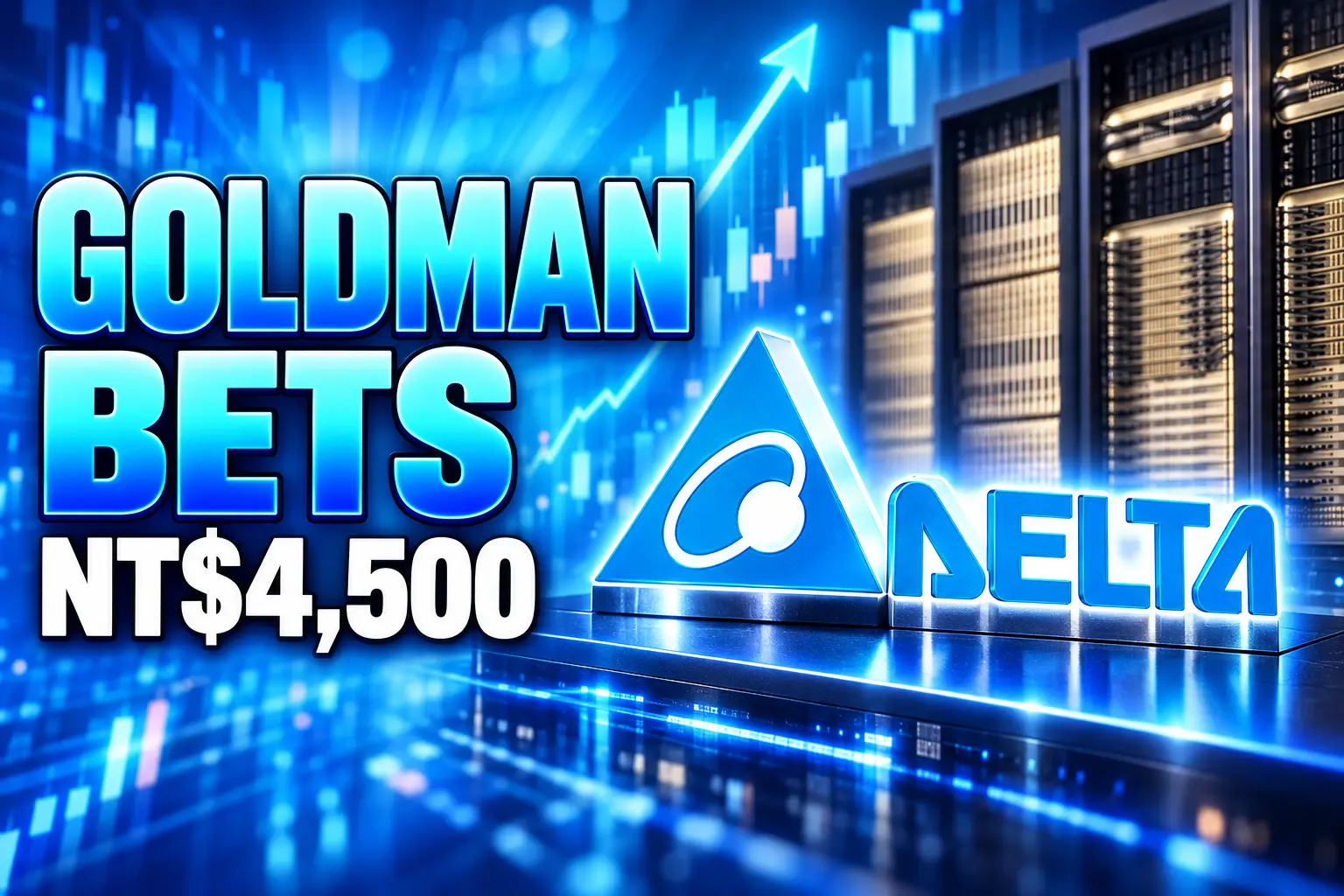
Goldman Still Bets NT$4,500 on Delta’s AI Power
Goldman Sachs still prints NT$4,500 on Delta Electronics, 178% above the September close, on 800-volt AI racks yet to ramp.

Goldman Sachs has a NT$4,500 target on Delta Electronics, 178% above the September 11 close of NT$1,620. The June note still sits there. The stock does not.
The bank kept a Buy rating when it raised its Delta target from NT$2,420, advertising 96% upside on AI power gear. Record second-quarter profit has since arrived, and an 800-volt sidecar is on the show floor. The 22-analyst average target is NT$2,474.18. The wager is 2028, not the last print.
Goldman’s NT$4,500 Call Now Implies 178% Upside
On June 4 Goldman Sachs lifted its 12-month price objective to NT$4,500 and left the Buy rating in place. That note sold a 96% gain from the then-current quote. Delta closed at NT$1,620 on September 11, down NT$55 or 3.28% on the day, so the same target now asks for a 178% rally.
The Taiwan-listed stock, ticker 2308, has a market value of NT$4.208 trillion. The 52-week range runs from NT$821 to NT$2,585. Trailing twelve-month earnings are NT$31.43 a share. The next report is due October 28. A 22-analyst book still clusters far below Goldman: average NT$2,474.18, high NT$4,120, low NT$1,330, with 21 buys and one hold. That high is not Goldman’s June print.
The gap is not a quiet quarter. It is a disagreement about when 800-volt racks, and the DC/DC modules inside them, become large enough to justify a 2028 multiple.
GOLDMAN VERSUS THE SEPTEMBER CLOSE
| Measure | Goldman Sachs, June 4 | Market, September 11 |
|---|---|---|
| 12-month target | NT$4,500 | Average NT$2,474.18 (high NT$4,120) |
| Upside vs NT$1,620 close | 178% | 52.7% |
| Rating | Buy | 21 buy, 1 hold, 0 sell |
| 2028 earnings vs then-consensus | 95% above | Not restated in the 22-analyst book |
A 178% climb to NT$4,500 would take the shares well through the 52-week high of NT$2,585. The average target of NT$2,474.18 still sits 52.7% above the close, which is a bullish Street, just not Goldman’s Street.
What Goldman Modeled for 2028
Goldman is not marking up last year’s power-supply run. It is rolling a 26.5 times earnings multiple onto 2028 profit, then discounting that back to 2027 at an 11% cost of equity. The multiple does not rise. The earnings do, if AI mix does what the note says.
The firm sees Delta’s overall AI power revenue, covering AC/DC units, DC/DC converters, and power racks other than the PSU itself, growing at a 210% compound annual rate from 2025 to 2028. Component-level margins stay at 50% to 60% or higher. Earnings estimates were lifted 1%, 5%, and 24% for 2026, 2027, and 2028, which the note put 19%, 50%, and 95% above then-consensus. High-margin AI products in the mix go from 9% in 2025 to 20%, 41%, and 66% in 2026 through 2028.
THE 2028 MIX GOLDMAN IS PRICING
- AI power sales: 210% compound annual growth from 2025 to 2028 across AC/DC, DC/DC, and racks excluding the PSU.
- DC/DC slice: 142% compound annual growth, then 5%, 9%, and 14% of group revenue in 2026, 2027, and 2028.
- DC/DC profit: 12%, 16%, and 20% of operating profit in those years, with operating margins above 40%.
- AI share of the mix: 9% in 2025, then 20%, 41%, and 66% in 2026 through 2028.
Those DC/DC shares are the load-bearing part of the bet. A 14% revenue line that throws off 20% of operating profit is how a 26.5 times multiple on 2028 earnings gets to NT$4,500 without the rest of Delta having to re-rate.
Delta Already Built the 800-Volt Sidecar
The kit Goldman is counting on is not a slide. At GTC in March, Delta put an 800 VDC in-row rack on the floor for Nvidia’s MGX systems, and the company still lists that stack on its Americas newsroom.
The 660 kW in-row power racks use six 110 kW shelves. Each shelf carries an 80 kW battery backup unit, for 480 kW of backup across the cabinet. The bricks behind those shelves are newly built 18.5 kW AC/DC supplies, rated up to 98% efficient, with aluminum capacitors meant to soak the fast load swings GPUs throw at a feed. Delta also showed a 1RU 90 kW DC/DC shelf, a 1RU capacitance shelf, and in-row liquid cooling at 2.4 MW and 3 MW.
On the Nvidia on-demand session from that show, Delta’s team walked the same ladder: GB200 and GB300 still sit on 50-volt bus bars, Vera Rubin NVL72 moves to a 110 kW three-phase shelf, and once a rack crosses about 250 kW the house advice is the 800-volt sidecar. The session’s 18.5 kW three-phase supplies are the same family Goldman’s note flags as a high-watt unit, though the bank wrote 18.3 kW and Delta stamps 18.5 kW on the GTC brick.
THE 800 VOLT HARDWARE DELTA HAS ON THE FLOOR
- In-row rack: 660 kW, six 110 kW shelves, 480 kW of embedded backup.
- AC/DC brick: 18.5 kW, up to 98% efficient, aluminum capacitor buffer.
- DC/DC shelf: 1RU, 90 kW, plus a matching capacitance shelf.
- Cooling: 2.4 MW and 3 MW liquid-to-liquid CDUs, the 2.4 MW unit on 800 VDC pumps.
- Grid step: a solid-state transformer rated up to 98.5% from medium-voltage AC to 800 VDC.
Asked at Computex whether 800-volt design would be the next power standard for AI halls, Nvidia chief Jensen Huang said, “Yes.” Asked whether Delta would be the primary supplier, he said, “I have no idea.” That second line is the part of the wager the NT$4,500 number cannot paper over. Lite-On, Flex, Vertiv, Eaton, and Schneider are in the same aisle, and Flex agreed in early September to buy EPC Power for $4.4 billion to get closer to 800-volt DC and grid-forming kit.
Watts Get Pricier as Racks Get Denser
The June note’s physics argument is still the cleanest reason Goldman is willing to sit 95% above 2028 consensus. A 12 kW PSU spends 43% more on materials per watt than a 5.5 kW unit. Industry average selling price per watt for AI supplies then grows at 40% a year from 2025 to 2028, in Goldman’s book, because density is rising rather than because factories are getting sloppy.
That ladder is not a bank invention. Infineon’s own AI-supply briefing already treats 12 kW AI PSU designs as the single-phase step and 18 kW to 30 kW as the three-phase step, with 5.5 kW, 8 kW, and 12 kW 50-volt units as the current rack path. Each jump packs more silicon, magnetics, and thermal hardware into the same shelf width. The bill per watt goes up.
The +400 V / 800 V rack adds a second kicker. Today’s 54-volt in-rack feed typically runs 40% to 60% redundancy. The new rack design, in Goldman’s telling, allows 100% redundancy, which means more DC/DC module slots per installation. That is why a converter line at 5% of 2026 sales can be modeled at 14% of 2028 sales and 20% of operating profit, with margins above 40%.
Hyperscalers do not love a 40% annual rise in price per watt. They pay it if the alternative is copper that no longer fits, or power shelves that eat the rack. Nvidia’s own 800 VDC write-up put full-scale production with Kyber rack-scale systems in 2027 for that reason: at megawatt class, a 54-volt shelf farm starts to crowd out the GPUs.
The Street Never Followed Goldman to NT$4,500
After the June print, Nomura held NT$2,650, JPMorgan NT$2,500, and Macquarie NT$2,200, all on July 30. Those are Buy ratings on a power-and-cooling franchise, not a 2028 DC/DC lottery ticket. The 22-analyst high of NT$4,120 is the closest anyone in that book gets to Goldman, and it still leaves a NT$380 hole under NT$4,500.
The shares also failed to treat a record quarter as proof. Investor relations director Rodney Liu put second-quarter revenue of NT$183.2 billion on the July call, up 48% from a year earlier and 15% from the first quarter. Gross profit was NT$65.3 billion and the gross margin 35.6%, the best quarter the company has printed aside from the one just before it. Net profit was NT$25.1 billion, up 80% year over year and 22% sequentially, for EPS of NT$9.68. First-half sales were NT$342.6 billion, up 41%, with first-half gross profit of NT$124.3 billion, a 36.3% margin, operating profit of NT$59.0 billion, and net profit of NT$45.7 billion, or NT$17.59 a share.
Those are not soft numbers. The re-rating still did not arrive, because the multiple is hanging on a mix shift that Goldman parks in 2027 and 2028. Incremental margins in the second quarter also took a hit from input costs and the lag in passing them through, so the beat did not come with a clean raise. A company that still makes industrial drives, building kit, and EV gear can print a record and still look expensive if the 66% AI mix is a 2028 story.
Year to date the stock is up 69.10%, and the one-year gain is 95.97%, so this is not a name that missed the AI tape. It is a name that ran, then gave a lot of that run back after Goldman had already taken the high seat.
Q4 Shipments Meet a 2028 Scale Debate
Goldman’s model starts new AI power racks in late 2026. That date is the hinge. Company voices have been early. Supply-chain checks have been late. Both can be true if small boxes ship this year and megawatt halls wait.
THE 800 VOLT CLOCK
- March 2026: Delta shows the 660 kW 800 VDC in-row rack, 18.5 kW PSU, and 90 kW DC/DC shelf at GTC.
- June 3, 2026: Ares Chen, vice president of the power and system business group, says 800 V HVDC is in verification and small-volume shipments to Nvidia are slated for the next quarter, with wider customers later.
- June 4, 2026: Goldman Sachs takes the target to NT$4,500 on late-2026 racks and 2028 DC/DC mix.
- June 25, 2026: TrendForce treats Nvidia’s 800 V power rack as an option for Vera Rubin customers from the third quarter, with broader use after Rubin Ultra and large-scale adoption around 2028.
- July 30 to 31, 2026: Chairman Ping Cheng points to third-quarter mass production of 800 V DC gear and raises this year’s capex to NT$70 billion from NT$46 billion.
- September 4, 2026: Flex agrees to buy EPC Power for $4.4 billion, another industrial check on 800-volt DC.
- September 11, 2026: Delta closes at NT$1,620. Goldman’s June target still implies 178% upside.
Chen’s June line and Cheng’s July line both sit on the early side of Goldman’s “late 2026.” TrendForce’s 2028 scale line sits on the late side. A separate supply-chain check has argued that first-generation cabinet and backup-unit validation, including a short-circuit flag in system tests, pushes low-volume 800 V HVDC toward the end of the first quarter of 2027, with a ramp from the second quarter, and that large-scale use can slip into 2028. That camp also says Rubin’s 50-volt rail inside the rack is not a kill shot for HVDC, because 50 volts is the last hop and 800 volts is the hall-to-rack hop.
WHERE EXPERTS DISAGREE
- Delta’s officers: Chen had small-volume HVDC in the quarter after June, and Cheng later said mass production of 800 V DC equipment in the third quarter of 2026, with a fatter second half than the first.
- TrendForce: The 800 V rack is optional on Vera Rubin from the third quarter of 2026, then builds through Rubin Ultra, with large-scale adoption around 2028. VR200 is about 225 kW a cabinet against 150 kW for GB300; Rubin Ultra is drawn at 660 kW.
- Supply-chain delay camp: Validation, not physics, is the hold-up, so low volume lands near the end of the first quarter of 2027 and full halls can wait until 2028, while ±400 V and 800 V run together in the first wave.
Nvidia has also denied a hard pushback of 800-volt DC, which is why the June tape that sold off on a delay rumor looked sloppy to people who walk Computex floors. The remaining argument is not whether the voltage changes. It is whether 2026 is a sample year or a revenue year, and whether Goldman’s 66% mix in 2028 needs the early year or only the late one.
A NT$70 Billion Check on the Same Wager
Cheng did not only talk voltage. He took this year’s capital budget to NT$70 billion (US$2.2 billion) from NT$46 billion last year, and he said the second half would outrun the first. That spend is a cash version of Goldman’s mix shift: more capacity for high-watt supplies, HVDC shelves, and the cooling that has to sit next to them.
The wave of AI data center construction will not stop.
Ping Cheng, Chairman, Delta Electronics, July 31, 2026
Huang’s “I have no idea” on who leads 800-volt supply is still the other side of that quote. Delta can be right about the wave and still share the sidecar with Lite-On, Vertiv, and whoever Flex just bought. Goldman’s NT$4,500 number needs Delta to keep a fat slice of the module-level converter, not merely to have a booth.
October 28 is the next public test, the quarter Cheng tied to 800-volt mass production. A shipment line in that report would not, by itself, prove 2028 earnings 95% above last June’s consensus. It would show whether late 2026 was a date or a hope. Until then the Buy at NT$4,500 and the close at NT$1,620 are the same bet, marked 99 days apart.
Disclaimer: This article is news reporting and analysis of a Goldman Sachs research view, Delta Electronics’ public results, and 800-volt product disclosures. It is for information only and is not investment advice, a solicitation to buy or sell TWSE:2308 or any other security, or a recommendation to follow any price target. Readers should consult a licensed financial adviser or securities broker about their own position, risk, and time horizon before acting. Targets, ratings, shipment dates, and financial figures reflect the cited notes, filings, and market data as of the dates named in the piece and can change with the next print.

Google Says AI Agents Now Compress Thefts Into Hours

Average People Feel AI First on the Power Bill

Suno Turns the Warner Settlement Into Licensed v6 Models

Lunit Turns Routine H&E Slides Into a Lung Pre-Screen

Meta’s Muse Agent Wants Your Inbox and Your Card

Fable 5 Came Back Under a Commerce On-Off Switch

Google’s SpaceX GPU Lease Has a Sept. 30 Deadline

Plasma One’s XPL Locks Face a 1.81 Billion Cliff

DGO’s Rs 549 World Cup Pass Cost Fans Sleep and Data

Moonshot AI’s $30 Billion Ask Became a $35 Billion Close
-
 AI3 months ago
Fable 5 Came Back Under a Commerce On-Off Switch
-
 AI4 months ago
Google’s SpaceX GPU Lease Has a Sept. 30 Deadline
-
 CRYPTO4 months ago
Plasma One’s XPL Locks Face a 1.81 Billion Cliff
-
 APPS4 months ago
DGO’s Rs 549 World Cup Pass Cost Fans Sleep and Data
-
 AI4 months ago
Moonshot AI’s $30 Billion Ask Became a $35 Billion Close
-

 NEWS4 months ago
ColorOS 17 Device List Spans Oppo, OnePlus and Realme
-

 GAMING4 months ago
Xbox Cuts 3,200 Jobs After Five Years of Thin Returns
-
 GAMING3 months ago
The RTX 4050 Under Rs 70,000 Hides a Wattage Gap