
AI
LG Turns Its NVIDIA AI Factory Into Robot Data
LG is turning a June NVIDIA AI factory pact into a Seoul robot-data lab, 800 VDC kit, and an 80 MW Cheonan hall, with no disclosed GPU bill.

LG Group is turning a June NVIDIA AI factory pact into a robot-data lab, an 80 MW hall, and hardware other builders can buy.
NVIDIA’s June 7, 2026 note promised compute for robotics, driving, data centers, and GPU cloud. It listed no site, no chip count, and no bill. By August 18, LG had a Seoul training floor, a Tennessee line test, and a Cheonan plant dated to the first half of 2028.
The June Notice Named No Site and No Spend
Madison Huang posted NVIDIA’s plan on June 7. The next day, NVIDIA founder and CEO Jensen Huang met LG Group chairman Koo Kwang-mo at LG Twin Towers in Yeouido. Huang told reporters the two companies would “build the future of humanoid robotics together with LG,” and that LG was “fantastic in power supply and the design and construction” of power grids.
The post itself was a stack map, not a construction schedule. LG Electronics would train home cobots such as CLOiD in Isaac Sim and Isaac Lab, and look at Isaac GR00T for home units and modular platforms. LG Innotek would tune sensors for NVIDIA silicon. LG CNS would fold Isaac, Cosmos, and GR00T into its PhysicalWorks industrial robot platform. LG Uplus would raise DSX-based halls with LG Electronics and LG Energy Solution. LG AI Research would keep training EXAONE on Blackwell GPUs, the NeMo framework, Nemotron data, and TensorRT-LLM.
None of that named a wattage, a GPU allotment, or a won figure. NVIDIA said the factory would let LG train, simulate, validate, and deploy AI across those businesses. It did not say where the racks would sit.
On August 13, Koo and Huang signed a later Santa Clara memorandum at NVIDIA headquarters. On August 18, NVIDIA staff walked LG’s Yangjae lab in Seoul. The second meeting is where floor plates and hour targets finally appeared.
HOW THE PACT WENT FROM A STACK TO A SITE
- June 7, 2026: NVIDIA posts the AI factory plan under Madison Huang’s byline, with no site and no spend.
- June 8, 2026: Huang and Koo meet at LG Twin Towers and talk robotics plus power and cooling.
- July 2026: LG Electronics creates a Robotics Business Center that reports to the CEO.
- August 13, 2026: The two sides sign at NVIDIA’s Santa Clara headquarters and put dates on a biped, a reference hall, and Cheonan.
- August 18, 2026: LG hosts NVIDIA officials at the Yangjae Data Factory and publishes the 100,000-hour target.
The June text still matters, because every later date hangs off that stack. What changed is that LG stopped describing a platform and started describing rooms, robots, and a calendar.
100,000 Hours From a Four-Floor Lab in Seoul
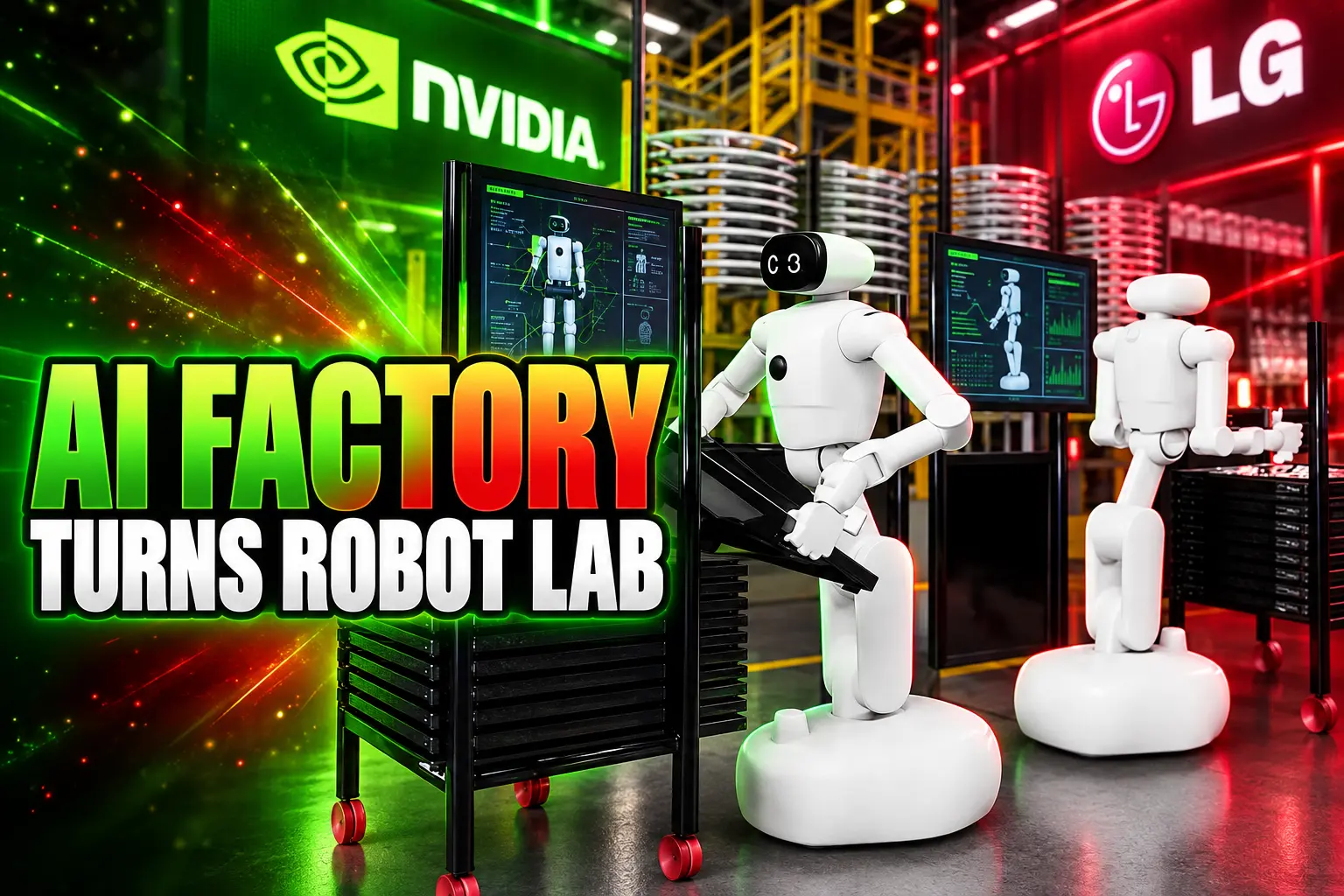
LG’s August 18 statement is the first document that treats the “physical AI data factory” as a building with a clock on it. The lab sits at the Yangjae R&D Campus, spans four floors (one below grade), and covers 10,000 square meters. LG says it will be fully running by the end of 2026 and will house several hundred robots.
YANGJAE ON PAPER
- Floor plate: 10,000 square meters on four floors, one of them below grade.
- Hour target: 100,000 hours by the end of 2026, mixing real takes with Cosmos synthetic data, a total LG called roughly 12 years of data.
- Robot count: several hundred units in the building by the end of 2026.
- Tooling: NVIDIA Omniverse libraries, Cosmos world models, and the Isaac robotics platform, from capture through deployment.
The rooms are task-specific. One bay copies a home so CLOiD can repeat cleaning. Another copies the washer plant in Tennessee so units can move, stack, and assemble parts. Other bays feed LG CNS logistics work and an LG Innotek space for robotic hands. Takes from those rooms go into NVIDIA’s robotics stack, get padded with Cosmos, and flow into LG’s Robot Foundation Model.
NVIDIA’s June note had already said LG would “turn compute into data” and sell training sets to Korean and global robotics teams. Yangjae is that line becoming a floor plan. The scarce input in physical AI is not another language model. It is repeated contact with objects, doors, parts, and wet floors, logged at a scale a single demo cannot supply.
LG Electronics CEO Lyu Jae-cheol has made the group slogan do commercial work here. The lab is where appliance history, logistics software, camera modules, and NVIDIA’s simulators meet on one timetable. If the hour target holds, the product is the dataset as much as any robot that later walks out of the building.
CLOiD Trains on a Washing-Machine Line First
CLOiD is a wheeled indoor robot with arms, shown folding clothes, pulling items from a fridge, and loading a washer. It is not the two-legged machine booked for 2027. It is the unit that has to generate the hours, because it already exists in enough copies to staff a lab.
LG plans to put CLOiD on the washer line at its Tennessee plant by the end of 2026, with PhysicalWorks running the data path. The Seoul lab already contains a replica of that line, which is a tell. The home robot is going to the factory because a production floor is the cheapest, lowest-risk place to record the same reaches and grasps a living room would demand, minus the pets and the furniture a customer moves overnight.
Through the synergy built on ‘One LG’, bringing together core capabilities across the Group, and strategic collaboration with global partners, we will secure our competitiveness in physical AI and become a comprehensive robotics solutions provider.
Lyu Jae-cheol, CEO, LG Electronics, August 18 statement
That is why the Tennessee date is more useful than another CES clip. A washer line repeats. It has parts with known shapes. It produces a log LG already knows how to store. Cosmos can multiply those logs. The living-room pitch still needs that factory tape, and LG is collecting it before the biped is on a stage.
LG Wants to Sell Cooling, Power, and Prefab Halls
The other half of the June note is easy to miss if the eye stops on robots. LG Electronics is already in NVIDIA’s cooling checks for coolant distribution units and cold plates, and it is adding prefab modules that LG says can cut build time by more than 20 percent. Those pieces sit on the NVIDIA DSX AI factory platform, the same blueprint NVIDIA is pushing for Vera Rubin halls.
LG Uplus plans DSX factories and a large GPU data center. LG CNS plans DSX halls on NVIDIA GPUs. LG Energy Solution is working on 800 volt-direct-current energy systems aligned with NVIDIA’s BESS Self-Qualification guidelines, so the power path can follow the next GPU generation.
NVIDIA’s own write-up on 800 VDC power distribution is the reason a battery company is in an AI factory photo. Racks are heading past 1 MW. The hop from Hopper to Blackwell already lifted rack density 3.4 times. At low voltage the copper does not work. Facility-level 800 VDC is NVIDIA’s answer, with batteries used as a buffer against the swing of thousands of GPUs ramping in unison.
Oh Kyung-jin, who leads ESS grid system development at LG Energy Solution, said the company is building cells for that 800 VDC layout. The path he described runs from today’s NCM-based JP5 to an LFP JP6 in 2028 and a sodium-ion JP7 in 2029. The LFP date lines up with the Cheonan hall.
THE DATES LG HAS PUT ON THE FACTORY
| Step | Target date | What LG has described |
|---|---|---|
| Yangjae Data Factory, Seoul | End of 2026 | 10,000 square meters, several hundred robots, 100,000 hours |
| CLOiD on the Tennessee washer line | End of 2026 | Live factory data into PhysicalWorks |
| Vera Rubin reference site | First half of 2027 | Test cooling, power, and IT on NVIDIA’s next platform |
| Bipedal humanoid unveiling | First quarter of 2027 | Isaac GR00T, Jetson Thor, and Halos |
| Cheonan AI factory | First half of 2028 | 80 MW, prefab modules, robot-model training |
The Cheonan hall is the reference LG wants to show other buyers. NVIDIA gets another DSX campus. LG gets a working brochure for cooling, batteries, telecom, and prefab shells. Koo said after the August signing that the tasks in AI factories, physical AI, and mobility had “become clear,” and that LG would “accelerate the adoption of AI by building industry-leading reference models.” A reference model, in this usage, is a plant other customers can copy.
A Bipedal Robot Is Booked for Early 2027
The shareable object is still a two-legged robot. LG says it will show one in the first quarter of 2027, built on Isaac GR00T, with NVIDIA Jetson Thor on board and Halos for Robotics as the safety stack. Huang’s line after the August meeting was that physical AI should “give every machine the ability to understand the real world, reason and act safely alongside people.”
THE BIPED BILL OF MATERIALS
- Onboard compute: NVIDIA Jetson Thor for on-robot processing and motion control.
- Foundation model: NVIDIA Isaac GR00T, the open reasoning vision-action model named in both the June post and the August plan.
- Safety stack: Halos for Robotics, NVIDIA’s full-stack safety system for robots.
- Actuators: LG Electronics, from the same group that already ships appliance motors and robot joints.
- Sensors: LG Innotek, with optics and sensing modules cut for NVIDIA’s tools.
- Batteries: LG Energy Solution, which is also on the 800 VDC factory path.
That split is the industrial logic. NVIDIA keeps the model, the onboard computer, and the safety software. LG keeps the body and the plants that can run the body. A wheeled CLOiD on a washer line is the rehearsal. The biped is the later catalog photo. Joint “reference robots” were already in the June text; August simply put a quarter on the calendar.
Great to welcome @LGE_Global Group Chairman Kwang-mo Koo and LG leaders to NVIDIA as we enter the next chapter of our collaboration.
Together, we’re expanding our work across AI infrastructure, physical AI and robotics.
We’re excited about what our teams can build together. pic.twitter.com/75yVaxSdIT
— NVIDIA (@nvidia) August 14, 2026
NVIDIA’s own post from the Santa Clara visit stays at the slogan layer, “AI infrastructure, physical AI and robotics,” which is honest about the breadth and silent on the bill. The video is the handshake. The lab hours are the work.
EXAONE and Cockpit Computers Ride the Same Stack
The same racks are supposed to serve language models and cars. LG AI Research trained EXAONE on Blackwell, NeMo, Nemotron, and TensorRT-LLM. The July 15, 2025 EXAONE 4.0 technical report describes a hybrid that switches between fast answers and longer reasoning. The 4.0 release put a 32 billion parameter expert model and a 1.2 billion on-device model into the open EXAONE model family, with weights posted for research use.
LG AI Research published MMLU-Redux and MMLU-Pro scores of 92.3 and 81.8 for the 32 billion reasoning mode, plus 66.7 on LiveCodeBench v6. Inside the group, the family already runs as ChatEXAONE, an enterprise chatbot LG says it wants to spread as agentic tools. Sovereign models are the political half of the same factory: Korean weights on NVIDIA silicon, then a chatbot on LG desks.
On the vehicle side, LG Electronics is lining ADAS and in-vehicle AI up with NVIDIA DRIVE Hyperion and plans to use DRIVE AGX for cockpits and edge AI. That work sits in the same software-defined vehicle designs automakers are already being forced to rebuild around camera, compute, and software stacks. LG Innotek wants the next sensors cut for NVIDIA’s architecture rather than sold as generic modules.
WHAT WE KNOW
- The stack: Isaac, Cosmos, GR00T, DSX, DRIVE, Blackwell, and EXAONE are the named NVIDIA and LG pieces.
- The lab: Yangjae is 10,000 square meters, aimed at 100,000 hours and several hundred robots by the end of 2026.
- The hall: Cheonan is an 80 MW AI factory in the first half of 2028, after a Vera Rubin reference site in the first half of 2027.
WHAT IS UNCONFIRMED
- The invoice: neither side has published capex, a GPU count, a cloud price, or a revenue split.
- The mix: LG has not said how much of the 100,000 hours will be real robot time versus Cosmos output.
- The tenants: no first external buyer is named for the GPU cloud service, the training data, or a turnkey DSX hall.
The June notice read like a customer win for NVIDIA. The dated work since then is LG trying to be a supplier of hours, cooling, 800-volt storage, and prefab halls, while a biped waits on a 2027 stage. The hours have a number. The plant has a wattage. The invoice still does not.

Instagram Plus Tests a Read-Only Mode That Cuts Stories

Altman Asks the Public to Accept Some AI Harm

Google Freezes OSS VRP Product Reports After AI Flood

AI Agents Make Payment Rails the Scarce Prize

Turkey’s Crypto Boom Now Runs Through Three Banks

Fable 5 Came Back Under a Commerce On-Off Switch

Google’s SpaceX GPU Lease Has a Sept. 30 Deadline

Plasma One’s XPL Locks Face a 1.81 Billion Cliff

DGO’s Rs 549 World Cup Pass Cost Fans Sleep and Data

Moonshot AI’s $30 Billion Ask Became a $35 Billion Close
-
 AI3 months ago
Fable 5 Came Back Under a Commerce On-Off Switch
-
 AI4 months ago
Google’s SpaceX GPU Lease Has a Sept. 30 Deadline
-
 CRYPTO4 months ago
Plasma One’s XPL Locks Face a 1.81 Billion Cliff
-
 APPS4 months ago
DGO’s Rs 549 World Cup Pass Cost Fans Sleep and Data
-
 AI4 months ago
Moonshot AI’s $30 Billion Ask Became a $35 Billion Close
-

 NEWS4 months ago
ColorOS 17 Device List Spans Oppo, OnePlus and Realme
-

 GAMING4 months ago
Xbox Cuts 3,200 Jobs After Five Years of Thin Returns
-
 GAMING4 months ago
The RTX 4050 Under Rs 70,000 Hides a Wattage Gap