
COMPUTERS
OQC Bets £260 Million on Data-Centre Quantum Machines
Oxford Quantum Circuits raised £260 million to put superconducting machines in commercial data centres, with a £100 million state cheque and a 2028 TITAN target.

Oxford Quantum Circuits closed an oversubscribed £260 million Series C on 3 June 2026, Europe’s largest private round for a quantum computing company. The UK firm priced the raise at $350 million and said Bullhound Capital led a book that also took money from the British Business Bank, Spanish development lender COFIDES, Chevron Technology Ventures, and Magdalen College Oxford. J.P. Morgan was exclusive placement agent.
The cheque is not a lab grant. OQC builds superconducting machines meant to sit in commercial data centres, and it will spend this round to spread those systems, to advance a 2028 machine called TITAN, and to put a factory in Barcelona.
What the British Business Bank Is Buying
The British Business Bank committed £100 million to OQC inside the same close. That is £100 million of the £260 million round, on top of the £7 million the Bank put into the company’s Series A in 2022. In a year-one update to the Digital and Technologies Sector Plan, the government called the £100 million its largest ever direct investment.
THE ROUND IN FOUR FIGURES
- The close: £260 million ($350 million) Series C, dated 3 June 2026, led by Bullhound Capital.
- The state cheque: £100 million from the British Business Bank, after £7 million in the 2022 Series A.
- The parallel programme: up to £2 billion of UK quantum support, announced 17 March 2026, including up to £1 billion to buy large machines in the early 2030s.
- The 2028 target: TITAN, a 100 mm wafer machine with 200 logical qubits, funded as the commercial-era system.
Chancellor Rachel Reeves tied the raise to that March package. “OQC’s £260 million funding round is a major vote of confidence in the UK’s quantum sector,” she said, adding that the government had “recently committed up to £2bn to ensure UK quantum companies can successfully reach commercial scale.” Science minister Lord Vallance used the same figure and called the backing “further proof of the UK’s undeniable credentials.”
The March text is more than a slogan. Over £500 million of the new money is aimed at quantum computing in pharmaceuticals, financial services, and energy. A first-of-its-kind buying programme, ProQure, is meant to take prototypes and then fold the best of them into national computing kit. Officials also floated a £200 billion economic impact by 2045 if the sector lands. That is a forecast, not a contract. The £100 million in OQC is cash on the cap table now.
For deeptech in the UK, the challenge is not invention, it’s scale. In order to build global companies rooted in the UK, our financial firepower must match our scientific excellence. The Bank sees this as nothing short of a national economic imperative, so we are acting at pace to deliver significantly higher levels of funding for UK scale ups.
Leandros Kalisperas, Chief Investment Officer, British Business Bank
George Mills, a senior investment director in the Bank’s direct-equity team, was blunter about the product. He said quantum computing is “held back by its ability to scale up,” and that the Bank is backing OQC again “as they scale up their commercial offering with the development of OQC TITAN.” Per Roman, founding partner of Bullhound Capital, is joining the board. He said quantum computing is moving “into global infrastructure,” and that OQC is “positioned to shape that transition.”
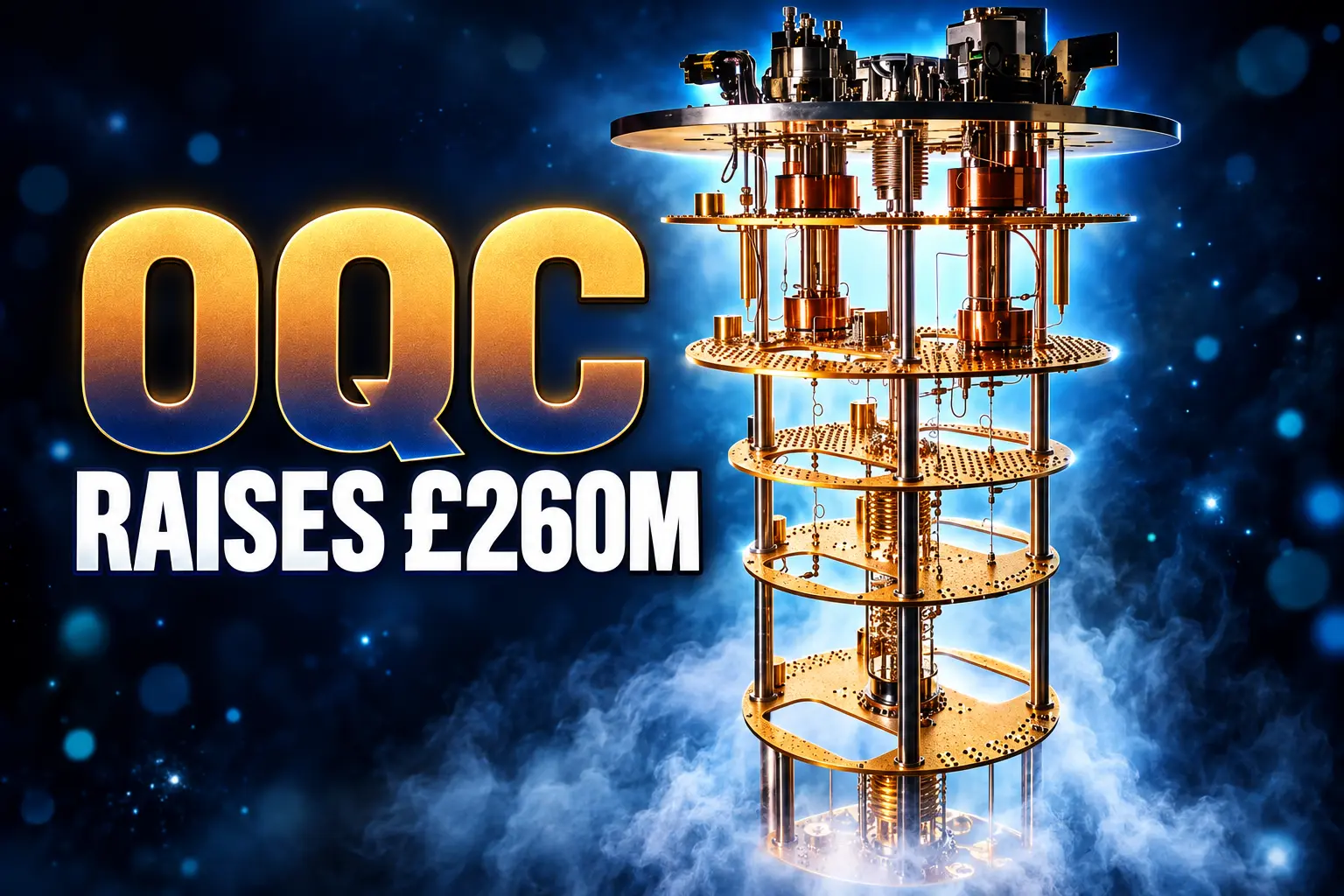
OQC Puts Quantum Boxes in Commercial Halls
OQC does not sell a science project that lives behind a university badge. It develops and runs superconducting computers designed for data-centre rooms that already serve companies and governments. Systems are deployed in the UK, the United States, Japan, and Spain. The University of Oxford Department of Physics, the lab home of the original research, calls OQC Europe’s first quantum-compute-as-a-service provider and the only company to put quantum computers directly into commercial data centres.
WHERE THE MACHINES ALREADY RUN
- United Kingdom: home base for the platform and for a new dedicated Quantum-AI hall in London.
- United States: a live footprint that the company groups with North America in its global platform.
- Japan: an Asian deployment, with Tokyo Edge Capital Partners still on the shareholder list.
- Spain: a live system, and now the site of a planned factory in Barcelona.
Customers in financial services, defence, and security are the demand the company names. They want machines they can reach without shipping sensitive workloads across a public cloud they do not control. That is the commercial motion this round is paying for: more halls, more uptime, and a path to fault-tolerant work that still sits next to classical racks.
The same day as the raise, OQC, JPMorganChase, and AMD said they would stand up a dedicated Quantum-AI data centre in London. JPMorganChase will be the first dedicated user in London, and the partners said the site should be fully operational within 12 months of that 3 June announcement, so by 3 June 2027. OQC’s GENESIS system will sit in the same room as AMD-backed AI and high-performance classical kit. Researchers at the bank will try near-term hybrid jobs, including portfolio optimisation and quantum machine learning, and they will train specialised AI models that try to make quantum circuits run better.
Jay Horine, who heads the Security and Resiliency Initiative for J.P. Morgan Global Banking, said the firm is “focused on identifying the platforms and companies positioned to lead as quantum scales,” and that OQC “has developed the hardware and infrastructure to play a meaningful role.” Founder and chief scientific officer Dr Peter Leek put the same idea in lab language: the company was “founded to use innovative quantum circuit designs to build engineered systems that scale as simply as possible,” and the new money supports “integrating quantum computers into the trusted infrastructure customers depend on.”
The chips themselves are transmon qubits on sapphire, a coaxial layout OQC has long branded Coaxmon, with readout kit on the other face of the wafer. The company says it can now drill the sapphire with industrial CNC tools rather than lasers, which cuts heat during manufacture. It also says a single wafer can hold the whole processor, so extra chips do not have to be stitched together at a cost in accuracy. Those are engineering claims, and they are the reason a data-centre operator can treat the stack more like a dense appliance than a one-off cryostat in a physics hall.
TITAN Has to Deliver 200 Logical Qubits
GENESIS is the 2026 product. OQC’s technical roadmap calls it a kiloquop device, the start of a logical-qubit era, commercially available from 2026, using a dual-rail “Dimon” encoding that fits one logical qubit in the footprint of a single Coaxmon. The company is building a fourth-generation chip with 16 logical qubits and has said TITAN follows that chip. TITAN is the machine this raise is meant to industrialise: a megaquop system OQC says will be “the first quantum system built for commercial advantage,” aimed at financial services and at security and defence.
GENESIS AND TITAN ON THE PUBLISHED ROADMAP
| System | Role on the map | Logical qubits | Processor | Performance target |
|---|---|---|---|---|
| GENESIS | 2026 kiloquop product, start of the logical era | 16 | Dimon dual-rail encoding in a Coaxmon-sized site | Thousands of quantum operations; commercially available from 2026 |
| TITAN | Commercial-era machine the Series C is paying to build | 200 | 100 mm wafer with 2,000 lattice sites | 1 MHz operation clock; logical error rate of 10-6; millions of operations |
The published map puts 200 logical qubits on TITAN inside those 2,000 lattice sites, which is 10 sites for each logical qubit, and it sets a 1 MHz clock with a 10-6 logical error rate on a 100 mm wafer. OQC has said it expects to launch TITAN in 2028. Later names on the same map, ATHENA and ATLAS, sit in 2031 and 2034 and are not what this round has to prove first.
That 10-to-1 encoding is an aggressive claim against surface-code machines that still spend dozens or hundreds of physical qubits on each reliable logical bit. The June 2025 Dimon paper showed error-suppressed qubits in a research setting. A 100 mm wafer with 2,000 working sites is a factory problem, which is why the Barcelona plan matters as much as the physics. Gerald Mullally, OQC’s chief executive, called the raise “a coming-of-age moment for British quantum computing” and “a clear shift in the market from long-term promise to near-term delivery.” Near-term, in the company’s own calendar, still means a 2028 box.
Barcelona Gets the Manufacturing Floor
Fifteen days after the close, Mullally stood at the Palau de la Generalitat in Barcelona and put a first factory on the map. Catalonia Trade and Investment says OQC will put €92 million into a Global Quantum Development and Manufacturing Centre in the city and create 210 skilled jobs over five years. It will be the company’s first site in the European Union and its first development and manufacturing centre anywhere. Works are due to start in the fourth quarter of 2026.
The hall is not another colo cage. ACCIO, the Catalan investment agency, says the site will hold labs, offices, and a technical assembly floor for applied research, industrialisation, systems integration, and engineering tests. Computers designed there are meant for the same service model OQC already runs in data centres, aimed at AI, finance, health, and energy. COFIDES, which joined the Series C, is the Spanish state lender in the cap table; the factory is the physical expression of that Spanish cheque.
“Barcelona and Catalonia have some of the strongest talent in the world,” Mullally said. “We are looking forward to recruiting quantum talent and scaling to 210 jobs in the region.” He told the Catalan government the company had worked with the Generalitat, the city council, and the Spanish government, and that “it felt like a team.” Other cities in the mix, including Munich, Copenhagen, and Paris, lost. The UK still holds the headquarters and the London Quantum-AI hall. The wafers and the assembly line are being stood up on the other side of the Channel.
That split is the tell. A company that only wanted more cloud hours would rent more cages. A company that intends to hit a 100 mm TITAN wafer in 2028 has to own process engineering, yield, and a hiring pipeline. The Series C is the war chest. Barcelona is where a chunk of it turns into benches, clean kit, and payroll.
On-Prem Boxes Versus Shared Cages
OQC is not the only European superconducting shop raising serious money, and it is not the only model. Finland’s IQM took a large 2025 Series B and then a US listing path. Its pitch is the opposite of shared colo: whole machines delivered into European supercomputing centres that do not want their jobs on an American cloud. France’s Pasqal, which traps neutral atoms rather than cooling transmons, has been on a US listing track of its own. Quantinuum, the Honeywell-backed trapped-ion group with a UK foot in Cambridge, has already been valued at a $10 billion pre-money price in a US-led round that dwarfs anything OQC just took.
Dealroom counted 18 quantum startups raising rounds of $50 million or more in 2026 through August, already above the previous full-year record of 16. OQC’s $350 million cheque sat among the largest of that list. The money is spreading across hardware, software, and enabling chips rather than pooling in one or two miracle names, which is a different market than 2024, when a handful of deals ate most of the pool. Broad funding does not make TITAN real. It does mean OQC is raising into a crowd, not into a vacuum.
The split that matters for this company is commercial, not patriotic. Public HPC centres want a box they can lock in a national hall. Banks and defence buyers want a machine in a cage they already trust, with classical GPUs one aisle over and no new building to certify. OQC is betting the second buyer writes the bigger, stickier cheque, and that a service in Equinix-class space is how you sell to them. IQM is betting the first buyer. Both can be right for a while. Only one of those motions matches the London JPMorganChase hall.
Sceptics still have the easier sentence. Useful, error-corrected quantum computing has been five years away for a decade. Superconducting qubits are noisy. A 10-6 logical error rate on a 100 mm wafer is a plan, not a benchmark on the floor. Mullally’s “near-term delivery” line will be judged in 2028, not in the Series C press pack. The raise does not settle that argument. It funds OQC’s side of it.
Nigel Higgins Is Already in the Room
The shareholder register looks like a map of the customers OQC wants. Chevron Technology Ventures stayed in. Magdalen College Oxford joined. Fynveur, advised by Invus, came in with COFIDES, Rokos Capital Management’s RCM Private Markets Fund, Alpha Edison, Fulcrum Asset Management, Pentland Ventures, Adaptive Capital Partners, Firgun Ventures, 18 West, and Oxford Capital. Oxford Science Enterprises, SBI, and the University of Tokyo Edge Capital Partners rolled their chips. Jack Boyer, OQC’s chair, said the quality of that group “reflects confidence in the company’s strategy, technology and ability to scale.”
Nigel Higgins, chair of Barclays and already an OQC director, did not talk like a trophy non-exec. “This funding gives the company the resources to scale internationally at a time when quantum computing is becoming increasingly important to enterprise and critical infrastructure,” he said. Ed Bussey, chief executive of Oxford Science Enterprises, called the raise a step from “the hard yards of translating its foundational science into a growing commercial venture” toward a company that “will redefine entire sectors of the economy.” That is investor language. The operational fact under it is simpler: a bank chair is on the board, a global bank is the first named user of the London hall, and J.P. Morgan ran the placement.
THE PATH TO THIS CHEQUE
- 2012: Dr Peter Leek’s laboratory at the University of Oxford begins work on superconducting quantum circuits that later become OQC’s core IP.
- 2022: The British Business Bank invests £7 million in OQC’s Series A as the spin-out leaves the lab.
- 3 June 2026: OQC closes the £260 million Series C, with £100 million from the Bank, and announces the London Quantum-AI collaboration with JPMorganChase and AMD.
- 18 June 2026: Mullally presents the €92 million Barcelona development and manufacturing centre, with 210 jobs planned over five years.
- 2028: OQC’s published target year for TITAN, the 200-logical-qubit commercial-era system this round is meant to fund.
OQC still has to build the wafer it just raised against. The London hall has to open for JPMorganChase by 3 June 2027. Barcelona has to turn a press event into a floor that can process 100 mm parts. If those dates hold, the £260 million will look like infrastructure finance. If they slip, it will look like another handsome European round that bought time. The bet is now on the calendar, not on the trophy for largest private raise.

Huang Sells Cybersecurity as AI’s Next Always-On App

Gemini for Windows Cannot Act on Gmail or Drive

Apple Health App Will Sell $119 Quest Blood Tests

AMD’s EPYC Playbook Now Runs Against NVIDIA’s AI Lead

A Nevada Ring Clip Turns a Door Kick Into Evidence

Fable 5 Came Back Under a Commerce On-Off Switch

Google’s SpaceX GPU Lease Has a Sept. 30 Deadline

Plasma One’s XPL Locks Face a 1.81 Billion Cliff

DGO’s Rs 549 World Cup Pass Cost Fans Sleep and Data

Moonshot AI’s $30 Billion Ask Became a $35 Billion Close
-
 AI3 months ago
Fable 5 Came Back Under a Commerce On-Off Switch
-
 AI4 months ago
Google’s SpaceX GPU Lease Has a Sept. 30 Deadline
-
 CRYPTO4 months ago
Plasma One’s XPL Locks Face a 1.81 Billion Cliff
-
 APPS4 months ago
DGO’s Rs 549 World Cup Pass Cost Fans Sleep and Data
-
 AI4 months ago
Moonshot AI’s $30 Billion Ask Became a $35 Billion Close
-

 NEWS4 months ago
ColorOS 17 Device List Spans Oppo, OnePlus and Realme
-

 GAMING4 months ago
Xbox Cuts 3,200 Jobs After Five Years of Thin Returns
-
 GAMING3 months ago
The RTX 4050 Under Rs 70,000 Hides a Wattage Gap