
COMPUTERS
Dell Bets the XPS Mini PC on Windows RTX Spark
Dell’s XPS mini PC wraps NVIDIA RTX Spark in a Mac Studio-shaped box, betting Windows on Arm and a fresh CUDA toolkit will be ready when the hardware arrives.

Dell showed an XPS mini PC at Computex 2026 that wraps NVIDIA’s RTX Spark chip in a Mac Studio-shaped box. The company still has not named a price, a configuration list, or a ship day for that desktop. NVIDIA says the Windows machines arrive in October.
The bet is not the gray metal. Dell already sells this class of chip as a Linux workstation. The XPS unit asks creators to trust Windows on Arm, a CUDA toolkit that only went generally available on September 9, and apps that vendors say they are still rebuilding.
Dell Put the XPS Name on NVIDIA’s Windows ARM Box
On May 31, NVIDIA unveiled RTX Spark at GTC Taipei during Computex week and called it a new beginning for Windows PCs. The superchip pairs a Grace CPU with a Blackwell RTX GPU and unified LPDDR5X memory, and it is the first time NVIDIA has sold a full client PC platform rather than a discrete GPU.
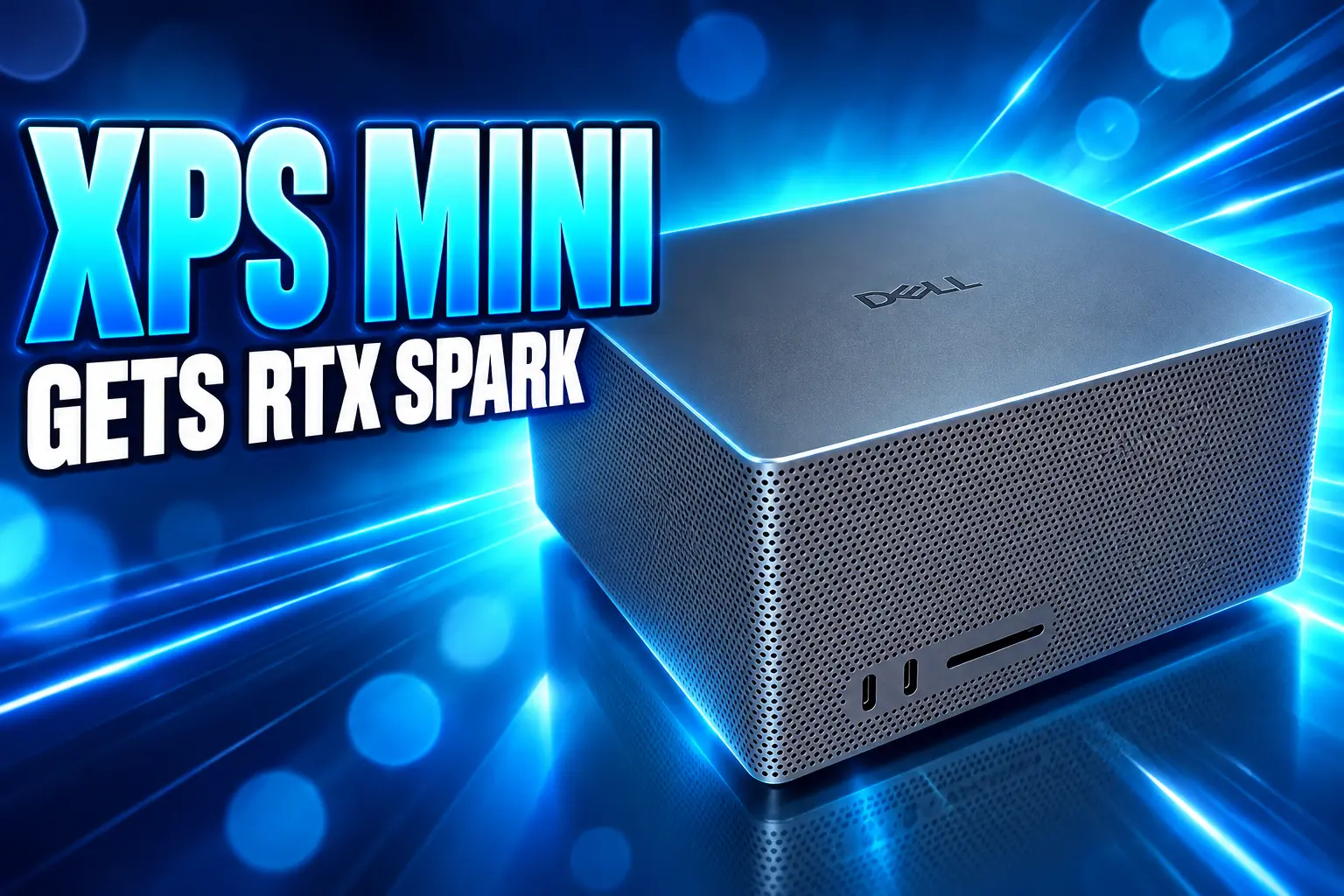
Dell put the XPS badge on a compact desktop built around that chip, the Windows counterpart to the company’s Pro Max with GB10. The show unit was a dark gray square with vents along the sides and a lid on the underside that lifts for the storage drive. It is taller than Dell’s GB10 box, which is a hint about cooling rather than a published spec sheet. Dell has not issued a dedicated product page for the mini PC.
NVIDIA’s public desktop SKU is the full N1X: a 6,144-core Blackwell GPU and 20-core Grace CPU, up to 128 GB of unified LPDDR5X, Windows 11, and a 140 W TDP. Laptop chips in the same family sit at 45-80 W, with a second N1X cut that uses an 18-core CPU, a 5,120-core GPU, and up to 64 GB. MediaTek worked with NVIDIA on the custom Grace CPU design.
NVIDIA’S DESKTOP N1X SKU
- GPU: 6,144-core NVIDIA Blackwell RTX, fourth-generation RT cores, fifth-generation Tensor cores, DLSS 5, Reflex 2.
- CPU and memory: 20-core NVIDIA Grace CPU with unified LPDDR5X up to 128 GB, Windows 11.
- Power: 140 W TDP on the desktop SKU, versus 45-80 W on the laptop chips.
- Claimed work: NVIDIA lists up to 1 petaflop of FP4 AI performance, 12K 4:2:2 video, 90 GB 3D scenes, and 1440p games over 100 frames per second.
Those figures are NVIDIA’s platform numbers, not a Dell XPS scoreboard. The XPS chassis is still a Computex object. What Dell locked in public is the brand and the audience: creators who already buy XPS laptops and want a Windows box that sits beside a display.
The Same Chip Already Sits on Dell Desks
NVIDIA has sold the Linux sibling since October 15, 2025. DGX Spark, formerly Project DIGITS, uses the GB10 Grace Blackwell superchip in a 150 x 150 x 50.5 mm, 1.2 kg enclosure running NVIDIA DGX OS. Dell’s version is the Pro Max with GB10, the same 20-core Grace design and 128 GB of LPDDR5X, still on DGX OS 7.
The running read on the show floor was that RTX Spark N1X is that GB10 design, rebadged for Windows and stripped of the ConnectX-7 NIC that lets two DGX Sparks link for larger models. ServeTheHome’s Computex walk-through found 10 Gb Ethernet, 20 Gbps USB-C, and a PCIe Gen5 x4 M.2 slot across the mini PCs that disclosed I/O, matching the GB10 boxes minus the expensive fabric port. At Computex, NVIDIA’s first client CPU took Best in Show, which is the Grace side of this package under another name.
LINUX BOX VERSUS WINDOWS BOX
| Attribute | Dell Pro Max with GB10 | Dell XPS RTX Spark Desktop |
|---|---|---|
| Operating system | NVIDIA DGX OS 7 | Windows 11 |
| Chip | GB10 Grace Blackwell | RTX Spark N1X desktop SKU |
| CPU / GPU | 20-core Grace, Blackwell GPU | 20-core Grace, 6,144-core Blackwell RTX |
| Memory | 128 GB LPDDR5X unified | Up to 128 GB LPDDR5X unified |
| Extra networking | ConnectX-7 class fabric on the DGX family | 10 Gb Ethernet, no ConnectX-7 on Spark minis |
| Status | Shipping since 2025 | Shown June 2026, no price or date from Dell |
Dell is not discovering this silicon. It is putting XPS paint and Windows 11 on a package it already sells to AI developers who boot Linux. The Windows machine drops the fabric port that made the Linux box a tiny cluster node, and it adds creator I/O the DGX family never bothered to market.
CUDA 13.4 Finally Speaks Windows on Arm
The software clock is tighter than the chassis photos. CUDA has run on Arm for years, but only on Linux. NVIDIA released a Windows on Arm developer preview of CUDA Toolkit 13.4 in July. The generally available toolkit landed on September 9, written up by Jonathan Bentz on NVIDIA’s developer blog.
CUDA Toolkit 13.4 adds support for Windows on Arm. CUDA applications have long been supported on Arm platforms through Linux; this release extends that capability to the Windows on Arm platform.
Jonathan Bentz, NVIDIA Technical Blog, September 9, 2026
That sentence is the entire wager. CUDA Toolkit 13.4 adds Windows on Arm a few weeks before NVIDIA says Spark PCs hit shelves. Native Arm64 builds and x86_64 cross-compilation are now first-party paths. Drivers, firmware, and the OEM images still ship separately, and the apps that pay for an XPS badge have to land on top.
NVIDIA’s May 31 newsroom brief said Adobe is rebuilding Photoshop and Premiere for RTX Spark and claimed up to 2x faster AI and graphics in those tools. Firefly-powered Generative Fill and Generative Extend are on the list, and Adobe’s next Photoshop engine is described as GPU-composited with TensorRT in the path. Updates “are expected to start rolling out alongside RTX Spark availability,” which is another way of saying the apps and the PCs are on the same calendar, not a finished storefront.
Jensen Huang framed the chip as a PC you ask rather than click.
The PC is being reinvented. For forty years, you launched apps. Click. Type. With RTX Spark and Microsoft Windows, you ask, and the PC does the work.
Jensen Huang, founder and CEO of NVIDIA, GTC Taipei
Microsoft is in that sentence on purpose. Pavan Davuluri, executive vice president for Windows and Devices, said the Prism emulator tuned for RTX Spark will keep x86 apps alive, including the AVX and AVX2 paths Microsoft added a year earlier. Prism is how a Windows ARM desktop avoids becoming a software island. It is also how a slow or broken translation shows up on a $thousands creator box.
What Ports Sit on the XPS Mini PC?
The Computex unit put two USB-C ports and a full-size SD card reader on the front, with more USB-C, power delivery, HDMI, a wired Ethernet jack, and the power button on the back. That front reader is the one hardware detail no other RTX Spark mini PC on the floor copied, and it is why a photographer can dump a card without a dongle while a video editor hangs drives, a display, and network storage at once.
WHAT THE COMPUTEX UNIT SHOWED
- Front I/O: Two USB-C ports and a full-size SD card reader on the front, the slot rival Spark minis omitted.
- Rear I/O: Additional USB-C with power delivery, HDMI, 10 Gb Ethernet, and the power button.
- Service: A removable underside lid for the storage drive, no full teardown required.
- Build: Dark gray squared chassis with side vents, taller than Dell’s GB10 Pro Max, still without published millimeters from Dell.
NVIDIA’s broader Spark pitch is local agents as much as timelines. The newsroom list includes 120-billion-parameter models with up to 1 million tokens of context, plus more than 100 Windows software providers such as Adobe, Blackmagic Design, Blender, CapCut, ComfyUI, and OTOY. That is a partner roll call, not a compatibility matrix you can buy against today.
ASUS Published Dimensions. Dell Published Photos.
Dell was not alone on that floor, and it was not the loudest. ASUS, Lenovo, and MSI all stood up Spark minis with the same four-USB-C, HDMI, and 10 GbE recipe. ASUS even printed a size: 150 x 150 x 51 mm, basically the DGX Spark footprint, with cooling claimed up to 140 W. Dell’s unit is the one that looks most like a Mac Studio from the front, and the one Dell has been quietest about in writing.
THE MINI PC FIELD AT COMPUTEX
| Machine | What was public in June | I/O called out |
|---|---|---|
| Dell XPS RTX Spark Desktop | Taller than Dell’s GB10 box; no official spec sheet | Front 2x USB-C and SD; USB-C, HDMI, 10 GbE at the rear |
| ASUS ProArt mini PC | 150 x 150 x 51 mm; cooling up to 140 W | Four USB-C on the rear, HDMI, 10 GbE |
| Lenovo SFF RTX Spark | New chassis versus ThinkStation PGX | Four USB-C, HDMI, 10 GbE |
| MSI EdgeMesa N AI+ | White box aimed at edge AI as well as creators | Four USB-C, HDMI, 10 GbE |
NVIDIA’s partner list for fall machines is ASUS, Dell, HP, Lenovo, Microsoft Surface, and MSI, with Acer and GIGABYTE to follow. On September 3 at IFA, NVIDIA said RTX Spark Windows PCs arrive in October, and it pointed at new Lenovo and Acer hardware in that wave. Dell still has not attached the XPS mini PC to a week inside that month.
The matching portable is public in a way the desktop is not. Dell’s own blog describes the XPS 16 Creator Edition laptop as the first XPS notebook on RTX Spark, with up to 128 GB of unified memory, a tandem OLED panel rated True Black HDR 600, and an SD reader plus HDMI in the portable chassis. Michael Dell tied that laptop, not the mini PC, to the line that creators should not choose between portability and performance. NVIDIA says Spark laptops can be as slim as 14 mm and as light as three pounds in 14- to 16-inch sizes. The desktop is the always-on half of the same pitch.
Photographers Get a Card Slot. Agents Still Want Linux.
The people who already live on this silicon are not waiting for Photoshop. They run GB10 boxes every day, and the objection that keeps coming back is the operating system. Owners of paired DGX Spark units say the agent work happens in a Linux shell with ssh and systemd, and that Windows Subsystem for Linux is a translation layer rather than a place those jobs want to stay. That complaint landed in NVIDIA’s mentions the same week CUDA 13.4 went GA.
Gerardo Delgado, NVIDIA’s senior director of product for local AI, creators, and developers, replied on September 11.
RTX Spark laptops are going to be the best Windows laptops for developers. The ability to develop, prototype and test in Windows (and Linux with WSL) all in 1 machine is amazing. But I get the preference for pure Linux.
Gerardo Delgado, senior director of product, local AI, creators and developers, NVIDIA, September 11, 2026
Dell already blesses Linux on other XPS systems, which makes the Spark desktop’s Windows-only product page feel like a channel choice, not a technical ceiling. NVIDIA’s RTX Spark spec table lists Windows 11 and nothing else. The Linux GB10 path remains the Pro Max and the DGX Spark. A buyer who wants the SD slot and Premiere on one square box is the XPS customer. A buyer who wants the fabric port and DGX OS is already served, and has been since 2025.
Qualcomm no longer has Windows on Arm to itself, which is the other half of NVIDIA’s client debut. Spark is the CUDA answer to that market, and it is also the first time a Windows ARM PC ships with the graphics stack NVIDIA spent two decades locking to x86 GeForce. Games are part of the brief: Electronic Arts, Embark, and Ubisoft were named at IFA, and NVIDIA still quotes 1440p at over 100 frames per second with ray tracing, DLSS, and Reflex. A mini PC that looks like a Mac Studio and plays RTX titles is a different shopper than the GB10 developer, which is why XPS exists as a badge on this board.
October Ships the Boxes Before Apps Are Proven
The calendar is now shorter than the missing price list. NVIDIA spent the summer converting a Linux desk-side superchip into a Windows OEM program, and the last first-party piece, CUDA on Windows on Arm, is measured in days, not seasons. Dell still owes the XPS mini a number, a SKU stack, and a sentence that says whether the Computex box is the shipping chassis or a stand-in.
THE ROAD TO A WINDOWS SHIP DATE
- October 15, 2025: NVIDIA starts shipping DGX Spark, the Linux GB10 box Dell also sells as Pro Max.
- May 31, 2026: NVIDIA unveils RTX Spark with Microsoft, names Dell among fall desktop and laptop partners, and says Adobe is rebuilding Premiere and Photoshop.
- June 2026: Dell shows the XPS RTX Spark Desktop at Computex and publishes the XPS 16 Creator Edition laptop, without pricing the mini PC.
- July 2026: NVIDIA ships the CUDA 13.4 developer preview for Windows on Arm.
- September 3, 2026: At IFA, NVIDIA says RTX Spark Windows PCs arrive in October.
- September 9, 2026: CUDA Toolkit 13.4 goes generally available with Windows on Arm support.
NVIDIA’s product page still asks visitors to sign up to be notified when RTX Spark laptops and desktops are available. Dell’s XPS mini PC will either be in that October wave with a Windows image, an SD slot, and whatever Adobe builds have actually shipped, or it will miss the month NVIDIA already printed. The chip is not the open question. The OS and the apps are, and Dell put the XPS name on both.

Huang Sells Cybersecurity as AI’s Next Always-On App

Gemini for Windows Cannot Act on Gmail or Drive

Apple Health App Will Sell $119 Quest Blood Tests

AMD’s EPYC Playbook Now Runs Against NVIDIA’s AI Lead

A Nevada Ring Clip Turns a Door Kick Into Evidence

Fable 5 Came Back Under a Commerce On-Off Switch

Google’s SpaceX GPU Lease Has a Sept. 30 Deadline

Plasma One’s XPL Locks Face a 1.81 Billion Cliff

DGO’s Rs 549 World Cup Pass Cost Fans Sleep and Data

Moonshot AI’s $30 Billion Ask Became a $35 Billion Close
-
 AI3 months ago
Fable 5 Came Back Under a Commerce On-Off Switch
-
 AI4 months ago
Google’s SpaceX GPU Lease Has a Sept. 30 Deadline
-
 CRYPTO4 months ago
Plasma One’s XPL Locks Face a 1.81 Billion Cliff
-
 APPS4 months ago
DGO’s Rs 549 World Cup Pass Cost Fans Sleep and Data
-
 AI4 months ago
Moonshot AI’s $30 Billion Ask Became a $35 Billion Close
-

 NEWS4 months ago
ColorOS 17 Device List Spans Oppo, OnePlus and Realme
-

 GAMING4 months ago
Xbox Cuts 3,200 Jobs After Five Years of Thin Returns
-
 GAMING3 months ago
The RTX 4050 Under Rs 70,000 Hides a Wattage Gap